

How many solutions an equation has depends on what is left after you simplify it. A linear equation has one solution if the variable survives, no solution if you reach a false statement like 5 = -1, and infinitely many if you reach a true one like 6 = 6. A quadratic has 0, 1 or 2 real solutions.
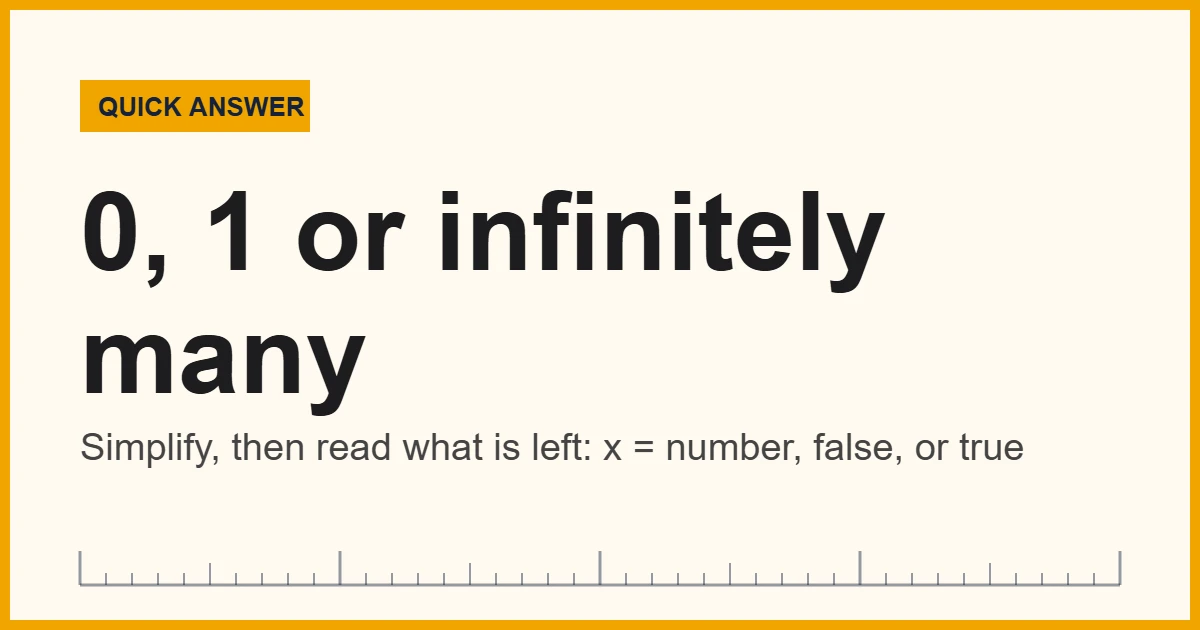
Tests often ask you to count the solutions without finding them. Fortunately, a short routine settles it: first simplify, then read the result.
How Many Solutions? The Three Possible Outcomes
Every linear equation in one variable fits one of three groups. The free OpenStax Intermediate Algebra text calls them conditional equations, identities and contradictions.
| Type | What you see after simplifying | Example | Number of solutions |
|---|---|---|---|
| Conditional | x = a number | 4x – 7 = 2x + 3 gives x = 5 | Exactly one |
| Contradiction | A false statement | 2x + 5 = 2x – 1 gives 5 = -1 | None |
| Identity | A true statement | 3(x + 2) = 3x + 6 gives 6 = 6 | Infinitely many |
So if both sides have the same x coefficient, the x terms cancel, and the constants decide the outcome.
How to Tell How Many Solutions a Linear Equation Has
- Distribute to remove parentheses, and clear any fractions.
- Combine like terms on each side.
- Move x terms to one side and numbers to the other.
- If an x term remains, divide by its coefficient: exactly one solution.
- If x cancels, a false statement means no solution and a true one means infinitely many.
- Finally, check your answer in the original equation.
Quadratics: Let the Discriminant Decide
For a quadratic written as ax^2 + bx + c = 0, the discriminant is b^2 – 4ac. It sits under the square root in the quadratic formula. Therefore its sign tells you how many real solutions exist before you solve anything, as the OpenStax quadratic formula section explains.
| Equation | b^2 – 4ac | Real solutions | Solutions |
|---|---|---|---|
| x^2 – 5x + 6 = 0 | 25 – 24 = 1 | Two | x = 2 and x = 3 |
| x^2 – 6x + 9 = 0 | 36 – 36 = 0 | One (repeated) | x = 3 |
| x^2 + 2x + 5 = 0 | 4 – 20 = -16 | None | x = -1 + 2i and x = -1 – 2i |
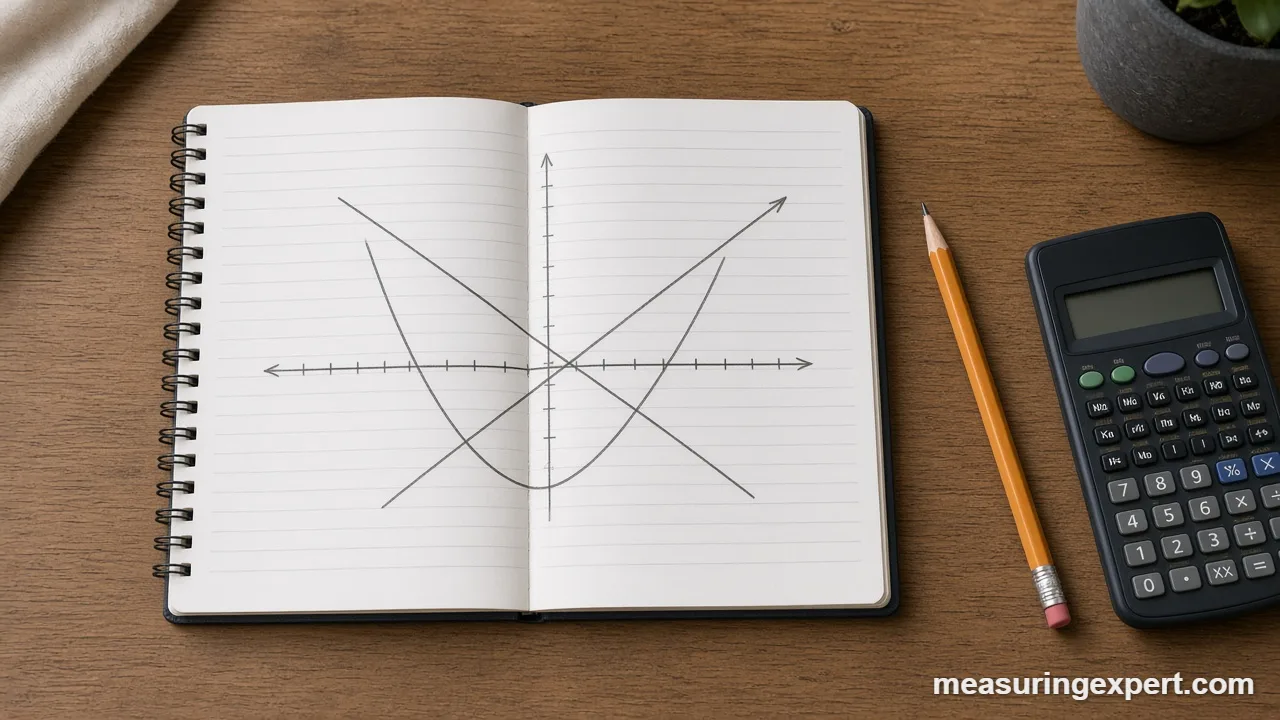
Graphically, the parabola crosses the x-axis twice, touches it once, or misses it. However, a negative discriminant still gives two complex solutions.
How Many Solutions Does a System of Equations Have?
Two linear equations in x and y are two lines. So write both as y = mx + b and compare slopes and intercepts.
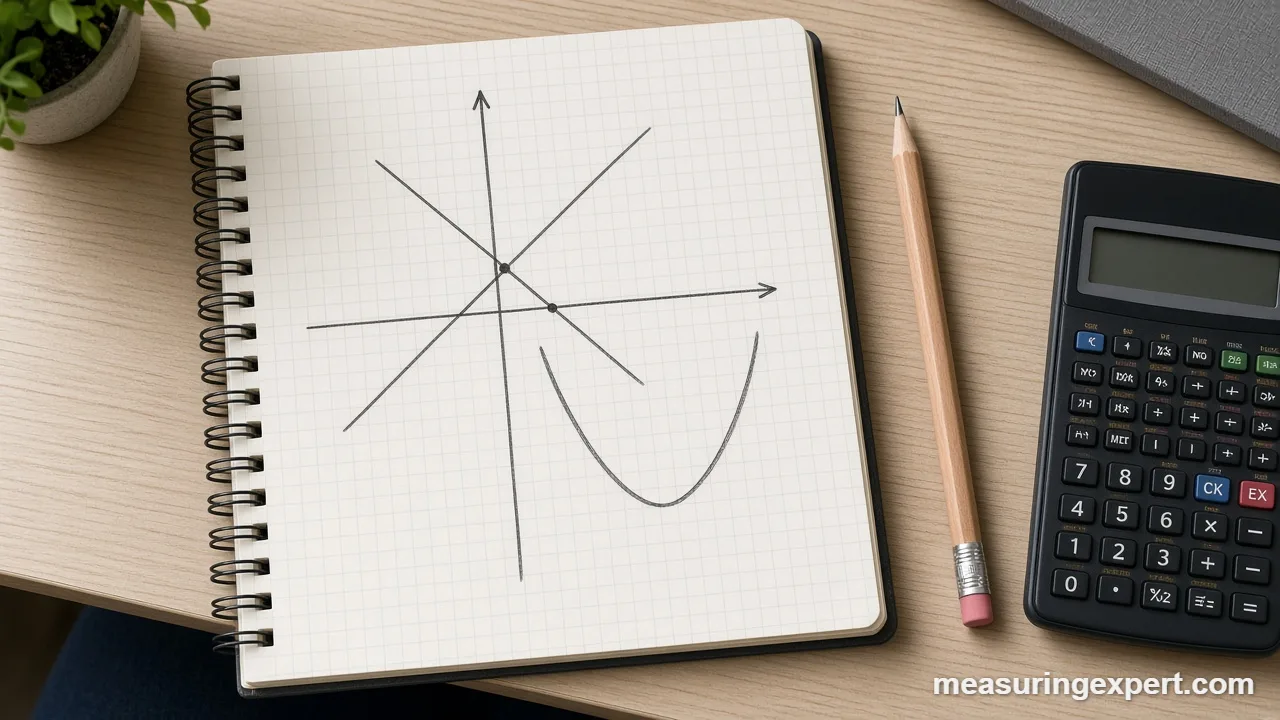
- Different slopes: one solution. For instance, y = 2x + 1 and y = -x + 4 meet at (1, 3).
- Same slope, different intercepts: parallel lines, so no solution, as with y = 2x + 1 and y = 2x – 3.
- Same slope and intercept: one line, so infinitely many. For example, 4x – 2y = -2 is just y = 2x + 1.
Slope is the same rise-over-run idea behind the angle of inclination of a ramp. Also, a nonzero determinant means exactly one solution, while a zero one means none or infinitely many.
Cubics and Higher-Degree Equations
A polynomial equation of degree n has at most n real solutions, and exactly n when you count repeats and complex values. So a cubic has one, two or three distinct real solutions, because its graph must cross the x-axis at least once.
Other equations, such as sin x = x/10, need a graph: plot both sides and count the crossings. For trig plots, our guide to converting degrees to radians helps, and so does our overview of types of angles.
Common Mistakes When Counting Solutions
First, 0 = 0 does not mean x = 0; the x already cancelled. Next, a value that zeroes a denominator never counts. Finally, dividing both sides by x can lose the solution x = 0, so factor instead.
How Many Solutions: Frequently Asked Questions
How many solutions can a linear equation have?
Exactly one, none, or infinitely many. It can never have exactly two.
How do you know if an equation has no solution?
Simplify both sides. If the variable cancels and leaves a false statement, such as 5 = -1, there is no solution.
How do you know if an equation has infinitely many solutions?
If the variable cancels and leaves a true statement, such as 6 = 6, every real number works.
How many solutions does a quadratic equation have?
Two real solutions if b^2 – 4ac is positive, one if it is zero, and none if it is negative (then it has two complex ones).
What does a discriminant of zero mean?
The parabola just touches the x-axis, so there is one repeated real solution, as in x^2 – 6x + 9 = 0.
How many solutions does a system of two linear equations have?
One if the slopes differ, none if the lines are parallel, and infinitely many if both equations give the same line.
Does a zero determinant mean no solution?
No. It means there is no unique solution, so the system has either none or infinitely many.
How many solutions can a cubic equation have?
One, two or three distinct real solutions, and always at least one.
Can a graph show the number of solutions?
Yes. Graph each side and count where the graphs meet. However, confirm the count with algebra.
Is 0 = 0 a solution?
No. It is a true statement left after x cancels, so the equation has infinitely many solutions.
Bottom Line
In short, simplify first and read what remains: a lone x means one solution, a false statement means none, and a true one means infinitely many. For quadratics, check the sign of b^2 – 4ac.