

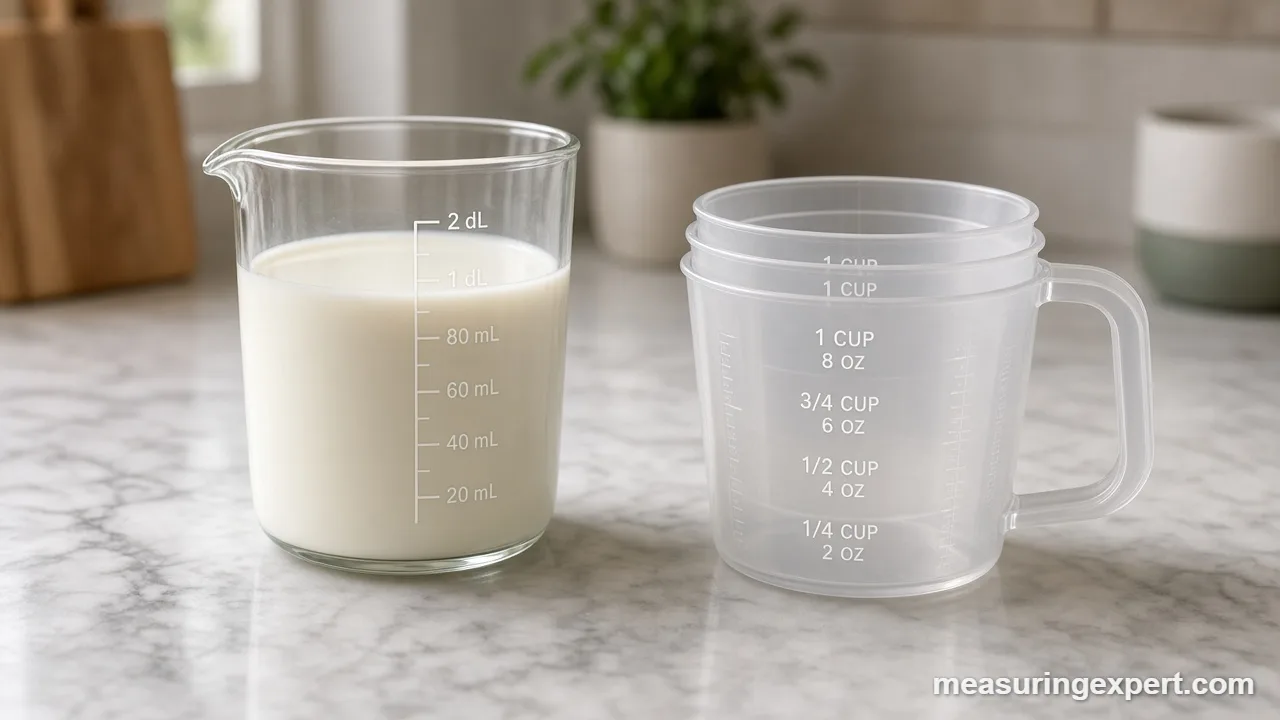
A dL measurement is one deciliter: one tenth of a liter, or exactly 100 milliliters. In US kitchen units, therefore, that is about 3.38 fluid ounces, 0.42 cup, or 6.76 tablespoons. So a recipe that asks for 2 dL of milk needs 200 mL, which is a little less than 7/8 of a US cup.
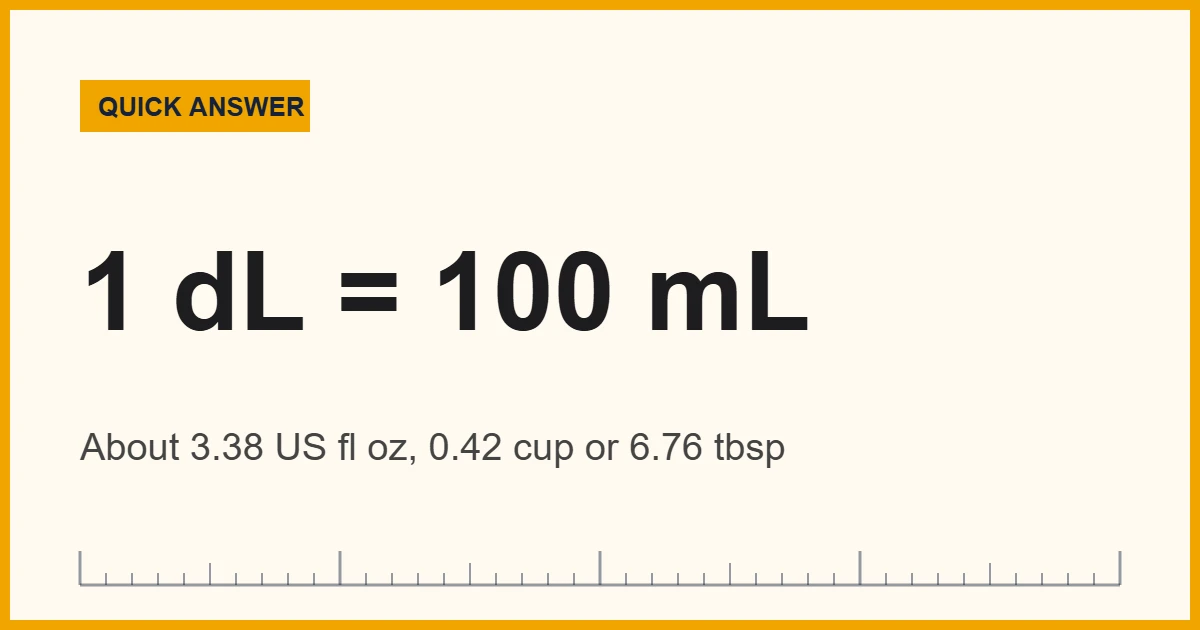
Convert Any DL Measurement to Cups, Ounces and Spoons
First, enter your amount in milliliters below. Because 1 dL equals 100 mL, simply multiply your deciliters by 100 first (2.5 dL becomes 250 mL). Next, the converter shows US cups, fluid ounces and spoons, plus metric and UK units.
The letters “dL” (also written “dl”) stand for deciliter, spelled decilitre outside the US. Also, the unit is simple once you know where it comes from. First, the liter is the everyday metric unit of volume. Next, the prefix “deci” means one tenth. So, put them together and a deciliter is a tenth of a liter.
The US National Institute of Standards and Technology (NIST) lists deci (symbol d) as the factor 10 to the power of minus 1 in its table of metric prefixes. In other words, that makes the deciliter an exact, defined unit, not an estimate. As a result, every value on this page comes from two fixed numbers: 1 dL = 100 mL, and 1 US fluid ounce = 29.5735295625 mL.
In practice, most Americans meet the deciliter in two places. First comes the Scandinavian, Swiss or German recipe. Second comes the blood test report, where results such as glucose appear in milligrams per deciliter.
DL Measurement Conversion Chart
Here are the amounts you will see most often. In addition, every milliliter value is exact, while the US values are rounded to two decimals. Then print this chart or save it to your phone for the kitchen.
| Deciliters | Milliliters | US fl oz | US cups | US tablespoons |
|---|---|---|---|---|
| 0.5 dL | 50 mL | 1.69 | 0.21 | 3.38 |
| 1 dL | 100 mL | 3.38 | 0.42 | 6.76 |
| 1.5 dL | 150 mL | 5.07 | 0.63 | 10.14 |
| 2 dL | 200 mL | 6.76 | 0.85 | 13.53 |
| 2.5 dL | 250 mL | 8.45 | 1.06 | 16.91 |
| 3 dL | 300 mL | 10.14 | 1.27 | 20.29 |
| 4 dL | 400 mL | 13.53 | 1.69 | 27.05 |
| 5 dL | 500 mL | 16.91 | 2.11 | 33.81 |
| 10 dL | 1,000 mL (1 L) | 33.81 | 4.23 | 67.63 |
Going the other way, similarly, one US cup is about 2.37 dL, and one US tablespoon is about 0.15 dL. For smaller amounts, see our guide to how much 30 mL is in spoons and ounces.
Recommended Measuring Cups for Metric Recipes
The easiest fix for deciliter recipes is a liquid measuring cup printed in milliliters. For example, look for clear markings every 25 or 50 mL, a spout that pours cleanly, and markings that do not wash off. Also, a kitchen scale helps when a European recipe lists some ingredients by weight and others by volume.

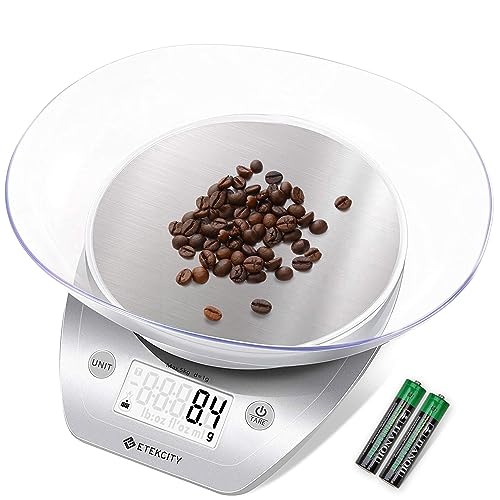
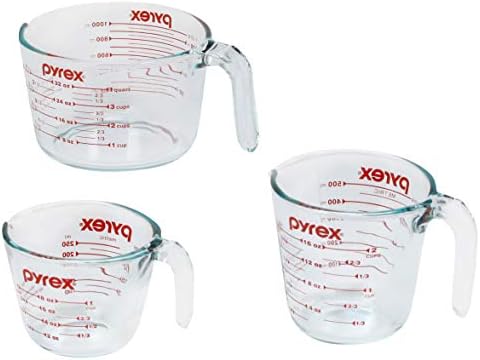

As an Amazon Associate, Measuring Expert earns from qualifying purchases.
Where You Will See Deciliters
Outside a science class, the deciliter shows up in a few specific places:
- Nordic recipes. Swedish, Norwegian and Finnish cooks scoop flour, sugar and oats in deciliters. In fact, many kitchens there own a set of dL scoops.
- Swiss and German recipes. Likewise, you may also find dL or dl for milk, cream and stock.
- Medical lab results. In addition, US labs often report blood values per deciliter. For example, the CDC lists a normal fasting blood sugar as 99 mg/dL or below.
- Drink and serving sizes. Similarly, some European menus list a small glass as 1 dL or 2 dL.
How a DL Measurement Compares With mL, cL and L
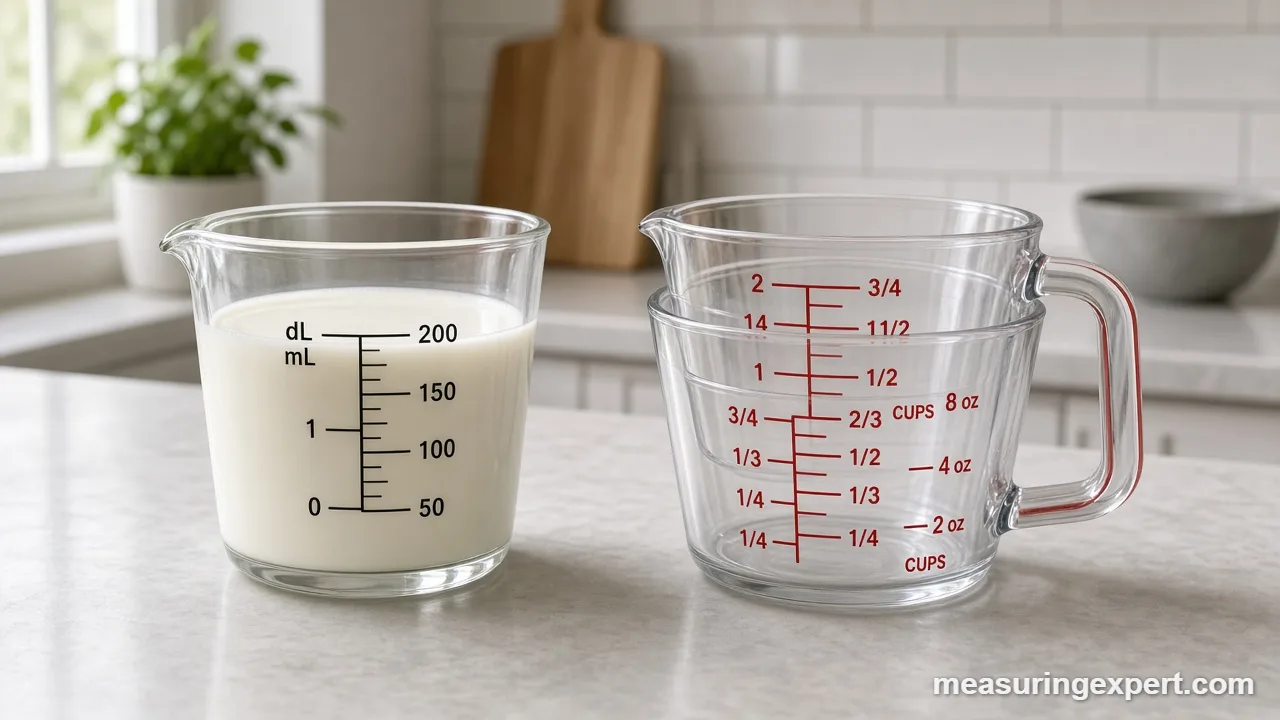
Metric volume units step up by factors of ten, so the main risk is a misplaced decimal point. Therefore, the table below separates the four units people mix up most.
| Unit | Symbol | In liters | In milliliters | Rough US match |
|---|---|---|---|---|
| Milliliter | mL | 0.001 L | 1 mL | about 1/5 teaspoon |
| Centiliter | cL | 0.01 L | 10 mL | about 2 teaspoons |
| Deciliter | dL | 0.1 L | 100 mL | a scant 1/2 cup |
| Liter | L | 1 L | 1,000 mL | about 1.06 US quarts |
Note that a metric cup holds 250 mL, or 2.5 dL. A US cup, however, holds about 236.6 mL, or roughly 2.37 dL. Our guide to metric vs imperial units explains how the two systems differ.
How to Measure 1 dL in a US Kitchen
- Convert to milliliters. Multiply the dL amount by 100, or type it into the converter above.
- Find the mL scale on your cup. Most US liquid measuring cups also carry a milliliter scale on the opposite side.
- Set the cup on a flat counter. Otherwise, a tilted cup gives a false reading.
- Pour to the mark at eye level. Crouch so your eye lines up with the line, then read the bottom of the curved surface.
- Without mL markings, use US units. Measure 1/3 cup plus 1 tablespoon plus 1 teaspoon, which totals about 98.6 mL.
- For dry ingredients, spoon and level. Then sweep a flat edge across the top, since Nordic recipes assume a level scoop.
Deciliters to Grams: Why Weight Differs
A deciliter measures space, not weight. So 1 dL of water weighs close to 100 g (about 3.5 oz), because water has a density near 1 g per mL. However, other ingredients weigh less or more. A deciliter of all-purpose flour comes to roughly 50 g, while granulated sugar lands near 85 g. Of course, those figures change with how firmly you pack the scoop.
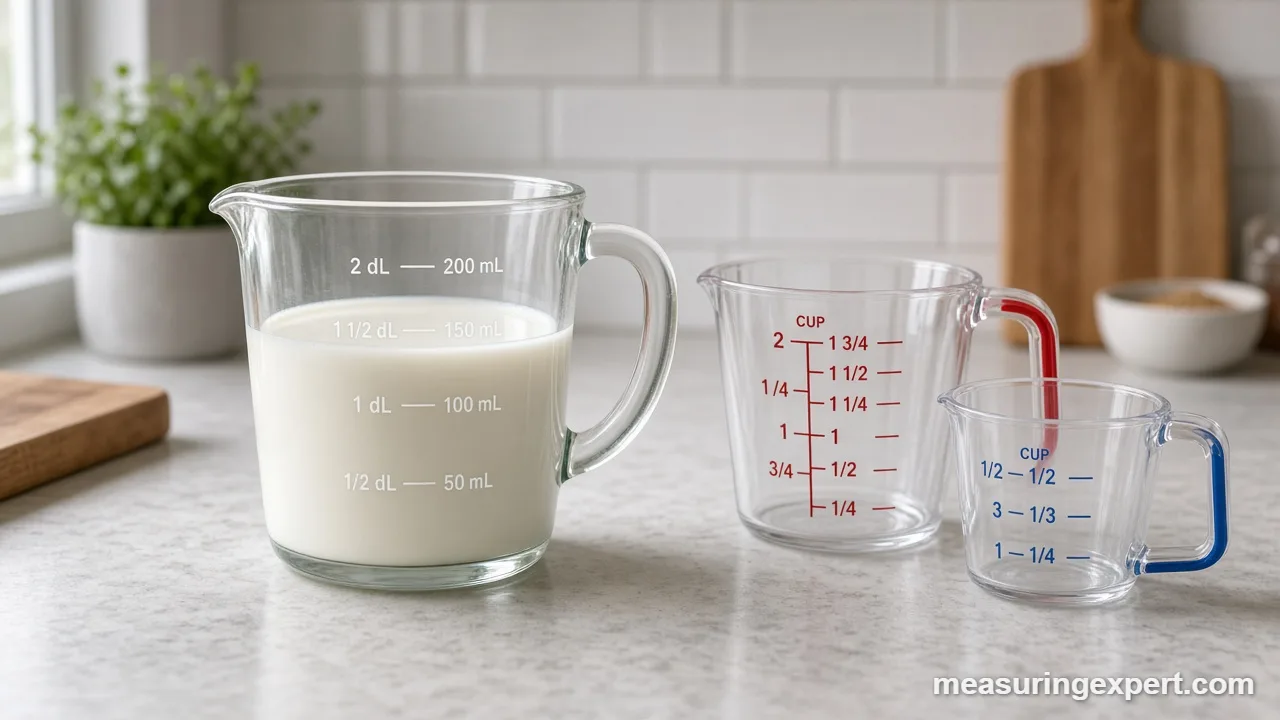
For that reason, many bakers weigh flour instead of scooping it. If a European recipe gives grams, use a scale. On the other hand, if it gives dL, a measuring cup with mL markings works well. For more on weight units, read how much an ounce is.
Do and Don’t With Deciliter Recipes
Do
- First, multiply dL by 100 to get mL.
- Also, read liquid lines at eye level.
- Level dry scoops with a flat edge.
- Check whether a recipe uses a 250 mL metric cup.
- Weigh flour when a bake needs precision.
Don’t
- Confuse dL with cL; the difference is tenfold.
- Treat 1 dL as a full US cup, since it holds less than half.
- Assume dL of flour weighs 100 g.
- Pack flour into a dL scoop, because packing adds weight.
- Guess medicine doses from kitchen tools.
Honest Limits of a DL Measurement
The deciliter itself is exact, but your kitchen tools are not. For one thing, printed lines on a plastic jug can sit a few milliliters off. Meanwhile, the US equivalents on this page get rounded: 3.38 fl oz is really 3.3814 fl oz. Still, in everyday cooking these gaps make no difference. For dry ingredients, however, packing and sifting change the amount far more than any rounding does. In short, treat volume as close enough for soups and sauces, and switch to a scale for bread and cakes.
When Accuracy Really Matters
Generally, most recipe amounts forgive a small error. Even so, a few situations call for care:
- Baking and bread. Too much liquid in a dough changes the texture, so use the mL scale or a scale.
- Lab and school work. Use a graduated cylinder, because it reads more precisely than a kitchen jug.
- Reading blood test results. Units such as mg/dL and mmol/L are not the same scale, and your doctor interprets them for you.
- Medicine. Use the oral syringe or dosing cup that comes with the medicine, and dose in mL.
DL Measurement FAQs
What does dL stand for in measurement?
dL stands for deciliter, a metric unit of volume equal to one tenth of a liter, or 100 mL.
How many mL are in 1 dL?
In short, there are exactly 100 milliliters in 1 deciliter.
Is a DL measurement the same as a cup?
No. A deciliter is 100 mL, while a US cup is about 236.6 mL. So 1 dL is about 0.42 US cup, a little less than half.
How many fluid ounces are in a deciliter?
A deciliter holds about 3.38 US fluid ounces and also about 3.52 UK fluid ounces.
How many deciliters are in a liter?
A liter contains 10 deciliters. Thus, to turn liters into deciliters, multiply by 10.
How do I convert 2 dL to cups?
Multiply 2 by 100 to get 200 mL, then divide by 236.6. As a result, you get about 0.85 US cup, just under 7/8 cup.
Is dL or dl the correct way to write it?
Both appear, so either is fine. Official SI rules allow a lowercase l or a capital L for liter, and US style prefers dL so the letter l is not mistaken for the number 1.
What does mg/dL mean on a blood test?
It means milligrams per deciliter: the weight of a substance in each 100 mL of blood. For that reason, your doctor explains what your own numbers mean.
How much does 1 dL of water weigh?
About 100 grams at room temperature, which is also roughly 3.5 ounces.
How can I measure a DL measurement without metric tools?
Use 1/3 cup plus 1 tablespoon plus 1 teaspoon. Together, they hold about 98.6 mL, within 2 percent of 1 dL.
The Bottom Line on the DL Measurement
To sum up, a deciliter is 100 mL, or one tenth of a liter. In US terms, likewise, that is about 3.38 fluid ounces or a scant half cup. Therefore, the fastest way to follow a dL recipe is to multiply by 100 and pour to the mL line on your measuring cup.
Finally, keep the context in mind. In a recipe, dL is just a volume. On a lab report, by contrast, it is part of a concentration, and only your doctor can interpret those numbers for you.
3 thoughts on “DL Measurement: What Is a Deciliter and How Much Is 1 dL?”