

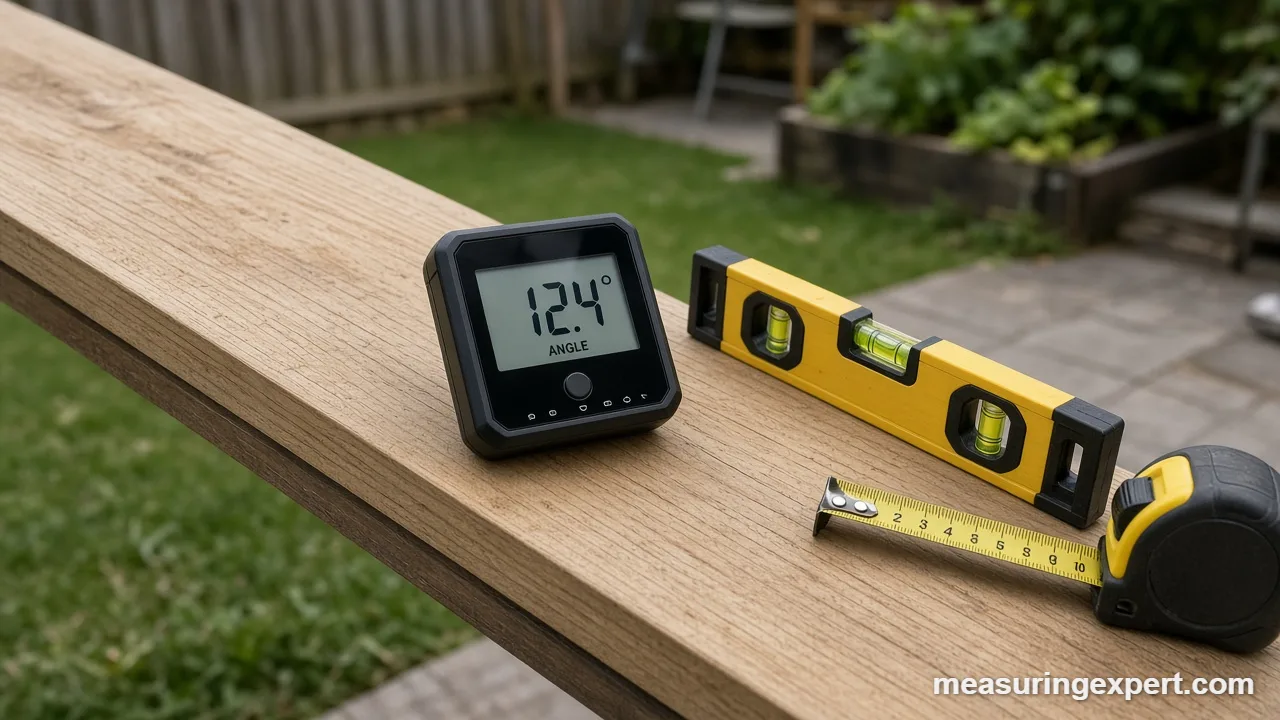
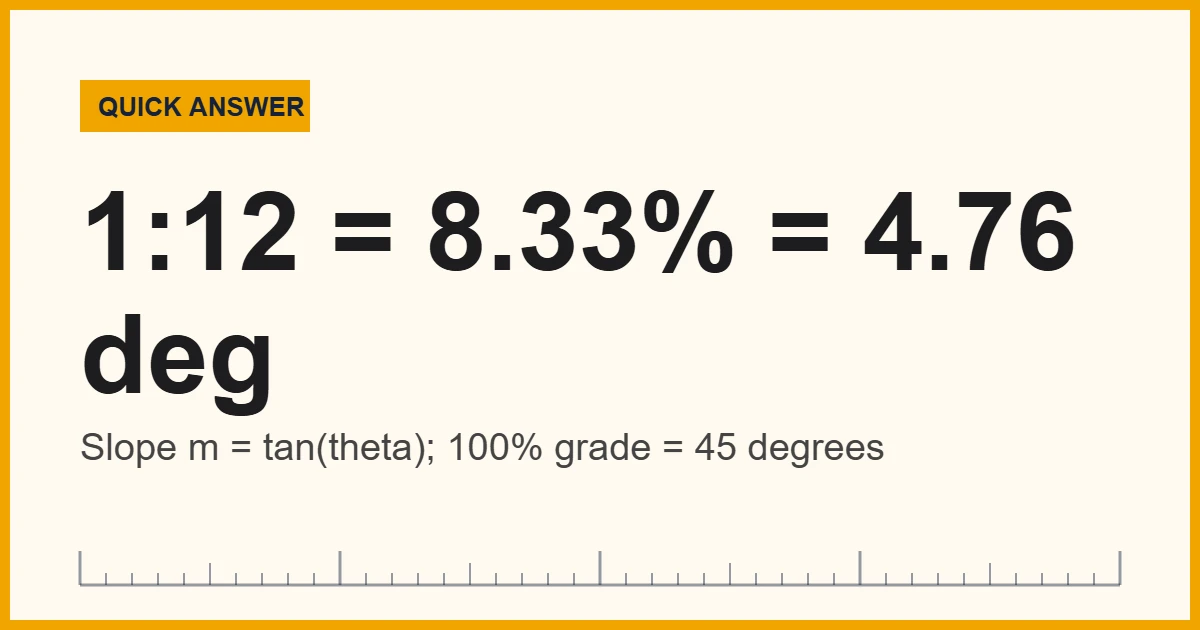
The angle of inclination is the angle a line or surface makes with the horizontal. In math, it is the angle from the positive x-axis to the line, and the slope equals its tangent: m = tan(theta). For example, an ADA ramp at 1:12 rises 8.33%, which is about 4.76 degrees.
Every ramp, roof, driveway, road and hillside has a tilt, and that tilt has a number. For example, builders often state it as a ratio, road engineers as a percent grade, roofers as a pitch, and math teachers as an angle in degrees. Yet all four describe the same thing, so once you know how they connect, you can move between them in seconds.
In short: measure the rise and the run, divide rise by run to get the slope, and take the inverse tangent to get the angle. Alternatively, put a digital inclinometer, an angle finder or a phone level on the surface and read the angle directly.
Accessibility rules, for example, show why the number matters. For instance, the US Access Board’s ADA Standards, section 405, say a ramp’s running slope cannot be steeper than 1:12 and its cross slope cannot be steeper than 1:48. Because a wheelchair user feels every fraction of a degree, those limits translate into tight targets on site.
Below, you will first of all find a converter for your own numbers. After that, the guide covers the math definition, the tools, a step-by-step method, and finally the mistakes that throw readings off.
Convert Percent Grade to Degrees and Pitch
Enter a percent grade (or switch the unit to degrees or roof pitch). The converter then shows the angle of inclination in degrees, the percent grade, and the pitch in inches of rise per 12 inches of run. By default, the value is 8.33%, the ADA maximum ramp slope.
- The angle of inclination of a line is the angle from the positive x-axis, between 0 and 180 degrees.
- Slope and angle connect through the tangent: m = tan(theta), so theta = arctan(m).
- Percent grade is rise divided by run, times 100; 100% grade equals 45 degrees, not 90.
- Roof pitch states inches of rise per 12 inches of run; a 6/12 roof sits at about 26.57 degrees.
- ADA ramps may not exceed 1:12, which works out to 8.33% or about 4.76 degrees.
- Digital inclinometers read the angle directly, while a level plus a tape gives rise and run.
- Calibrate any digital tool on a known flat surface before you trust a reading.
Angle of Inclination: The Math Definition
In coordinate geometry, the angle of inclination of a non-horizontal line is the angle measured counterclockwise from the positive x-axis to the line. As a result, it always falls between 0 and 180 degrees. For example, a horizontal line has an angle of 0 degrees, while a vertical line has an angle of exactly 90 degrees.
In addition, the slope of the line, m, is the tangent of that angle:
m = tan(theta) and theta = arctan(m)
So a line through the points (1, 2) and (4, 8) has a slope of (8 – 2) / (4 – 1) = 2. Therefore its angle of inclination is arctan(2), or about 63.43 degrees. Similarly, a slope of 1 gives 45 degrees, and a slope of 1/sqrt(3) gives 30 degrees.
Angle of inclination for a negative slope
A line that falls from left to right has a negative slope, so its angle sits between 90 and 180 degrees. Your calculator, however, returns a negative value for arctan of a negative number. To fix it, add 180 degrees. For example, a slope of -1 gives arctan(-1) = -45 degrees, and -45 + 180 = 135 degrees.
Recommended Tools for Measuring an Angle of Inclination
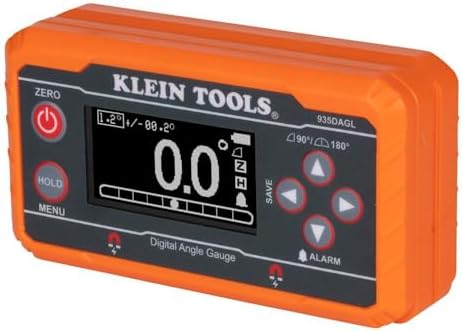
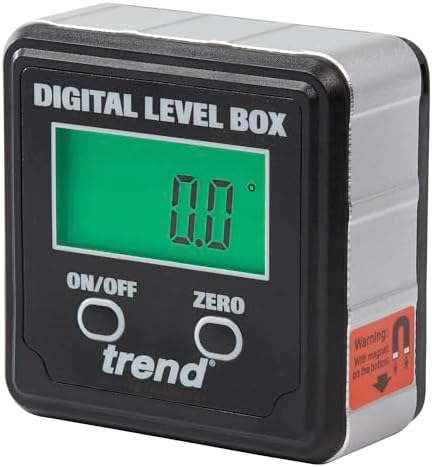
For real surfaces, a digital angle gauge or a digital level usually saves the most time, because it shows the angle at once. First, look for a magnetic base if you work on saw blades or steel. Next, check that the tool can show degrees and percent, and that it has a zero or calibrate button. Finally, a longer level averages out small bumps on rough surfaces such as ramps and decks.



As an Amazon Associate, Measuring Expert earns from qualifying purchases.
Degrees vs Percent Grade vs Pitch
People often describe the same tilt in different units, and mixing them up is the most common error. Therefore, the table below shows how the angle of inclination lines up with grade, ratio and roof pitch.
| Degrees | Percent grade | Ratio (rise:run) | Pitch (x/12) | Typical example |
|---|---|---|---|---|
| 1.19° | 2.08% | 1:48 | 0.25/12 | ADA maximum cross slope |
| 2.86° | 5% | 1:20 | 0.6/12 | Gentle walkway |
| 4.76° | 8.33% | 1:12 | 1/12 | ADA maximum ramp slope |
| 5.71° | 10% | 1:10 | 1.2/12 | Steep road hill |
| 14.04° | 25% | 1:4 | 3/12 | Low-slope roof |
| 18.43° | 33.33% | 1:3 | 4/12 | Common roof pitch |
| 26.57° | 50% | 1:2 | 6/12 | Common roof pitch |
| 45° | 100% | 1:1 | 12/12 | Steep roof or stair stringer |
In fact, the formulas behind the table are short. Percent grade = (rise / run) x 100. Degrees = arctan(rise / run). Pitch = (rise / run) x 12. Because the tangent is not linear, doubling the grade does not double the angle; in fact, 100% grade is 45 degrees, and a 90-degree wall would have an infinite grade.
How to Measure the Angle of Inclination of a Slope
You only need a straight level and a tape measure for this method. It also works as a check on any digital tool, because it relies on nothing but geometry.
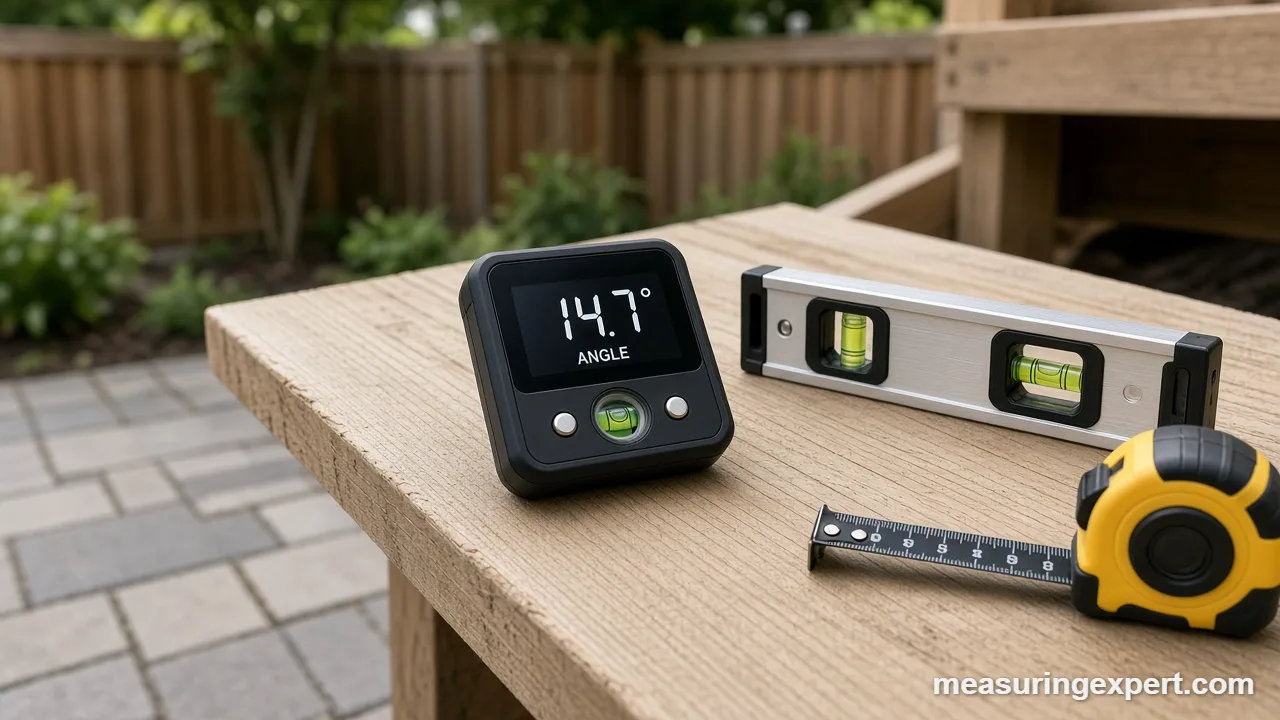
- Clean the surface. Sweep away grit and pebbles where the level will rest, because a single stone can tip the reading.
- Lay the level along the slope. Point it straight uphill, not at an angle across the surface.
- Raise the low end. Lift the downhill end until the bubble sits centered between the lines.
- Measure the gap. Read the vertical distance from the bottom of the level to the surface at the lifted end. That gap is the rise.
- Note the run. Use the length of the level (for example, 24 or 48 inches) as the run.
- Calculate. Divide rise by run, then enter the result in the converter above as a percent (multiply by 100) to get the angle of inclination in degrees.
For instance, a 1-inch gap under a 12-inch span gives 1/12, or 8.33%, which is 4.76 degrees. Likewise, a 2-inch gap under a 48-inch level gives about 4.17%, or roughly 2.39 degrees.
Measuring the Angle of Inclination With Tools
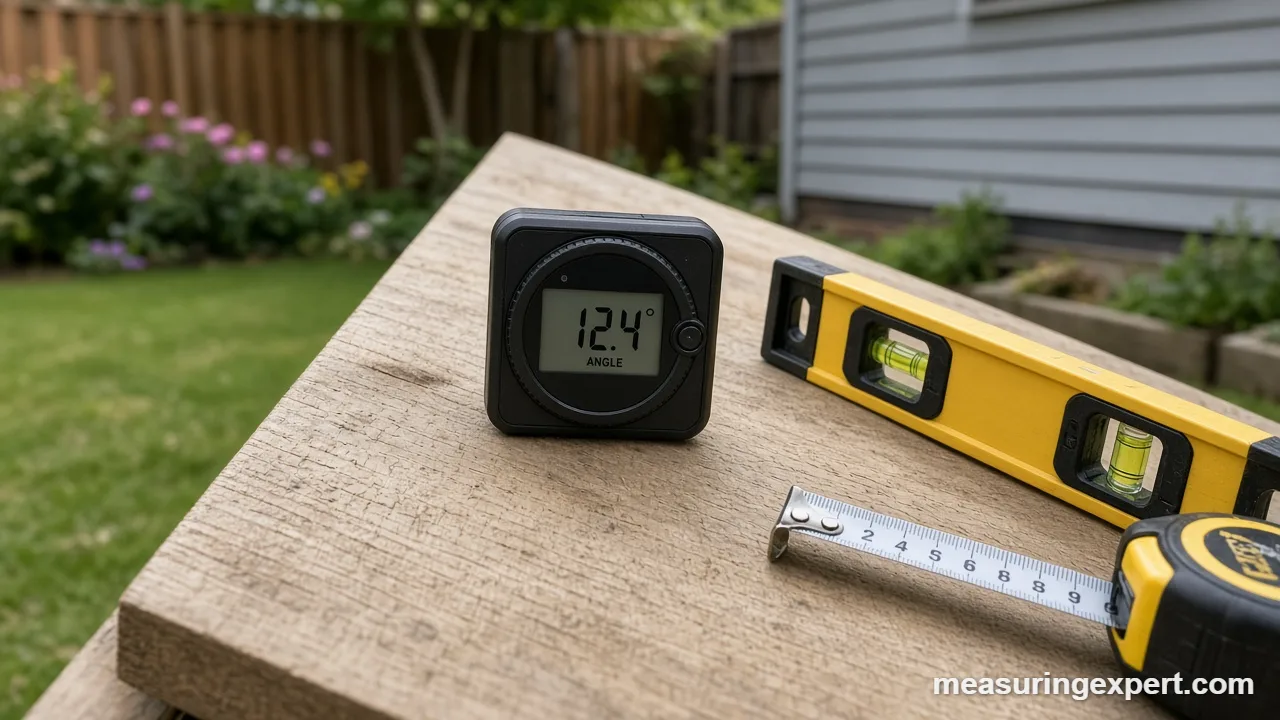
Several instruments read the tilt for you. However, each one suits a different job, so pick by the size of the surface and the accuracy you need.
| Tool | How it reads the angle | Best for | Watch out for |
|---|---|---|---|
| Digital inclinometer / angle gauge | Built-in tilt sensor, shown in degrees (often also percent) | Saw blades, machinery, small surfaces | Short base picks up surface bumps |
| Digital level | Tilt sensor in a long level body | Ramps, decks, framing, drainage | Needs calibration after drops |
| Spirit level + tape | Rise over run, then arctan | Any slope; cheap check | Small gap errors, especially on short levels |
| Clinometer | Sighting or pendulum scale | Hillsides, tree height, distant slopes | Hand steadiness |
| Phone level app | Phone accelerometer | Quick rough checks | Camera bumps and cases tilt the phone |
| Protractor | Printed degree scale | Drawings and models | Hard to use on large surfaces |
Digital inclinometers and levels
First of all, a digital inclinometer uses an internal sensor that senses the direction of gravity. Many show 0.1-degree resolution, and makers commonly list accuracy around 0.1 degrees near level and plumb. Even so, resolution is not accuracy. Therefore, before each job, run the zero or calibration routine on a flat, stable surface, then flip the tool 180 degrees and confirm the reading stays the same.
Clinometers for distant slopes
When you cannot touch the surface, such as a hillside or a roofline, a clinometer lets you sight along the slope. Our guide on how a clinometer measures angles covers the sighting method in detail.
Phone apps
In addition, most smartphones include a level, and dedicated inclinometer apps add degrees and percent. As a result, they work well for rough checks. However, a raised camera bump or a thick case can tilt the phone, so lay it on a straightedge, or calibrate it on a known level surface first.
Angle of Inclination for Ramps, Roads and Roofs
In everyday building work, nobody writes “4.76 degrees” on a ramp drawing. Instead, each trade uses its own unit; as a result, it helps to know the conversions.
ADA ramps
The ADA Standards cap the running slope of a ramp at 1:12. In other words, you need at least 12 inches of run for every inch of rise, which equals 8.33% or about 4.76 degrees. Also, the cross slope may not exceed 1:48 (about 2.08%, or 1.19 degrees), and a single ramp run may rise no more than 30 inches. As a result, a 30-inch rise at 1:12 needs at least 360 inches, or 30 feet, of run before a landing.
Road grades
Unlike math books, road signs give hills in percent, not degrees. For example, a 6% grade sign means the road climbs or drops 6 feet for every 100 feet of horizontal distance, which is only about 3.43 degrees. Similarly, a 10% grade is about 5.71 degrees. Highways in mountainous terrain typically stay at single-digit grades, because trucks lose speed climbing and heat their brakes descending.
Roof pitch
Roofers write pitch as rise over a 12-inch run, such as 4/12 or 6/12. For example, a 4/12 roof has an angle of inclination of about 18.43 degrees, while a 12/12 roof sits at exactly 45 degrees. In addition, the converter above accepts pitch directly if you switch the unit.
Angle of Inclination vs Related Angles
Several terms sound alike, yet they answer different questions. So the table below separates them.
| Term | What it measures | Reference line |
|---|---|---|
| Angle of inclination | Tilt of a line or surface | Horizontal (positive x-axis) |
| Angle of elevation | Line of sight up to an object | Horizontal at the eye |
| Angle of depression | Line of sight down to an object | Horizontal at the eye |
| Angle of repose | Steepest stable slope of loose material | Horizontal base of the pile |
| Orbital inclination | Tilt of an orbit | A reference plane, such as the equator |
| Magnetic inclination (dip) | Tilt of Earth’s magnetic field | Horizontal at that location |
Similarly, the angle of repose is a special case of inclination: it is the steepest slope a pile of sand or gravel holds before it slides. Also, you can read more in our article on the angle of repose and how to measure it. Meanwhile, in anatomy, clinicians use “inclination angle” for features such as the femoral neck, and they measure it on X-rays rather than with a level.
Do and Don’t When Measuring a Slope
Do
- Calibrate digital tools on a flat surface before each job.
- Measure along the steepest direction of the slope.
- Take three readings and average them.
- Record the unit next to every number.
- Use a longer level on rough or uneven surfaces.
Don’t
- Confuse 100% grade with 90 degrees.
- Trust a phone app with a thick case on.
- Forget to add 180 degrees for a negative slope.
- Build a ramp right at the 1:12 limit.
- Read a bubble at an angle; look straight at the vial.
Honest Limits of Slope Readings
Still, every method has limits. For one thing, real surfaces are not perfect planes, so a short tool reads the local bump while a long one reads the average. Moreover, digital resolution of 0.1 degrees does not guarantee 0.1-degree accuracy; temperature, drops and a dead battery can all shift the sensor. Rise-and-run methods also magnify small errors: on a 12-inch level, a 1/16-inch mistake in the gap changes the result by about 0.3 degrees. In short, treat any single reading as an estimate, and repeat it before you cut, pour or sign off.
When to Call a Professional
Some slopes, however, carry legal or safety weight. For example, a ramp for public use, a driveway that must drain away from a foundation, or a retaining wall on a hillside all deserve a check by a surveyor, engineer or licensed contractor. Similarly, a calibration lab can certify an inclinometer when a contract or inspection demands traceable accuracy.
Angle of Inclination FAQs
What is the angle of inclination in simple terms?
It is how much a line or surface tilts away from horizontal. For instance, flat ground is 0 degrees, a vertical wall is 90 degrees, and everything else falls in between.
What is the formula for the angle of inclination?
Use theta = arctan(m), where m is the slope, or rise divided by run. For a negative slope, add 180 degrees to the calculator result.
How do you find the angle of inclination from two points?
First, find the slope: m = (y2 – y1) / (x2 – x1). Then take arctan(m). For example, the points (1, 2) and (4, 8) give m = 2, which is about 63.43 degrees.
Is a 100% grade the same as 90 degrees?
No. A 100% grade means the rise equals the run, so it is 45 degrees. A vertical 90-degree surface would have an infinite grade.
What angle of inclination is an ADA ramp?
The ADA maximum running slope is 1:12, which is 8.33% or about 4.76 degrees. The maximum cross slope is 1:48, about 1.19 degrees.
How do I convert percent grade to degrees?
Divide the percent by 100 and take the arctan. For example, 8.33% becomes arctan(0.0833), which is about 4.76 degrees. The converter on this page does it for you.
Can I measure an angle of inclination with my phone?
Yes, for rough checks. First, use the built-in level or an inclinometer app, remove thick cases, and calibrate on a known flat surface first.
What is the difference between an inclinometer and a clinometer?
Both measure tilt. However, an inclinometer usually sits on the surface, while a clinometer often lets you sight along a distant slope or up to the top of an object.
What is a 6/12 roof pitch in degrees?
A 6/12 pitch rises 6 inches per 12 inches of run, a 50% grade, which is about 26.57 degrees.
Can the angle of inclination be more than 90 degrees?
Yes. In coordinate geometry, lines with a negative slope have angles between 90 and 180 degrees. For example, a slope of -1 gives 135 degrees.
The Bottom Line on the Angle of Inclination
To sum up, the angle of inclination is the tilt of a line from horizontal, and it links to slope through m = tan(theta). Similarly, percent grade, ratio and pitch are simply other ways to write the same tilt, so convert with arctan instead of guessing.
For real surfaces, use a calibrated digital level or the level-and-tape method, and repeat each reading. Finally, if you are building a ramp, stay a little gentler than the 1:12 ADA limit and confirm local code before you pour or cut.
5 thoughts on “What Is the Angle of Inclination and How Is It Measured?”