

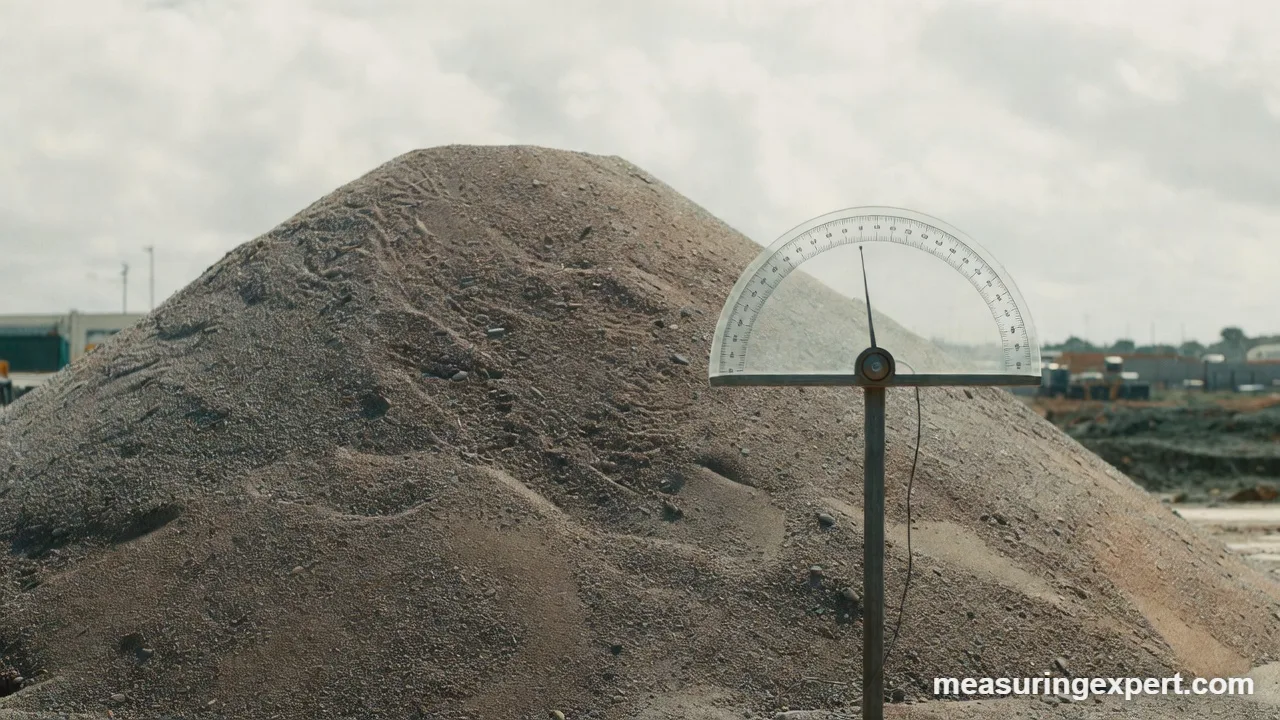
The angle of repose is the steepest slope, measured from the horizontal, at which a pile of loose dry material such as sand, gravel or grain stays put without sliding. To find it, measure the pile’s height and base radius; then tan(angle) = height / radius. Dry sand, for example, settles at about 35 degrees.
Pour sugar into a bowl and it builds a small cone. Then keep pouring, and the cone gets bigger, but its sides never get steeper. Instead, extra grains roll down the face, and the slope stays at the same angle. That limiting slope is the material’s resting angle, and every granular material has its own.
Engineers, farmers and drug makers all rely on this number. For example, it tells a quarry how much ground a gravel stockpile will cover, it helps a designer pick the wall angle of a hopper, and it gives a pharmacist a quick read on how well a powder will flow into a tablet press.
The Angle of Repose in Short
In short: the angle of repose is a simple geometry measurement. You build a cone, measure two lengths, and take an arctangent. However, the hard part is building the cone the same way every time, because the result changes with how the material falls, how damp it is and how the base is set up.
The harmonized pharmacopeial chapter on powder flow (published by the US, European and Japanese pharmacopeias and posted by Japan’s drug regulator, PMDA) defines it as the constant, three-dimensional angle a cone of powder makes with its horizontal base. Moreover, that chapter sets out the standard fixed-funnel test and a flow rating scale, both of which appear below.
First, try the converter. After that, you will find typical values, the three main test methods, a step-by-step funnel test, and the places where the number matters most.
Turn a Pile’s Height and Base Into an Angle of Repose
The converter below works in percent grade, which is simply height divided by base radius, times 100. So first divide the pile height by its base radius (half the base diameter), multiply by 100, and enter that number. The converter then returns the angle in degrees, plus the matching roof-style pitch.
Worked example: a sand pile stands 4 ft (1.22 m) tall on a round base 12 ft (3.66 m) across, so the base radius is 6 ft (1.83 m). Then 4 / 6 = 0.667, or 66.67% grade. Finally, arctan(0.667) = 33.7 degrees, which is the angle of repose for that pile.
angle of repose = arctan(height / base radius)
4 ft / 6 ft = 0.667 -> arctan(0.667) = 33.7 degrees
The formula also works in reverse. If you know a material settles at 35 degrees, then the height of a cone-shaped pile is its radius times tan(35), or about 0.70 times the radius. A 10 ft (3.05 m) radius pile of that material therefore peaks at about 7 ft (2.13 m).
Recommended Tools for Measuring Pile Slopes and Angles
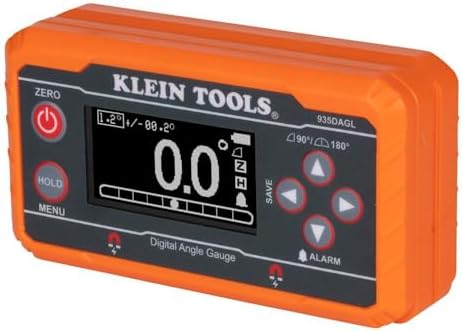
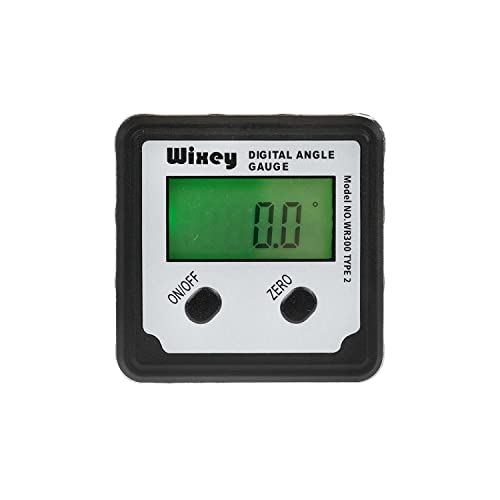
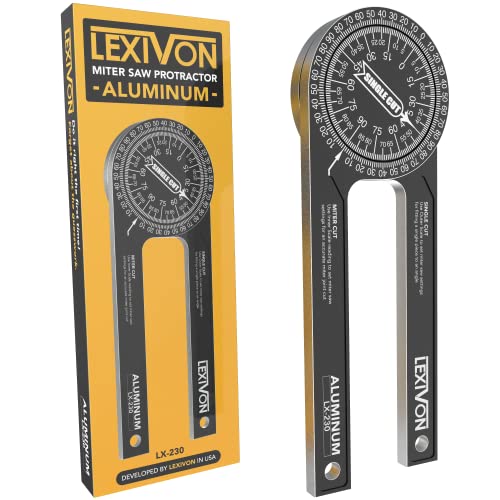
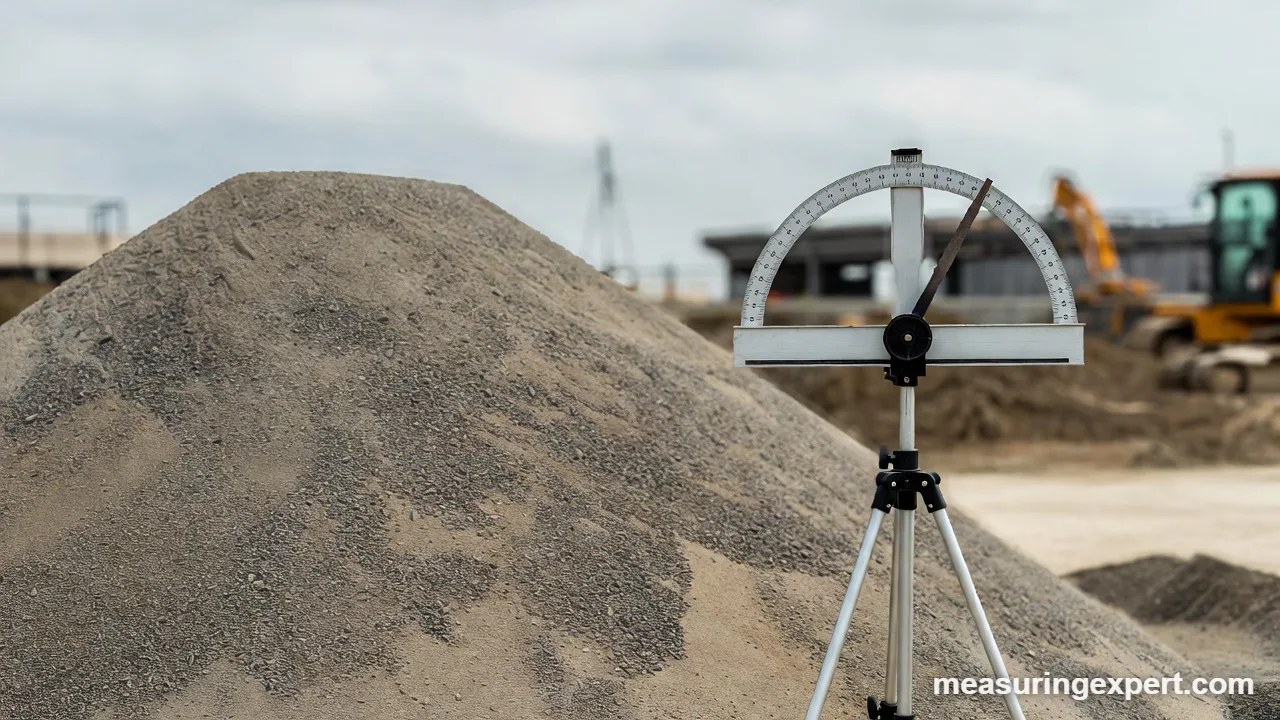
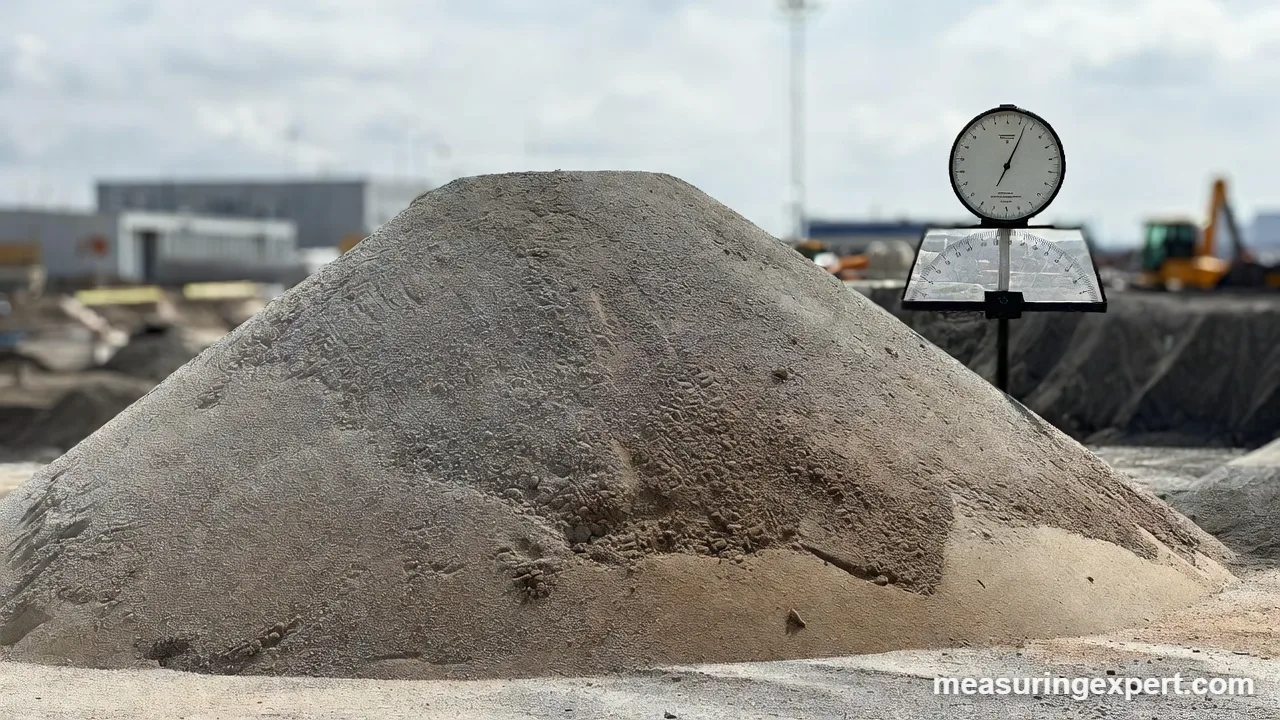
For a lab cone, a ruler and calipers are enough. On a real stockpile or a tilted box, however, a digital angle gauge reads the slope directly, which saves the arithmetic. Look for 0.1-degree resolution, a zero (relative) button so you can reference an uneven base, and a magnetic or flat base that sits steady on a straightedge laid along the slope. In addition, a simple protractor works for quick checks on photos and small cones.



As an Amazon Associate, Measuring Expert earns from qualifying purchases.
Key Takeaways
- It is the steepest stable slope of a loose pile, measured from horizontal.
- Formula: tan(angle) = pile height / base radius.
- Common values run from about 24 degrees (hard coal) to about 40 degrees (gravel, damp sand).
- Lower angles mean freer flow; pharmacopeias rate 25 to 30 degrees as excellent flow.
- Main tests: fixed funnel (static cone), tilting box, and rotating cylinder (dynamic angle).
- Moisture, particle shape, size spread and test setup all shift the result.
- For excavations, OSHA slope tables apply, not a material’s angle of repose.
What the Angle of Repose Means
Picture a cone of dry sand on a flat table. The angle of repose is the angle between the table and the side of that cone. Meanwhile, friction and interlocking with their neighbors hold the grains on the surface in place. As soon as the slope gets steeper than that balance allows, the surface layer slips and the slope relaxes back.
Because the slope of a cone is the same all the way around, one height and one radius describe it. In other words, the relationship is plain right-triangle geometry: the height is the opposite side, the base radius is the adjacent side, and the tangent of the angle is their ratio. As a result, you never need to measure the angle itself if you can measure those two lengths well.
Physics classes sometimes use the phrase for a block on a ramp, where the tangent of the slip angle equals the coefficient of static friction. That ramp idea is related, but for a pile of grains, the angle also depends on particle shape and cohesion, so the two numbers are not interchangeable. For the general idea of measuring a slope from horizontal, see our guide to the angle of inclination and how it is measured.
| Term | What it describes | How it is found |
|---|---|---|
| Static angle of repose | Slope of a pile at rest | Fixed funnel cone or tilting box |
| Dynamic angle of repose | Slope of material that is moving | Rotating cylinder (drum) |
| Angle of inclination | Any slope from horizontal | Inclinometer, clinometer or rise over run |
| Friction angle (block on ramp) | When a solid block starts sliding | Tilt the ramp until it slips |
Angle of Repose Values for Common Materials
First of all, the table below lists typical values from the Engineering ToolBox angles of repose table, a widely used engineering reference. The percent grade column is computed from each angle, so you can check a pile against it with the converter above.
| Material | Typical angle | Height / radius | Percent grade |
|---|---|---|---|
| Coal, hard | 24° | 0.45 | 44.5% |
| Wheat | 28° | 0.53 | 53.2% |
| Earth, loose | 28° | 0.53 | 53.2% |
| Coal, soft | 30° | 0.58 | 57.7% |
| Ashes, dry | 33° | 0.65 | 64.9% |
| Sand, dry | 35° | 0.70 | 70.0% |
| Sand, damp | 40° | 0.84 | 83.9% |
| Gravel | 40° | 0.84 | 83.9% |
| Clay | 45° | 1.00 | 100% |
For powders, the same chapter from the pharmacopeias groups results into a flow scale. In general, lower angles mean the powder pours more freely.
| Flow property | Angle of repose |
|---|---|
| Excellent | 25-30° |
| Good | 31-35° |
| Fair (aid not needed) | 36-40° |
| Passable (may hang up) | 41-45° |
| Poor (must agitate, vibrate) | 46-55° |
| Very poor | 56-65° |
| Very, very poor | over 66° |
Three Ways to Measure the Angle of Repose
In fact, labs use several setups, and each one answers a slightly different question. So always report which method you used along with the number.
| Method | How it works | Best for | Watch out for |
|---|---|---|---|
| Fixed funnel (static cone) | Material pours through a funnel onto a flat base and forms a cone; you measure height and radius. | Powders, sand, grain samples | Funnel height and pour rate change the cone |
| Tilting box | A box filled level with material tilts slowly until the surface starts to slide; you read the tilt angle. | Coarser materials, quick field checks | Tilt speed and box wall friction |
| Rotating cylinder | A partly filled clear drum turns slowly; you measure the slope of the moving surface. | Mixers, kilns, dynamic flow | Gives the dynamic angle, usually not the same as the static one |
Fixed funnel. This is the standard pharmacopeial approach. The funnel stays about 2 to 4 cm (0.8 to 1.6 in) above the top of the growing pile, which limits the impact of falling powder. Some labs fix the base diameter with a round plate; others let the cone spread and measure its width.
Tilting box. Here you fill a box, level the surface, and then tilt the box slowly. Next, you note the angle at which the top layer begins to move. A digital angle gauge resting on the box lid or side makes this reading quick, and our guide to how a clinometer measures angles explains the same principle with a handheld tool.
Rotating cylinder. Finally, the drum method turns a clear cylinder about its axis at a slow, steady speed. The material climbs the wall and keeps sliding back, so its surface holds a fairly steady slope. Because the material is moving, this dynamic angle suits equipment such as mixers and rotary dryers.
How to Measure the Angle of Repose With a Fixed Funnel
- Set up a level base. Place a flat, rigid plate on a level bench and check it with a level so the cone sits on true horizontal.
- Mount the funnel. Clamp a funnel over the center of the plate so its outlet sits about 2 to 4 cm (0.8 to 1.6 in) above the pile top.
- Pour the material slowly. Feed it into the funnel at a steady rate and raise the funnel as the cone grows so the drop stays short.
- Stop when the cone is complete. End the pour once the pile reaches the plate edge or the height you planned, without bumping the bench.
- Measure height and diameter. Read the cone height at the tip, then measure the base diameter in two directions at right angles and average them.
- Calculate the angle. Halve the diameter to get the radius, divide height by radius, and enter the result times 100 in the converter above.
- Repeat and average. Rebuild the cone at least three times and report the mean along with the method and moisture of the sample.
What Changes How Steep a Pile Stands
Indeed, two samples of “sand” can give different results. That is because the result depends on the particles and on the way you build the pile, not just on what the material is called.
- Particle shape. Angular, rough grains interlock and stand steeper. Rounded, smooth grains roll, so they settle lower.
- Moisture. A little water adds cohesion between grains, which is why damp sand stands steeper than dry sand. However, saturated material can slump and flow.
- Fines and size spread. Very fine powders tend to be cohesive and form steeper, uneven cones; free-flowing granules form flatter ones.
- Drop height and pour rate. Material falling from higher up hits harder and spreads the pile, which lowers the measured angle.
- Base and vibration. A rough base holds the bottom layer, while a smooth or vibrating base lets it creep outward.
Why the Angle of Repose Matters
Stockpiles. Since a conical pile has height = radius x tan(angle), the angle of repose sets how much ground a pile needs. For example, a material that rests at 35 degrees, piled on a 10 ft radius, reaches about 7 ft and holds about 733 cubic feet (27.2 cubic yards, or 20.8 cubic meters). On a 3 m (9.8 ft) radius, the same material peaks at about 2.1 m and holds about 19.8 cubic meters.
Hoppers and silos. Designers use flow properties when they choose outlet sizes and wall angles, and the pile angle is a quick first indicator. Meanwhile, proper hopper design relies on shear-cell testing of wall friction and material strength, not on the angle of repose alone.
Conveyors and chutes. Likewise, chute angles must be steep enough for material to keep moving. Similarly, the surcharge on a loaded belt depends on how the material piles while it moves.
Tablets and capsules. In drug and food manufacturing, a powder with a low pile angle fills dies and capsules evenly, so doses stay consistent. Therefore, it is one of the first flow checks run on a new blend.
Slopes and trenches. For loose fill, the resting angle hints at how steep a dumped embankment will stand. For excavations, though, US law uses soil classes instead. The OSHA sloping table allows 53 degrees for Type A soil, 45 degrees for Type B and 34 degrees for Type C in trenches under 20 feet deep.
Angle of Repose Testing: Do and Don’t
Do
- Level the base before every test.
- Keep the funnel close to the pile top.
- Average at least three cones.
- Record moisture and the test method.
- Measure the diameter twice, at right angles.
Don’t
- Drop material from a large height.
- Bump or vibrate the bench mid-pour.
- Compare static and drum results directly.
- Use the full diameter in the tan formula.
- Treat handbook values as design limits.
Honest Limits of Angle of Repose Numbers
This test is popular because it is cheap and fast. Still, it is not a basic material property in the way density is. For one thing, results depend on the apparatus, so two labs testing the same powder can report different angles. In addition, real cones are rarely perfect: the tip may be rounded and the base ragged, which makes the height and radius slightly uncertain.
A small error in height also matters more on steep piles. For instance, on a 4 ft by 6 ft cone, misreading the height by 1 inch moves the result by about half a degree. In short, report one decimal place at most, state the method, and use the number for comparison rather than as an exact constant.
When to Call a Professional
Generally, lab cones and backyard sand piles are fine for learning and quality checks. However, bring in the right expert when the stakes are higher:
- Silo, bin and hopper design: a bulk-solids engineer who can run shear-cell and wall-friction tests.
- Retaining walls, embankments and excavations: a licensed geotechnical engineer or the competent person on site.
- Large stockpiles near people or roads: a site safety professional familiar with MSHA or OSHA rules.
- Regulated products such as medicines: a qualified lab following the official pharmacopeial method.
Frequently Asked Questions
What is the angle of repose in simple terms?
It is the steepest slope a pile of loose material can hold before grains start to slide down its sides, measured in degrees from the horizontal.
What is the formula for the pile angle?
The tangent of the angle equals the pile height divided by the base radius. So the angle equals arctan(height / radius).
How do you calculate the angle of repose from a pile?
Measure the height and base diameter, halve the diameter, and divide the height by that radius. For example, 4 ft / 6 ft = 0.667, and arctan(0.667) = 33.7 degrees.
What is the angle of repose of sand?
Dry sand typically rests at about 35 degrees and damp sand at about 40 degrees, according to the Engineering ToolBox table. Your own sand may differ by a few degrees.
How steep does gravel pile up?
Gravel typically settles at about 40 degrees, although rounded river gravel usually sits lower than crushed, angular stone.
What angle of repose means good flow?
In the pharmacopeial flow scale, 25 to 30 degrees is excellent and 31 to 35 degrees is good. Above about 45 degrees, a powder usually needs help to flow.
Is the angle of repose the same as the friction angle?
Not exactly. They are related, but the slope of a pile also depends on particle shape, cohesion and how the pile forms, so the two values often differ.
Does moisture change the slope of a pile?
Yes. A little moisture adds cohesion and usually raises the angle, which is why damp sand stands steeper. Very wet material, however, can slump to a lower slope.
What is the dynamic angle of a moving material?
It is the slope of material that is moving, usually measured in a slowly rotating clear drum. It is generally not the same as the static angle of a pile at rest.
What tool measures a pile slope directly?
A digital angle gauge or inclinometer laid on a straightedge along the slope reads the angle directly. For small lab cones, a ruler and the tan formula are more accurate.
Angle of Repose: The Bottom Line
The angle of repose is the steepest stable slope of a loose pile, and you find it with one formula: arctan(height / base radius). Typical values run from the mid-20s for hard coal and wheat to about 40 degrees for gravel and damp sand, while pharmacopeias rate 25 to 30 degrees as excellent powder flow.
Above all, measure carefully and the same way each time: a level base, a short drop, and three or more repeats. Next, use the converter at the top of the page to turn any height and radius into an angle, and leave stockpile, hopper and trench decisions to the professionals who design them.
1 thought on “What Is the Angle of Repose and How Is It Measured?”