

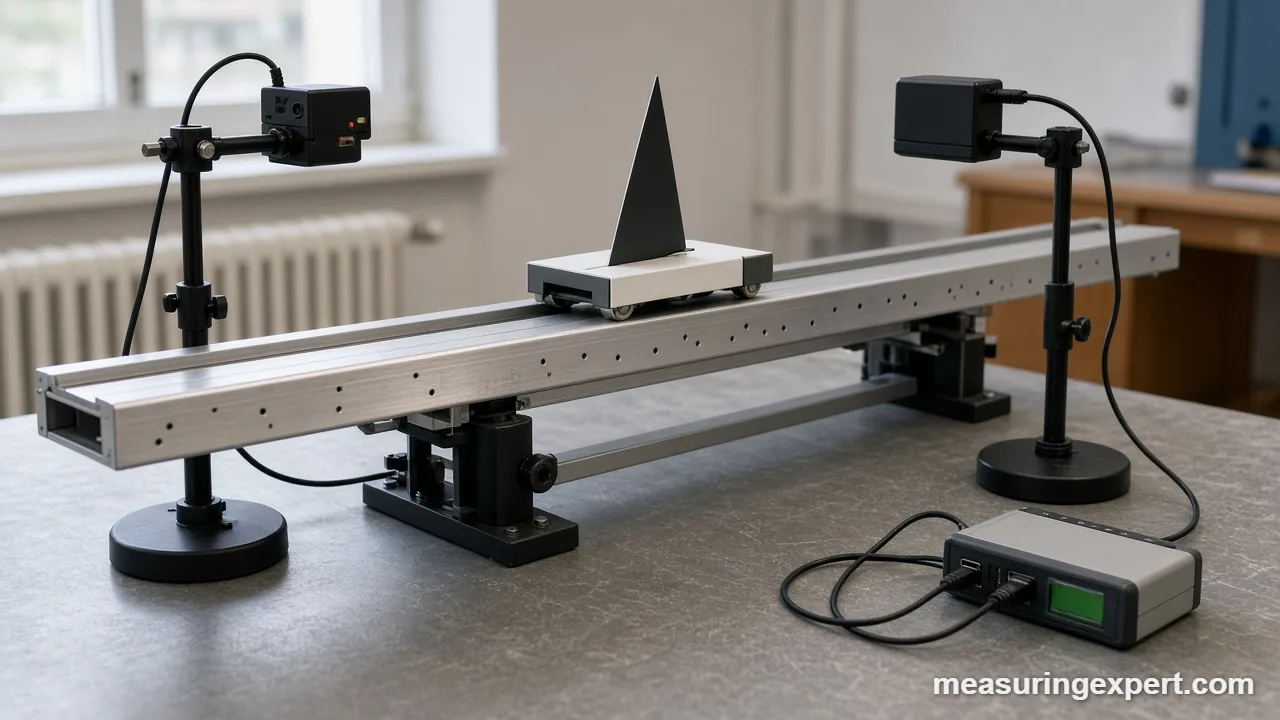
Light gates measure speed by timing how long an object blocks an infrared beam. With one gate, speed equals the length of the card on the object divided by the time the beam was blocked. With two gates, speed equals the distance between the gates divided by the time between them.
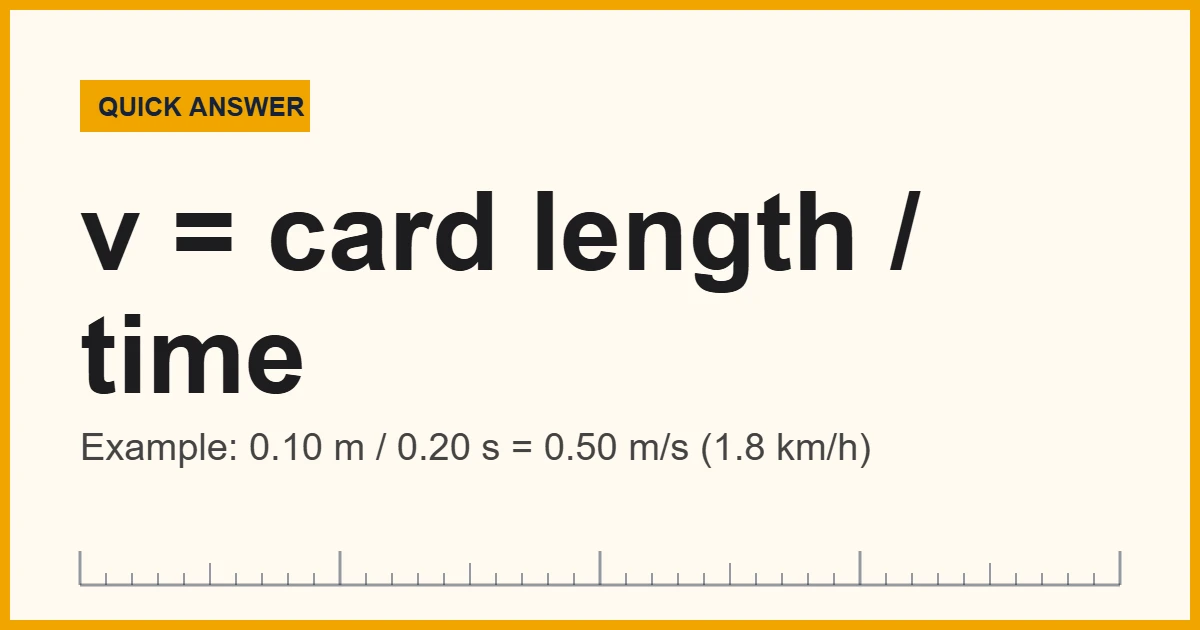
If you have used a stopwatch to time a trolley rolling down a ramp, you know the problem. Your reaction time is around a fifth of a second, and that is often as long as the whole event. However, light gates remove the human from the timing. Instead of you pressing a button, the beam itself starts and stops the clock, so the timer can resolve a thousandth of a second or better.
What Light Gates Are
A light gate is a small U-shaped or two-post sensor. One side sends out a narrow beam, usually infrared, and the other side detects it. When something passes through the gap, the beam is cut off. The timer or data logger then records exactly when the beam broke and when it came back. From those times and one known length, you can work out speed, and with two readings you can also find acceleration.
In short: one gate plus an interrupt card gives the speed at one point, two gates give the average speed between them, and a double-segment card (or two gates with a card) gives acceleration.
The Institute of Physics (IOP) describes this method on its teaching site, IOP Spark. It suggests an interrupt card about 10 or 20 cm long and points out that each reading is an average over the short time the card blocks the beam. Similarly, the AQA GCSE Physics practical handbook lists a linear air track with light gates as one way to run the force and acceleration required practical.
Below, you will find a speed converter, the three main methods with worked examples, a setup checklist, and the errors that catch most students out.
Convert the Speed You Measure With Light Gates
Most light gate software reports speed in meters per second. Type your result below to see it in kilometers per hour, miles per hour and feet per second. For example, 0.5 m/s is a typical trolley speed on a gentle ramp.
The conversions use exact definitions: 1 m/s = 3.6 km/h, 1 mile = 1,609.344 m and 1 foot = 0.3048 m.
Recommended Light Gates and Timers for School Labs
A basic speed practical needs a timer with at least one photogate, something smooth to move along, and a card of known length. First, check whether the timer shows speed directly or only time. Next, look at how many gates it supports, because acceleration work is easier with two. Also consider a track or air track if friction keeps spoiling your results. The picks below are based on manufacturer specs and buyer reports.
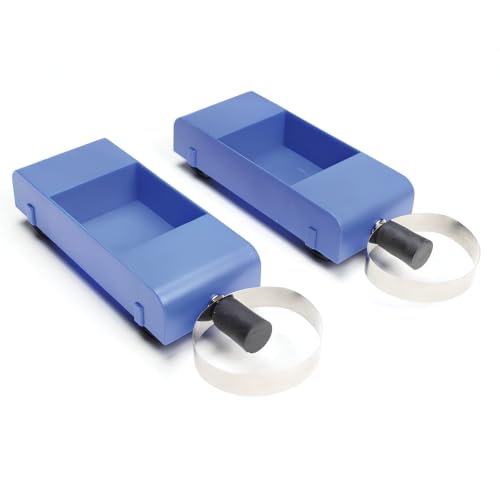
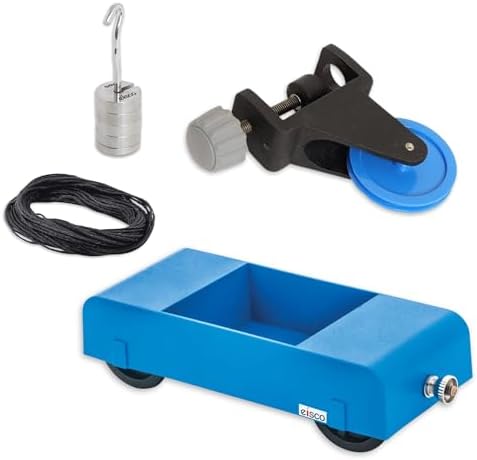


As an Amazon Associate, Measuring Expert earns from qualifying purchases.
Key Takeaways
- Light gates time how long an infrared beam is blocked, often to 1 ms or better.
- Single gate: speed = card length / time blocked.
- Two gates: average speed = gate separation / time between gates.
- Acceleration = (v – u) / t, using two speed readings and the time between them.
- Measure the card with a ruler; a 1 mm error on a 10 cm card is a 1% error in speed.
- Each reading is an average over the card, not a true instantaneous speed.
- Repeat each run at least three times and take the mean.
How Light Gates Work
First, each gate has an emitter, usually an infrared LED, and a detector facing it across a gap. While the beam reaches the detector, the output stays in one state. As soon as an object enters the gap, the detector goes dark and the output flips. As a result, the timer simply records the moments when that output changes.
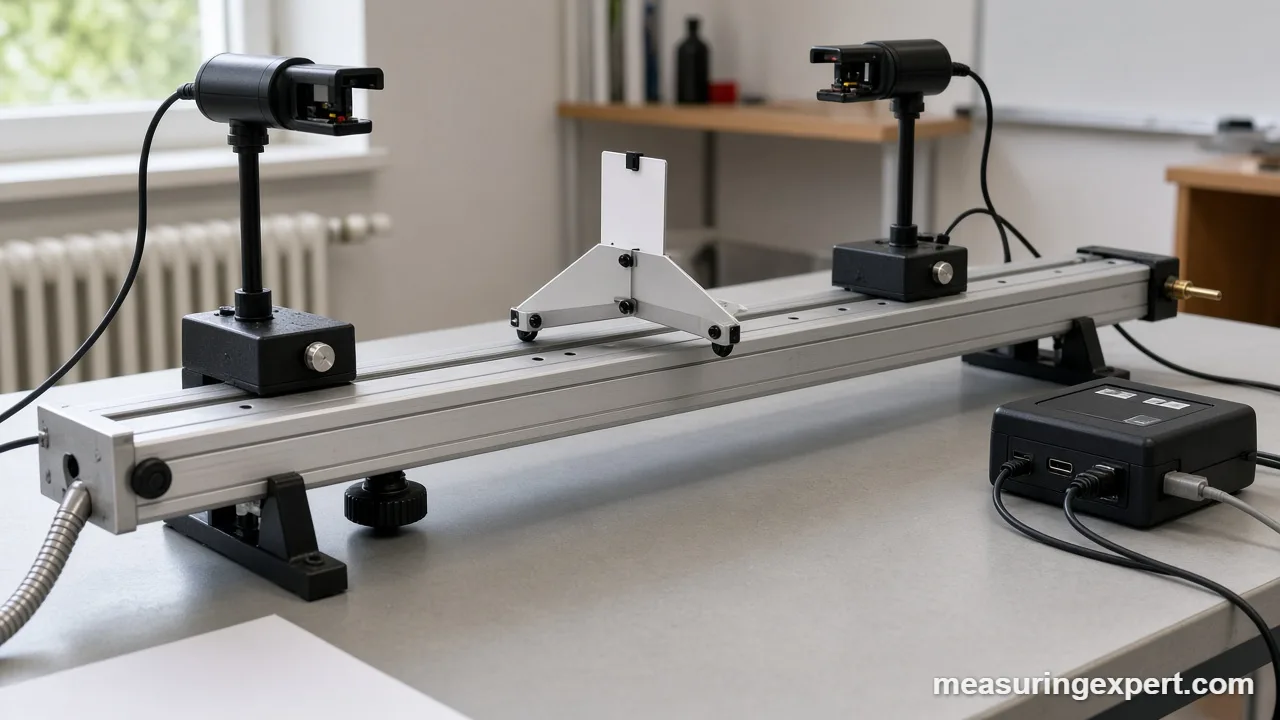
So a gate does not measure speed directly. Instead, it measures time, and very well. The speed comes from combining that time with a length you supply: either the length of the card that blocks the beam, or the distance between two gates. That is why careful length measurement matters just as much as the timer itself.
In addition, most school systems connect the gates to a data logger or a stand-alone timer. Some timers do the division for you once you type in the card length. Others, however, only show the time, so you calculate the speed by hand.
Method 1: One Gate and an Interrupt Card
In fact, this is the most common way to use light gates for speed. You fix a card of known length upright on the trolley so that it passes through the beam. Meanwhile, the timer records how long the beam stays blocked.
speed = card length / time blocked
For example, a 10.0 cm card that blocks the beam for 0.200 s gives 0.100 m / 0.200 s = 0.50 m/s. That is about 1.8 km/h or 1.12 mph.
Because the card is short, the result is close to the speed at that point on the track. However, it is still an average over the 10 cm the card travels. A shorter card gives a value closer to the instantaneous speed. On the other hand, a shorter card also makes the timing error a bigger share of the result, so 5 to 10 cm is a sensible middle ground.
Method 2: Two Gates and the Time Between Them
With two gates, the card length no longer matters for average speed. Instead, you measure the distance between the two beams. The timer records the moment the front of the object reaches gate 1 and the moment it reaches gate 2.
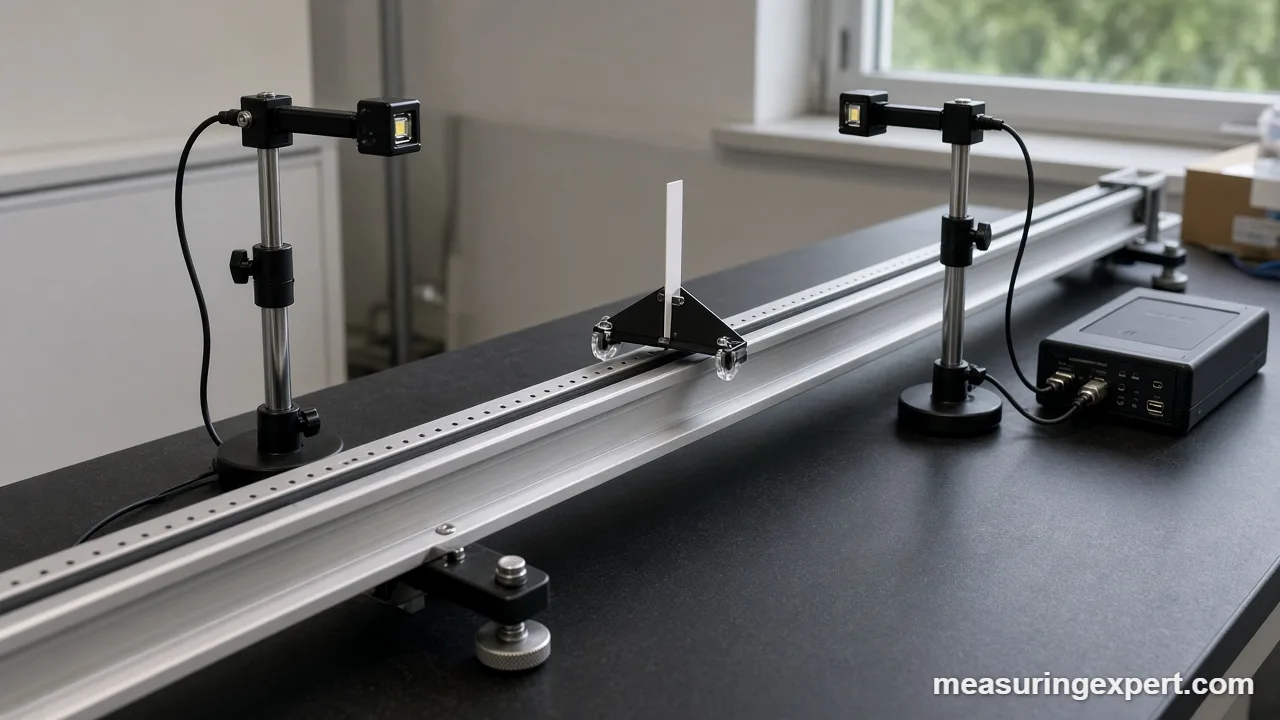
average speed = distance between gates / time between gates
For instance, gates 50.0 cm apart and a time of 0.625 s give 0.500 m / 0.625 s = 0.80 m/s. This method suits longer runs, falling objects, and anything that has no room for a card. However, keep in mind that it gives the average over the whole gap. If the object speeds up between the gates, the reading will not match the speed at either gate.
Measure the separation from beam to beam, not from the edges of the gate housings. For example, a tape measure or meter rule laid along the track works well. Our guide on how to use an iPhone to measure speed covers a phone-based option if you have no second gate.
Method 3: Measuring Acceleration With Light Gates
To find acceleration, you need two speeds and the time between them. Then you use the familiar equation:
a = (v – u) / t
Here u is the first speed, v is the second speed, and t is the time between the two readings. There are two common setups.
- Two gates, one card. Each gate measures the card’s blocking time, so you get u at gate 1 and v at gate 2. The timer also gives the time taken to travel from gate 1 to gate 2.
- One gate, a double-segment card. The card has two solid sections with a gap between them. Each section blocks the beam in turn, so a single gate gives u and v. The time between them comes from the same timer.
Strictly, t should run from the middle of the first blocked interval to the middle of the second. Each speed is an average over its blocked interval, and that average applies best near its midpoint. Of course, many data loggers already do this. If you calculate by hand, however, using the start times instead adds a small error.
The same speeds also feed into momentum and kinetic energy work. If that is your next step, see how to use mass to find speed.
Light Gates Worked Examples
All results below were calculated from the stated readings and rounded at the end.
| Setup | Readings | Calculation | Result |
|---|---|---|---|
| One gate, 10.0 cm card | Blocked for 0.200 s | 0.100 / 0.200 | 0.50 m/s (1.8 km/h) |
| Two gates, 50.0 cm apart | 0.625 s between gates | 0.500 / 0.625 | 0.80 m/s (2.88 km/h) |
| Two gates, 10.0 cm card, gates 48.0 cm apart | Gate 1: 0.250 s; gate 2: 0.125 s; 0.80 s between | u = 0.40, v = 0.80; (0.80 – 0.40) / 0.80 | 0.50 m/s² |
| One gate, double card (two 5.0 cm segments, 5.0 cm gap) | Segment 1: 0.115 s; segment 2: 0.090 s, starting 0.215 s after segment 1 | u = 0.435, v = 0.556; t = 0.260 – 0.0575 = 0.2025 s | 0.60 m/s² |
In the third example, you can check the answer another way. The equation v^2 = u^2 + 2as gives (0.80^2 – 0.40^2) / (2 x 0.48) = 0.50 m/s^2, which matches. Similarly, the average speed of 0.48 m / 0.80 s = 0.60 m/s sits halfway between u and v, as it should for steady acceleration.
In the fourth example, the midpoint of segment 1 is at 0.0575 s and the midpoint of segment 2 is at 0.215 + 0.045 = 0.260 s. So t = 0.2025 s, and a = (0.556 – 0.435) / 0.2025, which is about 0.60 m/s^2.
How to Set Up Light Gates for a Speed Practical
- Clamp the gates. Fix each gate to a stand so the beam crosses the track at the height of the card. Make sure it cannot shift when the trolley passes.
- Connect the timer. Plug the gates into the data logger or timer and choose the right mode: one gate, two gates, or acceleration.
- Measure your lengths. Use a ruler for the card and a meter rule for the distance between beams. Then enter these values if the software asks for them.
- Test the beam. Pass a hand or the card slowly through the gap and check that the timer responds every time.
- Release the trolley the same way each run. Let it go from a marked start line without pushing, so every run starts from rest.
- Record and repeat. Write down each time or speed, run at least three trials, and discard obvious misreads before taking a mean.
- Calculate. Work out speed or acceleration with the formulas above, or enter your result in the converter at the top of this page.
Light Gates vs Stopwatch vs Ticker Timer
Light gates are not the only way to time motion in a school lab. This comparison shows where each method fits.
| Method | What it measures | Typical resolution | Main weakness |
|---|---|---|---|
| Hand stopwatch | Time between two events you see | 0.01 s display, but reaction time is roughly 0.2 s | Human reaction time dominates short events |
| Ticker timer | Dots on a paper tape at fixed intervals (often 50 per second) | 0.02 s per dot | Tape friction slows light trolleys |
| Light gate and timer | Time a beam is blocked, or time between beams | Often 1 ms or better | Gives averages over a card or gap |
| Video analysis | Position in each frame | 1/30 or 1/60 s per frame | Needs a scale in the frame and careful tracking |
Error Sources When Measuring Speed
Even good equipment gives poor results if the setup is sloppy. The table separates three ideas that students often mix up.
| Term | Meaning | Light gate example |
|---|---|---|
| Resolution | The smallest change the instrument can show | A timer that displays 0.001 s |
| Precision | How closely repeat readings agree | Three runs of 0.201, 0.199 and 0.200 s |
| Accuracy | How close the result is to the true value | A misread card length makes every run wrong by the same amount |
The common error sources are:
- Card length. A 1 mm mistake on a 100 mm card is a 1% error in every speed. This is a systematic error, so repeats will not remove it.
- Timer resolution. A 1 ms resolution on a 0.200 s reading is a 0.5% uncertainty, which is usually smaller than the card error.
- Beam alignment. If the beam clips the corner of the card or the trolley, the blocked time changes.
- Averaging. The result is an average over the card or the gap, not a speed at a single instant.
- Friction and release. A push at the start or a sticky wheel changes the motion from run to run, which shows up as poor precision.
- Stray light. Bright sunlight on the detector can stop it registering a block. Shade the gate or move it.
Do and Don’t With a Light Gate Setup
Do
- Measure the card with a ruler before you start.
- Line the beam up with the middle of the card.
- Release the trolley from the same mark each time.
- Repeat runs and take a mean.
- Record units with every value.
Don’t
- Trust a printed card length without checking it.
- Let the trolley wobble through the gate.
- Mix centimeters and meters in one calculation.
- Call a two-gate average an instantaneous speed.
- Leave the detector in direct sunlight.
Honest Limits of This Method
Light gates are excellent timers, but they only know about time. Every speed they report depends on a length you measured, so the result can never be better than your ruler and your setup. In addition, each value is an average. For a trolley that is speeding up, the single-gate reading sits close to, but not exactly at, the true speed at the gate.
The method also struggles with objects that have no clean edge, such as a rolling ball. A sphere cuts the beam along a chord that depends on its height, so the effective length is not its diameter unless the beam passes through its center. Finally, the gates only see what passes through a small gap, which rules out most outdoor or large-scale speed measurements.
When to Ask a Teacher or Technician
If the timer gives wildly different readings for identical runs, or no reading at all, ask your teacher or lab technician before taking the equipment apart. For example, faults are often a loose cable, the wrong timer mode, or a detector that needs reversing. For work where accuracy really matters, such as coursework graded on uncertainty, ask how the timer has been checked against a known reference. Above all, never open mains-powered units yourself.
Frequently Asked Questions
How do light gates measure speed?
They time how long an object blocks an infrared beam. Dividing a known length, such as the card length, by that time gives the speed.
What is the formula for speed with one light gate?
Speed equals the length of the interrupt card divided by the time the beam was blocked. For example, 0.10 m / 0.20 s = 0.50 m/s.
How do you find acceleration with light gates?
Measure two speeds, u and v, and the time t between them. Then use a = (v – u) / t. A double-segment card or two gates gives both speeds.
How do you measure the average speed of a trolley?
Set two gates a measured distance apart and record the time the trolley takes to travel between them. Average speed equals distance divided by that time.
Why are light gates more accurate than a stopwatch?
A stopwatch depends on human reaction time, roughly 0.2 s. A light gate is triggered by the beam itself and often resolves 0.001 s.
How long should the interrupt card be?
The IOP suggests about 10 or 20 cm. Shorter cards get closer to instantaneous speed, but timing errors then become a larger share of the result.
Do light gates give instantaneous speed?
No. They give an average speed over the card length or the gap between gates. With a short card, that average is close to the speed at that point.
What is a double-segment card?
It is a card with two solid sections and a gap between them. Each section blocks the beam in turn, so one gate can measure two speeds for an acceleration calculation.
Are light gates the same as photogates?
Yes. Light gate is the usual UK school term, while photogate is common in the US. Both use an emitter and a detector to time a blocked beam.
What are the main errors with light gates?
The biggest are a wrong card length, a misaligned beam, inconsistent release and friction. Timer resolution is usually a smaller source of error.
Light Gates: The Bottom Line
Light gates turn a timing problem into a length problem. One gate and a card give the speed at a point, two gates give the average speed between them, and two speeds with the time between them give acceleration. As a result, the timer is rarely the weak link; the card length, the alignment and the release usually are.
So measure your lengths carefully, repeat your runs, and remember that every reading is an average. Then, if you need the answer in km/h, mph or ft/s, the converter at the top of this page does it in one step.
3 thoughts on “How to Use Light Gates to Measure Speed and Acceleration”