

Buret vs graduated cylinder: a buret is roughly five to ten times more accurate. For example, a Class A 50 mL buret is allowed an error of only 0.05 mL, while a Class A 100 mL graduated cylinder may be off by about 0.4 mL. So use a buret for titrations and a cylinder for quick, rough measurements.
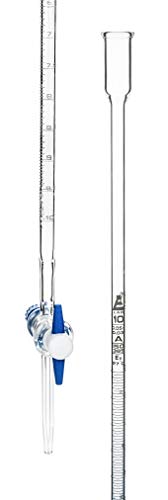
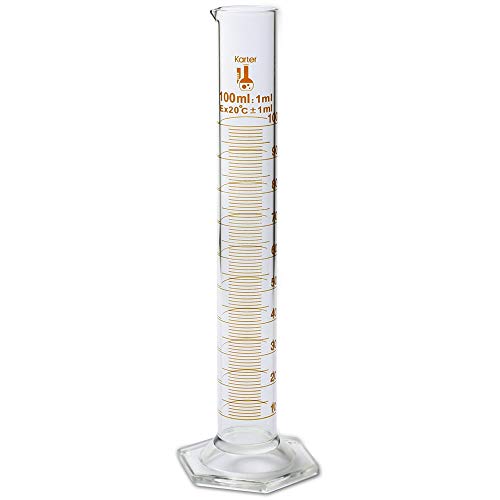
In any buret vs graduated cylinder comparison, remember that both tools are tall glass tubes with lines on the side, so they look like close cousins. However, they do different jobs. A graduated cylinder holds a liquid so you can read how much is there. A buret, by contrast, dispenses liquid through a stopcock, and you read how much has left it. That difference in design is the main reason the buret wins on accuracy.
In short: if the result of your work depends on the second decimal place, reach for a buret (or a volumetric pipette). If you only need to know “about 40 mL”, a graduated cylinder is faster and easier.
The numbers on this page come from the published glassware classes. Specifically, ASTM E287 covers laboratory glass burets and ASTM E1272 covers laboratory glass graduated cylinders. Both standards define a precision Class A and a general-purpose Class B, and Class B tolerances are twice as wide. The tolerance values themselves come from a University of Texas chemistry glassware table.
Convert a Buret or Cylinder Reading to Other Units
Lab glassware reads in milliliters, but recipes, labels and homework sometimes want ounces, teaspoons or liters. So type your reading below to convert it. The converter uses the exact US definitions (1 US fluid ounce = 29.5735295625 mL).
Key takeaways
- A Class A 50 mL buret has a tolerance of plus or minus 0.05 mL.
- A Class A 100 mL graduated cylinder has a tolerance of about plus or minus 0.4 mL.
- Class B glassware of either type is allowed twice the Class A error.
- Burets are calibrated “to deliver”; you subtract the start reading from the end reading.
- Cylinders are read once, at the bottom of the meniscus, at eye level.
- Relative error grows when you measure a small amount in a big cylinder.
- Use a buret for titration and a cylinder for preparing rough solutions.
Buret vs Graduated Cylinder Accuracy, Side by Side
The table below compares common sizes. In addition, the last column shows the error as a share of the full volume, which is the fairest way to compare tools of different sizes.
| Glassware (Class A) | Smallest marks | Tolerance | Error at full volume |
|---|---|---|---|
| 25 mL buret | 0.1 mL | +/- 0.03 mL | 0.12% |
| 50 mL buret | 0.1 mL | +/- 0.05 mL | 0.10% |
| 100 mL buret | 0.2 mL | +/- 0.10 mL | 0.10% |
| 10 mL graduated cylinder | 0.1 to 0.2 mL | +/- 0.09 mL | 0.9% |
| 25 mL graduated cylinder | 0.5 mL | +/- 0.17 mL | 0.7% |
| 50 mL graduated cylinder | 1 mL | +/- 0.25 mL | 0.5% |
| 100 mL graduated cylinder | 1 mL | +/- 0.4 mL | 0.4% |
Now take a real task: measuring 25 mL. With a 50 mL buret, the error limit is 0.05 mL, or 0.2% of 25 mL. With a 100 mL cylinder, however, the limit is 0.4 mL, which is 1.6% of 25 mL. That is eight times worse. For scale, 0.05 mL is about 0.0017 US fluid ounces, roughly one small drop, while 0.4 mL is about 0.08 of a US teaspoon.
Recommended Tools for Buret vs Graduated Cylinder Work
If you are setting up a bench for both jobs, start with one Class A buret and a small set of glass cylinders. Also, a micro buret is handy when you titrate small samples, because its finer marks cut reading error. Finally, look for borosilicate glass, clear permanent graduations and a PTFE stopcock, since PTFE needs no grease.


As an Amazon Associate, Measuring Expert earns from qualifying purchases.
Buret vs Graduated Cylinder Design: Why the Buret Wins
Three design choices explain the gap. First, a buret is long and narrow. Because the bore is small, each 0.1 mL of liquid makes the level move a visible distance, so you can estimate between the marks to about 0.01 mL. A cylinder, on the other hand, is wide, and the same 0.1 mL barely moves the surface.
Second, a buret measures a difference. You read the level before and after you open the stopcock, then subtract. As a result, any small error in where the scale starts cancels out. Third, the stopcock lets you add liquid one drop at a time near the end point, which no cylinder can do.
| Feature | Buret | Graduated cylinder |
|---|---|---|
| Main job | Dispense a measured, variable amount | Hold and measure a set amount |
| Calibration | To deliver (TD) at 20 °C | To contain (TC) or to deliver, at 20 °C |
| Scale direction | 0 at the top, numbers increase downward | 0 at the bottom, numbers increase upward |
| Reading | Two readings, then subtract | One reading |
| Setup | Ring stand and buret clamp | Stands on the bench |
| Speed | Slow; fill, clear bubbles, drain | Fast; pour and read |
| Typical use | Titration, standardizing solutions | Rough solutions, rinses, reagent volumes |
How to Read a Buret Accurately
- Rinse it with your solution. After washing, rinse the buret two or three times with small portions of the titrant so water does not dilute it.
- Fill above zero and clear the tip. Then open the stopcock briefly so the liquid pushes any air bubble out of the tip.
- Take the start reading. Put your eye level with the bottom of the meniscus and record it to two decimals, for example 0.37 mL.
- Dispense slowly. Next, swirl the flask and add titrant drop by drop as you approach the end point.
- Wait a few seconds, then read again. Let the film on the walls drain, and record the final reading, for example 24.81 mL.
- Subtract. Finally, the delivered volume is final minus start: 24.81 – 0.37 = 24.44 mL.
How to Read a Graduated Cylinder
A cylinder is simpler, but the same eye-level rule applies. First, set it on a flat, level bench. Then pour until the liquid is close to the line you want, and finish with a dropper. Next, crouch so your eye is level with the surface and read the bottom of the curved meniscus. Looking from above makes the reading look high, while looking from below makes it look low; this effect is called parallax.
Also, estimate one digit past the smallest mark. On a 100 mL cylinder with 1 mL marks, for instance, you would record 43.5 mL rather than “about 43”. Our guide on how to measure the volume of a liquid covers meniscus reading in more detail.
Buret vs Graduated Cylinder: Which One Should You Use?
Settle the buret vs graduated cylinder choice by the accuracy your result needs, not by habit. For example:
- Titrations and standardizing a solution: use a buret. The answer depends on the exact volume delivered.
- Adding a fixed volume to a reaction precisely: use a volumetric pipette. A Class A 25 mL pipette has a tolerance of plus or minus 0.03 mL.
- Making up a rough buffer, rinse or growth medium: a graduated cylinder is fine and much faster.
- Measuring the volume of a solid by displacement: a cylinder is the usual choice; see our displacement method guide.
- Roughly sizing up a liquid in a beaker: a beaker is even less accurate than a cylinder, as explained in can you measure volume with a beaker.
Similarly, match the cylinder size to the job. Because tolerance is fixed per cylinder, measuring 8 mL in a 10 mL cylinder is far more accurate than measuring 8 mL in a 100 mL one.
Buret vs Graduated Cylinder: Do and Don’t
Do
- Read the bottom of the meniscus at eye level.
- Record one digit past the smallest mark.
- Clear air bubbles from the buret tip before reading.
- Choose the smallest cylinder that holds your volume.
- Check the class marking (A or B) on the glass.
Don’t
- Blow out the last drop of a buret or cylinder.
- Read a buret from above at an angle.
- Use a 100 mL cylinder for 5 mL of liquid.
- Leave base solutions sitting in a glass stopcock.
- Dry glassware in a hot oven if you need its calibration.
Honest Limits of Buret vs Graduated Cylinder Readings
Tolerance figures describe the glass, not the person using it. In practice, reading error, drainage and temperature often matter more. For instance, a buret reading is usually good to about plus or minus 0.01 to 0.02 mL, and since you take two readings, those errors add up. Likewise, liquids that cling to glass, such as viscous oils, drain slowly and leave more behind than water does.
Temperature is the other quiet source of error. Both tools are calibrated at 20 °C (68 °F), so a warm solution takes up slightly more space and reads high. Moreover, a plastic cylinder is usually rated Class B, and scratches or old graduations make any tool harder to read. Therefore, treat the buret vs graduated cylinder numbers on this page as best-case limits for clean, undamaged Class A glassware.
When to Call a Calibration Lab
For teaching labs and home science, the class marking is enough. However, regulated work is different. If your results feed into quality control, pharmaceutical testing, environmental reporting or accredited methods, have your burets and cylinders checked by an accredited calibration lab, or buy them with individual certificates. A calibration lab weighs the water each tool delivers and converts it to volume, which shows the real error of your specific piece of glass.
Buret vs Graduated Cylinder FAQs
Is a buret more accurate than a graduated cylinder?
Yes. A Class A 50 mL buret has a tolerance of 0.05 mL, while a Class A 100 mL graduated cylinder has a tolerance of about 0.4 mL, so the buret is several times more accurate.
What is the main buret vs graduated cylinder difference?
A buret dispenses a measured amount through a stopcock and is read twice. A graduated cylinder holds a liquid and is read once at the meniscus.
Is buret the same as burette?
Yes. Buret is the usual American spelling and burette is the British spelling of the same instrument.
How many decimal places do you record for a buret?
For a 50 mL buret with 0.1 mL marks, record two decimal places, such as 23.47 mL, by estimating between the marks.
How many decimal places do you record for a graduated cylinder?
Record one digit past the smallest mark. On a 100 mL cylinder with 1 mL marks, that means one decimal place, such as 43.5 mL.
Why does a buret read from top to bottom?
Because it measures what leaves it. Zero is at the top, and the number grows as liquid drains, so the final reading minus the start reading equals the volume delivered.
Buret vs graduated cylinder: when is the cylinder the better choice?
A cylinder is faster, cheaper, sturdier and needs no stand. Use it when an error of about half a percent to a few percent does not matter.
What is the difference between Class A and Class B glassware?
Class A is the precision grade. Class B is general purpose and is allowed twice the Class A tolerance.
Is a volumetric pipette more accurate than a buret?
For one fixed volume, a Class A volumetric pipette is about as accurate as a buret. A 25 mL pipette has a tolerance of 0.03 mL, but it can only deliver that one volume.
What temperature are burets and graduated cylinders calibrated at?
Both are normally calibrated at 20 degrees C, which is 68 degrees F. Liquids at other temperatures can read slightly high or low.
The Bottom Line
To sum up, the buret vs graduated cylinder question comes down to precision versus convenience. A buret is narrow, read twice and drained through a stopcock, so a Class A 50 mL buret stays within 0.05 mL. A graduated cylinder is wide and read once, so a Class A 100 mL cylinder only promises about 0.4 mL.
So use a buret, or a volumetric pipette, whenever the exact volume decides your result, and keep the cylinder for quick everyday measuring. For more options, see our overview of tools that measure volume.
2 thoughts on “Buret vs Graduated Cylinder: Which Measures Volume More Accurately?”