
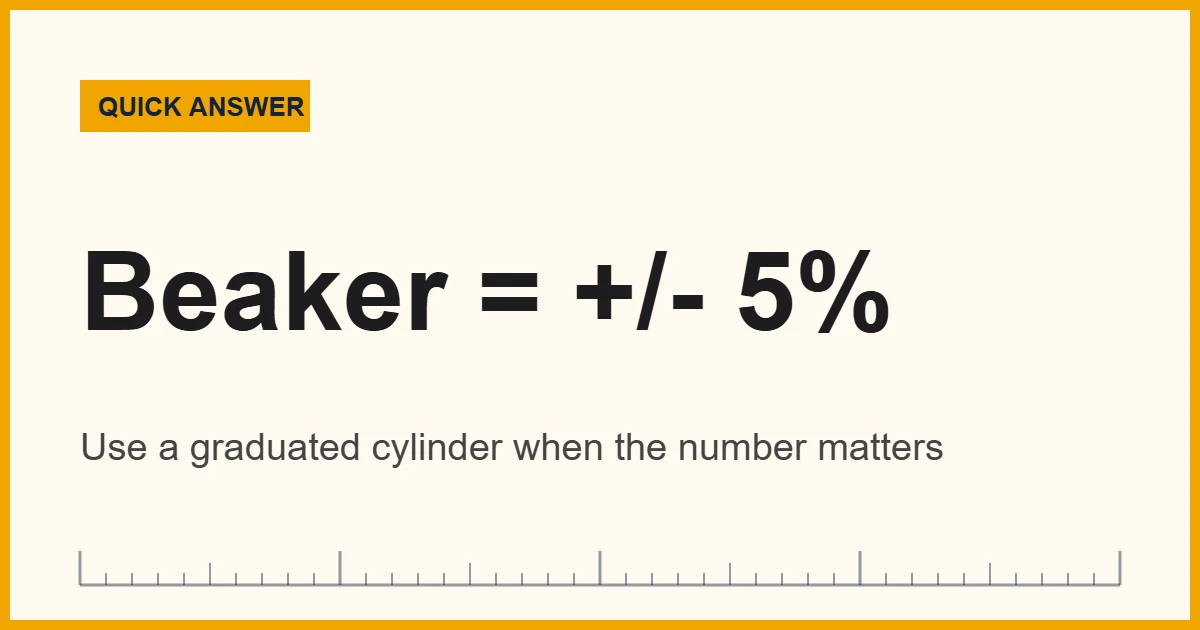
Yes, you can measure volume with a beaker, but only roughly. Beaker graduations are approximate and usually good to about plus or minus 5 percent, so a 100 mL mark could mean anywhere from 95 to 105 mL. That is fine for mixing and heating. For real measurements, however, use a graduated cylinder.
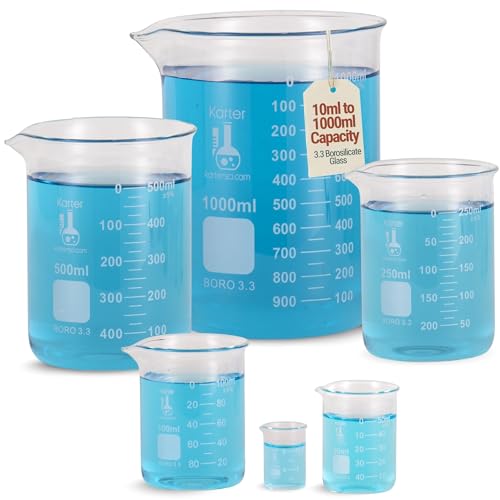
A beaker is the first piece of glassware most students pick up. Typically, it has a flat bottom, a wide mouth, a pouring spout, and a row of printed lines up the side. Those lines look like a scale, so it is natural to treat them as one.
The catch is what the lines are for. Manufacturers add them as a convenience, so you can see roughly how much liquid is in the glass. However, nobody calibrates them for accuracy. As a result, a beaker tells you “about 200 mL”, not “200.0 mL”.
In short: a beaker gives an estimate within about 5 percent, a graduated cylinder gives a measurement within about 1 percent or better, and volumetric glassware such as pipets, burets and volumetric flasks goes further still.
That 5 percent figure is not a guess. For example, the Florida State University chemistry lab guide states that the volumes printed on beakers and flasks are approximate, within about 5%. By contrast, a certified Class B plastic cylinder such as this 100 mL Nalgene cylinder lists a tolerance of plus or minus 1 mL, which is five times tighter.
Below, you will first find a quick converter for your reading. After that, the guide shows how to read a beaker properly, how big its error really is at each size, and when you need better glassware.
Convert Your Beaker Reading to Other Units
First, type the number you read off the beaker in milliliters. The converter then shows the same amount in US fluid ounces, cups, spoons and liters. Keep in mind that the result is only as good as the reading, so a beaker reading still carries its 5 percent uncertainty.
Recommended Glassware for Measuring Volume
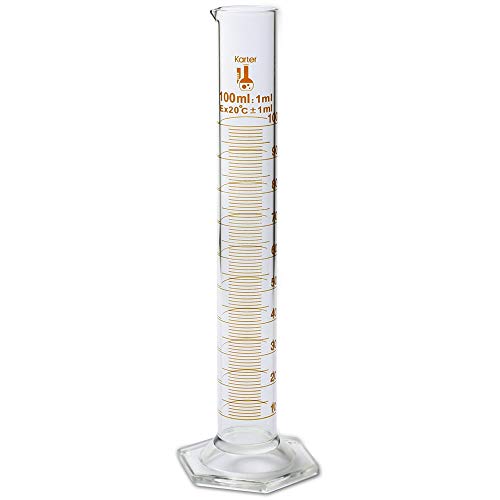
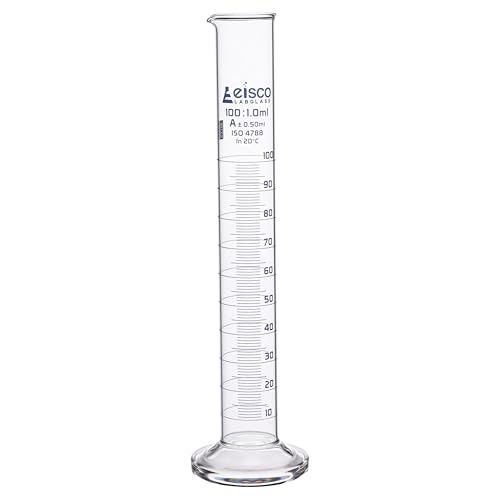
If you only own beakers, adding one or two graduated cylinders makes the biggest difference. First, choose borosilicate glass, because it handles heat and most chemicals. Next, look for a Class A or Class B rating on cylinders, since that rating means the maker states a tolerance. Also, a beaker set in several sizes lets you pick a beaker that your liquid fills well, which keeps the reading easier to see.


As an Amazon Associate, Measuring Expert earns from qualifying purchases.
- You can read a volume off a beaker, but treat it as an estimate.
- Beaker marks are approximate, typically within about 5 percent of the stated volume.
- On a 250 mL beaker, that means an error of up to about 12.5 mL.
- Always read clear liquids at the bottom of the meniscus, at eye level.
- Use a graduated cylinder when the number goes into a calculation or a report.
- Use a pipet, buret or volumetric flask for analytical work.
- A beaker is still the right tool for mixing, heating and holding liquids.
How Accurate Is Volume With a Beaker?
In general, the usual rule is plus or minus 5 percent of the marked volume. Because that error scales with size, big beakers carry big errors in milliliters. The table below shows what 5 percent means at common beaker sizes, with US customary values for comparison.
| Beaker mark | US fluid ounces | Possible error (5%) | Realistic range |
|---|---|---|---|
| 25 mL | 0.85 fl oz | 1.25 mL | 23.75 to 26.25 mL |
| 50 mL | 1.69 fl oz | 2.5 mL | 47.5 to 52.5 mL |
| 100 mL | 3.38 fl oz | 5 mL | 95 to 105 mL |
| 250 mL | 8.45 fl oz | 12.5 mL | 237.5 to 262.5 mL |
| 400 mL | 13.53 fl oz | 20 mL | 380 to 420 mL |
| 600 mL | 20.29 fl oz | 30 mL | 570 to 630 mL |
| 1000 mL | 33.81 fl oz | 50 mL | 950 to 1050 mL |
So why so loose? A beaker is wide, and a wide vessel spreads each milliliter over a large area. For example, in a beaker with a 7 cm inside diameter, one milliliter raises the liquid by only about 0.26 mm. A small misreading of the line therefore turns into several milliliters. In addition, the marks are spaced far apart, often every 25 or 50 mL, so you must guess between them.
Beaker vs Graduated Cylinder vs Volumetric Glassware
People often lump all lab glassware together. However, each piece has a different job, and the narrow ones measure far better than the wide ones. This table separates them.
| Glassware | Main job | Typical accuracy | Use it when |
|---|---|---|---|
| Beaker | Hold, mix, heat | About 5% of the mark | A rough amount is enough |
| Erlenmeyer flask | Swirl, mix, store | About 5% of the mark | Same as a beaker, with less splashing |
| Graduated cylinder (Class B) | Measure | About 1% (100 mL: +/-1 mL) | Routine measuring |
| Graduated cylinder (Class A) | Measure | Tighter; a 100 mL glass cylinder is often listed at +/-0.5 mL | Careful lab work |
| Pipet, buret, volumetric flask | Deliver or contain one exact volume | Best of the group | Titrations, standards, analysis |
For a closer look at the two measuring tools at the precise end, see our comparison of a buret and a graduated cylinder.
How to Measure Volume With a Beaker
A careful reading will not make the marks more accurate. Still, it keeps your own reading error small, so the 5 percent tolerance is the only big error left.
- Choose a beaker that your liquid will half fill or more. A small volume in a big beaker sits below the first useful mark.
- Set it on a flat, level bench. A tilted beaker gives a tilted surface, so the reading changes from side to side.
- Pour slowly and let the liquid settle. Then wait a few seconds so bubbles and ripples clear.
- Bring your eye level with the surface. Crouch down rather than looking from above, because a high angle makes the volume look larger.
- Read the bottom of the meniscus. Water curves down in the middle, so use the lowest point of that curve. For mercury or opaque liquids, read the top edge instead.
- Estimate between the nearest marks. Then record the value with a note such as “about 150 mL, beaker reading”.
If you want the same routine for cylinders and other tools, our guide on how to measure the volume of a liquid walks through each one.
Finding Volume With a Beaker That Has No Marks
Some beakers have no graduations at all, and some have marks that have worn off. In that case, you have two good options.
First, you can calculate. A beaker is close to a cylinder, so the volume of liquid is pi times the radius squared times the liquid height. For instance, with a 7.0 cm inside diameter and a 4.0 cm liquid depth, the volume is 3.1416 x 3.5 x 3.5 x 4.0 = 153.9 cubic centimeters, or about 154 mL (5.2 US fl oz). In inches, that same beaker is about 2.76 in across with liquid 1.57 in deep, giving 9.39 cubic inches. Because 1 cubic centimeter equals 1 mL, no further conversion is needed.
Second, you can weigh. Tare the empty beaker on a kitchen or lab scale, add water, and read the mass. Water at room temperature has a density close to 1 g per mL, so 150 g of water is close to 150 mL. As a result, a scale often beats the printed marks.
Measuring a Solid’s Volume With a Beaker
You can also find the volume of a small object by displacement. Pour in some water, read the level, drop the object in, and read again. Finally, the difference is the object’s volume.
The problem is the size of that difference. Suppose the water rises from 200 to 235 mL. In that case, the object displaced 35 mL. However, each reading on a 250 mL beaker could be off by 10 mL or more. That error is large next to a 35 mL change. In other words, a beaker works for a quick classroom demo, but a graduated cylinder gives a far better answer. Our page on finding the volume of an irregular object covers the full method.
Do and Don’t for Volume With a Beaker
Do
- Read at eye level, at the bottom of the meniscus.
- Pick a beaker the liquid fills well.
- Write “approximate” next to beaker readings.
- Switch to a cylinder for any number you will calculate with.
- Check a beaker against a cylinder once, so you know its bias.
Don’t
- Report a beaker reading to a decimal place.
- Measure a few milliliters in a large beaker.
- Read from above or below the surface.
- Read hot liquids and expect room-temperature volumes.
- Use a beaker for medicine doses or titrations.
Honest Limits
The 5 percent figure is a typical value, not a promise. For instance, some brands do better, and cheap beakers can do worse. Also, the tolerance says nothing about your own reading error, which adds on top. Temperature matters too, because liquids expand when warm, so 100 mL of hot water shrinks a little as it cools. Finally, the converter on this page only changes units. It cannot make a beaker reading more precise than the beaker itself.
When to Call a Professional
For home projects and school labs, a beaker reading is usually fine. In contrast, regulated work needs calibrated tools and records. For example, that includes pharmacy compounding, food or water testing for compliance, and any lab that reports results to a client. In those cases, use certified volumetric glassware and, if needed, send it to an accredited calibration lab. For medicine at home, use the dosing syringe or cup that comes with the product.
Frequently Asked Questions
Can you measure volume with a beaker accurately?
Not accurately. A beaker gives an estimate within about 5 percent. For accurate work, use a graduated cylinder, pipet or buret.
Why are beakers not accurate?
Beakers are wide, and their marks are approximate and far apart. A small reading error therefore becomes several milliliters.
Is a graduated cylinder more accurate than a beaker?
Yes. A Class B 100 mL cylinder is typically good to about 1 mL, while a 100 mL beaker mark can be off by about 5 mL.
How do you read volume with a beaker?
Set the beaker on a level surface, bring your eye level with the liquid, and read the bottom of the meniscus between the nearest marks.
What is the meniscus?
The meniscus is the curved surface of a liquid in glass. Water curves down in the middle, so you read its lowest point.
How do you find volume with a beaker that has no marks?
Measure the inside diameter and the liquid depth, then use pi times radius squared times height. Alternatively, weigh water and use 1 g per mL.
How many fluid ounces is a 250 mL beaker?
A 250 mL beaker holds about 8.45 US fluid ounces at its top mark, or about 1.06 US cups.
Can you use a beaker to measure the volume of a solid?
Yes, by displacement, but the error is large. A graduated cylinder gives a much better result for small objects.
Are plastic beakers less accurate than glass beakers?
Usually they are about the same. Both carry approximate marks, so treat either one as an estimate.
When should you use a beaker instead of a cylinder?
Use a beaker to mix, heat, dissolve or hold liquids, and when a rough amount is all you need.
Bottom Line
You can measure volume with a beaker, as long as you treat the result as an estimate within about 5 percent. Read it at eye level, at the bottom of the meniscus, and pick a beaker that the liquid fills well.
Whenever the number matters, however, pour the liquid into a graduated cylinder or use volumetric glassware. That way, the beaker does what it does best, which is holding, mixing and heating, and the measuring tools do the measuring.
3 thoughts on “Can You Measure Volume With a Beaker? Yes, to About 5 Percent”