

Volume lab equipment ranges from rough to exact. Beakers and flasks give estimates, graduated cylinders measure to about 0.5 percent, and burets, volumetric pipettes and volumetric flasks reach about 0.1 to 0.2 percent. For tiny amounts, labs also use micropipettes set in microliters (uL). All of them read in milliliters (mL).
Every lab measures liquid volume. However, no single tool does every job well. So the real question is not only which tool measures volume. Instead, it is which tool gives the accuracy your task needs. For example, a beaker is fine for mixing a rinse solution. However, it is the wrong choice for a titration or a standard solution.
In practice, the six tools below cover almost every lab task. First come the containers that hold and estimate liquid. Next come the cylinders that measure it reasonably well. Finally come the precision tools that deliver or contain an exact amount.
In short: use a beaker or flask to hold liquid, a graduated cylinder to measure it roughly, and a buret, pipette or volumetric flask when the number has to be right.
Also, all of these tools share one unit. According to the National Institute of Standards and Technology (NIST), the liter is a special name for the cubic decimeter, and the milliliter equals exactly one cubic centimeter. As a result, 1 mL and 1 cc are the same volume, and 1,000 mL make 1 L (about 33.81 US fluid ounces).
Convert Lab Volumes to Everyday Units
Lab glassware reads in milliliters, while many recipes and data sheets use US units. Simply enter any amount below, and then the converter will also show liters, cubic centimeters, fluid ounces and spoon equivalents. Note that this is a unit converter, so it does not account for temperature or tool tolerance.
Recommended Volume Lab Equipment for Home and School Labs
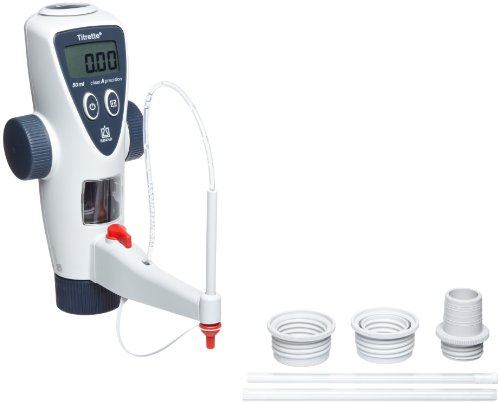
For a small teaching or hobby lab, start with one Class A graduated cylinder and a Class A buret. After that, add a volumetric flask set and a few transfer pipettes if you prepare solutions. Also, look for borosilicate 3.3 glass, permanent graduations and a printed tolerance. In addition, the picks below are based on manufacturer specs and buyer reports.


As an Amazon Associate, Measuring Expert earns from qualifying purchases.
Key Takeaways
- Beakers and Erlenmeyer flasks hold liquid; their marks are only estimates.
- A Class A 100 mL graduated cylinder is good to about 0.5 mL.
- Class A burets, such as a 50 mL buret, deliver within about 0.05 mL.
- Volumetric pipettes deliver one fixed volume, for example 10 mL within 0.02 mL.
- Volumetric flasks contain one fixed volume; a 100 mL Class A flask is within 0.08 mL.
- Micropipettes handle microliters, where 1,000 uL equals 1 mL.
- Read every scale at eye level, at the bottom of the meniscus.
The Six Main Pieces of Volume Lab Equipment
Each tool below solves a different problem. So it helps to know what each one is built for before you pick it up.
Beakers: Holding and Rough Estimates
First, a beaker is a straight-sided cup with a pouring spout. Contrary to a common myth, most beakers do carry graduations. Still, those marks are approximate, often around 5 percent, so a 100 mL mark may sit a few milliliters off. Use beakers to mix, heat and hold liquids, not to measure them. For a closer look, see our guide on how to measure volume with a beaker.
Erlenmeyer Flasks: Swirling Without Spills
An Erlenmeyer flask has a cone shape and a narrow neck. Because the neck limits splashing, it is the classic vessel for titrations and for swirling mixtures. Like a beaker, though, its printed marks are only rough guides.
Graduated Cylinders: Everyday Measuring
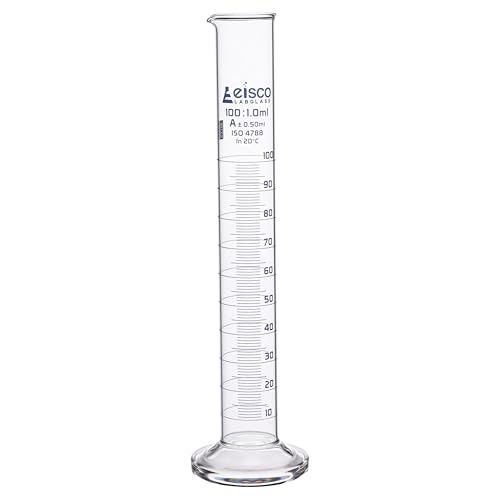
A graduated cylinder is tall and narrow, with fine marks along its side. That narrow shape spreads each milliliter over more height, so you can read it far better than a beaker. For example, one Class A 100 mL cylinder lists a tolerance of plus or minus 0.5 mL with 1 mL divisions. In other words, it is the default choice for general measuring.
Burets: Variable, Precise Delivery
A buret (also spelled burette) is a long graduated tube with a stopcock at the bottom. You read the level before and after, and the difference is the volume you delivered. Therefore, it shines in titrations, where you add liquid drop by drop until a color change. Our comparison of the buret vs graduated cylinder explains when each one wins.
Volumetric Pipettes: One Exact Volume
A volumetric (transfer) pipette has a bulb in the middle and a single ring on its stem. As a rule, it delivers exactly one volume, such as 10 mL or 25 mL. Meanwhile, graduated (Mohr or serological) pipettes have a full scale, so they offer flexibility at the cost of some accuracy.
Volumetric Flasks: Making Exact Solutions
A volumetric flask has a round body, a long thin neck and one etched line. First you dissolve a sample, then you fill to the line, so the flask contains a known total volume. As a result, it is the standard tool for preparing solutions of known concentration.
Micropipettes: Microliter Work
A micropipette is a handheld, adjustable piston pipette with disposable tips. Biology and chemistry labs use it for volumes from about 0.1 uL up to 10 mL. Because 1 uL is one thousandth of a milliliter, even small handling errors matter here.
Volume Lab Equipment Accuracy Compared
The table lists typical Class A tolerances. By comparison, Class B glassware usually allows about twice the error. The pipette, buret and cylinder values follow a University of Texas chemistry handout, and the flask values follow ASTM E288 as listed by glassware makers. Your own cylinder may differ, so check the tolerance printed on the glass.
| Tool (size) | Typical tolerance | As a percent | Best use |
|---|---|---|---|
| Beaker (100 mL) | about 5 mL | about 5% | Mixing, heating, holding |
| Graduated cylinder, Class A (100 mL) | 0.4 to 0.6 mL | about 0.5% | General measuring |
| Buret, Class A (50 mL) | 0.05 mL | 0.1% | Titrations |
| Volumetric pipette, Class A (10 mL) | 0.02 mL | 0.2% | Transferring one exact volume |
| Volumetric flask, Class A (100 mL) | 0.08 mL | 0.08% | Preparing standard solutions |
| Micropipette (1,000 uL setting) | 8 uL (ISO 8655 limit) | 0.8% | Microliter volumes |
To Deliver vs To Contain on Volume Lab Equipment
People often confuse two markings that look similar but mean opposite things. TD means “to deliver”: the tool pours out the stated volume, and a thin film stays behind. TC means “to contain”: the tool holds the stated volume, but pouring it out leaves some behind.
| Marking | Meaning | Typical tools | What to do |
|---|---|---|---|
| TD (to deliver) | Delivers the stated volume | Burets, volumetric pipettes, most cylinders | Drain normally; do not blow out the last drop unless marked “blow out” |
| TC (to contain) | Holds the stated volume | Volumetric flasks | Make up the solution in the flask itself |
| 20 °C | Calibration temperature | Most Class A glassware | Measure near room temperature for best results |
Similarly, accuracy, precision and resolution are not the same. For instance, accuracy is how close a reading sits to the true value. Precision, on the other hand, is how closely repeated readings agree. Resolution, by contrast, is the smallest division you can read.
How to Read a Meniscus on Volume Lab Equipment
Water curves down inside narrow glass and forms a meniscus. These steps work for cylinders, burets and pipettes:
- Set the tool on a level surface. A tilted cylinder or buret gives a false reading.
- Bring your eye level with the liquid. Looking from above or below causes parallax error.
- Find the bottom of the curve. For water and most solutions, read the lowest point of the meniscus.
- Hold a white card behind it. A card with a dark stripe makes the curve stand out clearly.
- Estimate one more digit. On a buret with 0.1 mL marks, read to 0.01 mL, for example 23.46 mL.
- Record the value right away. Then write the unit (mL) next to it so nothing gets lost.
How to Choose Volume Lab Equipment for the Job
First, start with the accuracy your result needs. Then pick the smallest tool that holds the full volume. This short guide covers common tasks:
- Rinsing, heating or mixing: a beaker or Erlenmeyer flask.
- Measuring a reagent for a reaction: a graduated cylinder sized close to the volume.
- A titration: a 25 mL or 50 mL Class A buret.
- Transferring an aliquot: a volumetric pipette of that exact size.
- Making a standard solution: a volumetric flask.
- DNA, enzyme or cell work: an adjustable micropipette.
Meanwhile, solids and gases need other methods. For an odd-shaped solid, you can drop it into a cylinder and read the rise in water level, as our guide to the volume of an irregular object shows. For gases, labs use gas syringes or inverted cylinders, covered in how to measure volume of gas.
Do and Don’t With Lab Volume Tools
Do
- Rinse a buret or pipette with the solution first.
- Read at eye level, at the bottom of the meniscus.
- Choose a tool close in size to your volume.
- Check the class and tolerance printed on the glass.
- Let warm liquids cool before measuring.
Don’t
- Measure exact volumes with a beaker.
- Heat a volumetric flask or graduated cylinder.
- Pipette by mouth; always use a bulb or pump.
- Leave an air bubble in the buret tip.
- Blow out a TD pipette unless it says to.
Honest Limits of Volume Measurements
Printed tolerances describe new, clean glassware at 20 degrees C. In practice, real results drift for several reasons. For example, water expands slightly as it warms, so a hot liquid reads high. Moreover, greasy glass leaves droplets behind, and a rushed drain leaves extra film inside a pipette. Plastic cylinders also tend to be less accurate than glass ones. Finally, each reading carries your own judgment of the meniscus. In short, the tool sets the best case, and technique decides how close you get to it.
When to Call a Professional
For classroom or hobby work, the tolerance on the glass is usually enough. However, regulated labs, pharmacies and quality-control teams often need traceable results. In that case, send glassware and micropipettes to an accredited calibration lab. Typically, they test by weighing water and correcting for temperature, and then they issue a certificate. Also, follow your lab’s own procedures and your instructor’s directions.
Frequently Asked Questions
What volume lab equipment is the most accurate?
For a single fixed volume, a Class A volumetric flask or volumetric pipette is the most accurate common tool. For a variable volume, a Class A buret is best.
Can a beaker measure volume?
Yes, but only roughly. Beaker marks are approximate, often around 5 percent, so use a graduated cylinder when the number matters.
Which volume lab equipment works best for titrations?
A buret works best, because it delivers a variable volume precisely. A Class A 50 mL buret is good to about 0.05 mL.
What is the difference between a pipette and a micropipette?
A glass pipette moves milliliters, while a micropipette is an adjustable piston tool for microliters. One milliliter equals 1,000 microliters.
Is 1 mL the same as 1 cc?
Yes. One milliliter equals exactly one cubic centimeter, so labs and medicine use the two terms for the same volume.
Why do graduated cylinders read from the bottom of the meniscus?
Water clings to glass and curves down in the middle. Makers calibrate the marks for a reading at the lowest point of that curve.
What does Class A mean on volume lab equipment?
Class A is the tighter tolerance grade under ASTM standards. Class B glassware usually allows about twice the error.
What do TD and TC mean on lab glassware?
TD means to deliver, so the tool pours out the stated volume. TC means to contain, so it holds the stated volume.
How do you measure the volume of a solid in the lab?
Partly fill a graduated cylinder with water and read it. Then add the solid and read again. The difference is the solid’s volume.
How many US fluid ounces are in 100 mL?
There are about 3.38 US fluid ounces in 100 mL, since 1 US fluid ounce equals 29.57 mL.
The Bottom Line on Volume Lab Equipment
Volume lab equipment comes in two groups. Beakers and Erlenmeyer flasks hold and estimate liquid. By contrast, graduated cylinders, burets, pipettes, volumetric flasks and micropipettes measure it, each at a different level of precision.
So match the tool to the task, choose the smallest one that holds your volume, and read the meniscus at eye level. Finally, when a result must be traceable, rely on Class A glassware and a calibration certificate.
1 thought on “What Lab Equipment Is Used to Measure Volume? 6 Tools Compared”