

Volume in chemistry comes in liters (L), milliliters (mL) and cubic centimeters (cm3), and 1 mL equals exactly 1 cm3. For liquids, chemists read the bottom of the meniscus in calibrated glassware: a volumetric pipet or buret for precise work, and a graduated cylinder or beaker for rough amounts.
Chemistry runs on amounts. A recipe for a solution, a titration or a gas law problem only works when the volumes are right. However, not every container in a lab measures volume equally well. A beaker and a pipet can both say “25 mL” on the side, yet one can be off by more than a milliliter while the other stays within a few hundredths.
In short: pick the unit, pick the right glassware for the accuracy you need, and read it the same careful way every time. With liquids, that means reading at eye level at the bottom of the curve. Solids, meanwhile, need a formula or water displacement. For gases, you measure the space the gas fills and then correct for temperature and pressure.
The US National Institute of Standards and Technology (NIST) explains on its SI units for volume page that the cubic meter is the SI unit of volume. It also names the liter as a special name for the cubic decimeter, and the milliliter as a special name for the cubic centimeter. As a result, a reading of 25.0 mL is the same as 25.0 cm3.
Below you will find a converter, a glassware accuracy table, a step-by-step reading method, and the errors that most often spoil lab results.
Convert a Lab Volume From mL to Liters, cm3 and Fluid Ounces
Enter a volume in milliliters to see it in liters, cubic centimeters, US fluid ounces, cups and gallons. For example, a 250 mL beaker holds about 8.45 US fluid ounces when full to its top mark.
The math behind it is simple. One US fluid ounce is exactly 29.5735295625 mL, so 250 / 29.5735 = 8.454 fl oz.
Recommended Tools for Measuring Volume in Chemistry
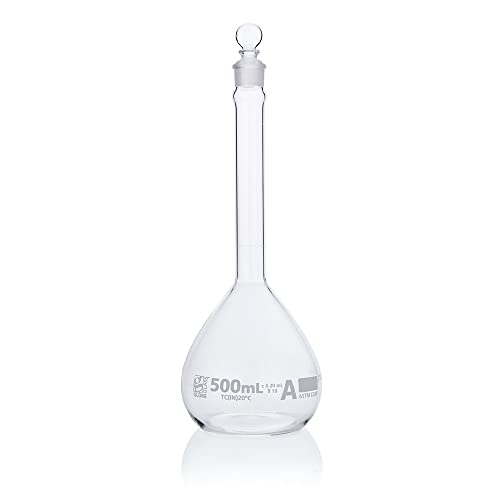
A basic home or classroom kit needs only a few pieces. First, a set of graduated cylinders covers everyday measuring. Next, volumetric flasks let you make solutions of known concentration. Finally, pipets and a buret handle the small, exact amounts that titrations need. For a deeper look at each item, see our guide to lab equipment used to measure volume.


As an Amazon Associate, Measuring Expert earns from qualifying purchases.
- Chemists report liquid volume in mL or L, and 1 mL is exactly 1 cm3.
- Volumetric pipets, burets and flasks give the best accuracy.
- Graduated cylinders suit routine amounts, while beakers give only rough estimates.
- Always read the bottom of a water meniscus with your eye level to the line.
- Glassware is usually calibrated at 20 degrees C, so temperature matters.
- Gas volumes change with temperature and pressure, so always state both.
- Solids need a formula or water displacement instead of glassware marks.
Units Used for Volume in Chemistry
Most lab work uses just three units. Milliliters cover the amounts you pour and pipet. Liters cover stock bottles and solution concentrations, because molarity means moles per liter. Cubic centimeters show up in older textbooks and in density problems, and they equal milliliters exactly.
| Unit | Symbol | Equals | Typical use in the lab |
|---|---|---|---|
| Microliter | µL | 0.001 mL | Micropipets, biochemistry |
| Milliliter | mL | 1 cm3 = 0.001 L | Pipets, burets, cylinders |
| Cubic centimeter | cm3 (cc) | 1 mL | Density of solids, older texts |
| Liter | L | 1,000 mL = 1 dm3 | Molarity, stock solutions |
| Cubic meter | m3 | 1,000 L | SI base for volume, industrial tanks |
For US readers, 1 liter is about 33.81 US fluid ounces, and 1 US gallon is exactly 3.785411784 liters. Still, chemistry almost never uses US units, so do your lab math in metric and convert at the end if you must.
Glassware for Volume in Chemistry, Ranked by Accuracy
Every piece of glassware has a tolerance, which is how far the true volume may sit from the marked line. Under ASTM and ISO standards, Class A glassware meets the tightest limits. Class B pieces, by contrast, are allowed roughly twice the error. The table compares common pieces in Class A form.
| Glassware | Typical size | Class A tolerance | Best for |
|---|---|---|---|
| Volumetric pipet | 25 mL | ±0.03 mL | One exact volume, delivered |
| Buret | 50 mL | ±0.05 mL | Titrations, variable volumes |
| Volumetric flask | 100 mL | ±0.08 mL | Making solutions of known concentration |
| Graduated cylinder | 100 mL | about ±0.5 to 1 mL, by standard | Routine measuring |
| Beaker or Erlenmeyer flask | 250 mL | No class; marks are often about 5% off | Mixing, heating, rough amounts |
So, the shape tells you a lot. Narrow necks and single marks mean high accuracy, because a small volume change moves the liquid level a long way. Wide containers with many marks, on the other hand, trade accuracy for convenience. If you need help choosing, our article on the most accurate volume measurement tool compares them in more detail.
Burets vs Graduated Cylinders for Volume in Chemistry
Both read variable amounts, but they serve different jobs. A buret delivers liquid drop by drop through a stopcock, and you read it to two decimal places. A cylinder, meanwhile, is faster and fine for amounts where 1% does not matter. Our buret vs graduated cylinder comparison covers how each one reads and when to choose it.
To Contain vs To Deliver: A Detail That Changes Volume in Chemistry
Look closely at a pipet or flask and you will find “TC” or “TD” printed near the top. The two labels sound similar, yet they mean different things.
| Label | Meaning | Common examples | What to do |
|---|---|---|---|
| TC (to contain) | Holds the stated volume when filled to the mark | Volumetric flasks, some cylinders | Fill to the line; the film left behind does not matter |
| TD (to deliver) | Pours out the stated volume; a thin film stays behind | Volumetric pipets, burets, most cylinders | Let it drain; do not blow out the last drop unless marked |
For example, a 25 mL TD pipet holds slightly more than 25 mL. The extra film clings to the glass, so the amount that leaves the tip is the 25 mL you need. Blowing out that last drop, therefore, adds error instead of removing it.
How to Measure Volume in Chemistry, Step by Step
The same method works for cylinders, burets and pipets. The steps below assume a clear liquid such as water or a dilute solution.
- Choose the right glassware. Match the tool to the accuracy you need, and pick a size close to your volume.
- Check that it is clean. Water should drain in an even film, not beads, because beads mean grease that traps liquid.
- Rinse with your solution. Rinse pipets and burets twice with a small amount of the liquid you will measure, then discard it.
- Fill above the mark. Next, let the level fall slowly until the meniscus bottom touches the line.
- Get your eye level with the line. Crouch or lift the glassware so the line looks flat, which avoids parallax error.
- Read the bottom of the meniscus. Estimate one digit past the smallest marking, such as 24.37 mL on a 50 mL buret.
- Record the reading at once. Then write the unit and note the temperature if the work is precise.
Reading the Meniscus Correctly
Water and most aqueous solutions curve downward in glass, because they cling to the walls. So you read the lowest point of that curve. Mercury and a few dark liquids are different, and they need a reading at the top of the curve. Also, for deeply colored solutions such as potassium permanganate, many chemists read the top edge because the bottom is hard to see. In that case, read every value the same way so the error cancels out.
Measuring Volume in Chemistry for Solids and Gases
Glassware marks only work for liquids. Solids and gases, however, need their own approaches.
Solids
For a regular shape, measure its dimensions and use a formula. A cube with 2.00 cm edges, for instance, fills 8.00 cm3, which equals 8.00 mL. For an irregular solid, use water displacement instead. Fill a graduated cylinder partway, record the level, lower the object in, and read the new level. The difference is the volume of the object, and that number helps you find density as mass divided by volume.
Gases
A gas fills whatever container holds it, so its volume depends on temperature and pressure. In the lab, you can collect a gas in an upturned cylinder over water, or in a gas syringe. After that, the ideal gas law (PV = nRT) lets you correct the reading to standard conditions. For example, one mole of an ideal gas fills about 22.41 L at 0 degrees C and 1 atm. At 0 degrees C and 100 kPa, the current IUPAC standard, it fills about 22.71 L instead. As a result, always state which standard you used.
Common Errors When Measuring Volume in Chemistry
Most bad readings come from a short list of habits. Fortunately, each one is easy to fix.
- Parallax: reading from above or below the line shifts the value. Instead, put your eye level with the meniscus.
- Air bubbles: a bubble in a buret tip throws off the first reading. So, run a little liquid through the stopcock first.
- Temperature: liquids expand when warm. Glassware calibration normally assumes 20 degrees C, so let hot solutions cool before you read them.
- Wrong tool: using a beaker where a pipet belongs can add an error of several percent.
- Dirty glass: droplets left on greasy walls mean less liquid comes out than the scale shows.
Pressure, by comparison, hardly affects liquids. Water barely compresses under normal lab conditions, so pressure matters mainly for gases.
Do and Don’t
Do
- Pick Class A glassware for anything that feeds a calculation.
- Read at eye level, at the bottom of a water meniscus.
- Rinse pipets and burets with the solution first.
- Record one estimated digit past the finest mark.
Don’t
- Measure reagents with beaker or flask markings.
- Heat volumetric glassware in an oven, because heat can change its calibration.
- Blow out a TD pipet unless it is marked for blow-out.
- Mix up mL readings with grams, unless you use the liquid’s density.
Honest Limits of Volume Measurements
Even perfect technique cannot beat the tolerance printed on the glass. A 50 mL Class A buret allows plus or minus 0.05 mL, so a 25 mL delivery still carries about 0.2% uncertainty. In addition, your eye adds its own reading error of a few hundredths of a milliliter.
Temperature adds another layer. Water’s density is about 0.9982 g/mL at 20 degrees C, so 25.00 mL of water weighs about 24.96 g, not 25.00 g. That is why NIST’s procedure for gravimetric calibration of volumetric ware weighs the water and corrects for temperature and air buoyancy. It also notes that glassware is typically calibrated at 20 degrees C.
Finally, volume is the wrong choice for some jobs. When the highest accuracy matters, many analysts weigh liquids on an analytical balance and convert with density.
When to Call a Professional
For classroom work and home experiments, careful technique is enough. However, regulated labs in pharmacy, food testing or environmental work must use certified glassware or have their pipets and burets checked by an accredited calibration lab. Likewise, if a micropipette or automatic buret gives results that drift, send it for service instead of guessing.
FAQs About Volume in Chemistry
What units measure volume in chemistry?
Chemists mainly use milliliters, liters and cubic centimeters. One milliliter equals one cubic centimeter, and 1,000 mL make one liter.
What is the most accurate way to measure volume in chemistry?
A Class A volumetric pipet is the most accurate glassware for one fixed volume. A 25 mL pipet has a tolerance of about 0.03 mL.
Why do chemists read the bottom of the meniscus?
Water clings to glass, so its surface curves down in the middle. Glassware makers set the marks for a reading at the lowest point of that curve.
Is 1 mL the same as 1 cm3?
Yes. NIST defines the milliliter as a special name for the cubic centimeter, so the two are exactly equal.
Can you measure volume with a beaker?
Only roughly. Beaker marks are often about 5 percent off, so use a cylinder, pipet or buret when the number matters.
What does TD mean on a pipet?
TD means to deliver. The pipet releases its stated volume when drained, while a small film stays inside.
How is the volume of a gas measured?
Collect the gas in a gas syringe or an upturned cylinder over water, then correct the reading for temperature and pressure with the gas laws.
How do you find the volume of an irregular solid?
Use water displacement. Read a cylinder before and after you lower the object in, and subtract the two readings.
Does temperature affect volume in chemistry?
Yes. Liquids expand as they warm, and glassware is normally calibrated at 20 degrees C, so precise work notes the temperature.
What is the SI unit of volume?
The cubic meter is the SI unit of volume. The liter is a special name for the cubic decimeter, which is one thousandth of a cubic meter.
The Bottom Line
Volume in chemistry comes down to three choices: the unit, the glassware and the reading technique. For most lab work, that means milliliters, the narrowest tool that fits the job, and an eye-level reading at the bottom of the meniscus.
So, use a pipet or buret when numbers feed a calculation, a cylinder for routine amounts, and a beaker only for mixing. Then use the converter above whenever you need the same volume in liters or US units.