

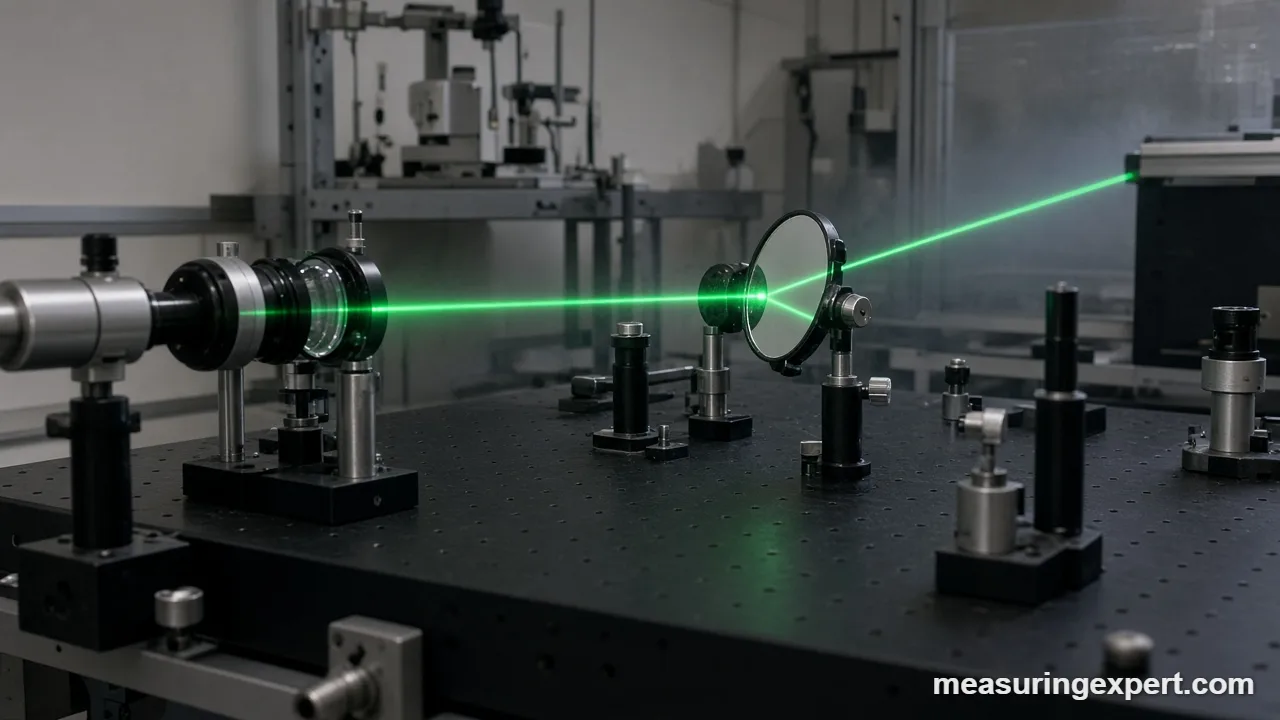
The speed of light in a vacuum is exactly 299,792,458 meters per second. That is about 299,792 km per second, 186,282 miles per second, or roughly 670.6 million mph. The value is exact because, since 1983, the meter itself has been defined by how far light travels in 1/299,792,458 of a second (NIST, BIPM).
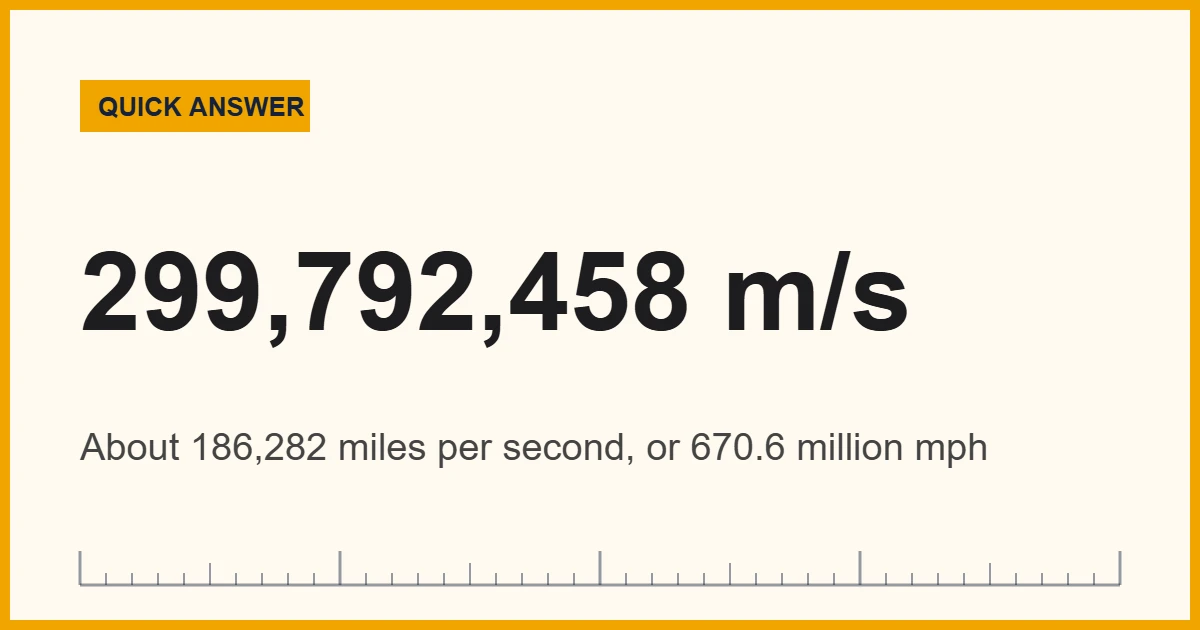
Convert the Speed of Light to Any Unit
The converter starts at 299,792,458 m/s. Then change the number or the unit, and it instantly shows the same speed in km/h, mph, feet per second and knots. You can also type a fraction of light speed, for example 29,979,245.8 m/s for 10 percent.
Light is the fastest thing in the universe, so its speed works as a cosmic speed limit. Moreover, nothing that carries mass can reach it. In fact, even radio signals, Wi-Fi and the laser in a tape measure travel at the same speed, because they are all forms of electromagnetic radiation.
Physicists write this value as a lowercase c, from the Latin word celeritas, meaning swiftness. For a long time, scientists first measured c and then refined the number. Then, in 1983, they flipped the logic. According to the NIST history of the meter, the meter became “the length of the path traveled by light in a vacuum” in a tiny fraction of a second. As a result, c is now a fixed number, and length is measured against it.
So you will not find a more precise figure than 299,792,458 m/s. Next, the sections below explain that number in everyday units, how far light travels in a second or a year, how people first measured it, and finally how you can check it in your own kitchen.
Speed of Light Conversion Chart
The first table gives the speed of light in the units people search for most. In addition, the second shows common fractions of light speed, which come up in science fiction and in particle physics. Also, all values are computed from the exact SI figure.
| Unit | Value | Rounded |
|---|---|---|
| Meters per second (m/s) | 299,792,458 | 3.00 x 10^8 m/s |
| Kilometers per second (km/s) | 299,792.458 | 300,000 km/s |
| Kilometers per hour (km/h) | 1,079,252,848.8 | 1.08 billion km/h |
| Miles per second (mi/s) | 186,282.397 | 186,000 mi/s |
| Miles per hour (mph) | 670,616,629 | 671 million mph |
| Feet per second (ft/s) | 983,571,056 | 984 million ft/s |
| Knots | 582,749,918 | 583 million knots |
| Feet per nanosecond | 0.98357 | about 1 ft/ns |
| Fraction of c | km/s | mph |
|---|---|---|
| 1 percent | 2,997.9 | 6,706,166 |
| 10 percent | 29,979.2 | 67,061,663 |
| 25 percent | 74,948.1 | 167,654,157 |
| 50 percent | 149,896.2 | 335,308,315 |
| 90 percent | 269,813.2 | 603,554,966 |
| 99 percent | 296,794.5 | 663,910,463 |
Printable tip: print this page or save it as a PDF, and the two tables fit on one sheet.
Recommended Tools That Measure With Light
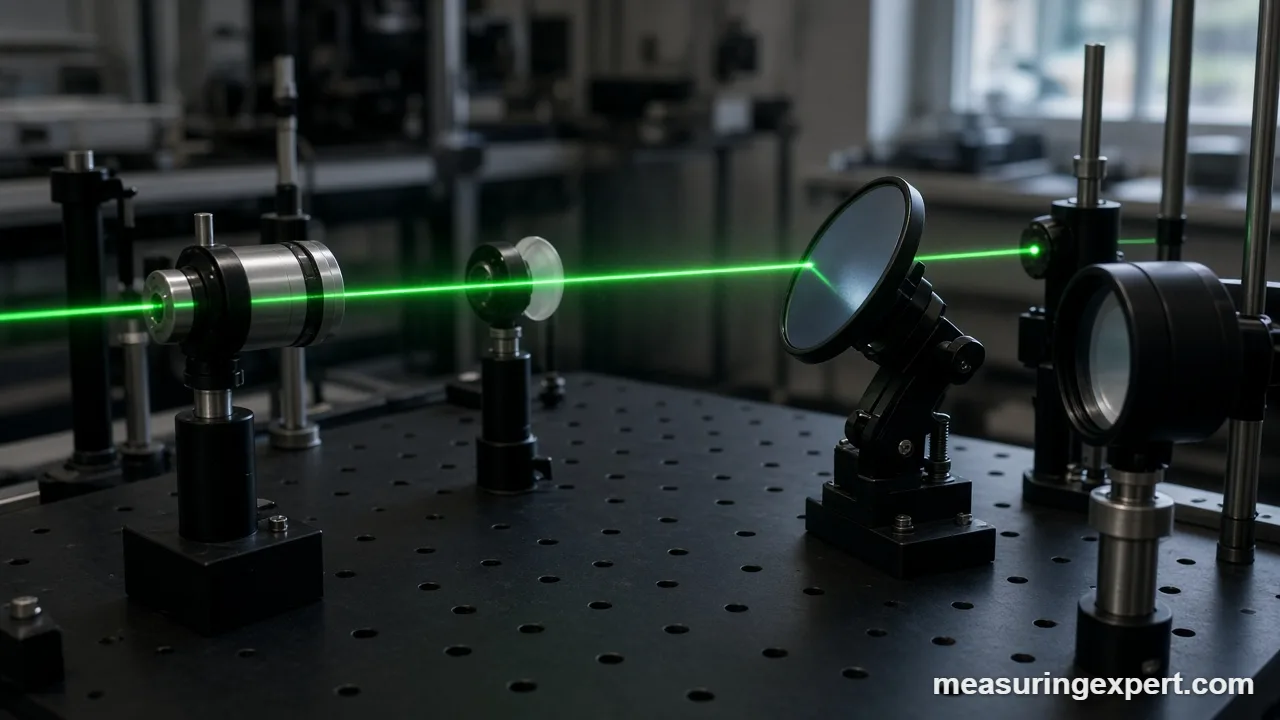
You rely on light speed every time you aim a laser measure. First, the tool sends a short pulse or a modulated beam to a wall, times the reflection, and then divides by two. Because light covers about 30 cm (11.8 inches) per nanosecond, the electronics must resolve tiny fractions of a second. In general, laser distance measurers suit rooms and job sites, while laser rangefinders suit golf, hunting and surveying at longer range.

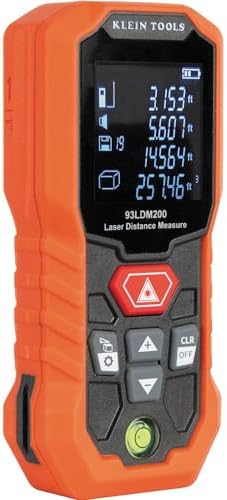


As an Amazon Associate, Measuring Expert earns from qualifying purchases.
How Far the Speed of Light Carries You
Of course, big numbers are hard to picture. Instead, it helps to ask how long light needs to cross familiar distances. For example, light could circle Earth’s equator about 7.5 times in one second.
| Trip | Distance | Light travel time |
|---|---|---|
| One foot (about) | 30 cm | about 1 nanosecond |
| New York to Los Angeles (straight line) | about 3,944 km (2,451 mi) | about 13 milliseconds |
| Around the equator | 40,075 km (24,901 mi) | about 0.13 seconds |
| Earth to the Moon (average) | 384,400 km (238,855 mi) | about 1.28 seconds |
| Sun to Earth (1 astronomical unit) | 149,597,870.7 km (92.96 million mi) | about 8 minutes 19 seconds |
| Earth to Mars | about 55 to 401 million km | about 3 to 22 minutes |
| To Proxima Centauri | about 4.2 light-years | about 4.2 years |
NASA’s Basics of Space Flight guide uses the same idea. For instance, it lists light travel times across the solar system, from about 8.3 minutes for the Sun to hours for distant spacecraft. That delay is also why mission teams cannot steer a Mars rover in real time.
How the Speed of Light Was Measured
At first, many thinkers assumed light arrived instantly. Then, in 1676, the Danish astronomer Ole Romer noticed that eclipses of Jupiter’s moon Io came early or late depending on Earth’s distance from Jupiter. As a result, he concluded that light needed time to cross space. His estimate was rough. Even so, it proved that light has a finite speed.
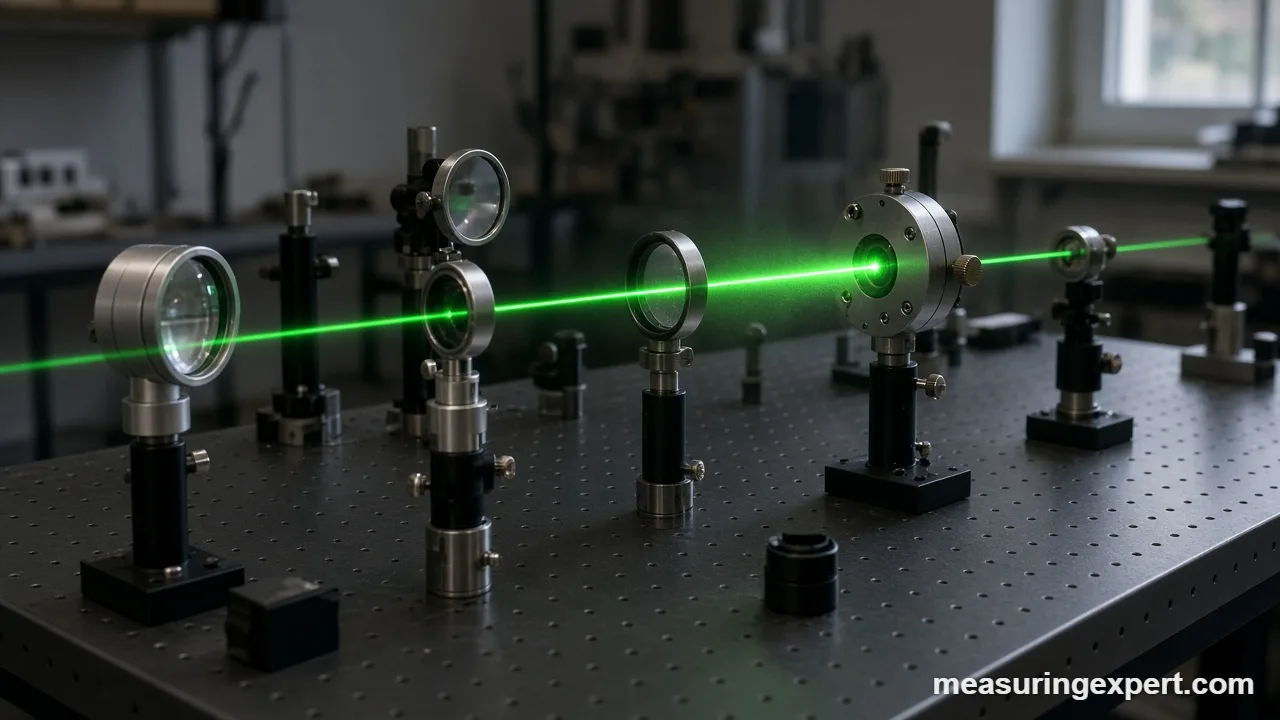
Later, experimenters brought the measurement down to Earth. First, in 1849, Hippolyte Fizeau sent a beam through a spinning toothed wheel to a distant mirror and back. Next, Leon Foucault used a fast rotating mirror in 1862 and came close to the modern value. After that, Albert Michelson refined the rotating mirror method for decades.
Still, the biggest jump came with lasers. In 1972, a NIST team in Boulder measured the frequency and wavelength of a stabilized laser. Specifically, their result, 299,792,456.2 m/s with an uncertainty of 1.1 m/s, was about a hundred times more accurate than earlier work. Soon after, c was fixed by definition.
| Year | Who | Method | What it showed |
|---|---|---|---|
| 1676 | Ole Romer | Timing of Io’s eclipses | Light has a finite speed |
| 1849 | Hippolyte Fizeau | Toothed wheel and mirror | First Earth-based measurement |
| 1862 | Leon Foucault | Rotating mirror | Close to the modern figure |
| 1972 | NIST (Evenson and colleagues) | Laser frequency and wavelength | 299,792,456.2 m/s, plus or minus 1.1 m/s |
| 1983 | General Conference on Weights and Measures | Definition of the meter | c fixed at exactly 299,792,458 m/s |
Consequently, the BIPM definition of the metre still rests on that fixed number today. In other words, scientists no longer measure c. Instead, they use c to realize the meter.
Speed of Light in a Vacuum vs Water, Glass and Air
Above all, the famous number applies to a perfect vacuum. Light slows down inside any material, however, because it interacts with the atoms along the way. Generally, physicists describe this slowdown with the refractive index, n. Therefore, to find the speed in a material, divide c by n.
| Medium | Refractive index (about) | Light speed (about) |
|---|---|---|
| Vacuum | 1 (exact) | 299,792 km/s |
| Air at sea level | 1.0003 | 299,705 km/s |
| Water | 1.33 | 225,000 km/s |
| Optical fiber glass | 1.47 | 204,000 km/s |
| Window glass | 1.5 | 200,000 km/s |
| Diamond | 2.42 | 124,000 km/s |
People also mix up a few related terms. So this table separates them.
| People often confuse | What it really is |
|---|---|
| Speed of light (c) | A speed: exactly 299,792,458 m/s in a vacuum |
| Light-year | A distance: about 9.46 trillion km (5.88 trillion mi) |
| Speed of sound | Much slower: about 343 m/s in air at 20 degrees C, so light is roughly 874,000 times faster |
| Speed of electricity in a wire | The signal moves at a large share of c, but the electrons themselves drift slowly |
How to Measure the Speed of Light With a Microwave
In fact, you can estimate c at home with a microwave oven, a plate and a bar of chocolate. The oven sets up a standing wave, so the chocolate melts first at hot spots spaced half a wavelength apart. Because speed equals frequency times wavelength, the spacing gives you c.
- Remove the turntable. Place an upside-down plate on the oven floor so the food stays still.
- Lay out the chocolate. Cover the plate with a flat bar or an even layer of chocolate chips.
- Heat briefly. Run the oven for about 15 to 20 seconds, just until a few small spots start to melt.
- Measure the gap. Use a ruler to find the distance between the centers of two neighboring melted spots.
- Find the frequency. Read it on the label inside the door or on the back; most ovens use 2,450 MHz.
- Do the math. Multiply the gap by 2 to get the wavelength, then multiply by the frequency in hertz.
For example, with a 6.12 cm gap, the wavelength is 0.1224 m. Next, 0.1224 m x 2,450,000,000 Hz gives about 299,900,000 m/s, within 0.04 percent of the true value. In practice, a real kitchen result will usually land within a few percent, since spots are hard to measure exactly.
Do and Don’t When Using the Speed of Light
Do
- Quote 299,792,458 m/s as exact.
- Round to 300,000 km/s or 186,000 mi/s for quick math.
- Divide by the refractive index for water or glass.
- Keep units consistent in every calculation.
- Remember that a light-year measures distance.
Don’t
- Call c a measured value with an error bar.
- Mix up km/s and km/h; they differ by 3,600 times.
- Use the vacuum figure for light inside fiber.
- Treat a light-year as a span of time.
- Look directly into any laser beam.
Honest Limits of These Figures
The vacuum value is exact, so it has no limits of its own. The everyday figures around it, however, carry some rounding. First, the Moon’s distance changes by tens of thousands of kilometers over its orbit, so 1.28 seconds is an average. Second, Mars travel times swing widely because both planets move around the Sun. Third, refractive indexes depend on wavelength, temperature and the exact glass, so the material speeds above are typical values. Finally, a microwave experiment gives an estimate, not a calibration. In short, use the exact c for calculations and treat the rest as good approximations.
When Accuracy Really Matters
Of course, for a homework answer, 300,000 km/s is fine. In technology, though, the exact value of c matters a great deal. For instance, GPS receivers work out position from signal travel times, and a timing error of just 1 nanosecond equals about 30 cm of range error. Similarly, laser rangefinders, radar and fiber networks all depend on precise timing. Meanwhile, astronomers convert light travel time into distance for planets and probes.
Likewise, if you want to compare speeds closer to home, see how fast a knot is or how fast a human can run. Also, for moving objects you can film, our guide on how to measure speed with an iPhone uses the same distance-over-time idea.
Frequently Asked Questions
What is the speed of light in mph?
In short, it is about 670,616,629 mph, often rounded to 671 million mph.
What is the speed of light in km/h?
It is exactly 1,079,252,848.8 km/h, so roughly 1.08 billion km/h.
What is the speed of light in miles per second?
Light covers about 186,282 miles per second, so most people round it to 186,000 mi/s.
Why is the speed of light an exact number?
Since 1983 the meter has been defined by the distance light travels in 1/299,792,458 of a second, so c is fixed at 299,792,458 m/s by definition.
How long does sunlight take to reach Earth?
About 8 minutes and 19 seconds on average, because the Sun is about 149.6 million km (93 million mi) away.
How long does light take to reach the Moon?
About 1.28 seconds, because the Moon is 384,400 km away on average.
Can anything travel faster than the speed of light?
No object, signal or information can travel faster than light in a vacuum. Light itself does slow down in water or glass, and some particles can outrun that slower light without breaking the rule.
Is the speed of light the same in water?
No. Instead, in water light travels at about 225,000 km/s, roughly three-quarters of its vacuum speed.
How far is a light-year?
A light-year is about 9.46 trillion km, which is also about 5.88 trillion miles.
Who first measured the speed of light?
Ole Romer showed in 1676 that light has a finite speed. Later, Hippolyte Fizeau made the first Earth-based measurement in 1849.
Speed of Light: The Bottom Line
To sum up, light in a vacuum travels at exactly 299,792,458 m/s, which is about 186,282 miles per second or 670.6 million mph. That number is exact because the meter is defined by it. In water, glass and fiber, however, light moves more slowly.
Finally, use the converter at the top of the page to turn any fraction of light speed into km/h, mph or knots. Also, if you own a laser measure, you already carry a small light-speed timer in your toolbox.
1 thought on “How Fast Is the Speed of Light? Exact Value in mph, km/s and More”