


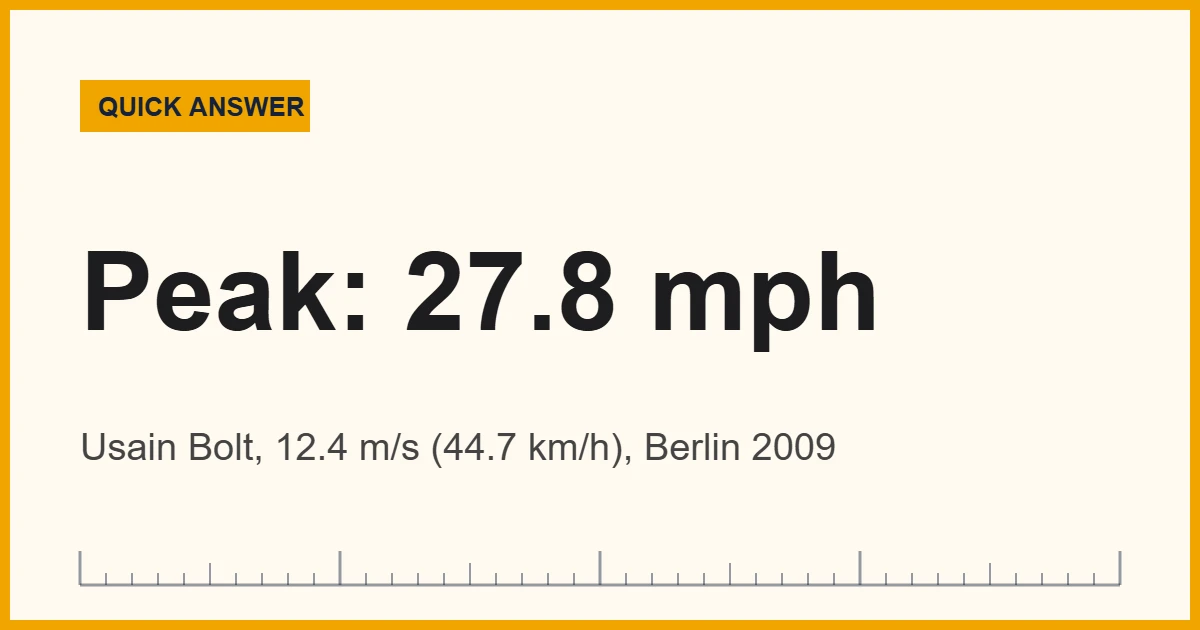
How fast can a human run? The fastest measured sprint belongs to Usain Bolt, who peaked at about 12.4 m/s (27.8 mph, 44.7 km/h) during his 9.58-second 100 m world record in 2009. However, over the whole race he averaged 10.44 m/s (23.35 mph). Typical recreational runners, by contrast, race at roughly 4.5 to 6 mph (7 to 9.5 km/h).
Convert Human Running Speed: m/s, km/h and mph
The converter starts at Bolt’s peak of 12.4 meters per second. Next, type any speed, pick its unit, and it instantly shows the same speed in kilometers per hour and miles per hour, so you can compare your own pace with the record books.
Basically, running speed is simply distance divided by time, yet the answer to “how fast” depends on which number you mean. For example, a sprinter’s top speed lasts only a few strides, while a race average includes the slow start. Similarly, pace, the time per mile or kilometer, is the same idea turned upside down, and it is what most runners actually track.
First, the record figures here come from official sources. World Athletics, the sport’s governing body, keeps the official world records list. In addition, the top-speed figure comes from the biomechanics team that filmed the 2009 Berlin World Championships, as summarized in Milan Coh’s paper “Usain Bolt – Biomechanical Model of Sprint Technique” (Facta Universitatis, 2019). Finally, the conversions use the exact definition 1 mile = 1,609.344 meters.
How Fast a Human Can Run: Speeds Compared
This table puts world-record speeds next to everyday running. Also, each speed is computed from the distance and official time, so you can check the arithmetic yourself.

| Runner or effort | Time | m/s | km/h | mph | Pace per mile |
|---|---|---|---|---|---|
| Usain Bolt, peak speed (60-80 m segment, Berlin 2009) | – | 12.42 | 44.71 | 27.78 | 2:10 |
| Usain Bolt, 100 m average (world record) | 9.58 s | 10.44 | 37.58 | 23.35 | 2:34 |
| Usain Bolt, 200 m average (world record) | 19.19 s | 10.42 | 37.52 | 23.31 | 2:34 |
| Sabastian Sawe, men’s marathon record (London 2026) | 1:59:30 | 5.89 | 21.19 | 13.16 | 4:32 |
| Tigst Assefa, women’s marathon record (London 2026) | 2:15:41 | 5.18 | 18.66 | 11.59 | 5:11 |
| An 8-minute mile | 8:00 per mile | 3.35 | 12.07 | 7.50 | 8:00 |
| Average marathon finisher (2018 race data) | 4:32:49 | 2.58 | 9.28 | 5.77 | 10:24 |
| Average men’s 5K pace (2018 race data) | 7:04 per km | 2.36 | 8.49 | 5.28 | 11:22 |
| Average women’s 5K pace (2018 race data) | 8:18 per km | 2.01 | 7.23 | 4.49 | 13:21 |
Meanwhile, the average race figures come from RunRepeat’s State of Running analysis of millions of race results. If you want to see where an 8-minute mile sits in detail, read how fast an 8-minute mile is. You can also print this table and keep it with your training log.
Recommended Tools for Timing a Human Run
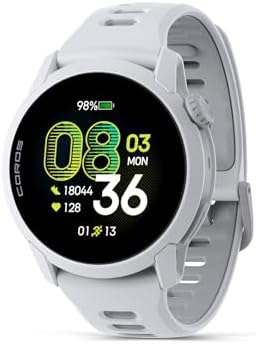
Fortunately, you do not need lab equipment to measure your own speed. First, a GPS running watch logs distance and pace on roads and trails. Next, a plain stopwatch is all you need on a measured track, because the lap distance is already known. Also, look for a watch with a lap button and an easy-to-read screen, since you will check it while moving.



As an Amazon Associate, Measuring Expert earns from qualifying purchases.
Human Run Speed in the 9.58-Second Record
Bolt set the 100 m world record of 9.58 seconds at the 2009 World Championships in Berlin. That works out to an average of 100 / 9.58 = 10.44 m/s. However, nobody runs at their average speed for the whole race. Instead, a sprinter starts from zero, accelerates hard for roughly the first half, holds top speed briefly, and then slows slightly near the finish.
For this reason, the biomechanics analysis of that final timed Bolt over 20-meter segments. As a result, his fastest stretch was between 60 and 80 meters, where he averaged about 12.42 m/s. In other words, that is 44.7 km/h or 27.8 mph, faster than many cars travel on a quiet residential street.
| People confuse | What it actually means | Bolt, Berlin 2009 |
|---|---|---|
| Top (peak) speed | The fastest short segment of a race, measured over a few meters | about 12.42 m/s (27.8 mph) |
| Average speed | Total distance divided by total time, including the start | 10.44 m/s (23.35 mph) |
| Pace | Time per mile or kilometer; a lower number is faster | 2:34 per mile (theoretical) |
How Fast Can a Human Run a Marathon?
Naturally, speed drops sharply as the distance grows, because muscles can only sprint flat out for a few seconds. In April 2026, Sabastian Sawe won the London Marathon in 1:59:30, the first sub-two-hour marathon in a record-eligible race, and World Athletics later ratified it as the world record. His average was 42,195 m / 7,170 s = 5.89 m/s, or 13.16 mph.
That pace is about 2:50 per kilometer, or 4:32 per mile, held for 26.2 miles. For example, at that speed he would cover 100 meters in about 17 seconds, again and again, more than 400 times in a row. Meanwhile, Tigst Assefa set the women’s record of 2:15:41 in the same race, an average of 11.59 mph.
For comparison, the average marathon finisher in RunRepeat’s 2018 data ran 4:32:49, which is about 5.8 mph. In short, Bolt’s peak is roughly 4.8 times faster than a typical marathon finisher, and about 2.1 times faster than the marathon record pace.
Running vs Walking and Animal Speeds
Of course, running is far faster than walking for most people, which is why long walks take so much longer than the same run. So, to see what a long walk looks like in time, read how long it takes to walk 5 miles. On the other hand, humans are slow sprinters next to many large animals. For a sense of how animals compare, see our guide to how fast a moose can run.
Still, humans do have one real strength: endurance. Because we sweat well and can hold a steady pace for hours, trained people can keep going long after many faster animals have to stop.
How to Measure Your Own Human Run Speed
You can measure your own speed with a stopwatch and a known distance. Below is a simple method that works on any standard track.

- Pick a measured course. For instance, use a standard 400 m track or a measured straight; one lap of lane 1 is 400 meters.
- Warm up first. First, jog easily for 10 minutes and add a few short strides before any fast effort.
- Start the timer as you start moving. Alternatively, ask a friend to time you from the finish line.
- Stop the timer at the finish line. Then write the time down right away, to the tenth of a second.
- Divide distance by time. For example, 400 m in 80 seconds is 400 / 80 = 5 m/s.
- Convert the result. Finally, enter your meters per second in the converter above to see km/h and mph.
Do and Don’t When Timing a Human Run
Do
- Always time yourself over a measured distance.
- Then repeat the test and use the average.
- Also note the wind, surface and temperature.
- Compare pace and speed in the same units.
Don’t
- Trust a single GPS reading for a short sprint.
- Confuse your peak speed with your race average.
- Skip the warm-up, even before a short effort.
- Assume treadmill and track numbers match.
Honest Limits of Running Speed Numbers
In fact, every number on this page is a measurement, and every measurement has limits. First, top speed is an average over a short segment, so the shorter the segment, the noisier the figure. Second, wind, altitude and track surface also all change results, which is why records list conditions. Third, GPS watches estimate distance from satellite fixes; they work well for steady runs but can drift on short sprints, near tall buildings, or on a curved track. Finally, race averages such as the 2018 figures describe people who entered races, not every person who runs. Therefore, use them as a rough guide rather than a target.
When Accuracy Really Matters
For casual running, a rough pace is usually fine. However, precision matters more in three cases. For example, coaches use exact splits to set training zones. In addition, researchers usually need calibrated timing gates, not watches, to compare athletes. Similarly, if you train on a treadmill, its belt speed can differ from the display, so check it against a measured run outdoors.
Human Run Speed: Frequently Asked Questions
How fast can a human run at top speed?
The fastest measured human sprint is about 12.4 m/s (27.8 mph, 44.7 km/h), reached by Usain Bolt between 60 and 80 meters of his 9.58-second 100 m world record in 2009.
What was Usain Bolt’s average speed in the 100 m?
On average, he ran 10.44 m/s, which is 37.58 km/h or 23.35 mph, over the full 100 meters including the start.
How fast can a human run a mile at Bolt’s speed?
Nobody can hold sprint speed for a mile. Even so, at his 100 m average, a mile would take about 2 minutes 34 seconds, which is only a theoretical figure.
What is the marathon world record?
As of October 2026 the men’s record is 1:59:30 by Sabastian Sawe (London, April 2026), and the women’s record is 2:15:41 by Tigst Assefa in the same race.
How fast is marathon world record pace?
Sawe averaged 5.89 m/s, or 13.16 mph (21.19 km/h). In other words, that is about 4:32 per mile or 2:50 per kilometer.
How fast does an average person run?
Average race paces in RunRepeat’s 2018 data work out to roughly 4.5 to 6 mph (7 to 9.5 km/h), depending on distance and sex.
Is 10 mph fast for a human run?
Yes, for most people, because 10 mph is a 6-minute mile, which is well beyond the average recreational race pace.
How do I convert m/s to mph?
To convert, multiply meters per second by 2.237 (exactly 3,600 / 1,609.344). For example, 12.4 m/s times 2.237 is about 27.7 mph.
Why do sources give different top speeds for Bolt?
Because analysts split the race into different segments and used different timing methods, so reported peaks range from about 12.3 to 12.4 m/s.
Can a human run 30 mph?
No measured sprint has reached 30 mph. In fact, the highest well-documented figure is Bolt’s peak of about 27.8 mph.
The Bottom Line on Human Running Speed
To sum up, the fastest a person has been measured running is about 12.4 m/s, or 27.8 mph, and the 100 m record works out to 23.35 mph on average. Over a marathon, however, the record pace drops to 13.16 mph, while everyday runners usually race at roughly 4.5 to 6 mph.
So if you want to see where you fit, time a measured distance, divide by the time, and enter the result in the converter above. After that, compare it with the table, and remember that improving your own pace matters far more than any record.
16 thoughts on “How Fast Can a Human Run? Top Speed, Records and Average Pace”