

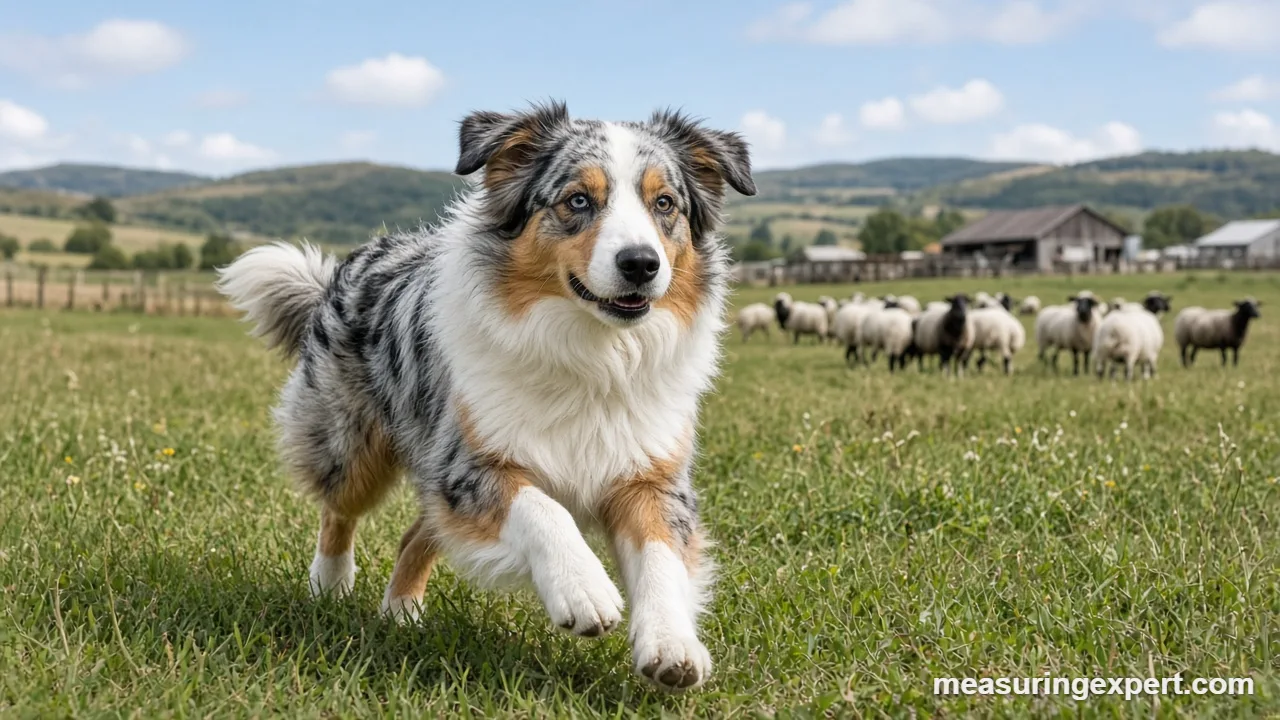
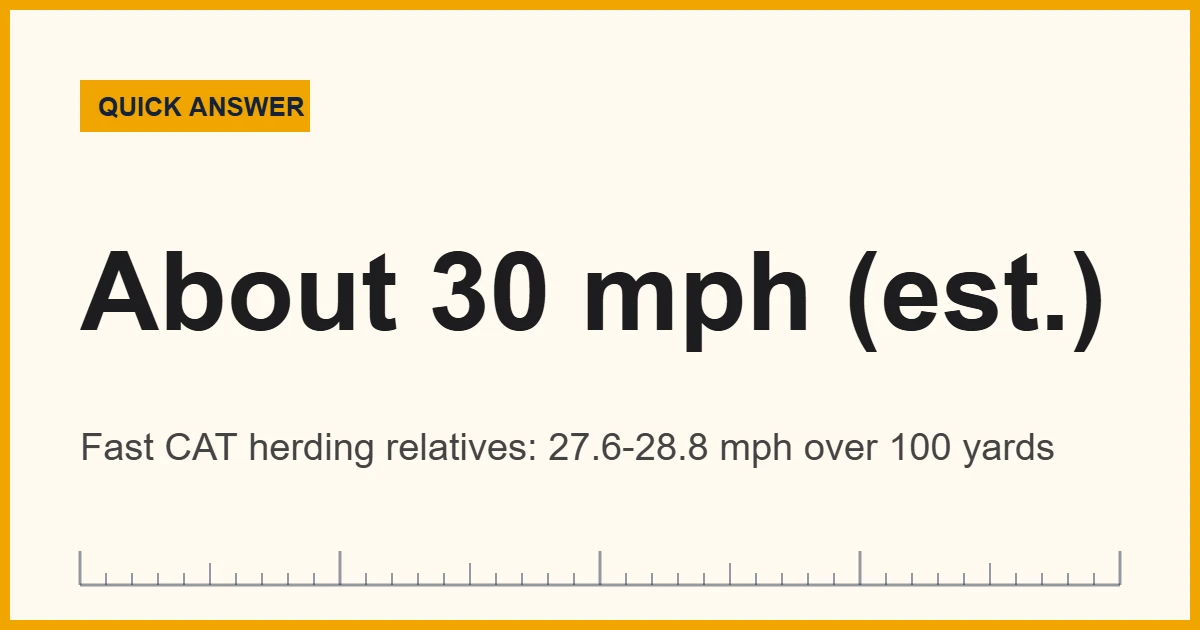
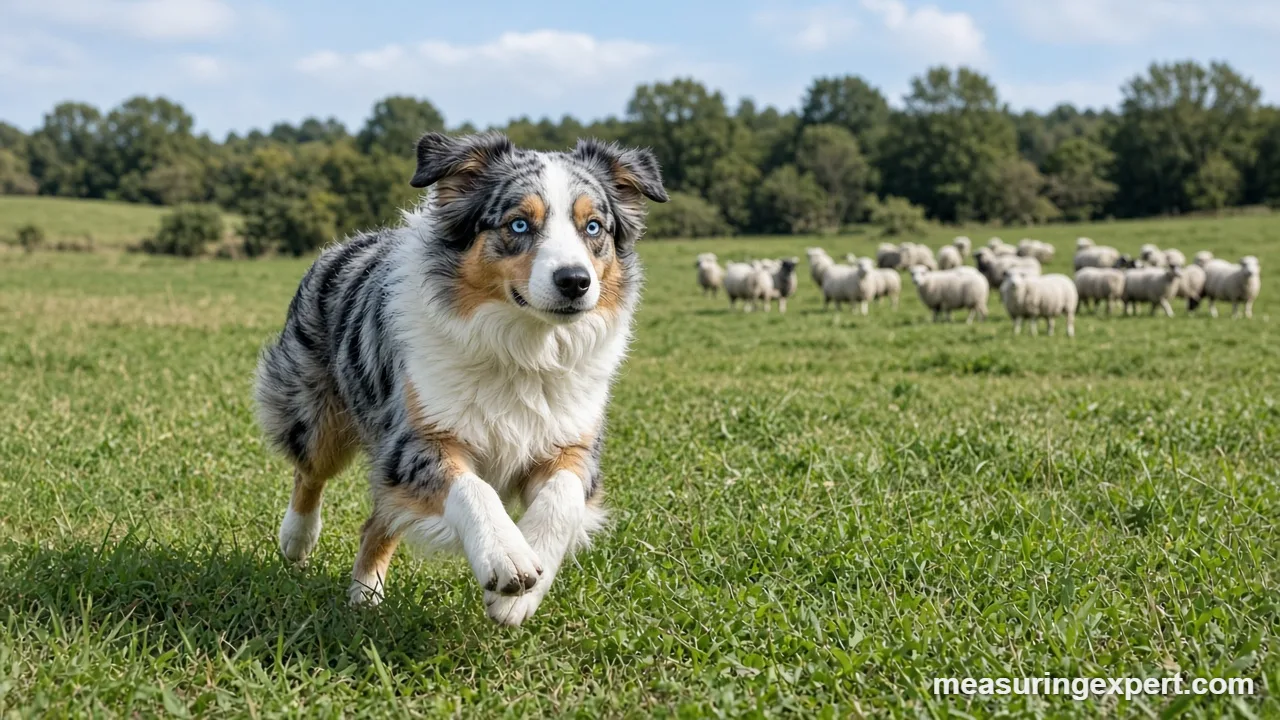
Australian Shepherd speed is usually quoted as up to about 30 mph (48 km/h) in a short sprint. However, that is an estimate, not a timed breed record. Timed AKC Fast CAT results for close herding relatives fall between about 27.6 and 28.8 mph over 100 yards, so a fit Aussie in the high 20s is realistic.
Convert Australian Shepherd Speed to km/h and More
Type any speed below, such as the popular 30 mph figure or a reading from a GPS collar. The converter then shows it in kilometers per hour, meters per second, feet per second and knots. It uses the exact definition 1 mile = 1.609344 km, so the results match the tables on this page.
Aussies look fast, and they are. Still, the breed was never built to win a straight drag race. Instead, it was built to work stock all day. For instance, the AKC calls it a lean, tough ranch dog, and the official AKC breed standard says it has the stamina to work all day. In other words, quick bursts plus long hours of steady movement are the real job description.
So this page treats speed in two parts. First, we look at the sprint, where the honest answer is a range. Then we look at the working pace, which matters far more on a ranch or a trail. Along the way, every conversion is computed from exact unit definitions, and every estimate is labeled as one.
Where the 30 mph Australian Shepherd Speed Figure Comes From
Search for this topic and you will see 30 mph again and again. Moreover, some pet sites go further and claim 35 or even 40 mph. Yet we found no study, kennel club record or published timing that measures Australian Shepherds as a group. In short, the 30 mph number is repeated, not measured.
Still, that does not make it wrong. A medium-size, lean herding dog with a deep chest and strong hindquarters fits the profile of a dog that can sprint in the high 20s. For example, the AKC standard asks for males of 20 to 23 inches at the shoulder and females of 18 to 21 inches, which puts most Aussies in the same size band as other fast working breeds. Even so, claims of 40 mph would put an Aussie ahead of the fastest greyhound timed at the 2026 AKC Fast CAT Invitational, so treat those as unrealistic.
AKC Fast CAT Results: The Closest Thing to Hard Data
The AKC runs Fast CAT, a timed 100-yard dash in which each dog chases a lure alone. Moreover, each run is timed to the hundredth of a second, and the time is converted to mph. According to the AKC, a dog that covers the course in 10 seconds is running at 20.46 mph.
At the 2026 AKC Fast CAT Invitational in Branson, Missouri, no Australian Shepherd placed in the top 10 of the tall-dog division. In fact, tenth place in that division ran 29.40 mph, so the fastest Aussies there averaged less than that over 100 yards. Meanwhile, two close herding relatives did place in the mid-height division:
| Dog (breed) | 100-yard time | Average speed | km/h |
|---|---|---|---|
| Rose (Australian Cattle Dog) | 7.112 s | 28.76 mph | 46.28 |
| Dottie (Miniature American Shepherd) | 7.413 s | 27.59 mph | 44.40 |
| Kat (Belgian Malinois, tall division) | 6.886 s | 29.70 mph | 47.80 |
| Fritz (Greyhound, fastest dog of the event) | 5.675 s | 36.04 mph | 58.00 |
The Miniature American Shepherd is especially useful here, because it was developed from small Australian Shepherds. Therefore, a full-size Aussie averaging around 27 to 29 mph over 100 yards on a good day fits the evidence well.
Australian Shepherd Speed Chart by Gait
Of course, most of the time, an Aussie is not sprinting at all. Instead, it moves through a walk, a trot and a lope while it works. Accordingly, the rows below are typical ranges for a fit adult. Only the Fast CAT row is a measured value; the rest are estimates.
| Gait or situation | mph | km/h | Basis |
|---|---|---|---|
| Walk | about 3-4 | about 5-6 | Estimate |
| Working trot | about 6-10 | about 10-16 | Estimate |
| Lope or canter | about 12-18 | about 19-29 | Estimate |
| All-out sprint | about 25-30 | about 40-48 | Widely quoted estimate |
| Fast herding relative, 100-yard average | 27.59-28.76 | 44.40-46.28 | Timed (AKC Fast CAT 2026) |
For quick reference, 30 mph equals 44 feet every second. Also, at that speed an Aussie would cover 100 yards in about 6.8 seconds.
Recommended Tools for Timing Australian Shepherd Speed
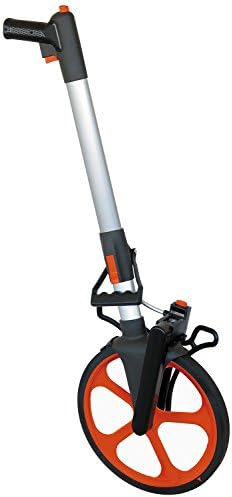
Generally, you can estimate your own dog’s speed with simple gear. First, a measuring wheel lets you lay out an exact course. Next, a stopwatch that reads to hundredths gives you a clean time. Finally, a GPS collar logs distance and pace on longer runs, which tells you more about stamina than about peak speed.




As an Amazon Associate, Measuring Expert earns from qualifying purchases.
Herding Stamina: Why Endurance Beats Top Speed
On a ranch, a herding dog rarely needs its absolute top speed for long. Rather, it needs to sprint out to head off a stray, drop back to a steady trot, and repeat that for hours. That pattern is called interval work, and it is exactly what the breed standard means by stamina to work all day.
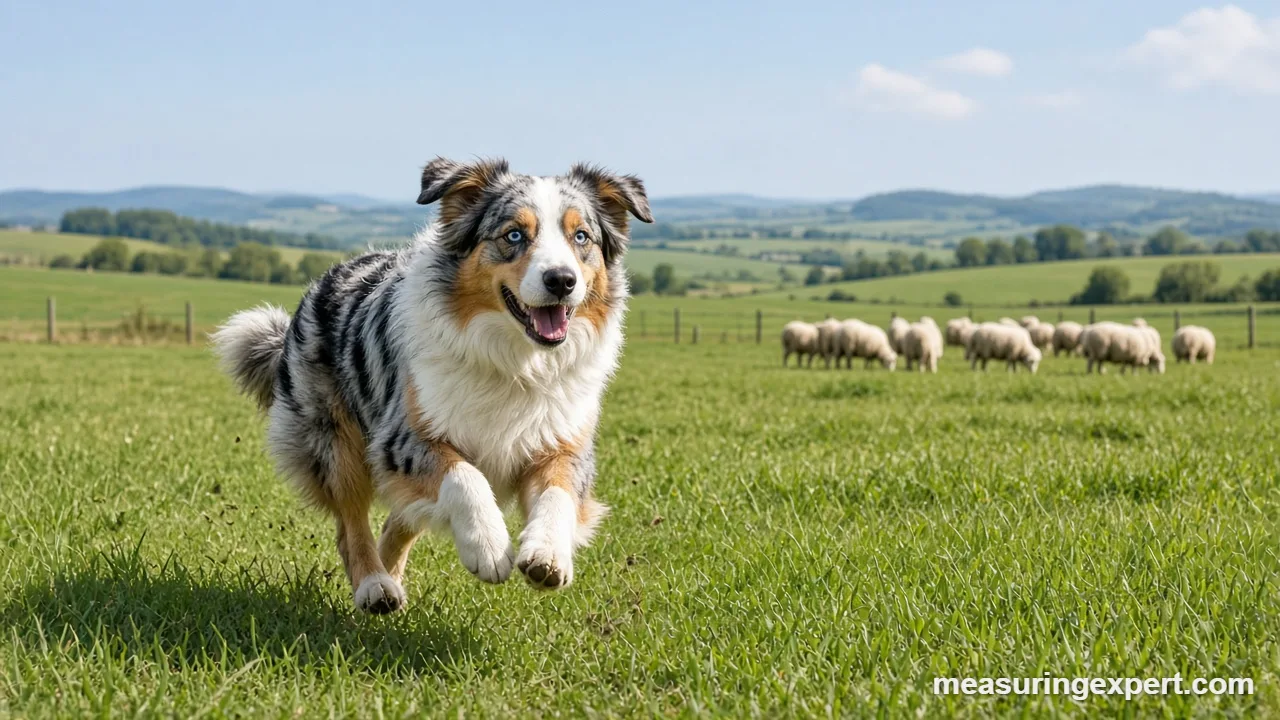
Because of this, an Aussie’s real strength is recovery. For example, a well-conditioned dog can burst to a gallop, settle, and burst again many times in a session. In contrast, a sight hound such as a greyhound is much faster over 100 yards but is built for short, all-out chases.
Similarly, the habit shows up at home too. Many owners find that one long walk is not enough, while short sprints mixed with fetch, herding games or agility tire the dog out far better. However, more running is not always better: young dogs and dogs in hot weather need limits, as the warning below explains.
Australian Shepherd Speed vs Other Breeds
Next, comparisons make the numbers easier to picture. Here, timed Fast CAT results are marked as timed, and everything else is labeled as an estimate.
| Runner | Speed | Basis |
|---|---|---|
| Australian Shepherd | about 25-30 mph (40-48 km/h) sprint | Estimate; no timed breed record |
| Australian Cattle Dog | 28.76 mph (46.28 km/h) over 100 yards | Timed (one dog, Fast CAT 2026) |
| Miniature American Shepherd | 27.59 mph (44.40 km/h) over 100 yards | Timed (one dog, Fast CAT 2026) |
| Belgian Malinois | 29.40-29.70 mph (47.31-47.80 km/h) over 100 yards | Timed (two dogs, Fast CAT 2026) |
| German Shepherd | about 30 mph (48 km/h) sprint | Estimate |
| Siberian Husky | about 25-30 mph (40-48 km/h) sprint | Estimate |
| Greyhound | 36.04 mph (58.00 km/h) over 100 yards | Timed (Fast CAT 2026) |
| Usain Bolt (100 m record) | about 23.4 mph average; about 27.8 mph peak | Computed from 9.58 s; peak widely cited |
So an Aussie sits in the same band as the German Shepherd and the husky, below the Malinois and well below sight hounds. For the details on those breeds, see our guides to German Shepherd speed and how fast a husky can run. Similarly, our page on how fast a human can run explains how Bolt’s speed was measured.
How to Measure Australian Shepherd Speed at Home
In general, this field method gives a fair estimate of your own dog’s sprint. Even so, it works only with an adult, healthy dog on a cool day.
- Check that your dog is ready. Use an adult dog only; the AKC requires dogs to be at least 12 months old for Fast CAT. Also ask your vet first if your dog has joint or heart problems.
- Find a flat, fenced area. Grass or packed dirt works best, away from roads and other animals.
- Measure the course. Roll a measuring wheel out 100 yards (91.44 m) or 50 yards, and place a cone at each end.
- Allow a running start. Have a helper release the dog several yards behind the first cone, while you call it or wave a toy past the finish.
- Time cone to cone. Start the stopwatch as the nose passes the first cone, then stop it at the second.
- Repeat and average. Do two or three runs with rest and water between them, then divide distance by time or enter the result in the converter above.
For example, 100 yards in 7.5 seconds is about 27.3 mph (43.9 km/h). Likewise, 50 meters in 5.0 seconds is 10 m/s, which equals 36 km/h or about 22.4 mph.
Do and Don’t When Running an Aussie
Do
- Warm up with 5 to 10 minutes of walking and trotting.
- Run early or late in the day when it is cool.
- Build distance slowly over several weeks.
- Check paws and offer water after every session.
- Mix sprints with herding games, fetch or agility.
Don’t
- Push a growing puppy into long or hard runs.
- Trust one GPS spike as a top speed.
- Sprint on hot pavement or right after a meal.
- Let an Aussie run loose near roads or livestock you do not own.
- Ignore limping, lagging or heavy panting.
Honest Limits of These Numbers
First of all, the 25 to 30 mph sprint range is the weakest figure on this page, because nobody has published a timed study of Australian Shepherds as a breed. On the other hand, the Fast CAT values are precise, yet they describe single dogs of related breeds, and they are 100-yard averages that sit a little below true peak speed. In addition, phone GPS apps can jump several mph over short distances. Finally, age, weight, coat, fitness, surface and temperature all change the result, so trust a few careful timings of your own dog more than any chart.
When Accuracy Really Matters
Of course, for a backyard test or a friendly debate, a rough number is fine. However, accuracy matters more if you plan to enter Fast CAT, track a canine athlete’s conditioning, or follow recovery after an injury. In those cases, an official timed run or a measured course with repeated trials is the way to go, and a vet or canine fitness professional can set safe limits.
Australian Shepherd Speed FAQs
How fast can an Australian Shepherd run?
A fit adult Aussie can probably sprint at about 25 to 30 mph (40 to 48 km/h) for a few seconds. That range is an estimate, because no timed breed record exists.
Is 30 mph a measured Australian Shepherd speed?
No. Instead, it is a widely repeated figure. Timed Fast CAT results for related herding dogs, around 27.6 to 28.8 mph over 100 yards, suggest it is close to the upper end.
Can an Australian Shepherd run 40 mph?
Very unlikely. The fastest greyhound at the 2026 AKC Fast CAT Invitational averaged 36.04 mph over 100 yards, and Aussies are not built like sight hounds.
What is 30 mph in km/h?
30 mph is about 48.28 km/h. It also equals about 13.41 meters per second or 44 feet per second.
Is an Aussie faster than a Border Collie?
They are thought to be similar. Both are usually quoted at about 25 to 30 mph, but neither breed has a published timed average, so no one can say which is faster.
Is an Australian Shepherd faster than a German Shepherd?
Probably about the same. Both are usually estimated at up to about 30 mph in a sprint, and individual fitness matters more than breed.
Can an Australian Shepherd outrun a human?
Yes. Usain Bolt averaged about 23.4 mph in his 100-meter record, and most people run far slower, while a fit Aussie sprints in the mid to high 20s.
How long can an Aussie hold its top speed?
Only a few seconds. After that, it drops to a lope or trot, which it can repeat for hours with rest breaks.
How far can an Australian Shepherd run?
It depends on fitness, age and weather. Many conditioned adults handle several miles at a trot, but build up slowly and ask your vet about safe distances.
How do I measure my Aussie’s speed?
Time a run between two cones a known distance apart, such as 100 yards, then divide distance by time. For example, 100 yards in 7.5 seconds is about 27.3 mph.
The Bottom Line
To sum up, an Australian Shepherd can sprint at roughly 25 to 30 mph, but that range is an estimate. The best hard data, timed Fast CAT runs by close herding relatives, lands between about 27.6 and 28.8 mph over 100 yards.
Above all, the breed’s real gift is stamina, not raw speed. If you want a number for your own dog, measure a course, time a few runs, and enter the result in the converter at the top of this page.