

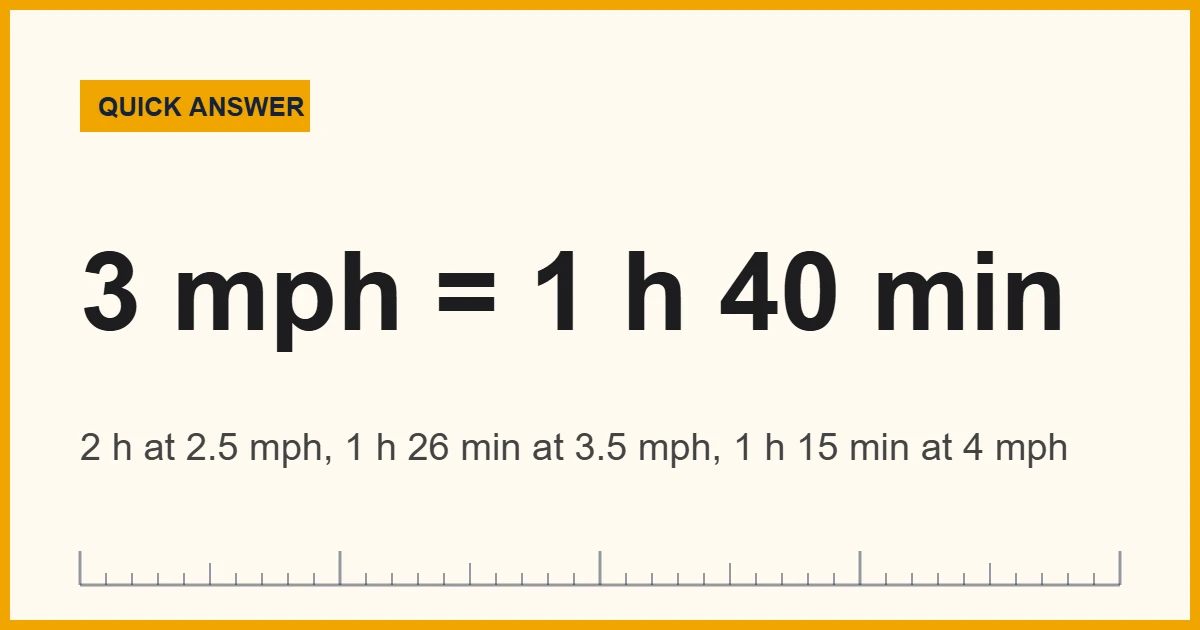
It takes about 1 hour 40 minutes to walk 5 miles (8.05 km) at a steady 3 mph (4.83 km/h). At a slow 2.5 mph it takes 2 hours, while a brisk 3.5 mph cuts it to about 1 hour 26 minutes and 4 mph to 1 hour 15 minutes. Hills, rough ground and stops add time.
Convert Your Walking Speed
Treadmills, apps and watches often show speed in different units, for example km/h instead of mph. So enter your speed below, and the converter turns mph into km/h, meters per second and feet per second. After that, match the mph value to the time chart further down.
The math behind every number on this page is one simple formula: time = distance / speed. For example, five miles divided by 3 miles per hour gives 1.667 hours, which is 100 minutes. In other words, you do not need a special app to plan the time to walk 5 miles; you only need an honest idea of your usual pace.
First, a mile is a fixed length. The US National Institute of Standards and Technology (NIST) defines the international mile as exactly 5,280 feet, or 1,609.344 meters. As a result, 5 miles is exactly 26,400 feet, or about 8.05 kilometers. Because the distance never changes, the only variable is how fast you move and how often you stop.
For reference, the CDC lists walking briskly at 2.5 miles per hour or faster as a moderate-intensity activity. So 2.5 mph makes a useful lower edge for a purposeful walk, while 3 to 3.5 mph is a typical steady pace for many adults on a flat path.
How Long to Walk 5 Miles at Each Pace
First, here is the time for 5 flat miles with no stops. Each row is computed from time = 5 / speed, and the pace columns show how long one mile or one kilometer takes at that speed.
| Speed | Metric speed | Pace per mile | Pace per km | Time for 5 miles |
|---|---|---|---|---|
| 2 mph (leisurely) | 3.22 km/h | 30 min | 18.6 min | 2 h 30 min |
| 2.5 mph (easy) | 4.02 km/h | 24 min | 14.9 min | 2 h 0 min |
| 3 mph (steady) | 4.83 km/h | 20 min | 12.4 min | 1 h 40 min |
| 3.5 mph (brisk) | 5.63 km/h | 17 min 9 s | 10.7 min | 1 h 26 min |
| 4 mph (fast) | 6.44 km/h | 15 min | 9.3 min | 1 h 15 min |
| 4.5 mph (race walking pace) | 7.24 km/h | 13 min 20 s | 8.3 min | 1 h 7 min |
In practice, most people who walk 5 miles at a comfortable but purposeful effort land between the 3 mph and 3.5 mph rows. Therefore, 1 hour 30 minutes to 1 hour 40 minutes is a sensible first estimate. If you are curious how this compares with running, our guide on how fast a human can run covers jogging and sprint speeds.
Recommended Tools for Timing a Walk
You can time a walk with any phone, yet a dedicated tool makes the numbers steadier. For example, a GPS watch records distance and pace directly. Meanwhile, a clip-on pedometer counts steps without a phone, and a measuring wheel lets you lay out a known distance so you can measure your own stride length.





As an Amazon Associate, Measuring Expert earns from qualifying purchases.
How Many Steps to Walk 5 Miles?
Step count depends entirely on step length, which is the distance from one heel strike to the next heel strike of the other foot. Also, taller people and faster walkers usually take longer steps. Because 5 miles is 26,400 feet, you can divide that number by your step length to get your total.
| Step length | Metric | Steps per mile | Steps in 5 miles |
|---|---|---|---|
| 2.0 ft (24 in) | 0.61 m | 2,640 | 13,200 |
| 2.2 ft (26.4 in) | 0.67 m | 2,400 | 12,000 |
| 2.5 ft (30 in) | 0.76 m | 2,112 | 10,560 |
| 2.8 ft (33.6 in) | 0.85 m | 1,886 | 9,429 |
| 3.0 ft (36 in) | 0.91 m | 1,760 | 8,800 |
In short, most adults take roughly 9,000 to 13,000 steps to walk 5 miles. The old rule of thumb, “about 2,000 steps per mile”, matches a step length of 2.64 feet, so it fits taller walkers better than shorter ones.
How Terrain and Weather Change the Time
Generally, a flat paved path is the fastest surface. However, soft sand, mud, snow, roots and loose rock all shorten your step and slow your cadence. In addition, heat, strong wind and a heavy pack add more time on top.
| Conditions | Typical speed | Time for 5 miles |
|---|---|---|
| Flat sidewalk or paved trail | 3 to 3.5 mph | 1 h 26 min to 1 h 40 min |
| Groomed dirt or gravel trail | 2.5 to 3 mph | 1 h 40 min to 2 h |
| Rough or rocky ground (Aitken) | about 2.5 mph | about 2 h |
| Soft sand, mud or snow | 1.5 to 2.5 mph | 2 h to 3 h 20 min |
| City streets with crossings | 2.5 to 3 mph average | 1 h 40 min to 2 h |
The rough-ground row comes from Aitken’s 1977 adjustment to Naismith’s rule, which uses 2.5 mph (4 km/h) off-path instead of 3 mph. By contrast, the sand and snow row is only a rough range, since conditions vary a great deal. Similarly, city times depend on block length and crossings; see how long a city block is to turn a route of blocks into miles.
Naismith’s Rule: Timing a 5-Mile Walk With Hills
Hills, however, are where simple speed math breaks down. For that reason, hikers have used Naismith’s rule since 1892. The original rule allows one hour per 3 miles plus one hour per 2,000 feet of climb. In other words, in metric terms that is 1 hour per 5 km plus 1 hour per 600 m of ascent.
Here is how it works for a 5-mile route:
- Flat 5 miles: 5 / 3 = 1.67 hours, which is 1 hour 40 minutes.
- With 1,000 ft (305 m) of climb: add 30 minutes, for 2 hours 10 minutes in total.
- With 2,000 ft (610 m) of climb: add 1 hour, for 2 hours 40 minutes in total.
However, the rule only counts uphill. Later, Langmuir suggested small corrections for descents: subtract about 10 minutes per 300 m on gentle slopes, but add about 10 minutes per 300 m on steep ones, because steep downhill walking is slow and careful. So to find the total climb on your route, read our guide to measuring elevation change.
How to Time Your Own Pace to Walk 5 Miles
Of course, the tables are averages, so your own pace is the best number to use. Fortunately, a one-mile test takes only about 20 minutes:
- Find a known mile. Use a 400 m track (4 laps is 1,600 m, just short of a mile), a marked trail, or a distance you measured with a wheel or GPS.
- Warm up for a few minutes. Then start timing only once you reach your normal walking rhythm.
- Walk one mile at the effort you plan to hold. Do not race it; the goal is a pace you could keep for 5 miles.
- Record the time. Afterward, write down minutes and seconds for that mile.
- Multiply by 5. Next, a 19-minute mile becomes 95 minutes, or 1 hour 35 minutes, for 5 miles.
- Add a buffer. Finally, add 5 to 10 percent for fatigue, hills and stops on a real route.
Also count your steps during the test mile. Then dividing 5,280 feet by your step count gives your personal step length, which then makes your pedometer far more accurate.
Do and Don’t for Planning Walk Times
Do
- Time a real mile first, before planning a long route.
- Add climb time with Naismith’s rule on hilly trails.
- Leave a buffer, because crossings, breaks and photos add up.
- Calibrate your step length on a measured distance.
- Carry water and wear shoes you have already broken in.
Don’t
- Assume treadmill speed equals outdoor speed, since belts and displays differ.
- Trust a default pedometer step length; instead, measure your own.
- Ignore heat, wind or soft ground.
- Count only distance on a route with big climbs.
- Start a remote walk late in the day, because darkness slows you down.
Honest Limits of These Estimates
Every time on this page assumes a constant speed; however, real walks are not constant. For example, most people start quicker and slow down near the end, especially on a first long walk. Similarly, GPS distance can drift by a few percent under trees or between tall buildings, so a watch may say 4.9 or 5.1 miles for the same route.
Step counts, moreover, carry even more uncertainty. For instance, wrist devices sometimes miss steps when you push a stroller or hold a rail, and they may add steps when you move your arms. As a result, treat any step total as an estimate within roughly ten percent, unless you have checked your device on a measured mile.
Finally, this page is about distance and time. It does not promise any fitness, health or weight result, because those depend on many personal factors.
Frequently Asked Questions
How long does it take to walk 5 miles?
At a steady 3 mph it takes about 1 hour 40 minutes. At 2.5 mph it takes 2 hours, at 3.5 mph about 1 hour 26 minutes, and at 4 mph about 1 hour 15 minutes.
Can I walk 5 miles in an hour?
Only at 5 mph, which is a 12-minute mile. That is clearly faster than normal walking and close to race walking or a slow jog, so most walkers need well over an hour.
How many steps does it take to walk 5 miles?
Usually about 9,000 to 13,000 steps, because step length varies. For example, with a 2.5-foot step it is about 10,560 steps; with a 2-foot step it is 13,200 steps.
Is 5 miles about 10,000 steps?
Roughly, but only for some people. A step length of 2.64 feet gives exactly 10,000 steps in 5 miles, but shorter steps push the total higher.
How long does it take to walk 5 miles uphill?
First, use Naismith’s rule: 1 hour 40 minutes for the distance plus 30 minutes for every 1,000 feet of climb. For example, 5 miles with 1,000 feet of ascent takes about 2 hours 10 minutes.
How many kilometers is 5 miles?
Five miles is about 8.05 km because one international mile is exactly 1.609344 km.
What pace do I need to walk 5 miles in 90 minutes?
You need 3.33 mph, which is an 18-minute mile or about 5.36 km/h. In practice, that is a brisk but sustainable pace for many regular walkers.
How long does it take to walk 5 miles on a treadmill?
It takes the same time as the speed setting suggests: 1 hour 40 minutes at 3.0 mph or 1 hour 15 minutes at 4.0 mph. However, treadmill displays can be slightly off, so outdoor times may differ.
How long should I plan to walk 5 miles in a city?
In general, plan about 1 hour 45 minutes to 2 hours. This is because traffic lights and crowded sidewalks often lower your average speed to 2.5 to 3 mph.
How can I measure my walking speed accurately?
Time yourself over a measured mile, such as 4 laps of a 400 m track plus about 9 meters, then divide 60 by your minutes. For example, a 20-minute mile equals 3 mph.
Walk 5 Miles: The Bottom Line
To sum up, plan about 1 hour 40 minutes to walk 5 miles at 3 mph, 2 hours at an easy 2.5 mph, and 1 hour 15 minutes at a fast 4 mph. Then add 30 minutes for each 1,000 feet of climb, and leave a buffer for rough ground, crossings and breaks.
So the most reliable number is still your own: time one mile, multiply by five, and use the speed converter above to translate treadmill or app readings. That way, your plan fits your legs instead of an average.
3 thoughts on “How Long Does It Take to Walk 5 Miles? Times at 2.5, 3, 3.5 and 4 mph”