

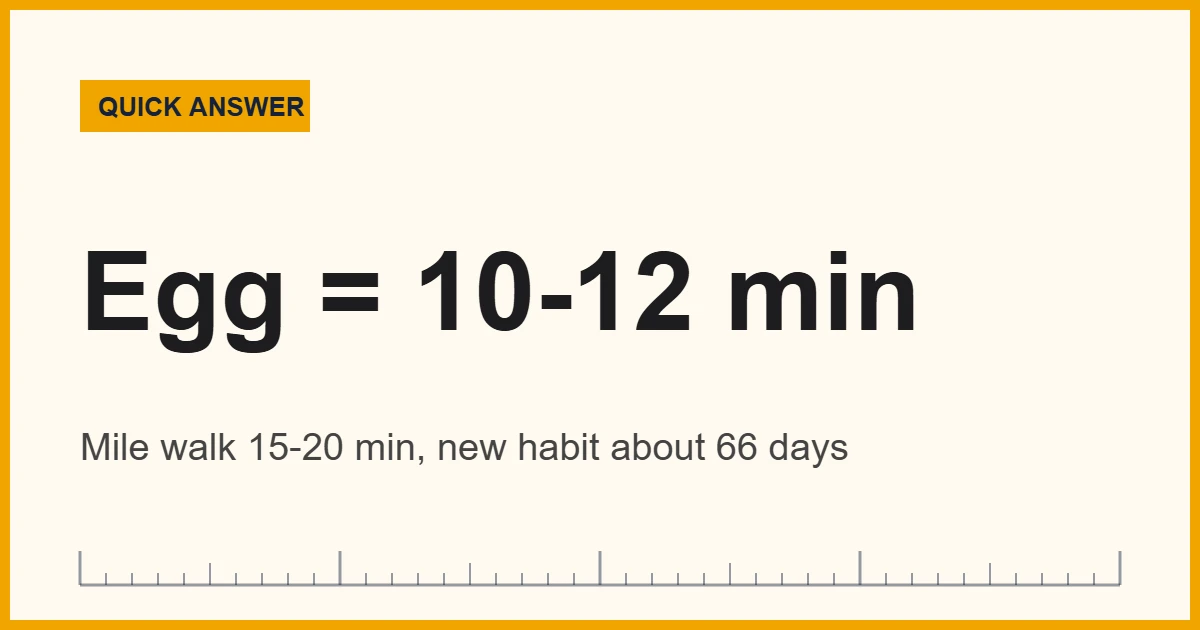
How long it takes depends on the task, but many everyday benchmarks are steady. For example, a hard-boiled egg needs 10 to 12 minutes, a mile on foot takes 15 to 20 minutes, white rice simmers for about 18 minutes, and a new habit takes about 66 days on average. Then use the converter below for your own numbers.
Turn Any Time Estimate Into Minutes, Hours or Days
First, enter a duration and pick its unit. The converter then shows the same span in seconds, minutes, days and weeks. A year here uses the 365.2425-day Gregorian average, so long spans stay accurate.
People search “how long does it take to” for hundreds of different jobs, from boiling an egg to learning Japanese. Most of those questions have a useful answer, because the time comes from something you can measure: a distance and a speed, a cooking temperature, or a number of class hours. So this guide collects reliable time estimates in one place and shows where each number comes from.
Each estimate is a typical range, not a promise, because your stove, your walking pace and your schedule all shift the result. Still, a good range beats a guess, because it lets you plan a meal, a trip or a study goal with real numbers. In addition, the converter above turns any of these estimates into the unit you need.
Next, the sections below cover cooking, travel, learning and a few big-number benchmarks. After that, you will find a simple method for estimating any task yourself, plus the honest limits of every time estimate.
How Long It Takes: Quick Chart of Everyday Tasks
Start with this chart, since each row gives a typical range and, where it helps, the assumption behind it.
| Task | Typical time | Assumption |
|---|---|---|
| Soft-boiled egg | 6 to 7 minutes | When a large egg goes into boiling water |
| Hard-boiled egg | 10 to 12 minutes | Same method, then an ice bath |
| Dried pasta | 8 to 12 minutes | Timed after the water boils, so check the box |
| White rice | 15 to 20 minutes, plus 5 to 10 resting | Covered, then left to rest off the heat |
| Preheat an oven to 350°F (177°C) | 10 to 15 minutes | Until the oven signals it is ready |
| Walk 1 mile (1.61 km) | 15 to 20 minutes | When walking 3 to 4 mph (4.8 to 6.4 km/h) |
| Walk 1 km | about 12 minutes | While walking 5 km/h (3.1 mph) |
| Run a 5K (3.1 miles) | about 31 minutes | When running 10 minutes per mile |
| Drive 100 miles (161 km) | 1 hour 40 minutes | Steady 60 mph (97 km/h), so no stops |
| Washing machine cycle | 30 to 60 minutes | Normal cycle, but eco cycles run longer |
| Learn Spanish or French to work level | 24 to 30 weeks | Full-time study, so 600 to 750 class hours (FSI) |
| Form a new daily habit | about 66 days on average | Some people take far longer than others |
| Sunlight reaching Earth | 8 minutes 19 seconds | When Earth is at its average distance |
Need a longer walk? Then our guide to how long it takes to walk 5 miles breaks the distance down by pace.
Recommended Timers for Tracking How Long It Takes
In fact, a dedicated timer is the easiest way to learn how long it takes you, personally, to do a task. First, a loud countdown timer keeps cooking on schedule. Next, a stopwatch with lap memory helps you time walks, runs and work sessions. Finally, a multi-channel timer is handy when several dishes cook at once.


As an Amazon Associate, Measuring Expert earns from qualifying purchases.
How Long It Takes to Cook Common Foods
Cooking times are the most searched estimates of all, but they are only half the story. Recipes give a time, but safety depends on temperature. For that reason, the US government food safety site lists safe minimum internal temperatures and recommends checking them with a food thermometer.
| Food | Typical time | Done when |
|---|---|---|
| Chicken breast, baked at 400°F (204°C) | 20 to 30 minutes | When the center reads 165°F (74°C) |
| Whole chicken, about 4 lb (1.8 kg), at 425°F (218°C) | 1 to 1 1/2 hours | When the thickest part reads 165°F (74°C) |
| Beef steak, 1 inch (2.5 cm) thick, pan-seared | 8 to 12 minutes | At 145°F (63°C), then 3 minutes rest |
| Ground beef burgers | 8 to 10 minutes | When it reaches 160°F (71°C) |
| Fish fillets, baked at 400°F (204°C) | 10 to 15 minutes | When it hits 145°F (63°C) and flakes |
| Brown rice | 40 to 45 minutes | Once the water is gone and grains are tender, then rest |
| Yeast bread, first rise | 1 to 2 hours | Until the dough roughly doubles |
How Long It Takes to Walk, Run or Drive a Distance
Travel time follows one formula, so time = distance / speed. For example, a 3-mile walk at 3 mph takes exactly 1 hour, and 100 miles at 65 mph takes about 1 hour 32 minutes. Real trips add stops, traffic lights and hills, therefore plan on 10 to 20 percent extra.
Walking pace makes a big difference too. At 3 mph a mile takes 20 minutes, while a brisk 4 mph cuts it to 15 minutes. Likewise, a 5K takes about 62 minutes to walk at 3 mph but only about 31 minutes to run at 10 minutes per mile. At that same running pace, a full marathon (26.2 miles, 42.195 km) takes about 4 hours 22 minutes.
For a common sports length, also see how long 90 minutes is in hours and in real life.
How Long It Takes to Learn a Language or Form a Habit
Skills take far longer than chores, and the best data comes from structured programs. For instance, the US Foreign Service Institute (FSI) trains diplomats full time and publishes its expected training times for English speakers to reach professional working skill.
| FSI category | Example languages | Weeks | Class hours |
|---|---|---|---|
| Category I | Spanish, French, Italian, Dutch | 24 to 30 | 600 to 750 |
| Category II | German, Indonesian, Swahili | about 36 | about 900 |
| Category III | Russian, Greek, Hebrew, Thai | about 44 | about 1,100 |
| Category IV | Arabic, Mandarin, Japanese, Korean | 88 | 2,200 |
Those hours assume about 25 classroom hours a week, plus homework. So at 1 hour a day, 600 hours stretches to well over a year and a half.
Habits, however, work differently. Researchers at University College London followed volunteers who repeated a new daily behavior, such as drinking water with lunch. After that, the UCL team found it took 66 days on average for the action to feel automatic. Also, missing one day did not derail the process. Consistency over weeks, on the other hand, made the difference.
Big-Number Benchmarks for How Long It Takes
Some time questions are pure arithmetic, so they make good sanity checks. Light from the Sun travels about 149.6 million km (93 million miles) to reach us, so it arrives about 8 minutes 19 seconds after leaving. Moonlight, by contrast, takes only about 1.3 seconds.
- One million seconds is about 11.6 days.
- One billion seconds, by comparison, is about 31.7 years, so it is far longer than most people guess.
- A day holds 86,400 seconds; see how many seconds are in a day for the full breakdown.
- Three days equal 72 hours, which our 72-hour guide turns into weekday plans.
Active Time vs Total Time: What People Mix Up
Many bad estimates happen because people measure the wrong thing. Recipes, courses and projects often quote one kind of time while you need another.
| People often confuse | What it really means |
|---|---|
| Active time vs total time | Active time is hands-on work, while total time also includes waiting and resting |
| Cook time vs rest time | Steaks and roasts keep cooking even after they leave the heat |
| Class hours vs calendar weeks | FSI weeks assume full-time study, so part-time learners need more weeks |
| Moving time vs trip time | Map apps show driving time, but stops and parking come on top |
| Calendar year vs average year | A calendar year has 365 or 366 days, whereas the Gregorian average is 365.2425 days |
How to Estimate How Long It Takes for Any Task
- Define the finish line. Decide what “done” means, such as a safe temperature, a distance covered or a skill level.
- Find the rate. Then look up a speed, a cooking time per pound or a number of hours from a reliable source.
- Divide the amount by the rate. For example, 6 miles at 3 mph gives 2 hours.
- Add the waiting time. Also include preheating, resting, drying or travel stops.
- Add a buffer. A margin of 10 to 25 percent usually covers surprises, so add it.
- Time it once yourself. Use a timer or stopwatch, then replace the generic estimate with your own number.
Do and Don’t When Planning Around Time
Do
- Check food with a thermometer, not the clock alone.
- Write down your real times so repeat tasks get easier.
- Plan travel with a buffer, because stops add up.
- Count total time, including resting and drying.
Don’t
- Treat a recipe time as a guarantee.
- Compare part-time study with full-time course hours.
- Assume map times include parking when they do not.
- Give up on a habit after one missed day, since one gap rarely matters.
Honest Limits of Time Estimates
Every number on this page is a typical range, so treat it as a starting point. Ovens run hot or cold, eggs vary in size, and altitude changes boiling times because water boils at a lower temperature up high. Likewise, walking speed depends on age, fitness and terrain. Learning estimates vary even more, because motivation and practice time differ from person to person. In short, a published estimate tells you what usually happens, while your own timer tells you what happens to you.
When Accuracy Really Matters
For most chores, a rough estimate is fine, though. Still, a few situations need exact timing or a proper check:
- Food safety. Meat, poultry and eggs must reach safe temperatures, and some also need a rest time.
- Paint, glue and concrete. Drying and curing times come from the manufacturer, so follow the label before you recoat or load anything.
- Medicine schedules. Instead, dosing intervals come from the label or your pharmacist, never from a general time chart.
How Long It Takes: Frequently Asked Questions
How long does it take to boil an egg?
When you lower a large egg into boiling water, it takes about 6 to 7 minutes for a soft yolk and 10 to 12 minutes for a fully hard yolk.
How long does it take to walk a mile?
Most adults walk a mile in 15 to 20 minutes, so that matches a pace of 3 to 4 mph (4.8 to 6.4 km/h).
How long does it take to drive 100 miles?
At a steady 60 mph, it takes 1 hour 40 minutes, so plan around that. At 65 mph it takes about 1 hour 32 minutes, before stops and traffic.
How long does it take to cook white rice?
White rice usually simmers for 15 to 20 minutes, covered, and then rests for 5 to 10 minutes. Brown rice, however, takes about 40 to 45 minutes.
How long does it take to form a habit?
A University College London study found it took 66 days on average before a new daily behavior felt automatic, although there was wide variation between people.
How long does it take to learn Spanish?
The Foreign Service Institute expects 24 to 30 weeks of full-time study, or 600 to 750 class hours, for professional working skill. Part-time learners, though, need longer.
How long does sunlight take to reach Earth?
Sunlight takes about 8 minutes 19 seconds to reach Earth when measured at the average Earth-Sun distance of about 149.6 million km.
How long is one million seconds?
One million seconds is about 11.6 days. One billion seconds, by comparison, is about 31.7 years.
How long does it take to run a 5K?
At 10 minutes per mile, a 5K (3.1 miles) takes about 31 minutes. Walking it at 3 mph, by contrast, takes about 62 minutes.
How do I work out how long it takes to travel a distance?
First, divide the distance by your speed. For example, 6 miles at 3 mph equals 2 hours. Then add time for stops.
How Long It Takes: The Bottom Line
To sum up, most “how long does it take” questions have a reliable range: about 10 to 12 minutes for a hard-boiled egg, 15 to 20 minutes for a mile on foot, and about 66 days for a new habit. Also, those numbers come from distances, temperatures and published research rather than guesswork.
Finally, use the converter at the top of this page to turn any estimate into minutes, hours, days or weeks. Then time the task once yourself, because your own number will always beat a general one.