

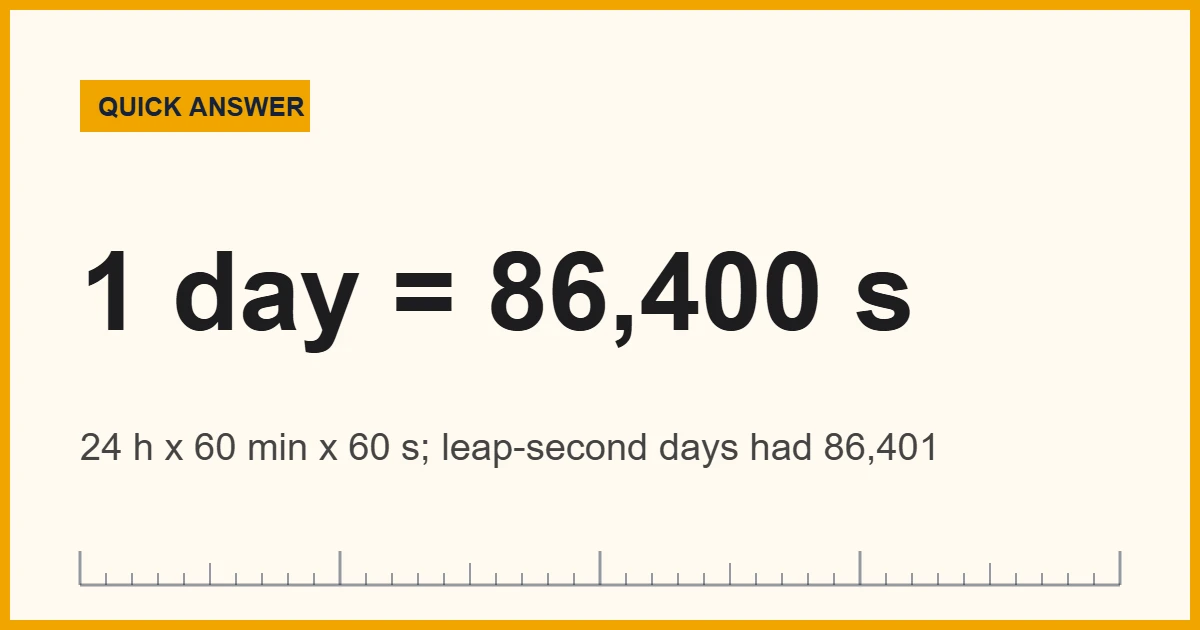
There are 86,400 seconds in a day. That number comes from 24 hours x 60 minutes x 60 seconds, so one calendar day equals 1,440 minutes or 86,400,000 milliseconds. The only exception is a day with a leap second, which has 86,401 seconds. Earth’s spin relative to the stars, however, takes about 86,164.09 seconds.


As an Amazon Associate, Measuring Expert earns from qualifying purchases.
Convert Days to Hours, Minutes and Seconds
Enter any number of days below, including decimals such as 0.5 or 2.75. The converter then multiplies by 86,400 and also shows the result in hours, minutes and milliseconds.
The second is the base unit of time in the International System of Units (SI). Today, however, it does not depend on the sun at all. Instead, the BIPM, which looks after the SI, ties it to an atomic constant: one second is the time cesium-133 atoms take to complete 9,192,631,770 cycles of a specific microwave radiation. The day, by contrast, is not an SI unit at all. Instead, it is simply an accepted unit equal to 24 hours, or exactly 86,400 seconds.
So why do people still argue about the number of seconds in a day? Because “day” can mean three things: the clock day on your phone, the solar day from noon to noon, and the sidereal day that astronomers use. In addition, the official world time scale (UTC) has occasionally added a leap second to keep clocks in step with Earth’s slightly uneven rotation. Therefore, this guide covers all of these, with exact math and a quick chart for weeks, months and years.
Why There Are 86,400 Seconds in a Day
The math takes two steps. First, find the seconds in one hour. Next, multiply by the 24 hours in a day.
3,600 x 24 hours = 86,400 seconds per day
You can also go through minutes: a day holds 24 x 60 = 1,440 minutes, and 1,440 x 60 = 86,400. In both cases you get the same answer, because both simply multiply 24 x 60 x 60. One small correction to a common claim: a minute does not hold “slightly more” than 60 seconds. In fact, on ordinary days every minute has exactly 60 seconds. Only the last minute of a leap-second day has 61, as explained below.
Seconds in a Day, Week, Month and Year (Chart)
This chart starts with the seconds in a day and builds up to longer spans. Every value comes from multiplying 86,400 by the number of days, so you can print it and use it as a reference sheet.
| Time span | Days | Seconds | Minutes |
|---|---|---|---|
| 1 minute | – | 60 | 1 |
| 1 hour | – | 3,600 | 60 |
| Half a day (12 hours) | 0.5 | 43,200 | 720 |
| 1 day (24 hours) | 1 | 86,400 | 1,440 |
| Leap-second day | 1 | 86,401 | 1,440 (last one has 61 s) |
| 3 days (72 hours) | 3 | 259,200 | 4,320 |
| 1 week | 7 | 604,800 | 10,080 |
| 30-day month | 30 | 2,592,000 | 43,200 |
| 31-day month | 31 | 2,678,400 | 44,640 |
| Average month (Gregorian) | 30.436875 | 2,629,746 | 43,829.1 |
| Common year | 365 | 31,536,000 | 525,600 |
| Leap year | 366 | 31,622,400 | 527,040 |
| Average Gregorian year | 365.2425 | 31,556,952 | 525,949.2 |
Note the leap year line. A leap year has 31,622,400 seconds, which is 86,400 more than a common year, not “86,784” as some pages claim. Similarly, the average month uses the Gregorian average year divided by 12. If you count hours instead of seconds, our guide to how long 72 hours is walks through multi-day spans.
Recommended Clocks and Timers for Measuring Seconds
Most clocks drift a few seconds a month, so they slowly fall out of step. A radio-controlled (“atomic”) clock fixes that, because it resets itself from the NIST WWVB radio signal in Colorado, which in turn follows NIST’s atomic time scale. Meanwhile, a good stopwatch is the simplest tool for timing short intervals. Above all, choose a clock with a clear seconds display, and look for a stopwatch with a large screen and lap memory.
Leap Seconds: When a Day Has 86,401 Seconds
Atomic clocks tick with near-perfect regularity, but Earth does not spin at a perfectly steady rate. For example, tides, shifts inside the planet and changes in the atmosphere make the length of a rotation wander by a few milliseconds. Over months, therefore, those milliseconds add up. To stop atomic time from drifting away from the sun, timekeepers added a leap second whenever the gap grew close to 0.9 seconds.
On those days, the clock ran 23:59:58, 23:59:59, 23:59:60 and only then 00:00:00. As a result, that day contained 86,401 seconds. According to NIST’s leap second page, the first leap second came on June 30, 1972, and there have been 27 in total. After that, the most recent one fell on December 31, 2016. A negative leap second (a day of 86,399 seconds) is possible in theory, yet nobody has ever needed one.
Leap seconds cause real trouble for computers, networks and satellite systems, which expect every day to have the same length. For that reason, the General Conference on Weights and Measures (CGPM) voted in November 2022 to change the rule. Its Resolution 4 says the allowed gap between atomic time and Earth-rotation time will grow in, or before, 2035. In practice, that means leap seconds should stop by 2035, and every UTC day will then have exactly 86,400 seconds.
Solar Day vs Sidereal Day: Two Kinds of Seconds in a Day
First, a solar day is the time from one noon to the next. Because Earth also moves along its orbit, it must turn a little more than one full rotation before the sun returns to the same spot in the sky. Averaged over a year, the mean solar day matches the 86,400-second clock day to within a few milliseconds.
A sidereal day, on the other hand, measures one rotation against the distant stars. It lasts about 23 hours, 56 minutes and 4.09 seconds, or roughly 86,164.09 seconds. As a result, it is about 236 seconds (nearly 4 minutes) shorter than a clock day. For this reason, astronomers use it to point telescopes, since a star rises about 4 minutes earlier each night.
| Kind of day | What it measures | Length in seconds |
|---|---|---|
| Civil (clock) day | 24 hours of SI seconds | 86,400 exactly |
| Leap-second day (UTC) | Clock day plus one inserted second | 86,401 |
| Mean solar day | Noon to noon, averaged over a year | About 86,400 (varies by milliseconds) |
| Apparent solar day | Noon to noon on a given date | Varies by up to about 30 s around the year |
| Sidereal day | One rotation relative to the stars | About 86,164.09 |
Daylight saving time is also another twist. On the spring-forward date in the US, the local day has only 23 hours (82,800 seconds), and on the fall-back date it has 25 hours (90,000 seconds). Even so, UTC itself does not change.
How to Calculate the Seconds in Any Number of Days
- Write down the number of days. Include fractions, for example 2.5 days.
- Multiply by 24 to get hours. 2.5 x 24 = 60 hours.
- Turn the hours into minutes. Multiply by 60: 60 x 60 = 3,600 minutes.
- Convert the minutes to seconds. Again multiply by 60: 3,600 x 60 = 216,000 seconds.
- Check your answer with the shortcut. Days x 86,400 should give the same result: 2.5 x 86,400 = 216,000.
- Adjust for special days if needed. Add 1 second for a leap-second day, and add or subtract 3,600 seconds for a daylight saving change.
To go the other way, simply divide seconds by 86,400. For instance, 1,000,000 seconds / 86,400 = about 11.57 days.
Counting Seconds in a Day: Do and Don’t
Do
- Use 86,400 for any normal calendar day.
- Multiply by 365 or 366 for a specific year.
- Store times in UTC when you write software.
- Note daylight saving dates for local schedules.
- Pick the sidereal day only for astronomy.
Don’t
- Assume a minute has more than 60 seconds.
- Use 30 days for every month in contracts.
- Forget leap years in long-term totals.
- Mix up solar and sidereal time.
- Trust a cheap quartz clock for exact seconds.
Honest Limits of the 86,400 Figure
For homework, cooking timers and project planning, 86,400 is the right answer every time. Still, a few limits apply. First, the number describes the clock day, not the exact time Earth takes to turn, which drifts by milliseconds. Second, past leap-second days really did contain 86,401 seconds, so precise historical timestamps must account for them. Third, local time zones can make a day 23 or 25 hours long. Finally, ordinary clocks are only as good as their crystal, so a wall clock without radio sync can gain or lose several seconds a month.
When Every Second Really Matters
Admittedly, most of us never notice a stray second. However, some fields depend on it:
- Navigation. Satellite positioning relies on precise timing, so errors matter. For example, a clock error of one microsecond equals about 300 meters of light travel.
- Networks and trading. Servers timestamp events in milliseconds, so they sync to atomic time.
- Science. Astronomers convert between sidereal and solar time to track objects.
- Deadlines. Similarly, legal and billing periods often depend on local time, including daylight saving.
For a lighter take on time units, see how long a moment is, a medieval unit that lasted about 90 seconds. Likewise, our page on how long a decade is scales the same math up to years.
Frequently Asked Questions
How many seconds in a day exactly?
There are exactly 86,400 seconds in a normal calendar day: 24 x 60 x 60. A day with a leap second has 86,401.
How many seconds in a day with a leap second?
A leap-second day has 86,401 seconds, because the clock shows 23:59:60 before midnight. The last one was December 31, 2016.
Are leap seconds going away?
Yes, most likely. In 2022 the CGPM decided to widen the allowed gap between atomic and Earth-rotation time in or before 2035, which should end new leap seconds.
How many seconds are in a sidereal day?
A sidereal day lasts about 86,164.09 seconds, or 23 hours, 56 minutes and 4.09 seconds. In other words, it measures one turn of Earth relative to the stars.
How many minutes are in a day?
There are 1,440 minutes in a day. Multiply by 60 and you get the 86,400 seconds.
How many seconds are in a week?
A week has 604,800 seconds, because 7 x 86,400 = 604,800.
How many seconds are in a year?
A common year has 31,536,000 seconds, while a leap year has 31,622,400. The average Gregorian year has 31,556,952.
How many seconds are in a month?
It depends on the month: 2,592,000 for 30 days, 2,678,400 for 31 days, and about 2,629,746 on average.
How many seconds in a day are there in milliseconds?
One day is 86,400,000 milliseconds, since each second has 1,000. To convert, multiply the 86,400 seconds by 1,000.
Does daylight saving time change the seconds in a day?
Locally, yes. The spring-forward day has 82,800 seconds, whereas the fall-back day has 90,000. UTC days, however, stay at 86,400.
Seconds in a Day: The Bottom Line
In short, a standard day has 86,400 seconds: 24 hours of 60 minutes, each with 60 seconds. Leap-second days had 86,401, the last one in 2016, and the CGPM plans to stop adding them by 2035. A sidereal day, meanwhile, is shorter, at about 86,164.09 seconds.
So for everyday math, simply multiply days by 86,400, or let the converter at the top of this page do it for you.
Black Friday is coming: shop the deals with Prime
11 thoughts on “How Many Seconds in a Day? 86,400, Leap Seconds and Sidereal Days”