


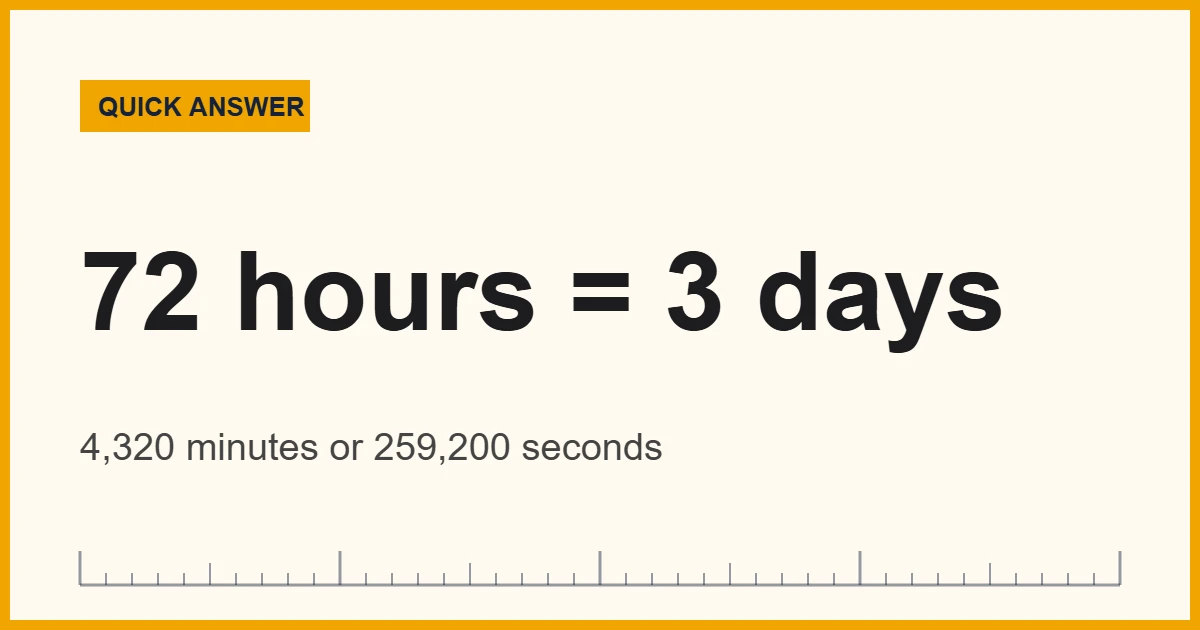
72 hours is exactly 3 days. Because one day has 24 hours, 72 / 24 = 3. In other words, that also equals 4,320 minutes, 259,200 seconds, or about 0.43 of a week. So if a 72-hour window starts Monday at 9 am, it ends Thursday at 9 am.
Convert 72 Hours to Days, Minutes and Seconds
Enter any number of hours below. Then the converter shows the same span in days, minutes, seconds and weeks, so you can check 48, 72 or 96 hours in one place.
| Hours | Days | Minutes | Seconds |
|---|---|---|---|
| 24 | 1 | 1,440 | 86,400 |
| 48 | 2 | 2,880 | 172,800 |
| 72 | 3 | 4,320 | 259,200 |
People search for this number when a deadline, a delivery promise or an instruction says “within 72 hours.” In fact, the phrase sounds longer and more formal than “three days,” yet it means exactly the same amount of elapsed time. However, the way you count it matters. A 72-hour clock runs nonstop through nights and weekends, while “3 business days” usually does not.
The math rests on fixed definitions. For example, the National Institute of Standards and Technology (NIST) lists the hour and the day as units accepted for use with the SI in its Guide to the SI, chapter 5: 1 hour is 3,600 seconds and 1 day is 24 hours, or 86,400 seconds. Therefore 72 hours is 72 x 3,600 = 259,200 seconds, and that figure never changes.
Below you will find a quick chart, then a simple method for counting from any start time. After that, the guide covers calendar days versus business days, daylight saving time, and the emergency “72-hour kit” advice.
72 Hours and Other Common Spans: Quick Chart
For quick reference, this chart lists the hour counts people look up most often. All values are exact, since every row is just a multiple of 24 hours, 60 minutes and 60 seconds.
| Hours | Days | Minutes | Seconds | Share of a week |
|---|---|---|---|---|
| 1 | 1/24 (0.042) | 60 | 3,600 | 0.6% |
| 6 | 1/4 | 360 | 21,600 | 3.6% |
| 12 | 1/2 | 720 | 43,200 | 7.1% |
| 24 | 1 | 1,440 | 86,400 | 14.3% |
| 36 | 1 1/2 | 2,160 | 129,600 | 21.4% |
| 48 | 2 | 2,880 | 172,800 | 28.6% |
| 60 | 2 1/2 | 3,600 | 216,000 | 35.7% |
| 72 | 3 | 4,320 | 259,200 | 42.9% |
| 96 | 4 | 5,760 | 345,600 | 57.1% |
| 120 | 5 | 7,200 | 432,000 | 71.4% |
| 168 | 7 | 10,080 | 604,800 | 100% |
Also, you can print this chart or save it as a PDF from your browser, and it fits on one page. For the seconds side of the math, see our guide to how many seconds are in a day.
The Math Behind the Conversion
As a result, each conversion uses one step. First, divide by 24 to get days. Next, multiply by 60 to get minutes. Finally, multiply by 3,600 to get seconds.
- Days: 72 / 24 = 3 days.
- Minutes: 72 x 60 = 4,320 minutes.
- Seconds: 72 x 3,600 = 259,200 seconds.
- Weeks: 72 / 168 = 0.4286 weeks, or 3/7 of a week.
- Milliseconds: 259,200 x 1,000 = 259,200,000 ms.
In addition, it helps to picture the span in work terms. At 8 hours a day, 72 hours equals 9 full workdays of clock time. Likewise, it is 1.8 standard 40-hour workweeks. Of course, those are clock hours, not calendar days.
How to Count 72 Hours From a Start Time
In short, a 72-hour period ends at the same clock time it started, three days later. So the only skill you need is moving the date forward correctly.

- Write down the exact start. Note the date, the time, and the time zone, for example Monday 9:00 am Eastern.
- Add three to the date. Monday becomes Thursday; the 29th of a 30-day month becomes the 2nd of the next month.
- Keep the same clock time. A window that opens at 9:00 am closes at 9:00 am, so Monday 9:00 am ends Thursday 9:00 am.
- Check for a clock change. If the span crosses a daylight saving switch, shift the end time by one hour (see below).
- Confirm the time zone. Next, make sure the deadline uses your zone and not the sender’s, and convert if they differ.
- Use the converter for odd spans. Enter hours such as 70 or 75 in the converter above to see the days and leftover hours.
| Start | Ends at |
|---|---|
| Monday 9:00 am | Thursday 9:00 am |
| Wednesday 6:00 pm | Saturday 6:00 pm |
| Friday 5:00 pm | Monday 5:00 pm |
| Saturday 11:30 pm | Tuesday 11:30 pm |
72 Hours vs 3 Business Days
In fact, this is where most confusion comes from. A 72-hour window counts every hour on the clock. By contrast, “3 business days” usually skips weekends and public holidays, and it may only count working hours. As a result, the two can end on very different days.
| Phrase | What it usually counts | Example starting Friday 5 pm |
|---|---|---|
| 72 hours | Every hour, nights and weekends included | Ends Monday 5 pm |
| 3 calendar days | Every day on the calendar; the exact end time depends on the rule | Usually ends Monday |
| 3 business days | Weekdays only, often excluding holidays | Usually ends Wednesday (Thursday if Monday is a holiday) |
| 24 working hours x 3 | Rare, because only staffed hours count | Can stretch past a week |
Do 72 Hours Change With Daylight Saving Time?
Elapsed time does not change; however, the wall clock does. In the United States, clocks fall back one hour on the first Sunday in November, so a 72-hour span across that night ends one hour earlier on the clock. For example, 72 elapsed hours from Friday, October 30, 2026 at 2:00 pm Eastern ends Monday, November 2 at 1:00 pm. Similarly, in spring the clocks jump forward, so the same span ends one hour later on the clock.
For example, most everyday deadlines simply use the clock time (“respond by Thursday 9 am”). Still, for medication timing, lab work or shift limits, the elapsed hours are what count, so subtract or add that hour.
The 72-Hour Emergency Kit: What the Guidance Says
The best-known use of the phrase is the “72-hour kit,” a bag of supplies meant to carry a household through the first days after a disaster. Also, the name comes from the idea of being self-reliant for about three days until help arrives.

Current official advice, however, is worded more broadly. Ready.gov, the FEMA preparedness site, recommends in its basic disaster supplies kit one gallon of water per person per day for several days, plus at least a several-day supply of non-perishable food. Meanwhile, the American Red Cross survival kit list suggests a 3-day supply for evacuation and a 2-week supply for home.
So the 72-hour figure is a minimum for a grab-and-go bag, not a ceiling. At one gallon per person per day, a 72-hour supply works out to 3 gallons (about 11.4 liters) of water per person. Therefore, for a family of four, that is 12 gallons, or about 45.4 liters.
Do and Don’t When Counting Hours
Do
- First, write down the start date, time and time zone.
- End the window at the same clock time, three days later.
- Also, check whether the rule means hours or business days.
- Adjust by one hour across a daylight saving change.
- Finally, set a phone reminder a few hours before the end.
Don’t
- Assume a “72-hour” deadline skips weekends.
- Count the start day as day one and end a day early.
- Forget that months have 28 to 31 days, so check month ends.
- Mix up the sender’s time zone with yours; instead, convert it.
- Treat a 3-day kit as enough for a long outage, because it is a minimum.
Honest Limits of Hour-to-Day Math
The conversion itself is exact: the span is always 3 days of 86,400 seconds each. Even so, a few things blur the edges in real life, for example clock changes. For one, civil time occasionally inserts a leap second, which makes one particular minute 61 seconds long; that matters for scientists and network engineers, not for deadlines. Also, a daylight saving change makes one calendar day 23 or 25 hours long, so “3 days” on the calendar and 72 elapsed hours can differ by one hour. In short, use elapsed hours when precision matters and the calendar when a person set the deadline.
When the Count Must Be Exact
Generally, for most plans, being off by an hour is harmless. In a few situations, however, the exact count matters:
- Medicine schedules. If a label gives an interval in hours, count elapsed hours and set alarms. Then ask a pharmacist if a clock change or a missed dose leaves you unsure.
- Legal, rental and refund deadlines. In these cases, the document decides how time is counted, so read it closely.
- Lab and food-safety work. Incubation and holding times follow the written method; log the start and end with a timestamp.
Related Time Conversions
If you are planning around shorter spans, our guide to how long 90 minutes is breaks down hours and minutes the same way. On the other end of the scale, see how long a decade is in years, days and hours. Finally, for counting weekdays across a year, try how many Sundays are in a year.
72 Hours: Frequently Asked Questions
How many days is 72 hours?
It is exactly 3 days, because 72 divided by 24 equals 3.
How many minutes are in 72 hours?
That span holds 4,320 minutes (72 x 60).
How many seconds are in 72 hours?
That span holds 259,200 seconds (72 x 3,600).
If it is Monday at 9 am, when do 72 hours end?
They end Thursday at 9 am. In other words, a 72-hour span always ends at the same clock time three days later, unless a daylight saving change falls in between.
Is 72 hours the same as 3 business days?
No. 72 hours counts weekends and holidays, while 3 business days usually skips them. Starting Friday at 5 pm, the hour count ends Monday at 5 pm, but 3 business days usually ends Wednesday.
How many weeks is 72 hours?
It is 3/7 of a week, or about 0.43 weeks, because a week has 168 hours.
How many 8-hour workdays are in 72 hours?
That much work time equals 9 workdays of 8 hours, or 1.8 workweeks of 40 hours.
Does daylight saving time change a 72-hour period?
The elapsed time stays the same, but the clock end time shifts by one hour. In the fall it ends an hour earlier on the clock; in spring it ends an hour later.
How much water is in a 72-hour emergency kit?
At the commonly advised one gallon per person per day, a 3-day supply is 3 gallons (about 11.4 liters) per person. Ready.gov advises water for several days, so more is better.
How many hours are in 3 days?
There are 72 hours in 3 days, because each day has 24 hours.
The Bottom Line on 72 Hours
To sum up, 72 hours equals 3 days, 4,320 minutes or 259,200 seconds, and it ends at the same clock time three days after it starts. Just remember that it runs through weekends, unlike 3 business days, and that a daylight saving change moves the clock end by one hour.
For any other span, enter the hours in the converter at the top of this page. Then write down the exact end date and time so the deadline cannot surprise you.
8 thoughts on “How Long Is 72 Hours? 3 Days, 4,320 Minutes and How to Count It”