


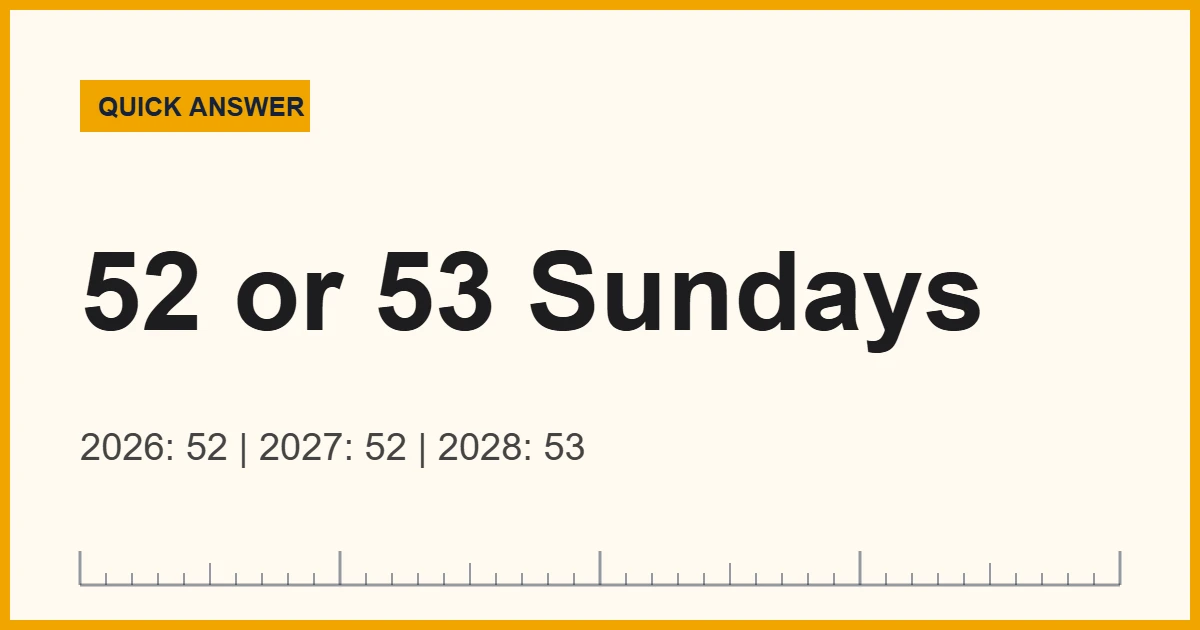
Most years have 52 Sundays in a year, but some have 53. A 365-day common year is 52 weeks plus 1 day, so it gets 53 Sundays only if January 1 is a Sunday. A 366-day leap year gets 53 if it starts on Saturday or Sunday. So 2026 and 2027 have 52, and 2028 has 53.
Count the Sundays in Any Year
Enter a year below and choose a weekday. The counter then walks through every date of that Gregorian year and reports how many times the day occurs, so you can check Sundays, paydays that fall on Fridays, or any other weekday.
| Year | Sundays |
|---|---|
| 2026 | 52 |
| 2027 | 52 |
| 2028 | 53 |
| 2034 | 53 |
The question sounds like trivia, yet the answer matters for real planning. For example, churches schedule a year of services, payroll teams count pay periods, and anyone booking a weekly Sunday class or rental needs the right total. Unfortunately, a lot of pages online say every year has exactly 52 Sundays. However, that is wrong about one year in six.
The reason, in fact, is simple arithmetic. A week has 7 days, and 52 weeks cover 364 days. Because no calendar year is exactly 364 days long, there are always 1 or 2 days left over, and those leftover days repeat whatever weekdays the year started with. As a result, one or two weekdays occur 53 times in every year.
The leap year rule decides whether you have 1 or 2 extra days. According to the US Naval Observatory’s calendar FAQ, a year divisible by 4 is a leap year, except century years, which are leap years only when divisible by 400. So 2000 was a leap year, but 2100 will not be. The same rule appears in the leap year guide at timeanddate.com.
Sundays in a Year: 2024 to 2035 Table
Each row below was computed date by date in Python using the Gregorian calendar. In addition, highlighted rows are the years with 53 Sundays.
| Year | Days | Starts on | Ends on | Sundays |
|---|---|---|---|---|
| 2024 | 366 (leap) | Monday | Tuesday | 52 |
| 2025 | 365 | Wednesday | Wednesday | 52 |
| 2026 | 365 | Thursday | Thursday | 52 |
| 2027 | 365 | Friday | Friday | 52 |
| 2028 | 366 (leap) | Saturday | Sunday | 53 |
| 2029 | 365 | Monday | Monday | 52 |
| 2030 | 365 | Tuesday | Tuesday | 52 |
| 2031 | 365 | Wednesday | Wednesday | 52 |
| 2032 | 366 (leap) | Thursday | Friday | 52 |
| 2033 | 365 | Saturday | Saturday | 52 |
| 2034 | 365 | Sunday | Sunday | 53 |
| 2035 | 365 | Monday | Monday | 52 |
Looking further ahead, the next years with 53 Sundays after 2034 are 2040, 2045, 2051 and 2056. The most recent one before 2028 was 2023, which began and ended on a Sunday.
Why Some Years Have 53 Sundays in a Year
Think of the year as 52 full weeks plus a short tail. Because every weekday appears once in each full week, every weekday gets 52 appearances. Next, the tail adds one more appearance to the first one or two weekdays of the year.

- Common year (365 days): 365 = 52 x 7 + 1. Only the weekday of January 1 gets a 53rd appearance, and December 31 falls on that same weekday.
- Leap year (366 days): 366 = 52 x 7 + 2. The weekdays of January 1 and January 2 both get a 53rd appearance.
Therefore, a common year needs to start on Sunday to get 53 Sundays. A leap year, by contrast, gets 53 if it starts on Saturday (so January 2 is a Sunday) or on Sunday. In 2028, for example, January 1 is a Saturday and January 2 is a Sunday, so the year ends on Sunday, December 31, with 53 Sundays in total.
Over the full 400-year Gregorian cycle, 71 of the 400 years have 53 Sundays, which is about 17.8 percent, or roughly one year in six. In short, 52 is the usual answer, but 53 is far from rare.
52 Weeks vs 52 Sundays vs ISO Weeks
Meanwhile, three different counts get mixed up in this topic. They often match, yet they do not always agree, so it helps to keep them apart.
| Term | What it counts | Typical value |
|---|---|---|
| Weeks in a year | 365 / 7 or 366 / 7 | 52.14 or 52.29 weeks |
| Sundays (or any weekday) | Actual dates that fall on that day | 52 or 53 |
| ISO 8601 week numbers | Monday-to-Sunday weeks; week 1 contains the first Thursday | 52 or 53 numbered weeks |
| Weekends | Saturday-Sunday pairs | 52, sometimes 53 when both extra days are Sat and Sun |
For example, 2026 has 53 ISO weeks because it starts on a Thursday, but it has only 52 Sundays. On the other hand, 2028 has 53 Sundays but 52 ISO weeks. So a business that budgets by ISO week numbers and a church that counts Sunday dates can get different totals for the same year.
How to Count Sundays in a Year by Hand
You do not need a calendar app. Instead, you only need two facts: whether the year is a leap year and which weekday January 1 falls on.
- Check for a leap year. Divide the year by 4. If it divides evenly, it is a leap year, unless it ends in 00 and does not divide evenly by 400.
- Find the weekday of January 1. Look at any calendar, or use the counter above. A common year moves January 1 forward by one weekday; a leap year moves the next January 1 forward by two.
- Apply the common-year rule. If the year has 365 days, it has 53 Sundays only when January 1 is a Sunday.
- Apply the leap-year rule. If the year has 366 days, it has 53 Sundays when January 1 is a Saturday or a Sunday.
- Otherwise, the answer is 52. Any other starting day leaves the extra days on weekdays other than Sunday.
- Double-check with December 31. In a 53-Sunday year, December 31 is always a Sunday, so a quick look at the last page of the calendar confirms your count.
Common Mistakes When Counting Sundays in a Year
Most of the time, wrong answers come from a few shortcuts that look reasonable but skip the leftover days. Here is what to do and what to avoid.
Do
- Start from the weekday of January 1.
- Check the leap year rule, including the 400-year exception.
- Confirm with December 31 for 53-Sunday years.
- Count dates, not week numbers, when you need actual Sundays.
- Use local dates for scheduling in your own time zone.
Don’t
- Assume 365 / 7 rounds to the right answer every time.
- Treat every year divisible by 4 as a leap year (2100 is not).
- Mix up ISO week numbers with Sunday counts.
- Subtract holidays; a holiday on a Sunday is still a Sunday.
- Copy last year’s total without checking the new start day.
Honest Limits of the 52 or 53 Rule
To begin with, the rule is exact for the Gregorian calendar, which the US and nearly every country use for civil dates. Even so, a few edge cases are worth knowing. First, years before a country adopted the Gregorian calendar (1582 in parts of Europe, 1752 in Britain and its American colonies) followed the Julian calendar, so historical counts can differ. Similarly, religious calendars such as lunar or lunisolar calendars have their own year lengths. Finally, the date line means it can be Sunday in one place and Saturday in another at the same moment, although each location still has the same number of Sunday dates in its own calendar year. In addition, a time zone does not change your total; it only shifts when each Sunday begins.
The Gregorian year averages 365.2425 days, which is close to the solar year of about 365.2422 days. That small gap is why century years skip the leap day, and it is also why the pattern of 53-Sunday years repeats exactly only every 400 years. For more on long time spans, see our guide to how long a decade is.
When the Exact Count Really Matters
For trivia, of course, 52 is close enough. For planning, however, the extra Sunday can change budgets and schedules.
- Weekly payroll and rent. Weekly pay runs on a fixed weekday, so a year with 53 of that weekday has 53 paydays instead of 52.
- Church and volunteer schedules. A 53-Sunday year needs one more service plan, reading, or rota slot.
- Classes, leagues and rentals. Weekly Sunday bookings priced per session cost more in a 53-Sunday year.
- Holiday countdowns. Counting weeks until a date works the same way; our days until Thanksgiving page shows a similar date calculation.
If you also need smaller units of time, our page on how many seconds are in a day walks through the 86,400-second day.
Frequently Asked Questions
How many Sundays in a year are there usually?
Usually 52. About one year in six has 53, because a year is always 1 or 2 days longer than 52 weeks.
How many Sundays are in 2026?
2026 has 52 Sundays. It starts and ends on a Thursday, so Thursday is the only weekday that appears 53 times.
How many Sundays are in 2027?
2027 has 52 Sundays. It is a common year that starts on a Friday, so it has 53 Fridays instead.
How many Sundays are in 2028?
2028 has 53 Sundays. It is a leap year that starts on Saturday, January 1, so January 2 and December 31 are both Sundays.
Can a year have 54 Sundays?
No. A year has at most 366 days, which is 52 weeks plus 2 days, so no weekday can occur more than 53 times.
Which leap years have 53 Sundays?
A leap year has 53 Sundays when it starts on a Saturday or a Sunday. For example, 2028 starts on a Saturday.
Do holidays change the number of Sundays in a year?
No. A holiday that falls on a Sunday is still a Sunday, so it does not add or remove any Sundays from the count.
How many Saturdays are in a year?
Also 52 or 53. A common year has 53 Saturdays if it starts on Saturday; a leap year has 53 if it starts on Friday or Saturday.
How many weekends are in a year?
Most years have 52 full Saturday-Sunday weekends. A leap year that starts on a Saturday, such as 2028, has 53.
How often does a year have 53 Sundays?
In the 400-year Gregorian cycle, 71 years have 53 Sundays, about 17.8 percent. Recent and upcoming examples are 2023, 2028, 2034 and 2040.
Sundays in a Year: The Bottom Line
To sum up, the answer is 52 in most years and 53 in about one year in six. A common year gets 53 Sundays only when it starts on a Sunday, and a leap year gets 53 when it starts on a Saturday or Sunday. That makes 2026 and 2027 52-Sunday years, while 2028 and 2034 have 53.
So next time you plan a year of weekly events, check January 1 first, or simply enter the year in the counter at the top of this page.
Read unlimited home, cooking and DIY books