

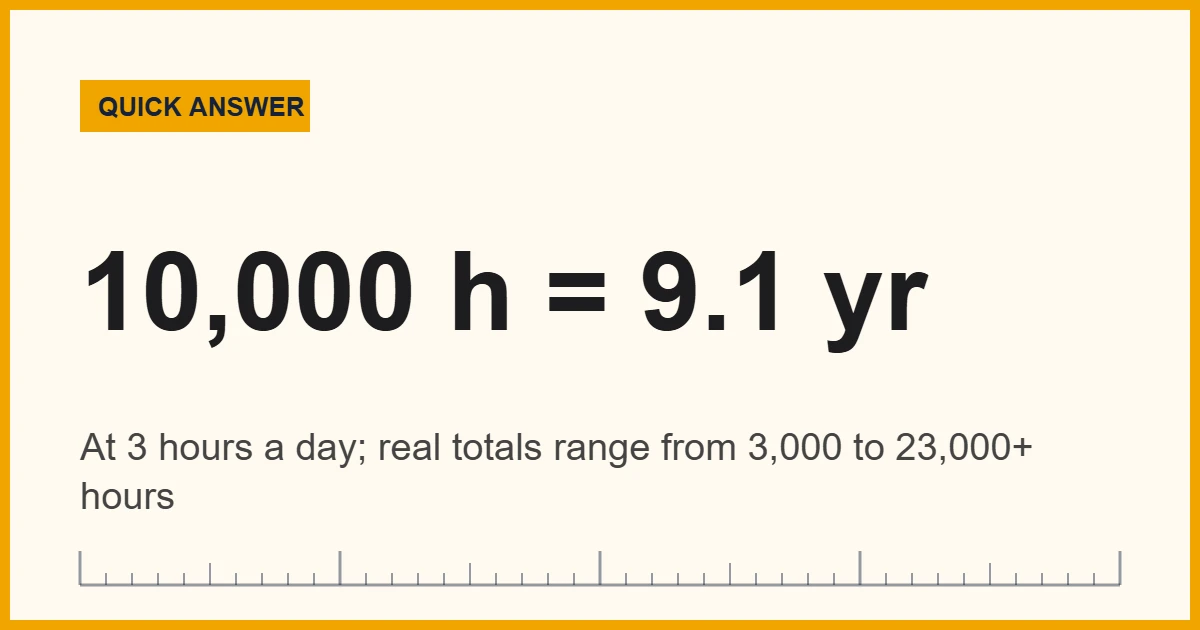
How many hours to become an expert? There is no fixed number. The famous 10,000 hours is an average from a 1993 study of violin students, not a rule. In chess, players needed anywhere from about 3,000 to more than 23,000 hours to reach master level. At 3 hours a day, 10,000 hours takes about 9.1 years.
So the honest answer depends on the skill, how you practice, and where you start. Below, you will see what the research found and how to turn an hour goal into years.
Convert Practice Hours Into Days and Years
Enter a practice goal in hours to see it in nonstop days, weeks, months and years. For example, 10,000 hours is about 417 days.
| Hours | Days | Weeks | Years |
|---|---|---|---|
| 20 | 0.83 | 0.12 | 0.002 |
| 1,000 | 41.67 | 5.95 | 0.114 |
| 10,000 | 416.7 | 59.52 | 1.141 |
Where the 10,000-Hour Rule Came From
In 1993, psychologist Anders Ericsson and his colleagues studied violin students at a Berlin music academy. Overall, the best group had logged about 10,000 hours of practice by age 20, on average. However, that was only an average. In fact, Ericsson later wrote that half of the ten top violinists had not reached 10,000 hours at that age.
Malcolm Gladwell then popularized the figure in his 2008 book Outliers. As a result, a research average turned into a “rule.” Ericsson pushed back in a 2016 excerpt from his book Peak. For example, he noted that a memory champion needed about 200 hours, while top pianists often practice 20,000 to 25,000 hours.
Hours to Become an Expert by Field
| Skill | Hours reported | Source |
|---|---|---|
| Memory contests | About 200 | Ericsson, Peak |
| Chess master (2200 Elo) | About 3,000 to 23,000+; average about 11,000 | Gobet and Campitelli |
| Top violin students by age 20 | About 10,000 on average | Ericsson, 1993 |
| Elite pianists | 20,000 to 25,000 | Ericsson, Peak |
Specifically, the chess figures come from a study by Fernand Gobet and Guillermo Campitelli, summarized by ChessBase.
How Long 10,000 Hours Takes on Your Schedule
First fix a daily or weekly amount. In addition, we use the average year of 365.2425 days.
| Practice schedule | Time to reach 10,000 hours |
|---|---|
| 1 hour a day, every day | About 27.4 years |
| 2 hours a day, every day | About 13.7 years |
| 3 hours a day, every day | About 9.1 years |
| 4 hours a day, every day | About 6.8 years |
| 20 hours a week | About 9.6 years |
| 40 hours a week, 50 weeks a year | 5 years |
Want to see how hours stack into days? Our guide to how long 72 hours is walks through the same conversion. Similarly, the count of Sundays in a year shows why rest days change a yearly total.
Why Hours Alone Will Not Help You Become an Expert
Practice matters, but it explains less than most people think. A 2014 meta-analysis by Macnamara, Hambrick and Oswald, reported by the Association for Psychological Science, found that deliberate practice explained about 12% of performance differences overall.
| Field | Share of performance differences explained by practice |
|---|---|
| Games | 26% |
| Music | 21% |
| Sports | 18% |
| Education | 4% |
| Professions | Less than 1% |
In other words, starting age, coaching and ability explain much of the rest.
How to Become an Expert Faster
Above all, Ericsson’s main point was about the kind of practice, not the clock. For this reason, here is a plan built on that idea.
- Pick one narrow skill, such as sight-reading or chess endgames.
- Next, set a specific goal for each session.
- Also, practice at the edge of your ability, where you make mistakes.
- After that, get fast feedback from a coach, a recording or a score.
- Then fix one weakness at a time and repeat.
- Finally, log your hours in a sheet to track progress.
Become an Expert: Frequently Asked Questions
How many hours does it take to become an expert?
There is no fixed number. The 10,000-hour figure is an average from one violin study, and chess masters needed about 3,000 to 23,000+ hours.
Is the 10,000-hour rule true?
Only in part. Practice matters, but a 2014 meta-analysis found it explained about 12% of performance differences overall.
How many years is 10,000 hours?
About 1.14 years if you practiced nonstop. However, at 3 hours a day it takes about 9.1 years, and at 40 hours a week for 50 weeks a year it takes 5 years.
What is the 20-hour rule?
It is author Josh Kaufman’s idea that about 20 hours of focused practice makes you reasonably good at a new skill. It aims at basic skill, not expert level.
Can you become an expert in 2 years?
Sometimes. Two years at 3 hours a day gives about 2,191 hours, which can be enough for a narrow skill but rarely for chess or music.
What is deliberate practice?
In short, it is focused practice with a clear goal, fast feedback and tasks just beyond your current level.
Did Malcolm Gladwell invent the 10,000-hour rule?
No. Instead, he popularized it in his 2008 book Outliers, based on research by Anders Ericsson and his colleagues.
Does talent matter as much as practice?
It can. Practice left most performance differences unexplained in the 2014 meta-analysis, so starting age, coaching and ability also count.
Do work hours count toward expertise?
Only partly. In the 2014 meta-analysis, practice explained less than 1% of performance differences in professions.
How do I track my practice hours?
First, log each session, then enter your total in the converter above.
Bottom Line
In short, 10,000 hours is a famous average, not a law. The hours to become an expert range from a few hundred in narrow skills to over 20,000 in chess or piano. Focus on how you practice, then use the converter to plan your timeline. For a lighter look at time units, read how long a moment is.