

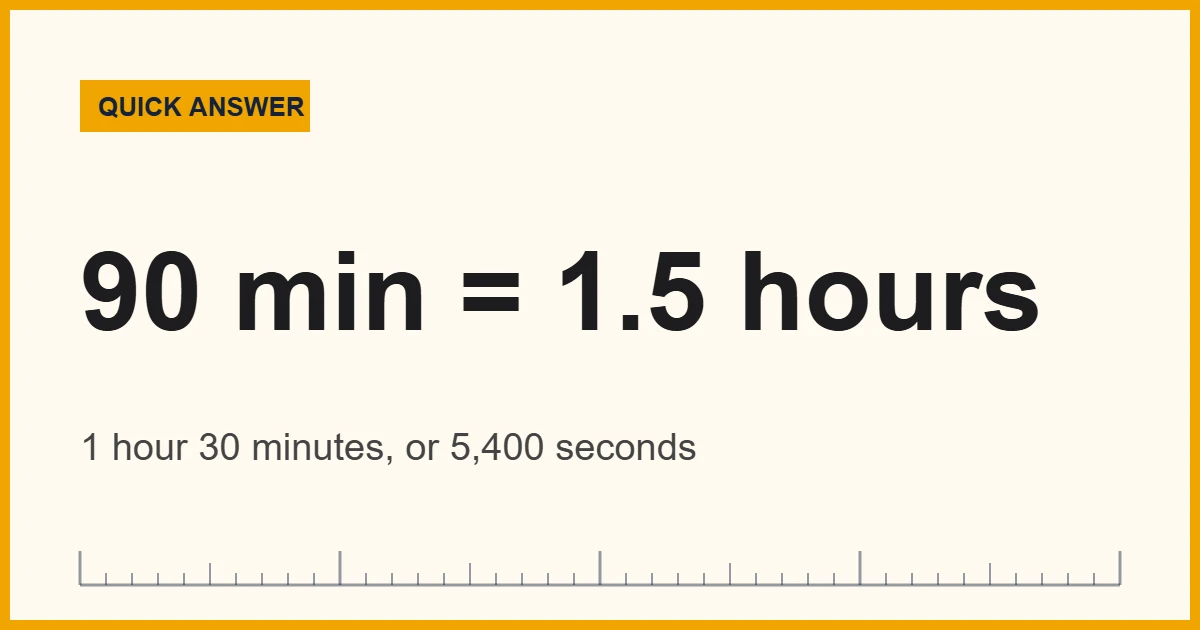
90 minutes is exactly 1.5 hours, or 1 hour and 30 minutes. Because one hour always has 60 minutes, you divide 90 by 60 to get 1.5. The same span equals 5,400 seconds, 0.0625 of a day, and one sixteenth of a full 24-hour day. It is also the length of a regulation soccer match.
Convert 90 Minutes to Hours, Seconds and Days
First, type any number of minutes below, or switch the unit. The converter then shows the same span in seconds, hours, days and weeks, so you can check any other duration as well.
Ninety minutes shows up almost everywhere, especially in sports and school. A soccer match runs that long, many movies land near it, and plenty of classes, meetings and workouts book the same slot. Still, the number trips people up, because “1.5 hours” and “1 hour 50 minutes” look alike on a screen.
Overall, the math itself never changes. An hour has 60 minutes and a minute has 60 seconds, so these values are fixed definitions, not estimates. For example, the SI unit of time is the second, and the minute and hour are accepted units built on it, as the BIPM SI Brochure explains. In short, 90 minutes always equals 5,400 seconds, wherever you are.
Below, you will find a quick chart, the simple formula, and the decimal-hours mistake to avoid. After that, we cover what fits into 90 minutes and how to time it well.
90 Minutes Conversion Chart
First, this chart lists the conversions people ask about most. Every value comes straight from the definitions of the minute, hour and day, so nothing here is rounded unless it says “about”.
| Unit | Equals | How it is worked out |
|---|---|---|
| Hours (decimal) | 1.5 h | 90 / 60 |
| Hours and minutes | 1 h 30 min | 60 min + 30 min |
| Seconds | 5,400 s | 90 x 60 |
| Milliseconds | 5,400,000 ms | 5,400 x 1,000 |
| Days | 0.0625 day (1/16) | 90 / 1,440 |
| Share of a day | 6.25% | 0.0625 x 100 |
| Weeks | about 0.0089 week | 90 / 10,080 |
| Half-hour blocks | 3 | 90 / 30 |
| Quarter-hour blocks | 6 | 90 / 15 |
Similarly, nearby values follow the same rule. For instance, 75 minutes is 1.25 hours, 100 minutes is 1 hour 40 minutes, and 150 minutes is 2.5 hours. A full day holds exactly 16 blocks of 90 minutes, while a week holds 112.
Recommended Timers and Stopwatches
Generally, a phone works for casual timing. However, a dedicated timer is easier to read across a room, it keeps running when your phone dies, and it does not pull you into notifications. First, look for a timer that counts up to at least 99 minutes, since some cheap kitchen timers stop at 59. Next, check for a loud alarm and a magnet or stand. Finally, a stopwatch with lap memory helps if you split 90 minutes into intervals.


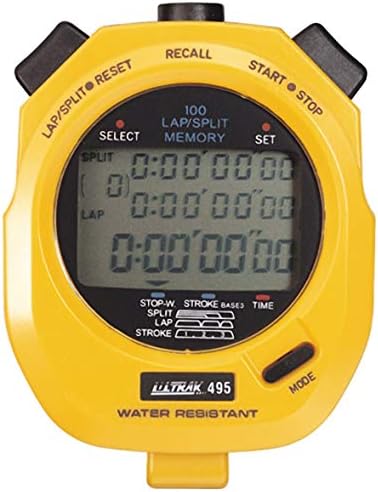

As an Amazon Associate, Measuring Expert earns from qualifying purchases.
The Minutes-to-Hours Formula
Basically, converting minutes to hours takes one step: divide by 60. So 90 / 60 = 1.5, which means one full hour plus half of another hour. Conversely, to go the other way, multiply hours by 60. For example, 1.5 x 60 brings you back to 90.
When you want hours and minutes instead of a decimal, use whole-number division. First, find how many full 60s fit into 90; the answer is 1. Then take the remainder, which is 30. As a result, you get 1 hour 30 minutes.
| Minutes | Decimal hours | Hours and minutes | Seconds |
|---|---|---|---|
| 15 | 0.25 | 0 h 15 min | 900 |
| 30 | 0.5 | 0 h 30 min | 1,800 |
| 45 | 0.75 | 0 h 45 min | 2,700 |
| 60 | 1 | 1 h 0 min | 3,600 |
| 75 | 1.25 | 1 h 15 min | 4,500 |
| 90 | 1.5 | 1 h 30 min | 5,400 |
| 120 | 2 | 2 h 0 min | 7,200 |
| 180 | 3 | 3 h 0 min | 10,800 |
If you work with seconds a lot, our guide to how many seconds are in a day uses the same chain of 60s.
Is 90 Minutes 1.5 Hours or 1.30 Hours?
Notably, this is the most common mistake with 90 minutes. For example, a clock writes the time as 1:30, which reads like “one point three”. In decimal hours, though, 30 minutes is half an hour, so the correct decimal is 1.5, not 1.3. Meanwhile, 1.3 hours is only 78 minutes.
| People often confuse | What it really means |
|---|---|
| 1:30 (clock format) | 1 hour 30 minutes = 90 min |
| 1.5 h (decimal hours) | 1 hour 30 minutes = 90 min |
| 1.3 h (decimal hours) | 1 hour 18 minutes = 78 minutes |
| 1.50 on a timesheet | Usually decimal, so 1 h 30 min; check the form |
How to Time 90 Minutes Accurately
- Pick one clock. Use a single timer or stopwatch for the whole session, so you never mix two devices.
- Set the full span. Enter 1:30:00 on a countdown timer, or 90:00 on a minute-and-second display.
- Write down the start time. A note such as “started 2:10” lets you check the finish (3:40) if the timer fails.
- Add planned breaks separately. Pause the timer during breaks, or else add the break time to your finish time.
- Set a warning alarm. A second alert at 75 minutes gives you a 15-minute heads-up.
- Confirm the end. When the alarm sounds, compare it with the clock time you wrote down.
What Fits Into 90 Minutes?
Real-world anchors also make a span of time easier to picture. Here are a few common ones, along with the distance you would cover at steady speeds.
- A soccer match. The IFAB Laws of the Game set two equal halves of 45 minutes, with a half-time break of up to 15 minutes. In addition, referees add stoppage time, so a match usually runs longer on the clock.
- The start of a night’s sleep. According to the National Institute of Neurological Disorders and Stroke, REM sleep first occurs about 90 minutes after you fall asleep.
- A feature film. Many movies also run somewhere between 90 and 120 minutes.
- Three Pomodoro rounds. Similarly, three cycles of 25 minutes of work plus a 5-minute break add up to exactly 90.
- A long class or meeting. Likewise, lots of schools and colleges schedule 90-minute blocks.
| Activity at a steady pace | Distance (US) | Distance (metric) |
|---|---|---|
| Walking at 3 mph | 4.5 miles | about 7.24 km |
| Running at 6 mph (10-minute mile) | 9 miles | about 14.48 km |
| Cycling at 12 mph | 18 miles | about 28.97 km |
| Driving at 60 mph | 90 miles | about 144.84 km |
If walking is your plan, see how long it takes to walk 5 miles for pace charts.
Do and Don’t When Timing a Long Session
Do
- Write 1.5 when a form asks for decimal hours.
- Note the clock time when you start.
- Check that your timer goes past 59 minutes.
- Pause the countdown for breaks you do not want to count.
- Set an early warning alarm before the end.
Don’t
- Type 1.30 on a decimal timesheet.
- Assume a soccer match ends exactly at 90 minutes.
- Rely only on a phone, because it may run out of battery.
- Forget daylight saving changes on overnight timers.
- Guess the end time without writing the start down.
Honest Limits: Real Events Rarely Stop at 90 Minutes
Certainly, the number itself is exact. Real events, however, rarely match it to the second. For one thing, soccer adds stoppage time and a half-time break, so a “90-minute” match often fills close to two hours on the TV schedule. Similarly, sleep cycles vary from person to person and from one part of the night to the next, so the 90-minute figure is an average guide, not a rule.
Clocks also drift. For example, a cheap quartz timer can gain or lose a few seconds over a long span, while phones sync to network time. In short, the conversion is perfect, but your timing tool and the event set the real limits.
When Timing Accuracy Really Matters
For most plans, a minute or two either way is fine. Still, a few situations deserve a dedicated timer:
- Exams and tests. Strict start and stop times affect everyone in the room, so use one visible clock.
- Cooking and baking. Long roasts and slow bakes also need the timer reset after you open the oven.
- Medicine schedules. If a label says to wait a set time between doses, follow the label exactly. Then ask a pharmacist if you are unsure.
- Parking and bookings. Paid parking and room bookings often charge by the block, so 91 minutes may cost a second block.
For longer spans, our explainer on how long 72 hours is walks through hours to days the same way.
Frequently Asked Questions
How many hours is 90 minutes?
Ninety minutes is 1.5 hours, which you can also write as 1 hour 30 minutes. Divide 90 by 60 to get the decimal.
Is 90 minutes 1.5 or 1.3 hours?
It is 1.5 hours, because the clock format 1:30 is not a decimal, while 1.3 hours equals only 78 minutes.
How many seconds are in 90 minutes?
There are 5,400 seconds, because 90 x 60 = 5,400. That is also 5,400,000 milliseconds.
What time will it be 90 minutes from now?
Add 1 hour and then 30 minutes to the current time. For example, 3:40 PM plus an hour and a half is 5:10 PM.
What fraction of a day is 90 minutes?
It is exactly 1/16 of a day, or 6.25%, since a day has 1,440 minutes and 90 / 1,440 = 0.0625.
Why is a soccer game 90 minutes?
The Laws of the Game set two equal 45-minute halves. However, stoppage time and a half-time break of up to 15 minutes make the real event longer.
How long is a sleep cycle?
There is no single fixed length. NINDS says REM sleep first occurs about 90 minutes after falling asleep, and cycle length varies between people and across the night.
How far can you walk in an hour and a half?
At a steady 3 mph, you cover 4.5 miles, or about 7.24 km. In addition, a faster or slower pace changes the distance in proportion.
How do I log an hour and a half on a timesheet?
Enter 1.5 if the timesheet uses decimal hours. Otherwise, enter 1:30 only if it asks for hours and minutes.
How many 90-minute blocks fit in a day?
Exactly 16 blocks fit into 24 hours. Likewise, a full week holds 112 of them.
90 Minutes: The Bottom Line
To sum up, 90 minutes equals 1.5 hours, 1 hour 30 minutes, or 5,400 seconds. So divide by 60 for hours, multiply by 60 for seconds, and remember that 1:30 on a clock means 1.5 in decimal hours, never 1.3.
Finally, for other numbers, the converter at the top of this page handles any span in seconds, minutes, hours, days and weeks. Then, when the exact end time matters, set a dedicated timer and note when you started.
3 thoughts on “How Long Is 90 Minutes? 1.5 Hours, Explained With a Converter”