


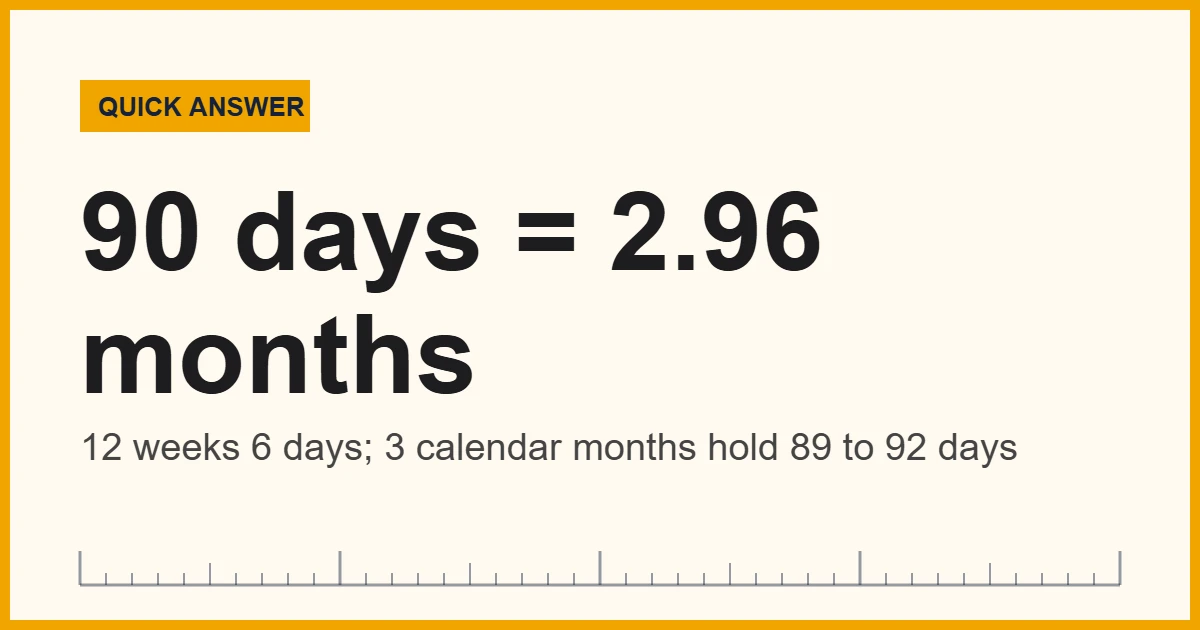
90 days in months is about 2.96 months, not exactly 3. An average Gregorian month lasts 30.44 days (365.2425 days divided by 12), so 90 / 30.44 = 2.96. Similarly, in weeks, 90 days is 12 weeks and 6 days. On a real calendar, however, a quarter of the year can run a day or two longer or shorter.
Convert 90 Days in Months, Weeks and Hours
First, type any number of days below. The converter then shows the result in average months, weeks, hours, minutes and years. Because it uses the same Gregorian average as this page, the results match the math below.
Most people ask this question for very practical reasons. For example, a lease, a return window, a probation period or a prescription refill says “90 days”, and you want to know when that actually ends. So the short answer is “about three months”. Still, the exact answer depends on which kind of month you mean.
First, days are fixed units. For instance, the International Bureau of Weights and Measures (BIPM) lists the day as exactly 86,400 seconds in its SI Brochure. Months, by contrast, are calendar units of uneven length, from 28 to 31. In addition, the US National Institute of Standards and Technology (NIST) explains that the Gregorian calendar mixes 365-day and 366-day years, giving an average year of 365.2425 days. Then, dividing that year by 12 gives an average month length of 30.44.
Quick Conversion Chart for Common Day Counts
In particular, this chart covers the day counts that show up most often in contracts, warranties and plans. Also, every value uses the Gregorian average and is rounded to two decimals.
| Days | Average months | Weeks and days |
|---|---|---|
| 30 | 0.99 | 4 weeks 2 days |
| 45 | 1.48 | 6 weeks 3 days |
| 60 | 1.97 | 8 weeks 4 days |
| 90 | 2.96 | 12 weeks 6 days |
| 120 | 3.94 | 17 weeks 1 day |
| 180 | 5.91 | 25 weeks 5 days |
| 365 | 11.99 | 52 weeks 1 day |
Printable tip: save or print this chart for your planner. In addition, 90 days equals 2,160 hours, 129,600 minutes and 7,776,000 seconds. Next, for more on how hours stack up, see how long 72 hours is in days and how many seconds are in a day.
Recommended Tools for Tracking 90 Days
Counting a long stretch of days is easier when you can see it. For example, a calendar clock shows the date at a glance, and a desk pad calendar lets you mark the start and end dates. Next, a countdown clock is handy for a fixed goal, because it ticks down the days for you.



As an Amazon Associate, Measuring Expert earns from qualifying purchases.
Why 90 Days in Months Is Not Exactly 3
The “3 months” answer assumes that every month has 30 days. After all, that shortcut is common in banking and business math. Real months, though, do not work that way. In fact, seven months are 31 long, four are 30, and February has 28 or 29.

As a result, there are three useful ways to express 90 days in months, and each one gives a slightly different number:
| Month used | Length | Result |
|---|---|---|
| Average Gregorian month | 30.44 days | 2.96 months |
| Banker’s month | 30 days | 3.00 months |
| Long month | 31 days | 2.90 months |
In short, three average months add up to 91.31 days. That is why this period falls about 1.3 days short of a full quarter of a year.
90 Days in Months vs 3 Calendar Months
A three-month span holds between 89 and 92 days. So the total depends on which ones you include. Below, you will find the count for each start month in a common year such as 2026. Meanwhile, a leap year adds one more to any span that includes February.
| Start month | Common year | Leap year |
|---|---|---|
| January | 90 | 91 |
| February | 89 | 90 |
| March | 92 | 92 |
| April | 91 | 91 |
| May to August | 92 | 92 |
| September | 91 | 91 |
| October or November | 92 | 92 |
| December | 90 | 91 |
So, only a span that starts in January, February or December comes close to that figure. Similarly, the four calendar quarters of 2026 hold 90, 91, 92 and 92 days.
How to Count 90 Days From a Date
- Write down the start date. Also check whether your document counts the start day itself as day 1.
- Enter the number in the converter above. As a result, you get the rough answer in months and weeks.
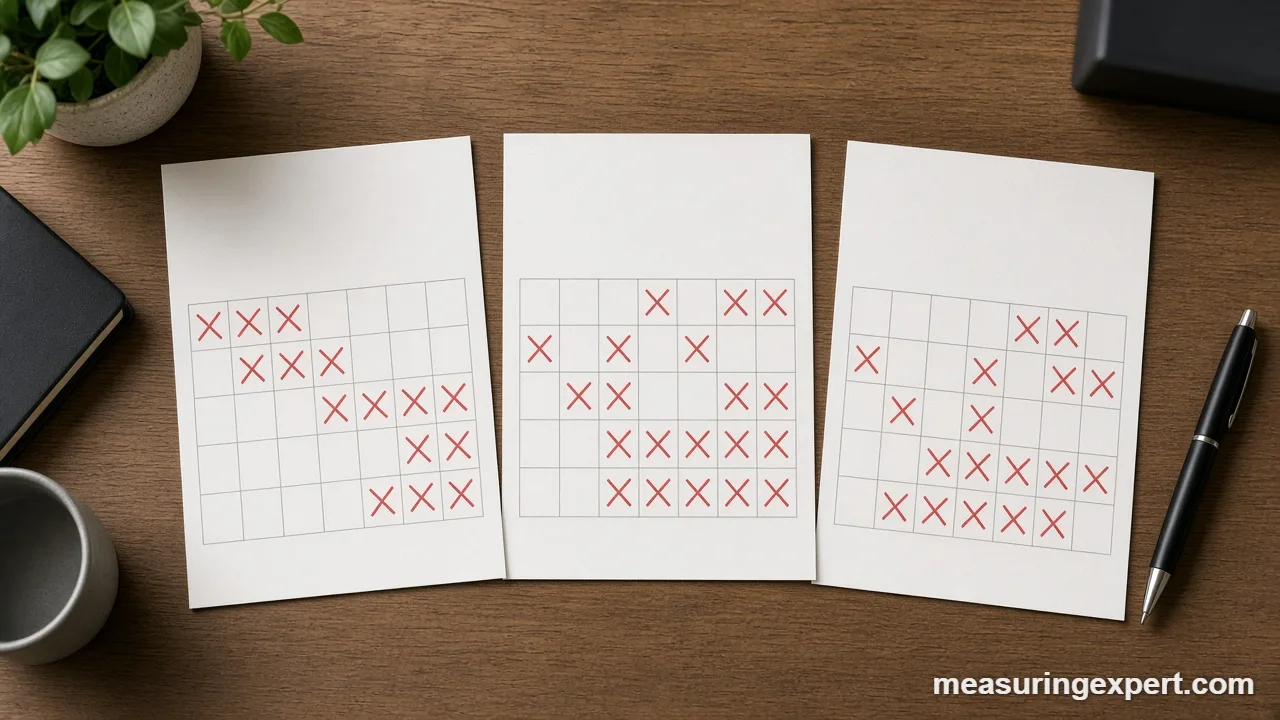
- Add the days on a calendar. Then count forward one page at a time, using the real length of each month.
- Adjust for the start day. If the start day counts as day 1, the last day falls one day earlier than “start date plus count”.
- Double-check with a date tool. Finally, a spreadsheet formula such as =A1+90 confirms the result.
For instance, starting on October 3, 2026, adding 90 days lands on January 1, 2027. However, if October 3 counts as day 1, then day 90 is December 31, 2026.
Where You Will See a 90-Day Period
Ninety days is popular because it feels like “one quarter” while still being a clean number. Here are common places you will meet it:
- Return and warranty windows. Stores and makers often set limits of this length, so read the policy to see which day it starts.
- Job probation periods. Many employers review new hires after about three months.
- Prescription supplies. For example, a 90-day supply is a common size for refills.
- Personal goals. Fitness, savings and habit plans often run for this length, or just under 13 weeks.
- Seasons. Astronomical seasons are close to this length, yet none is exact; they run roughly 89 to 94 days.
If your plan is longer, our guide on how long a decade is shows how the same averages scale up to years.
Do and Don’t for Day Counts
Do
- Use 30.44 as the average month length.
- Count real calendar days for deadlines.
- Check whether day 1 is the start date.
- Add one extra day for February in leap years.
- Write the end date down once you find it.
Don’t
- Assume every month is the same length.
- Treat a limit in days and a limit in months as identical.
- Divide by 4 weeks per month; a month is about 4.35 weeks.
- Forget time zones for deadlines that end at midnight.
- Round 12 weeks 6 days up to 13 weeks without saying so.
Honest Limits of Converting 90 Days in Months
Any single figure here is an approximation, because the month itself is not a fixed unit. For example, the 2.96 value is an average over the 400-year Gregorian cycle. Therefore, it is right on average but never exactly right for a specific stretch of dates. In the same way, the banker’s month is a convenience, not a definition. For planning, though, either figure works well. For deadlines, however, count actual days on a calendar or follow the exact wording of the document.
When the Exact Count Really Matters
Of course, for a vacation countdown, “about three months” is fine. In a few cases, though, one day makes a difference:
- Legal and contract deadlines. Notice periods and filing windows usually count calendar days, and some exclude weekends or holidays.
- Travel stays. Some entry rules limit visits to a number of days within a longer window, so track each day you spend there.
- Medicine. Any multi-month supply assumes you take each dose as prescribed. So if you miss or change doses, your supply will not line up with the calendar.
Frequently Asked Questions
How many months is 90 days?
It is about 2.96 average months. Under the banker’s rule of 30 per month, however, the answer is exactly 3.
Is 90 days in months the same as 3 months?
Not quite. A real calendar quarter can be a day or two longer or shorter, so the end dates may differ.
How many weeks is 90 days?
90 days is 12 weeks and 6 days, or about 12.86 weeks. In other words, it is one day short of 13 weeks.
How many hours are in 90 days?
There are 2,160 hours in 90 days, because each day has 24 hours.
How many minutes are in 90 days?
In total, there are 129,600 minutes in that period. That is 90 times 1,440 minutes per day.
What is 90 days in months for a quarter of a year?
By comparison, a quarter of a year is about 91.31 days. So 90 days is slightly shorter than a quarter.
What date is 90 days from October 3, 2026?
Adding 90 days to October 3, 2026 gives January 1, 2027. However, if October 3 counts as day 1, then day 90 is December 31, 2026.
Is 90 days two months?
No. Any two months in a row hold only 59 to 62 days, which is about 30 short.
How do I convert 90 days in months myself?
To do it, divide 90 by 30.44, the average month length. The result is 2.96. For a rough answer, divide by 30 instead.
What fraction of a year is 90 days?
In short, that span is about 24.6 percent of an average year, or roughly one quarter.
90 Days in Months: The Bottom Line
To sum up, 90 days is about 2.96 average months, exactly 3 thirty-day months, and 12 weeks plus 6 days. On a real calendar, however, a quarter can run a day or two longer, so end dates rarely match exactly.
Finally, for any other number of days, use the converter at the top of this page. Also, when a deadline really matters, count the actual calendar days instead of rounding.