

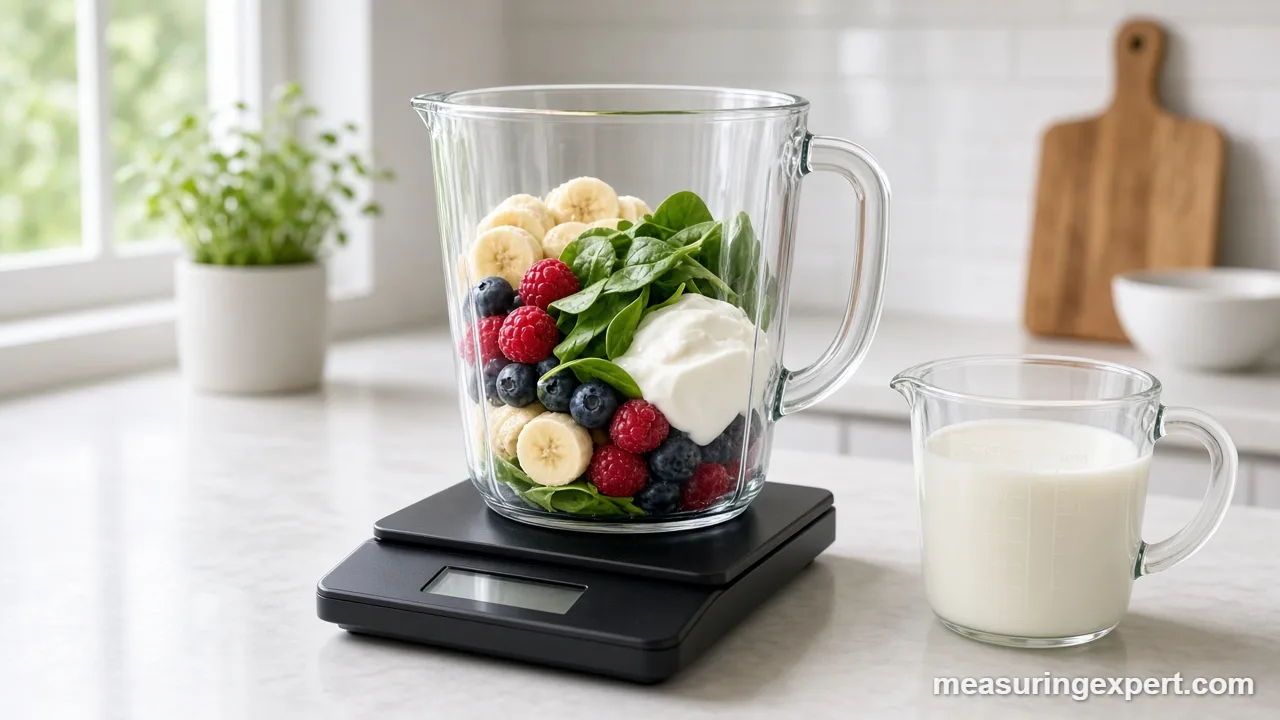
To measure smoothie ingredients, pour liquids into a clear measuring cup at eye level, pack leafy greens loosely into a dry cup, and weigh fruit, yogurt and nut butter on a kitchen scale. A good single serving is about 1 cup (237 mL) of liquid plus 1 1/2 to 2 cups of solids.
Why Measuring Smoothie Ingredients Matters
At first, a smoothie looks forgiving. After all, everything goes into one jar and gets blended. Even so, small measuring errors add up fast. For example, an extra splash of milk makes the drink thin and watery, while a heaping scoop of peanut butter can double the calories you planned for. Because of that, people who blend every morning often get a great drink one day and a disappointing one the next.
In short: measure the liquid first and by volume, then measure the solids. Liquids such as milk, juice, water and plant milk are easy to measure in a spouted cup marked in cups and milliliters. Fruit, greens and frozen chunks, however, trap air, so a cup of them can hold very different amounts. That is why a scale gives you the most repeatable smoothie. Finally, small add-ins like seeds, protein powder, honey and nut butter belong in measuring spoons or the scoop that comes with the product, because they carry the most calories per spoonful.
The US National Institute of Standards and Technology (NIST) publishes simple metric kitchen equivalents that round a cup to 240 mL, a tablespoon to 15 mL and a teaspoon to 5 mL. However, the exact US cup is 236.59 mL, so either value works for a smoothie. Meanwhile, the USDA explains that 2 cups of raw leafy greens count as only 1 cup of vegetables, which tells you how much air a cup of spinach holds.
Below, you will find a converter, a ratio chart, a step-by-step method, typical weights for common smoothie ingredients, and the mistakes that cause most bad blends.
Convert Smoothie Liquid Amounts
First, enter the amount from your recipe and pick its unit. The converter then shows the same volume in cups, milliliters, fluid ounces and tablespoons, so you can use whatever cup or bottle you have on hand.
Recommended Tools for Measuring Smoothie Ingredients
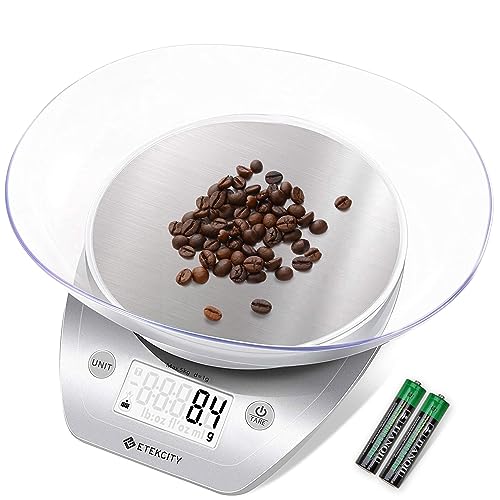
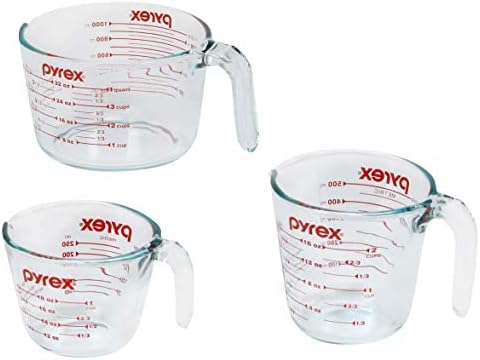
In fact, you do not need much gear. First, a clear liquid measuring cup with a spout handles milk, juice and water. Next, a set of nested dry cups and measuring spoons covers fruit, oats, seeds and powders. Finally, a digital kitchen scale with a tare button lets you weigh everything straight into the blender jar, so there are fewer dishes to wash.


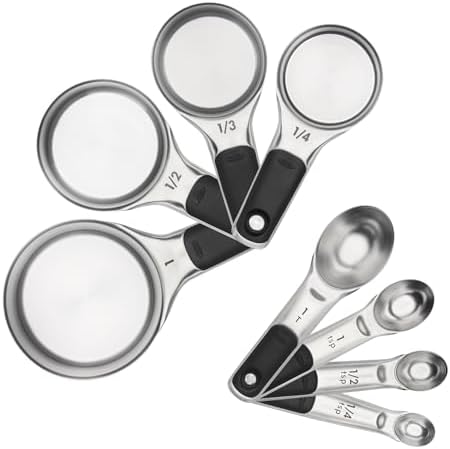

As an Amazon Associate, Measuring Expert earns from qualifying purchases.
Key Takeaways
- Liquid goes in first, measured in a clear spouted cup: about 1 cup (237 mL) per serving.
- Solids such as fruit and greens add up to roughly 1 1/2 to 2 cups per serving.
- A scale beats cups for fruit, frozen chunks and yogurt because air pockets vary.
- Seeds, honey and nut butter go in level measuring spoons, not cutlery.
- Protein powder scoops differ by brand, so check the grams on the label.
- Write down what you used; repeating a good smoothie is easier with numbers.
The Basic Ratio for Smoothie Ingredients
In general, most blended drinks follow the same simple pattern. Roughly speaking, use one part liquid to about one and a half to two parts solids by volume. In practice, that gives you a drink that pours but still feels thick. If you like a spoonable smoothie bowl, on the other hand, cut the liquid by about a third.

| Layer | Single serving (about 16 fl oz) | Metric | Examples |
|---|---|---|---|
| Liquid | 1 cup | about 237 mL | milk, plant milk, juice, water, coconut water |
| Soft or creamy base | 1/2 cup | about 118 mL | yogurt, banana, avocado, silken tofu |
| Fruit (fresh or frozen) | 1 cup | about 237 mL | berries, mango, pineapple, peach |
| Leafy greens | 1 cup, loosely packed | about 237 mL | spinach, kale, romaine |
| Add-ins | 1 to 2 tbsp | about 15 to 30 mL | chia, flax, nut butter, honey, oats |
Treat this chart as a starting point, not a rule. For instance, frozen fruit thickens a drink more than fresh fruit, so you may need a little more liquid. Similarly, a ripe banana adds sweetness and body, so you can skip honey entirely.
How to Measure Smoothie Ingredients Step by Step
This order keeps the blades moving and also makes each measurement easy. Enter your liquid amount in the converter above if your recipe uses a different unit.
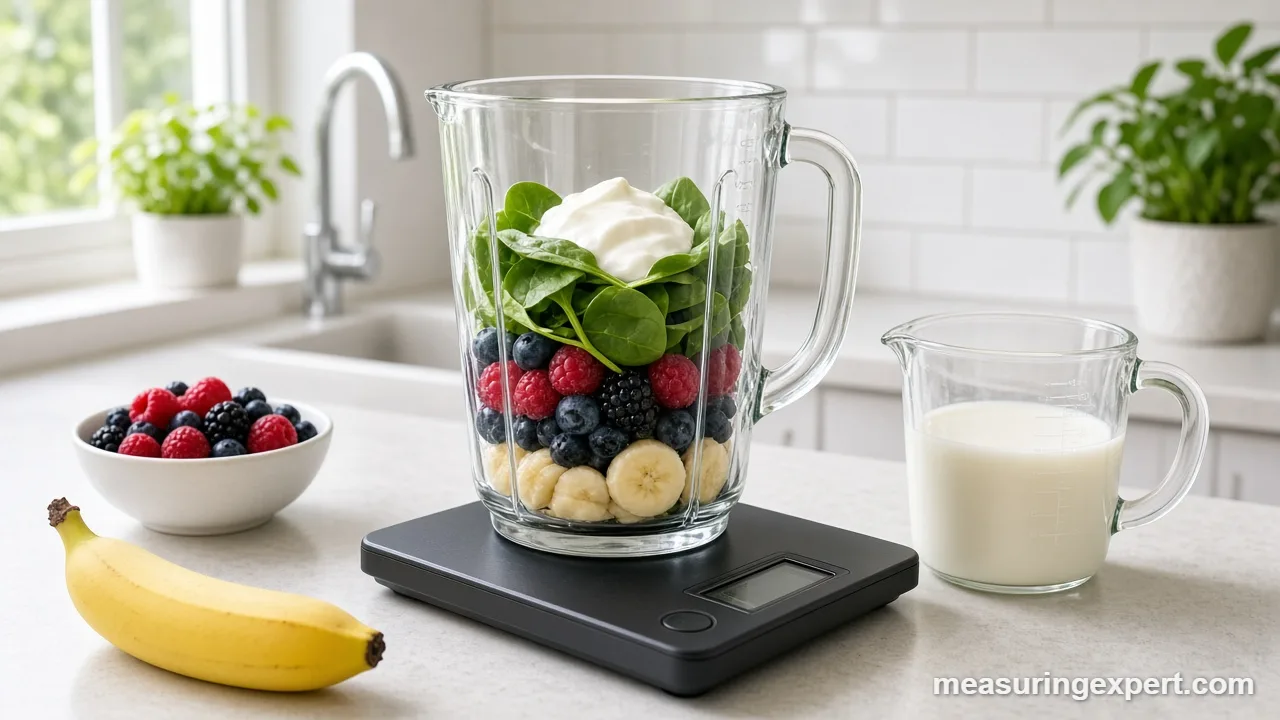
- Set the jar on a scale and press tare. If you weigh ingredients, zero the scale with the empty jar on it so you only see what you add.
- Pour the liquid into a clear measuring cup. Then place the cup on the counter and read the line at eye level, at the bottom of the curved surface.
- Add the creamy base next. Spoon yogurt into a dry cup and level it, or weigh it directly into the jar.
- Measure fruit by weight when you can. Otherwise, fill a dry cup to the rim without pressing the pieces down.
- Pack greens loosely. Drop spinach or kale into the cup and press lightly with your fingertips, just enough to level the top.
- Level the small add-ins. Scoop seeds or powder, then sweep a knife across the spoon so the top is flat.
- Blend, taste and adjust. Add liquid 2 tablespoons (about 30 mL) at a time until the texture is right, and write down the total.
Typical Weights of Common Smoothie Ingredients
In particular, these figures show why weighing helps. However, they are typical values, so your own produce will differ a little depending on size, ripeness and how you cut it.
| Ingredient | Household measure | Typical weight |
|---|---|---|
| Milk (dairy) | 1 cup | about 244 g (8.6 oz) |
| Water | 1 cup | about 237 g (8.3 oz) |
| Banana | 1 medium (7 to 8 in) | about 118 g (4.2 oz) |
| Blueberries, fresh | 1 cup | about 148 g (5.2 oz) |
| Strawberries, whole | 1 cup | about 144 g (5.1 oz) |
| Mango, pieces | 1 cup | about 165 g (5.8 oz) |
| Spinach, raw | 1 cup | about 30 g (1.1 oz) |
| Rolled oats, dry | 1/2 cup | about 40 g (1.4 oz) |
| Peanut butter | 2 tbsp | about 32 g (1.1 oz) |
| Honey | 1 tbsp | about 21 g (0.7 oz) |
For example, look at the spinach row. Indeed, a full cup of it weighs about a quarter as much as a cup of berries. As a result, “1 cup of greens” can mean very different amounts depending on how hard you press. In contrast, 30 g of spinach is always 30 g.
Smoothie Ingredients by Cup vs by Gram
Basically, cups measure space, while grams measure how much food is actually there. For liquids, the two match closely, since a cup of milk or water always fills the same space. For chunky solids, however, the gaps between pieces change from scoop to scoop. Our guide to weight vs volume in cooking explains this in more detail.
| People often confuse | What it really means |
|---|---|
| Fluid ounce (fl oz) | Volume: 1/8 cup, about 29.57 mL. Use it for milk and juice. |
| Ounce (oz) | Weight: about 28.35 g. Use it on a scale for fruit or yogurt. |
| US cup | About 236.59 mL by definition. |
| Nutrition label cup | 240 mL, the rounded value the FDA uses on food labels. |
| Metric cup | 250 mL, common in Australia, Canada and New Zealand. |
The FDA rule for food labels says 1 cup means 240 mL and 1 tablespoon means 15 mL. Therefore, when you compare your smoothie with a nutrition label, the small rounding gap between 237 and 240 mL makes no real difference.
Measuring Frozen Smoothie Ingredients
Above all, frozen fruit is the hardest thing to measure by volume. Big frozen chunks leave large gaps in a cup, whereas small berries pack tightly. For that reason, a cup of frozen mango can weigh noticeably less than a cup of frozen blueberries.
Instead of fighting the cup, read the bag. Most frozen fruit packages list a serving in cups and in grams, so you can weigh the gram amount. Also, if you prep freezer packs, weigh each one before freezing and write the weight on the bag. As a result, every pack makes the same drink.
No Measuring Cup? Other Ways to Measure Smoothie Ingredients
Still, you can get close without proper cups. A kitchen scale is the best backup, because 237 g of water or milk is very close to 1 cup. In addition, many drinking glasses and blender jars have printed lines in ounces or milliliters. For more ideas, see how to measure liquid without a measuring cup.
- A standard can or bottle. A 12 fl oz can holds 1 1/2 cups; a 16.9 fl oz water bottle holds about 500 mL.
- Your hand for greens. A loose double handful of spinach is roughly 1 cup, though this varies by hand size.
- The blender jar. Check the side markings, and read them with the jar on a flat counter.
- A yogurt container. Many single-serve cups hold 5.3 oz (150 g) by weight, which the label confirms.
Do and Don’t for Smoothie Measuring
Do
- Pour liquids into a clear spouted cup.
- Read the line at eye level.
- Weigh fruit, yogurt and nut butter when possible.
- Level seeds and powders with a knife.
- Keep notes on the version you like.
Don’t
- Pack greens down hard into the cup.
- Use a coffee mug as a “cup”.
- Assume every protein scoop is the same size.
- Pour honey from the jar without measuring.
- Add ice on top of a full cup of liquid.
Honest Limits of Measuring Smoothies
Of course, no method is perfect here. Fruit varies in size, water content and ripeness, so two bananas labeled “medium” can differ by 20 g or more. Likewise, the weights in this guide are typical values, not exact ones. Kitchen scales also have limits; many read in 1 g steps, which is fine for fruit but rough for a teaspoon of spice. In short, measuring gets you a consistent smoothie, not a lab-grade one, and that is all most people need.
When to Ask a Professional
For most people, a smoothie is just breakfast. Still, a few situations call for expert input. For example, if you track carbohydrates for diabetes, follow a kidney diet, manage a food allergy, or use smoothies as a meal replacement, ask a registered dietitian or your doctor how much of each ingredient fits your plan. They can also tell you how to read the portion sizes on labels. The USDA also explains what counts as a cup of fruit if you want to compare your smoothie with daily food-group goals.
Smoothie Ingredients FAQs
How much liquid goes in one smoothie?
About 1 cup (237 mL) of liquid makes a single 16 fl oz smoothie. Use a little less for a thick smoothie bowl and a little more if you add lots of frozen fruit.
What is a good ratio for smoothie ingredients?
A good starting ratio is 1 part liquid to about 1 1/2 to 2 parts solids by volume. For example, use 1 cup of milk with 1 cup of fruit and 1/2 to 1 cup of greens or yogurt.
Should I measure smoothie ingredients by weight or volume?
Measure liquids by volume and solids by weight when you can. A scale gives the most repeatable result for fruit, frozen chunks, yogurt and nut butter.
How do I measure spinach for a smoothie?
Fill a dry measuring cup with spinach and press lightly so the top is level. One cup of raw spinach weighs about 30 g, so weighing is even simpler.
How many grams is a cup of frozen fruit?
In general, it depends on the fruit and the chunk size. Check the bag, since most frozen fruit packages list a serving in both cups and grams.
How do I measure protein powder for smoothie ingredients?
Either use the scoop that comes with the product and level it, or weigh the gram amount on the label. Scoop sizes differ between brands.
How much is one serving of smoothie ingredients?
A typical single serving is about 1 cup of liquid plus 1 1/2 to 2 cups of solids, which blends to roughly 16 fl oz (473 mL).
Can I use a drinking glass to measure?
Only as a rough guide, because glasses vary in size. So check the volume by filling one with a measured cup of water first.
How do I measure honey or nut butter cleanly?
Coat the measuring spoon with a little oil so it slides out, or weigh it straight into the blender jar on a tared scale.
Why is my smoothie too thick or too thin?
Usually the liquid-to-solid ratio is off. Add liquid 2 tablespoons at a time to thin it, or add frozen fruit or a little yogurt to thicken it.
The Bottom Line on Smoothie Ingredients
To sum up, start with about 1 cup of liquid measured in a clear cup, then add roughly 1 1/2 to 2 cups of solids. For the most consistent results, weigh fruit, yogurt and nut butter, and level every spoonful of seeds or powder.
Once you find a blend you love, write it down in cups and grams. After that, the converter at the top of this page helps you scale the liquid up for a family-size batch or down for a small one.