

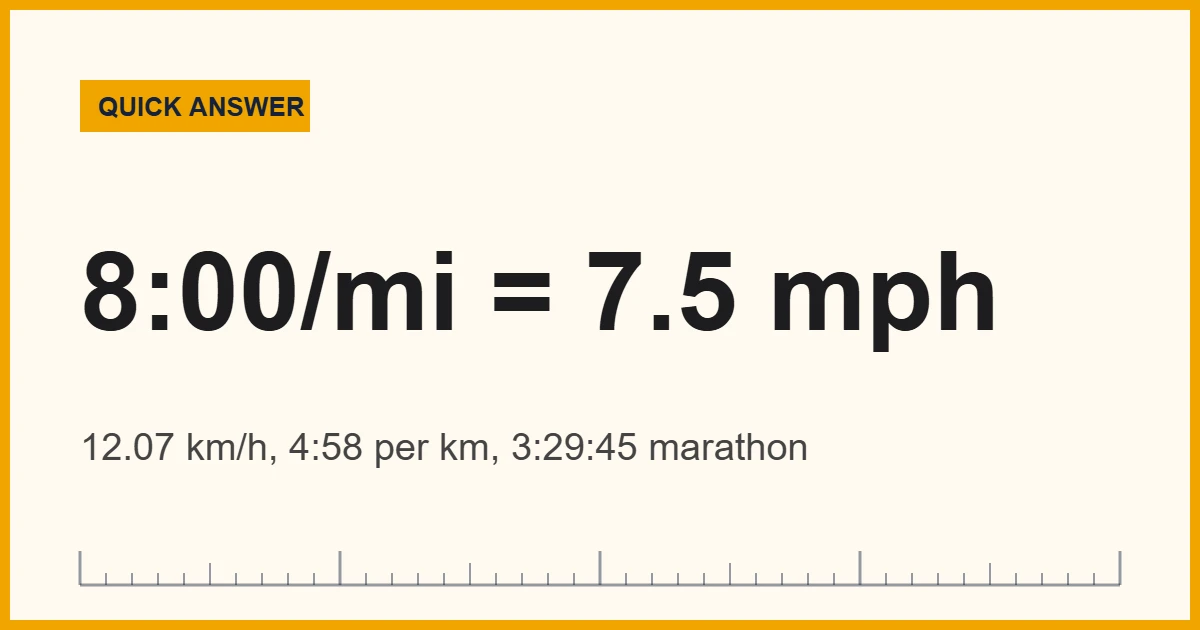
An 8-minute mile is a running speed of exactly 7.5 mph (12.07 km/h), or 3.35 meters per second. In metric terms, that pace is 4:58 per kilometer. So if you hold it the whole way, you finish a 5K in 24:51, a 10K in 49:43, a half marathon in 1:44:53 and a marathon in 3:29:45.
Convert an 8-Minute Mile Pace to Other Speeds
First, the converter starts at 7.5 mph. Then type any speed and it shows the same value in km/h, meters per second, feet per second and knots. To use it for a different pace, simply divide 60 by your minutes per mile; for example, a 9-minute mile is 60 / 9 = 6.67 mph.
Usually, runners talk in pace, while treadmills, cars and weather reports talk in speed. As a result, the same effort can look like three different numbers. In other words, pace is time per distance (minutes per mile), whereas speed is distance per time (miles per hour). So the two are simply flipped versions of each other.
In fact, the math rests on one exact definition. The international mile is 1,609.344 meters, as listed in the NIST unit conversion factors. Because one mile in 8 minutes means 60 / 8 = 7.5 miles in an hour, the metric value follows directly: 7.5 x 1.609344 = 12.07 km/h. In addition, 8 minutes divided by 1.609344 gives 4.971 minutes, or 4:58 per kilometer.
Next, below you will find a pace chart, finish times for every popular race distance, an honest answer to whether this pace is good, and tips for running it on a treadmill.
8-Minute Mile Pace Chart: Speed and Per-Kilometer Pace
To begin with, this chart puts the 8:00 pace next to its neighbors. Also, every value is computed from the exact mile, then rounded. Note, however, that speed does not change evenly with pace: going from 8:00 to 7:00 adds more than 1 mph, while going from 11:00 to 12:00 drops less than half a mile per hour.
| Pace per mile | Speed (mph) | Speed (km/h) | Pace per km | 5K finish |
|---|---|---|---|---|
| 6:00 | 10.0 | 16.09 | 3:44 | 18:38 |
| 7:00 | 8.57 | 13.79 | 4:21 | 21:45 |
| 7:30 | 8.0 | 12.87 | 4:40 | 23:18 |
| 8:00 | 7.5 | 12.07 | 4:58 | 24:51 |
| 8:30 | 7.06 | 11.36 | 5:17 | 26:24 |
| 9:00 | 6.67 | 10.73 | 5:36 | 27:58 |
| 10:00 | 6.0 | 9.66 | 6:13 | 31:04 |
| 11:00 | 5.45 | 8.78 | 6:50 | 34:11 |
| 12:00 | 5.0 | 8.05 | 7:27 | 37:17 |
| 15:00 (brisk walk) | 4.0 | 6.44 | 9:19 | 46:36 |
For instance, the older version of this page listed a 7-minute mile as 8.5 mph. However, the correct figure is 8.57 mph, because 60 / 7 = 8.571. Because small rounding slips like that add up to whole minutes over a marathon, the chart keeps two decimals.
Race Finish Times at an 8-Minute Mile Pace
First, to find a finish time, multiply the race distance in miles by 8 minutes. Metric races are a little awkward, so first convert kilometers to miles (divide by 1.609344). As a result, a 5K is 3.107 miles and a marathon is 26.219 miles.
| Race | Distance | Finish time at 8:00/mile |
|---|---|---|
| 1 kilometer | 0.621 mi | 4:58 |
| 1 mile | 1.609 km | 8:00 |
| 5K | 3.107 mi | 24:51 |
| 10K | 6.214 mi | 49:43 |
| 15K | 9.321 mi | 1:14:34 |
| 10 miles | 16.093 km | 1:20:00 |
| Half marathon | 13.109 mi (21.0975 km) | 1:44:53 |
| Marathon | 26.219 mi (42.195 km) | 3:29:45 |
Of course, these are even-pace times on a perfectly measured course. In real races, however, you rarely run the exact tangents, so your watch often reads a bit long. Therefore, many runners aim about 5 seconds per mile faster than their goal pace to bank a small margin.
Is an 8-Minute Mile a Good Pace?
Overall, for most recreational runners, yes. Still, it depends on the distance and on who is running it. For that reason, three benchmarks help.
First, compare it with typical race results. According to RunRepeat’s analysis of US 5K results, the average 2018 finish was 39:02, a pace of about 12:34 per mile. By comparison, an 8:00 pace finishes the same race in 24:51, roughly 14 minutes sooner. Keep in mind, though, that those averages include walkers, so the gap among regular runners is smaller.
Next, look at the marathon. For example, holding this pace for 26.2 miles gives 3:29:45. As a result, that is just under the 3:30:00 qualifying standard that the Boston Athletic Association lists for women aged 35 to 39 and for men aged 55 to 59. However, the B.A.A. notes that meeting the standard only lets you apply, and recent cutoffs have required runners to beat it by several minutes.
Finally, consider the distance. For a single mile, a fit adult who trains regularly can often reach 8:00 within a few months. Over a half marathon or marathon, by contrast, the same pace takes solid endurance training. In short, an 8-minute mile is a quick one-mile time for a beginner and a strong marathon pace for almost anyone.
For context, at the top end elite milers run under 4 minutes, which is twice as fast. Similarly, our guide on how fast a human can run compares sprint and distance records.
Pace vs Speed: Why Runners and Treadmills Disagree
Meanwhile, people often mix up these four ways of writing the same effort. So the table below separates them.
| Format | What it measures | Value for this pace | Who uses it |
|---|---|---|---|
| Minutes per mile | Time to cover one mile | 8:00 | US runners, race plans |
| Minutes per kilometer | Time to cover one km | 4:58 | Runners outside the US, most apps set to metric |
| Miles per hour | Distance covered in one hour | 7.5 | US treadmills, speed signs |
| Kilometers per hour | Distance covered in one hour | 12.07 | Metric treadmills, cycling |
For instance, a common mistake is reading 8:00 as 8.0 or 8.00. After all, pace uses minutes and seconds, so 7:30 means seven and a half minutes, not 7.3. Similarly, a speed of 8.0 mph is a 7:30 pace, not an 8:00 pace.
How to Check Your Own Running Pace
- Pick a measured distance. A standard 400 m track works best, because four laps are just under one mile (1,600 m vs 1,609.344 m).
- Start a stopwatch as you cross the line. Then run at an even effort, and also note each lap split.
- Check your lap time. At this pace, each 400 m lap takes about 1:59 and a full quarter mile takes exactly 2:00.
- Convert the total time to minutes. For example, 8:30 becomes 8.5 minutes, because 30 seconds is half a minute.
- Divide 60 by your minutes per mile. As a result, you get mph; then enter the result in the converter above for km/h or m/s.
After all, timing is the part most people get wrong, so a clear method matters. Our guide on how to measure average time explains how to average several runs so one good day does not skew your result.
Running an 8-Minute Mile on a Treadmill
To start, on a treadmill simply set the belt to 7.5 mph, or 12.1 km/h on a metric machine. Because there is no wind and the belt helps your leg turnover a little, many coaches suggest a 1% incline to make the effort feel closer to running outdoors.
Also, treadmill speed displays are not lab instruments. For example, a belt that slips or a sensor that drifts can be off by a few percent. So if your outdoor 8:00 feels much harder than the treadmill version, check the belt by timing 10 full revolutions against its measured length.
As for energy use, the Compendium of Physical Activities lists running at 7.5 mph at 11.8 METs (Adult Compendium, running). As a result, a 155 lb (70.3 kg) runner burns roughly 110 kcal per mile at this pace, and a 185 lb (83.9 kg) runner about 132 kcal.
Recommended Tools for Tracking Your Pace
For example, a GPS running watch shows live pace per mile or kilometer, while a simple stopwatch is still the most reliable tool on a track. Also, these picks are based on manufacturer descriptions and buyer reports.


As an Amazon Associate, Measuring Expert earns from qualifying purchases.
Do and Don’t for Pacing
Do
- Write pace as minutes:seconds.
- Start the first mile a few seconds slow.
- Check your watch against a track once a season.
- Use even splits for races over 10K.
Don’t
- Confuse 8.0 mph with an 8:00 pace.
- Trust GPS pace under bridges or tall buildings.
- Race every training run at goal pace.
- Expect identical treadmill and road times.
Honest Limits of Pace Math
Admittedly, the conversions on this page are exact, but real running is not. GPS watches estimate distance from satellite fixes, so they can drift by 1 to 3% depending on tree cover, buildings and how often they record a point. In addition, hills, heat, humidity and wind all change how hard a given pace feels. Even so, certified courses are measured along the shortest possible line, and almost nobody runs that line. As a result, treat the finish times above as targets, not promises, and judge your effort by feel as well as by numbers.
When Accuracy Really Matters
In general, for most training a pace that is close is good enough. However, precise numbers matter when you chase a qualifying time, set a treadmill test protocol, or plan race splits to the second. In those cases, use a certified course or a 400 m track, and confirm your watch against a stopwatch. Also, if you have a heart condition, high blood pressure or a recent injury, talk to your doctor before starting faster running.
Frequently Asked Questions
How many mph is an 8-minute mile?
It is exactly 7.5 mph, because 60 minutes divided by 8 minutes per mile equals 7.5 miles per hour. Therefore, in metric units, that is 12.07 km/h.
What is an 8-minute mile in minutes per kilometer?
About 4:58 per kilometer. Divide 8 minutes by 1.609344 to get 4.971 minutes, and 0.971 of a minute is 58 seconds.
How long is a 5K at an 8-minute mile pace?
It takes about 24 minutes and 51 seconds, because a 5K is 3.107 miles and 3.107 x 8 minutes is 24.85 minutes.
What marathon time is an 8-minute mile?
Overall, a marathon at an even 8:00 pace takes 3 hours, 29 minutes and 45 seconds. Similarly, a half marathon at the same pace takes 1:44:53.
Is an 8-minute mile good for a beginner?
Yes. For a new runner, one mile at 8:00 is a solid goal that usually takes some months of steady training. Over longer races, however, it is a strong pace for most recreational runners.
What treadmill speed is an 8-minute mile?
First, set the treadmill to 7.5 mph, or 12.1 km/h on a metric machine. In addition, many runners add a 1% incline to mimic outdoor effort.
How fast is 7.5 mph in meters per second?
It is 3.353 meters per second, or 11.0 feet per second. By comparison, a brisk walk is about 1.8 meters per second.
How many calories does an 8-minute mile burn?
Roughly 110 kcal for a 155 lb runner and 132 kcal for a 185 lb runner, based on the 11.8 MET value for running at 7.5 mph. Still, your own number varies with body weight and efficiency.
What is the lap time for an 8-minute mile on a track?
Each 400 m lap takes about 1:59, and a quarter mile takes exactly 2:00. However, four 400 m laps are 9 meters short of a full mile.
Is a 7-minute mile much faster?
Yes. A 7:00 mile is 8.57 mph, more than 1 mph faster, and it cuts a 5K from 24:51 to about 21:45.
The 8-Minute Mile in One Line
In short, an 8-minute mile equals 7.5 mph, 12.07 km/h or 4:58 per kilometer. As a result, it gives a 24:51 5K, a 49:43 10K, a 1:44:53 half and a 3:29:45 marathon.
Finally, for any other pace, divide 60 by your minutes per mile and enter the result in the converter at the top. After that, compare it with the chart to see where your own running fits.
3 thoughts on “How Fast Is an 8-Minute Mile? Speed, Pace per Km and Race Times”