

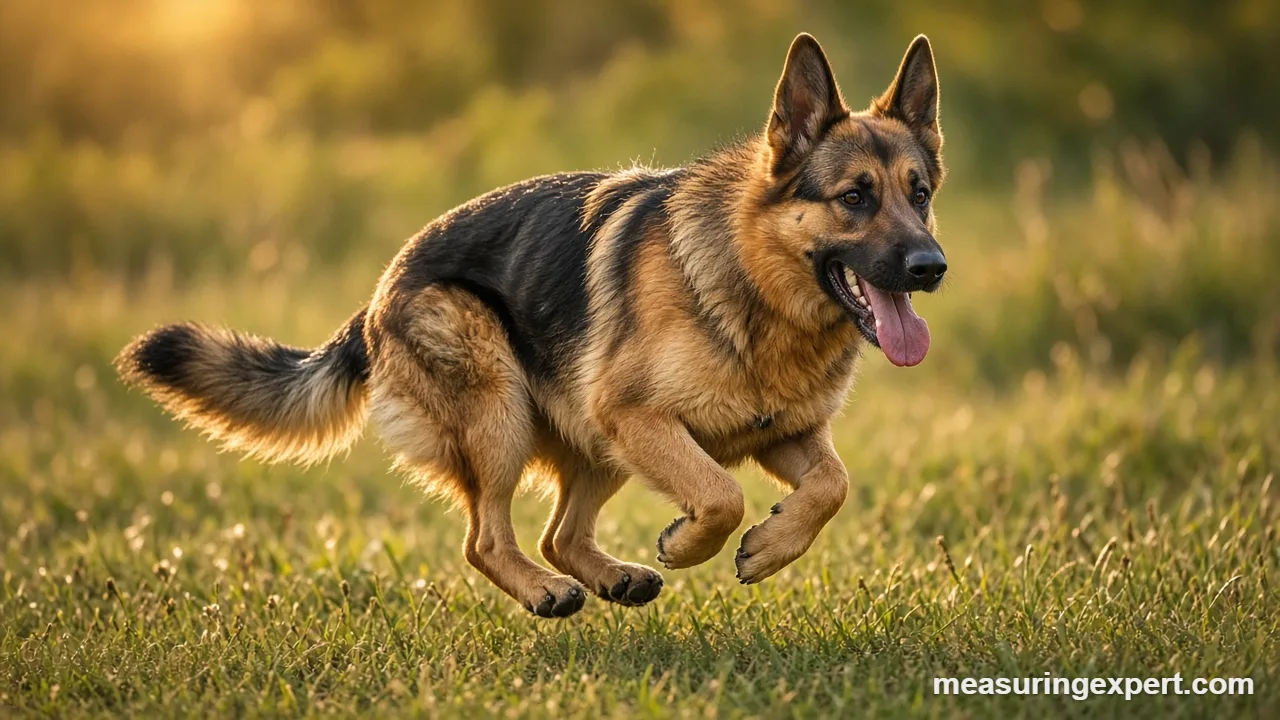
German Shepherd speed tops out at roughly 30 mph (about 48 km/h) in a short, all-out sprint. However, that is a widely repeated estimate, not a measured breed record. Over long distances, a fit German Shepherd usually trots at about 6 to 10 mph (10 to 16 km/h) and can hold that pace for a long time.
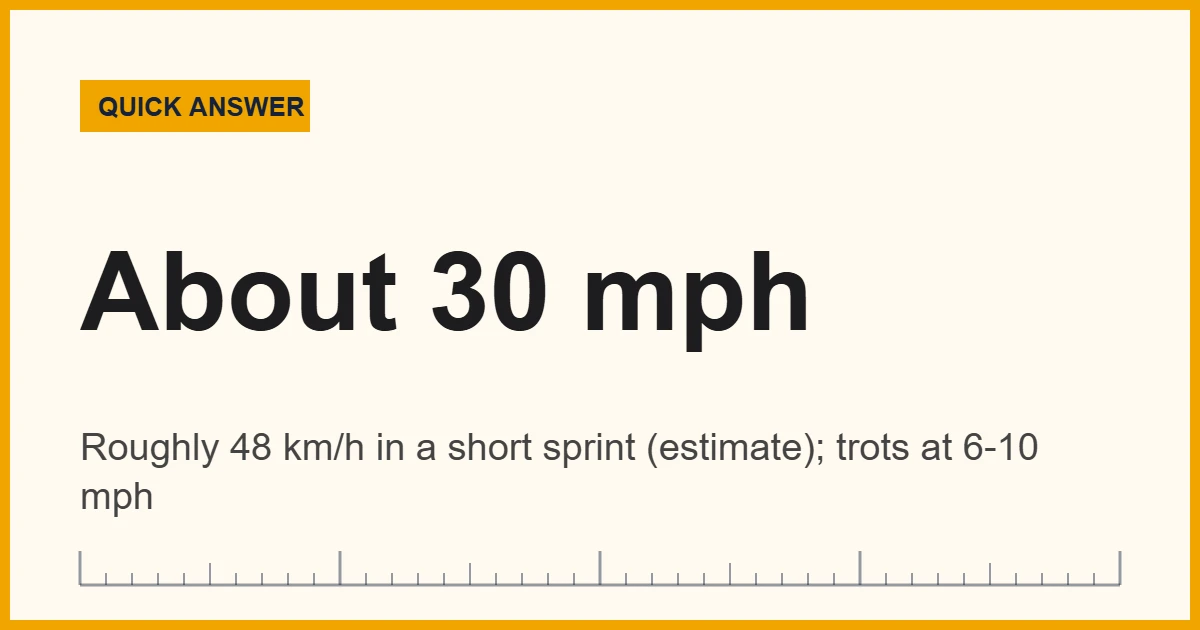
Convert German Shepherd Speed to km/h, m/s and Knots
The converter starts at 30 mph, the figure most dog books and websites quote. Next, type any other speed and pick its unit. For example, enter 8 for an easy trot, or enter a number from your own timing session to see it in kilometers per hour, meters per second, feet per second and knots.
Almost every page about this breed repeats the same line: a German Shepherd can run 30 miles per hour. Overall, that number is plausible, and it matches what owners see when a young, lean dog chases a ball across a field. Still, nobody has published a large timed study of the breed. So, this page treats 30 mph as a reasonable estimate and labels it that way.
In fact, the breed was not built for raw speed. The American Kennel Club’s official breed standard describes a trotting dog. Specifically, it asks for movement “covering the maximum amount of ground with the minimum number of steps.” In other words, the German Shepherd is an endurance worker first and a sprinter second.
Below, you get a speed chart in five units, the difference between sprint and trot, and comparisons with a greyhound, a wolf and a human. Finally, there is a safe way to time your own dog and turn a stopwatch reading into mph.
Where the 30 mph German Shepherd Speed Figure Comes From
To begin with, most speed figures for dog breeds come from owner reports, GPS collar readings and rough comparisons with other dogs. In contrast, very few come from controlled timing. As a result, you should read every breed speed, including this one, as a band rather than a precise number.
Fortunately, there is one place where real times exist. The AKC runs Fast CAT, a timed 100-yard dash in which dogs chase a lure one at a time. Also, dogs must be at least 12 months old to enter. Because the distance is fixed and the clock is electronic, a Fast CAT time converts directly into an average speed. For example, 100 yards in 7.0 seconds works out to about 29.2 mph (47.0 km/h).
| Claim | Value | How solid is it? |
|---|---|---|
| Top sprint speed | About 30 mph (48 km/h) | Estimate – widely repeated, no published breed study |
| Typical gallop when playing | About 20 to 25 mph (32 to 40 km/h) | Estimate – depends heavily on the dog |
| Working trot | About 6 to 10 mph (10 to 16 km/h) | Estimate – fits the breed’s trotting build |
| 100-yard dash average | Distance divided by time | Measured – for one dog on one run |
German Shepherd Speed Chart in mph, km/h, m/s, ft/s and Knots
Each German Shepherd speed in the table below is a straight unit conversion from mph, based on the exact definition 1 mile = 1.609344 km. Also, the pace labels are typical bands, so your own dog may sit a little above or below them.
| Pace | mph | km/h | m/s | ft/s | Knots |
|---|---|---|---|---|---|
| Slow walk | 3 | 4.83 | 1.34 | 4.4 | 2.61 |
| Easy jog with owner | 6 | 9.66 | 2.68 | 8.8 | 5.21 |
| Brisk working trot | 10 | 16.09 | 4.47 | 14.7 | 8.69 |
| Canter or lope | 15 | 24.14 | 6.71 | 22.0 | 13.03 |
| Playful gallop | 20 | 32.19 | 8.94 | 29.3 | 17.38 |
| Fast gallop | 25 | 40.23 | 11.18 | 36.7 | 21.72 |
| Top sprint (estimate) | 30 | 48.28 | 13.41 | 44.0 | 26.07 |
| Greyhound range for comparison | 40 | 64.37 | 17.88 | 58.7 | 34.76 |
Printable tip: the chart fits on one page when you print it from your browser, which is handy for a training notebook.
Sprint vs Endurance: Why a German Shepherd Trots
Peak German Shepherd speed burns energy fast, so no dog holds 30 mph for long. Usually, a German Shepherd reaches top speed for a few seconds while chasing a ball, a toy or another dog. After that, it drops back to a gallop or a trot.
In fact, the trot is where this breed shines. For example, herding dogs once patrolled the edges of a flock for hours, and police and military dogs still cover long distances on patrol. Because the trot is efficient, a well-conditioned German Shepherd can keep it up far longer than a sprint. Meanwhile, heat, fitness and terrain set the real limit, not the breed name.
| Measure | What it means | Typical German Shepherd value |
|---|---|---|
| Peak speed | The fastest instant during a sprint | About 30 mph (estimate) |
| Average sprint speed | Distance divided by time, start included | Lower than peak, often mid-20s mph |
| Cruising pace | A speed held for many minutes | About 6 to 10 mph trot |
| Daily distance | Total ground covered in a day | Depends on work, weather and fitness |
So, when someone asks about German Shepherd speed, it helps to ask which kind they mean. After all, a ball-chasing burst and a patrol trot are very different numbers.
German Shepherd Speed vs Greyhound, Wolf and Human
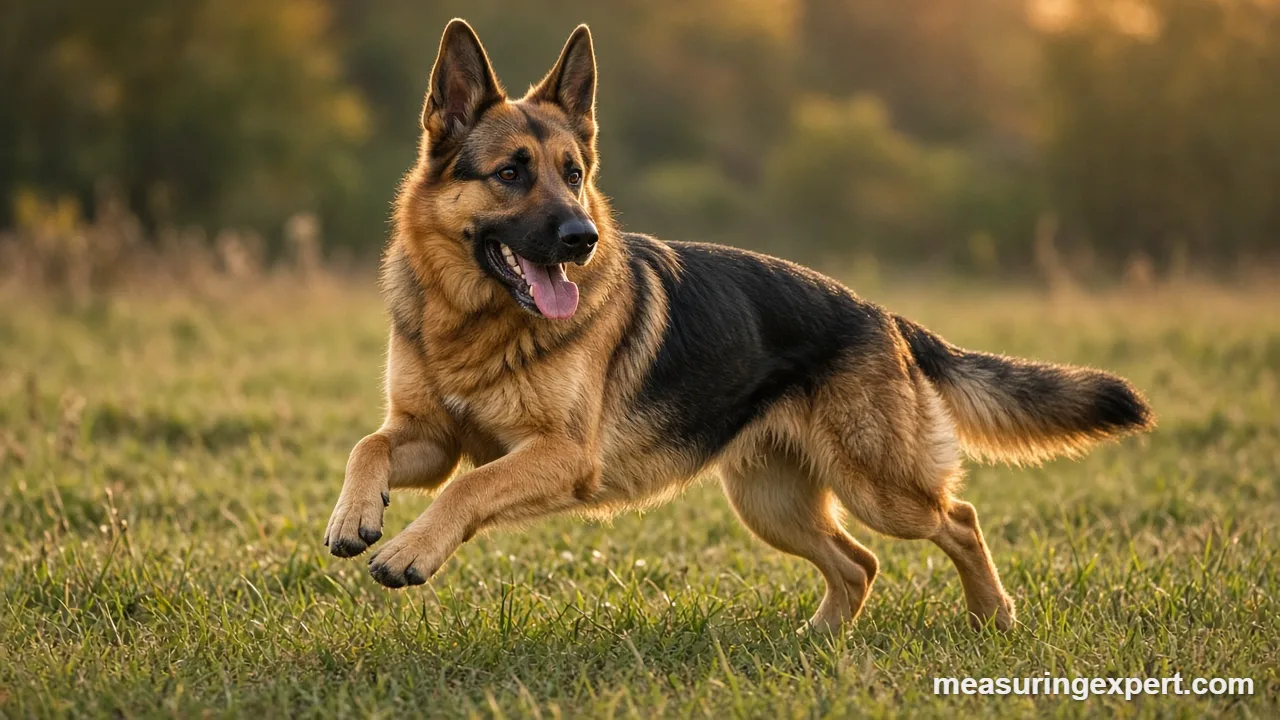
Comparisons make German Shepherd speed easier to picture. Here, the last column shows how long each runner would take to cover 100 yards at the listed speed, which matches the Fast CAT distance.
| Runner | Top speed | Source type | Time for 100 yd at that speed |
|---|---|---|---|
| German Shepherd | About 30 mph (48 km/h) | Estimate | 6.82 s |
| Greyhound | About 40 to 45 mph (64 to 72 km/h) | AKC cites up to 40 mph; other sources 45 | 5.11 to 4.55 s |
| Gray wolf (burst) | About 36 to 38 mph (58 to 61 km/h) | Field estimates | 5.68 to 5.38 s |
| Usain Bolt (peak) | 27.8 mph (44.7 km/h) | Measured in a race | 7.36 s |
| Recreational runner | About 6 mph (9.7 km/h) | Typical race pace | 34.09 s |
First, a greyhound wins easily. The AKC calls the greyhound a natural running machine and cites speeds up to 40 miles per hour. In addition, its light frame, deep chest and long legs suit a short sprint, while a German Shepherd carries more muscle and bone for a working life.
Next, a wolf is also faster in a burst. Our guide to how fast a wolf runs puts its sprint at about 36 to 38 mph, with a steady trot for travel. Interestingly, that trot-first lifestyle is close to how a German Shepherd works.
Against people, the dog comes out ahead even at its estimated top. In short, the fastest human sprint ever measured peaked at about 27.8 mph, as our page on how fast a human can run explains. Most adults, by contrast, cannot sprint much above 15 mph. For the same unit math on a larger animal, see how fast a horse runs.
How to Time German Shepherd Speed Safely
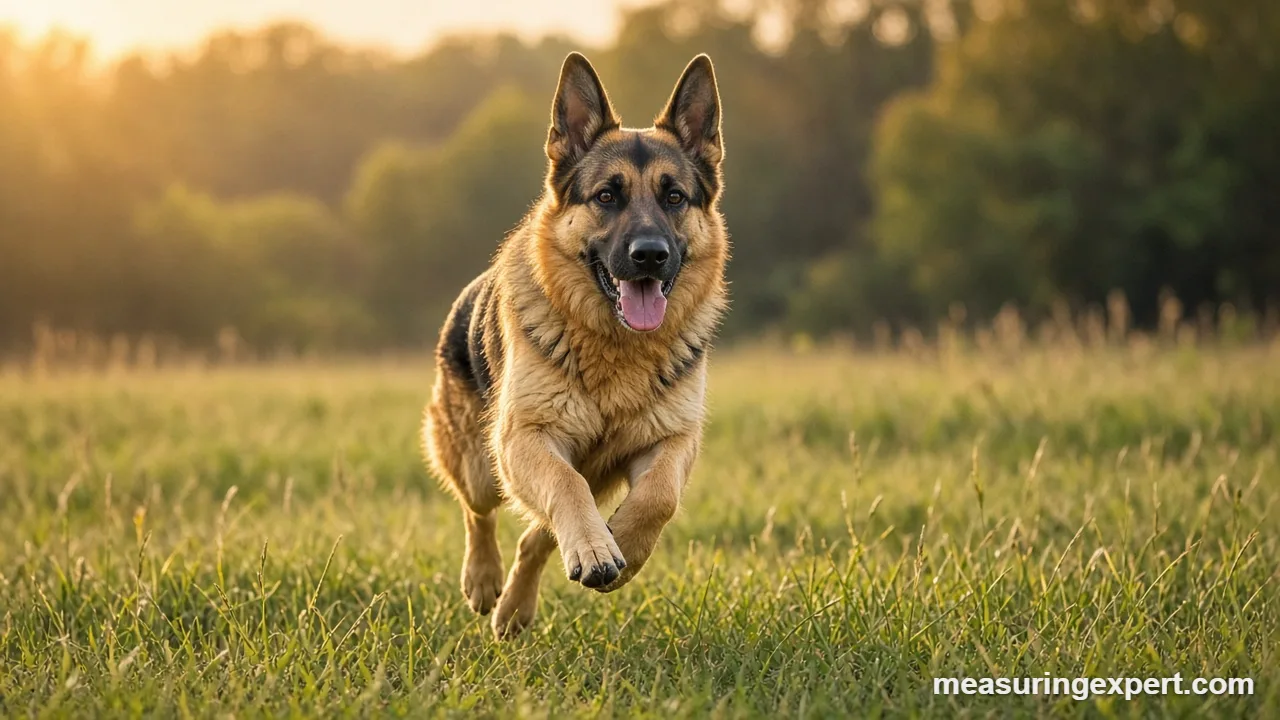
Luckily, you can measure your own dog with a stopwatch, a measured course and a helper. Then, the converter above turns that German Shepherd speed into any unit. Before you start, check with your vet if your dog is young, older, overweight or recovering from an injury.
- First, pick a flat, fenced, grassy area with good footing and no traffic.
- Measure a straight 50 or 100 yards with a measuring wheel or long tape, then mark the start and finish with cones.
- Next, warm your dog up with five to ten minutes of walking and easy trotting.
- Have a helper hold the dog behind the start line while you stand at the finish with a toy or treat.
- Start the stopwatch when the front paws cross the start line, and stop it when they cross the finish.
- After that, repeat two or three times with full rest between runs, then keep the fastest or the average time.
- Finally, divide distance by time, or enter the result in the converter, to get the speed in mph or km/h.
Turning a 100-Yard Time Into mph and km/h
Basically, the formula is simple: speed equals distance divided by time. For a 100-yard course, the shortcut is mph = 204.5 / seconds, because 100 yards per second equals 204.5 mph. Similarly, km/h = 329.2 / seconds for the same course.
| 100-yard time | Average mph | Average km/h |
|---|---|---|
| 6.0 s | 34.09 | 54.86 |
| 6.5 s | 31.47 | 50.64 |
| 7.0 s | 29.22 | 47.03 |
| 7.5 s | 27.27 | 43.89 |
| 8.0 s | 25.57 | 41.15 |
| 9.0 s | 22.73 | 36.58 |
| 10.0 s | 20.45 | 32.92 |
For a metric course, the math is just as easy. For instance, 50 meters in 12 seconds is 50 / 12 = 4.17 m/s, which is 15.0 km/h or about 9.3 mph. In that case, enter 4.17 in the converter with m/s selected.
What Changes German Shepherd Speed
German Shepherd speed varies a lot, and two dogs of the same breed can differ by 10 mph or more. Here are the main reasons, so check each one for your own dog.
- Age: young adults are usually fastest, whereas puppies and seniors run slower.
- Body weight: most adults weigh roughly 50 to 90 pounds, and extra weight costs speed.
- Build: for example, lean, long-legged dogs tend to sprint faster than heavy-boned ones.
- Fitness: regular exercise builds both sprint power and trotting stamina, so fit dogs win on both.
- Joints: hip or elbow problems are common in large breeds and, as a result, can slow a dog sharply.
- Weather and surface: heat, a thick coat, sand or mud all cut speed; therefore, test in mild weather.
- Motivation: a dog chasing a favorite toy often runs much harder than one called back, for obvious reasons.
For reference, the AKC standard puts males at 24 to 26 inches at the shoulder and females at 22 to 24 inches. Therefore, size alone does not explain speed; build and conditioning matter more.
Recommended Tools for Timing German Shepherd Speed
In practice, a reliable stopwatch and an accurate distance measurement are all you need. Thus, the list below covers a stopwatch with a large display and measuring wheels for laying out a straight course.


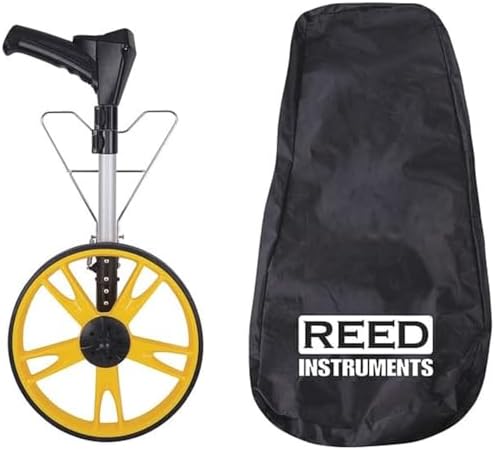
As an Amazon Associate, Measuring Expert earns from qualifying purchases.
Do and Don’t When Measuring a Dog’s Speed
Do
- Measure the course with a wheel or tape instead of pacing it.
- Time several runs, then use the average.
- Test on grass, especially in cool weather.
- Offer water and rest after each run, so the dog recovers.
Don’t
- Rely on a phone app’s top speed reading alone, because GPS lags.
- Sprint a growing puppy, or a dog with joint pain.
- Run your dog beside a bike or car to “clock” it.
- Compare a peak reading with an average time, since they differ.
Honest Limits of Any German Shepherd Speed Number
First, there is no official breed speed record. Indeed, Guinness and kennel clubs do not track one, so any single “fastest German Shepherd” claim online is unverified. Similarly, the old version of this page listed named record dogs, but we removed them because we found no source.
Second, hand timing adds error. For instance, a human reaction delay of about 0.2 seconds on a 7-second run shifts the result by roughly 3 percent. In addition, GPS collars often smooth or overshoot short sprints, so treat their top readings with care.
Finally, averages and peaks differ. Specifically, a 100-yard average includes the start, so it always sits below the dog’s true peak. Consequently, a time-based figure of 27 mph and a claimed top speed of 30 mph can both be right.
When Accurate Speed Numbers Really Matter
For most owners, German Shepherd speed is a fun fact. However, accurate numbers matter in a few cases. For example, sport handlers track Fast CAT times to see progress, and rehab vets may use timed walks or trots to follow recovery after surgery.
German Shepherd Speed FAQs
How fast can a German Shepherd run?
German Shepherd speed is usually estimated at about 30 mph (48 km/h) in a short sprint. However, no published breed study confirms an exact top speed.
How fast is 30 mph in km/h?
30 mph equals 48.28 km/h, because one mile is exactly 1.609344 kilometers. Similarly, that is 13.41 meters per second.
Is a German Shepherd faster than a human?
Yes. In fact, even the fastest measured human sprint peaked at about 27.8 mph, while a fit German Shepherd is estimated to reach about 30 mph.
Is a German Shepherd faster than a greyhound?
No. Greyhounds are built for sprinting, and they reach roughly 40 to 45 mph, so they are about 10 to 15 mph faster.
How long can a German Shepherd run at top speed?
Only for a few seconds. Then, after a short burst, the dog slows to a gallop or a trot, which it can keep up much longer.
What is a German Shepherd’s trotting speed?
Typically, a comfortable working trot is roughly 6 to 10 mph (10 to 16 km/h), depending on the dog’s size, fitness and the terrain.
Can I run with my German Shepherd?
Many adult German Shepherds make good running partners. Still, ask your vet first, start with short distances and avoid hot weather and pavement.
At what age is a German Shepherd fastest?
Generally, most dogs are fastest as young, fully grown adults. After that, speed usually drops slowly with age, weight gain and joint wear.
How do I measure my dog’s speed?
Measure a straight 100-yard course, time the dog with a stopwatch and divide 204.5 by the seconds to get the average mph.
Are working-line German Shepherds faster?
Usually, lean, athletic dogs sprint faster than heavier ones. Even so, individual build and fitness matter more than the line name.
Bottom Line
A German Shepherd can likely sprint at about 30 mph (48 km/h) for a few seconds, but treat that as an estimate. Instead, the breed’s real strength is a steady 6 to 10 mph trot it can hold for a long time. To get a true number for your own dog, time a measured 100-yard run and convert it with the calculator above.
2 thoughts on “How Fast Can a German Shepherd Run? Top Speed, Trot and Timing”