

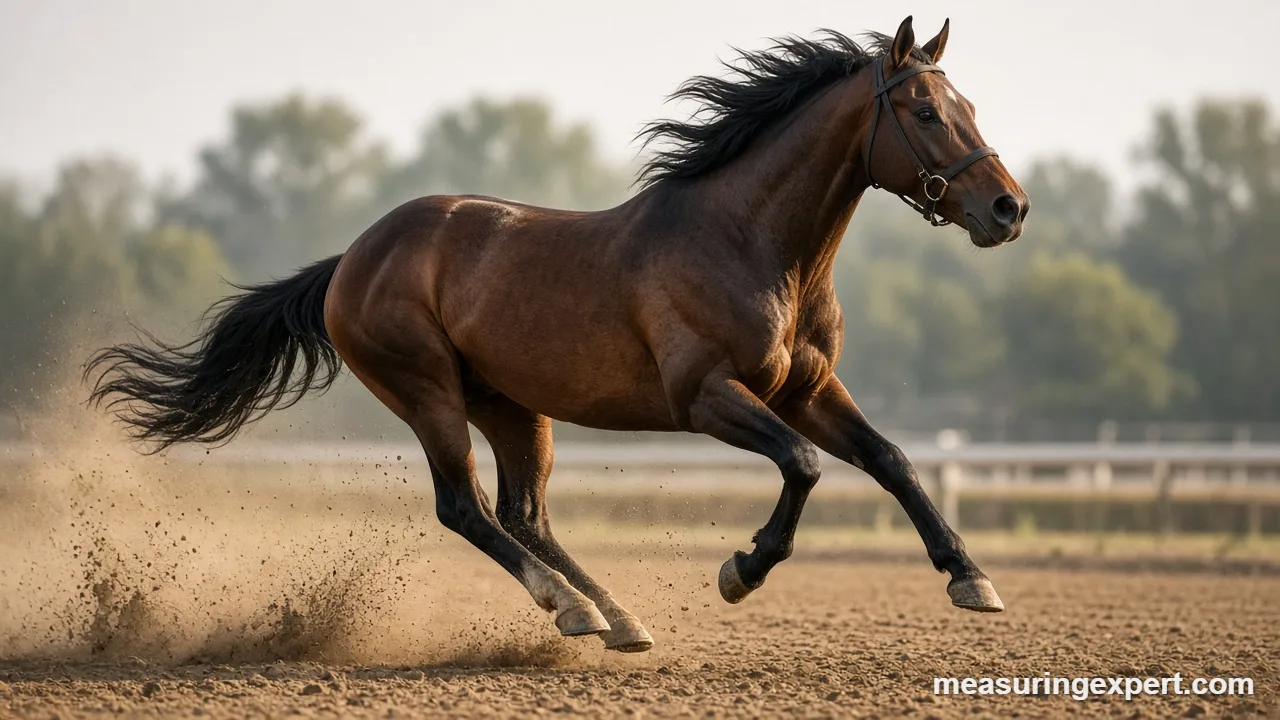
How fast can a horse run? An average horse run at full gallop is about 25 to 30 mph (40 to 48 km/h). Racing Thoroughbreds reach about 40 to 44 mph (64 to 71 km/h), and Guinness lists a record of 43.71 mph (70.35 km/h). By contrast, a walk is only about 4 mph (6.4 km/h).
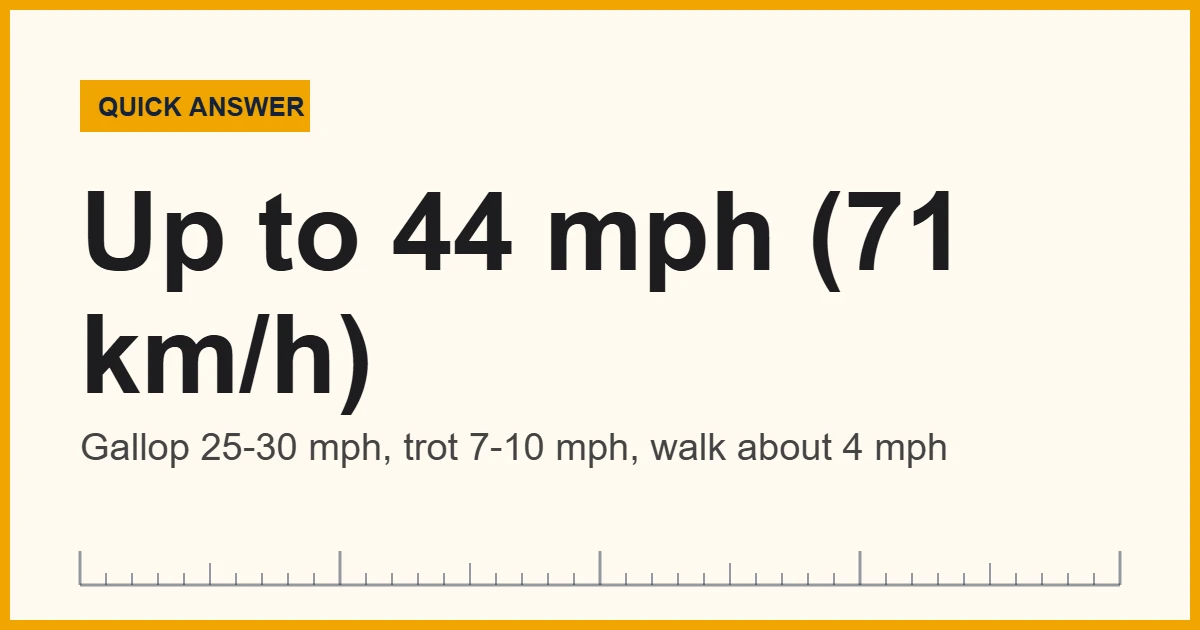
Convert Any Horse Run Speed to km/h, m/s and Knots
The converter opens at 44 mph, roughly the top of a Thoroughbred sprint. Then type any other speed, or switch the unit, to see it in kilometers per hour, meters per second, feet per second and knots. For example, enter 4 for a walk, 8 for a working trot, or 28 for a typical gallop.
Unfortunately, speed numbers for horses get repeated so often that the wrong ones stick. For instance, many pages say every horse can hit 55 mph. In reality, that figure comes from one breed over one very short distance, and it has never been confirmed by an official timed record. Meanwhile, most riding horses gallop at roughly half that speed.
In fact, the honest answer depends on the gait. Montana State University Extension’s guide to horse locomotion describes the walk as a four-beat gait at about 3.5 to 5 mph, and the trot as a two-beat diagonal gait averaging 7 to 10 mph. So, a horse moving at a relaxed pace covers ground only a little faster than a brisk human walker.
This page, therefore, sorts the figures by gait and by breed. First, you get a chart in five units. Next, you will see race records, the Quarter Horse question, comparisons with people and camels, and finally how to time a horse yourself with a stopwatch and a measured distance.
Horse Run Speed by Gait: Walk, Trot, Canter, Gallop
In total, a horse has four natural gaits, and each one has its own footfall pattern and speed range. Also, the table below uses typical published ranges. Because individual horses differ a lot, treat each row as a band rather than one fixed number.
| Gait | Beats | Typical speed (mph) | Typical speed (km/h) |
|---|---|---|---|
| Walk | 4-beat | 3.5 to 5 | 5.6 to 8 |
| Trot | 2-beat (diagonal pairs) | 7 to 10 | 11 to 16 |
| Canter (lope) | 3-beat | 10 to 17 | 16 to 27 |
| Gallop | 4-beat | 25 to 30 | 40 to 48 |
| Racing gallop (Thoroughbred) | 4-beat | 40 to 44 | 64 to 71 |
Published canter and gallop ranges vary more than walk and trot figures. For example, the Montana State guide lists a canter of 6 to 10 mph and a gallop of 12 to 20 mph for everyday riding horses, while racing data shows far higher numbers. In other words, the same gait name covers a relaxed trail lope and an all-out race.
Horse Run Speed Chart in mph, km/h, m/s, ft/s and Knots
Each row below is simply a straight unit conversion based on the exact definition 1 mile = 1.609344 km. As a result, you can also use the chart for any animal or vehicle in the same speed range.
| Speed | mph | km/h | m/s | ft/s | Knots |
|---|---|---|---|---|---|
| Walk | 4 | 6.44 | 1.79 | 5.9 | 3.48 |
| Working trot | 8 | 12.87 | 3.58 | 11.7 | 6.95 |
| Fast trot | 12 | 19.31 | 5.36 | 17.6 | 10.43 |
| Brisk canter | 17 | 27.36 | 7.60 | 24.9 | 14.77 |
| Average gallop | 27 | 43.45 | 12.07 | 39.6 | 23.46 |
| Fast gallop | 30 | 48.28 | 13.41 | 44.0 | 26.07 |
| Classic race average | 37.5 | 60.35 | 16.76 | 55.0 | 32.59 |
| Thoroughbred sprint | 40 | 64.37 | 17.88 | 58.7 | 34.76 |
| Top racing speed | 44 | 70.81 | 19.67 | 64.5 | 38.23 |
| Quarter Horse claim (unverified) | 55 | 88.51 | 24.59 | 80.7 | 47.79 |
Printable tip: this chart also fits on one page when you print it from your browser, so you can keep it with a barn notebook or a lesson plan.
How Fast Can a Horse Run by Breed?
Breed, however, changes the answer more than anything else, because each breed was selected for a different job. For example, Thoroughbreds were bred to hold a fast gallop over a mile or more. Quarter Horses, by contrast, were bred to explode out of the gate and win over a quarter mile, which gave them their name. Arabians, meanwhile, were bred for stamina in desert heat, so their strength is distance rather than raw speed.
| Breed | Built for | Speed people quote | What timed races show |
|---|---|---|---|
| Thoroughbred | Races of 5 furlongs to 1.5 miles | 40 to 45 mph | About 43.7 mph over 2 furlongs (Guinness record); about 37.5 mph average over 1.5 miles |
| American Quarter Horse | Sprints up to 440 yards | Up to 55 mph | About 43.5 mph average over 440 yards from a standing start |
| Arabian | Endurance riding | About 35 to 40 mph | Excels at long rides of 50 to 100 miles rather than sprints |
| Draft breeds (Clydesdale, Percheron) | Pulling heavy loads | Much slower at a gallop | Built for power, not speed |
Can a Quarter Horse Run 55 mph?
The 55 mph (about 88.5 km/h) figure is everywhere, too. PBS and several horse magazines repeat it, usually as a top speed in short bursts. However, none of them link it to a specific timed race, and no official record backs it up.
Still, here is what the timing data actually says. In 2005, A Long Goodbye set what was then the 440-yard world record of 20.686 seconds, according to a report of the race. Overall, that works out to an average of about 43.5 mph (70.0 km/h). Because the race starts from a standing gate, the peak speed during the run was higher than the average. Even so, reaching 55 mph would require a peak far above anything those timings suggest.
So the fair summary is this: a Quarter Horse is the fastest breed over a quarter mile, and it may briefly top the average speeds above, but 55 mph is a popular claim, not a measured fact.
Horse Run Records and Famous Times
According to Guinness World Records, the highest race speed recorded over two furlongs is 70.35 km/h (43.71 mph). Specifically, Winning Brew, a two-year-old Thoroughbred filly, set it at Penn National Race Course in Pennsylvania on May 14, 2008, covering the quarter mile in 20.57 seconds.
Longer races are slower on average, because no horse can hold a sprint for more than a short distance. For example, Secretariat’s 1973 Kentucky Derby time of 1:59.40 over 1 1/4 miles averages about 37.7 mph. Likewise, his famous Belmont Stakes win the same year, 2:24 over 1 1/2 miles, averages exactly 37.5 mph (about 60.4 km/h).
| Race | Distance | Time | Average speed |
|---|---|---|---|
| Winning Brew, 2008 | 2 furlongs (1/4 mile) | 20.57 s | 43.71 mph (Guinness) |
| A Long Goodbye, 2005 | 440 yards | 20.686 s | 43.5 mph (70.0 km/h) |
| Secretariat, Kentucky Derby 1973 | 1 1/4 miles | 1:59.40 | 37.7 mph (60.7 km/h) |
| Secretariat, Belmont Stakes 1973 | 1 1/2 miles | 2:24.00 | 37.5 mph (60.4 km/h) |
Horse Run vs Human and Camel Speed
Clearly, a galloping horse leaves even the fastest people far behind. Usain Bolt’s 100-meter world record of 9.58 seconds averages about 23.4 mph, and his peak was roughly 27.8 mph. That is close to an average horse gallop but well short of a racehorse. For the full numbers on people, also see how fast a human can run.
Camels, however, are a closer match. A dromedary can sprint at up to about 40 mph in short bursts, so a racing Thoroughbred still wins over a short course. Over a long, hot trek, however, the camel’s endurance becomes the advantage. Our guide to camel run speed covers that matchup in detail.
| Runner | Top speed (mph) | Top speed (km/h) |
|---|---|---|
| Racing Thoroughbred | about 44 | about 71 |
| Camel (sprint) | about 40 | about 64 |
| Average horse gallop | 25 to 30 | 40 to 48 |
| Usain Bolt (peak) | about 27.8 | about 44.7 |
If you also like comparing predators, our page on how fast a wolf runs shows another animal that trades sprint speed for stamina.
How to Time a Horse Run Yourself
Fortunately, you do not need radar or a race timing system. Instead, a measured distance and a stopwatch give a surprisingly good average speed.
- Measure a straight stretch. First, use a measuring wheel to mark exactly 100 yards or 100 meters on level, safe footing.
- Set clear markers. Next, put a cone or post at the start and at the finish so the timer can see both.
- Let the horse reach a steady gait first. Then start timing only after it has settled into the trot, canter or gallop you want to measure.
- Time the nose crossing each marker. Start the stopwatch when the nose passes the first cone, and stop it at the second.
- Repeat three times and average. Then divide the distance by the average time and enter the result in the converter above.
For example, if a horse covers 100 meters in 7.5 seconds, its speed is 13.33 m/s, or about 48 km/h (29.8 mph). Similarly, 100 yards in 10 seconds is 30 feet per second, or about 20.5 mph.
Recommended Tools for Timing a Horse Run
Generally, a simple kit is enough for a fair speed test. First, a stopwatch with a large display is easier to read than a phone in bright sun. Next, a measuring wheel lets you lay out an exact distance on a paddock or trail. Finally, a GPS watch or a laser rangefinder helps when you cannot walk the course with a wheel.


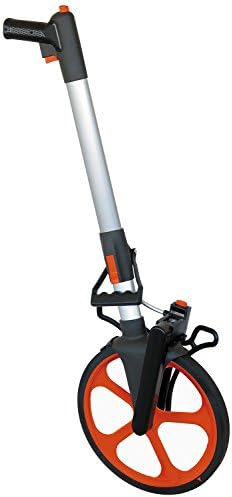
As an Amazon Associate, Measuring Expert earns from qualifying purchases.
Do and Don’t When Comparing Horse Speeds
Do
- First, check the breed and the race distance.
- Also, separate peak speed from average speed.
- Convert with 1 mile = 1.609344 km, since that value is exact.
- Time several runs, then average them.
- Finally, trust timed race results more than round numbers.
Don’t
- Assume every horse can gallop at 55 mph, because most cannot.
- Mix a sprint record with a long-race average when comparing.
- Push an unfit horse to a full gallop before it is ready.
- Stand near a busy track while you time.
- Rely on a GPS reading over a few seconds, since it can jump.
Honest Limits of Horse Run Numbers
Overall, horse speed figures are less precise than they look. For one thing, race times measure an average over a set distance, so they hide the peak. Peak speeds, on the other hand, come from short sections of a race and depend on the timing method. Besides, track surface, wind, the horse’s age and fitness, and the rider’s weight all change the result as well. Because of all this, the ranges on this page describe typical horses, not any one animal on any one day. Therefore, for a single horse, a few careful timed runs will tell you more than any chart.
When Accuracy Really Matters
For a school report, the ranges above are plenty, too. In contrast, training and racing decisions need real measurements. For that reason, trainers use official race timing, GPS trackers and heart rate monitors to judge fitness, because pushing a horse too hard risks injury.
Horse Run FAQs
How fast can a horse run?
An average horse gallops at about 25 to 30 mph (40 to 48 km/h). Racing Thoroughbreds, however, reach about 40 to 44 mph (64 to 71 km/h).
What is the fastest horse run speed ever recorded?
Currently, Guinness World Records lists 70.35 km/h (43.71 mph), set by Winning Brew over two furlongs at Penn National Race Course in 2008.
Can a Quarter Horse really run 55 mph?
That figure is widely repeated, but it is not backed by an official timed record. Record 440-yard times average about 43.5 mph from a standing start.
How fast does a horse walk?
Typically, a horse walks at about 3.5 to 5 mph, or roughly 5.6 to 8 km/h. Generally, around 4 mph (6.4 km/h) is typical.
How fast is a horse trot?
Usually, a working trot averages about 7 to 10 mph (11 to 16 km/h). However, an extended or racing trot can be much faster.
How fast is a canter?
Most sources put the canter at about 10 to 17 mph (16 to 27 km/h), though a slow western lope can be under 10 mph.
How long can a horse run at top speed?
Only for a short distance, usually well under a mile, because the effort is huge. That is why long races average around 37 to 38 mph instead of 44.
Can a human outrun a horse?
Not in a sprint. Even Usain Bolt peaked at about 27.8 mph. Over very long distances in heat, however, fit humans can sometimes keep up.
What is 44 mph in km/h?
In short, 44 mph is about 70.81 km/h, which equals 19.67 meters per second or 64.5 feet per second.
Is a horse faster than a camel?
Over a short sprint, yes, because its top speed is higher. A racing Thoroughbred reaches about 44 mph versus about 40 mph for a camel, but camels last longer in heat.
The Bottom Line on Horse Speed
In short, a typical horse walks at about 4 mph, trots at 7 to 10 mph, canters at 10 to 17 mph and gallops at 25 to 30 mph. Racing Thoroughbreds top out around 44 mph (71 km/h), the Guinness record is 43.71 mph, and the famous 55 mph Quarter Horse figure remains unverified.
Also, to compare any of these with your own numbers, use the converter at the top of the page. And if you want to measure a horse yourself, a measured 100-yard stretch and a good stopwatch are all you really need.
4 thoughts on “How Fast Can a Horse Run? Speeds by Gait, Breed and Record”