

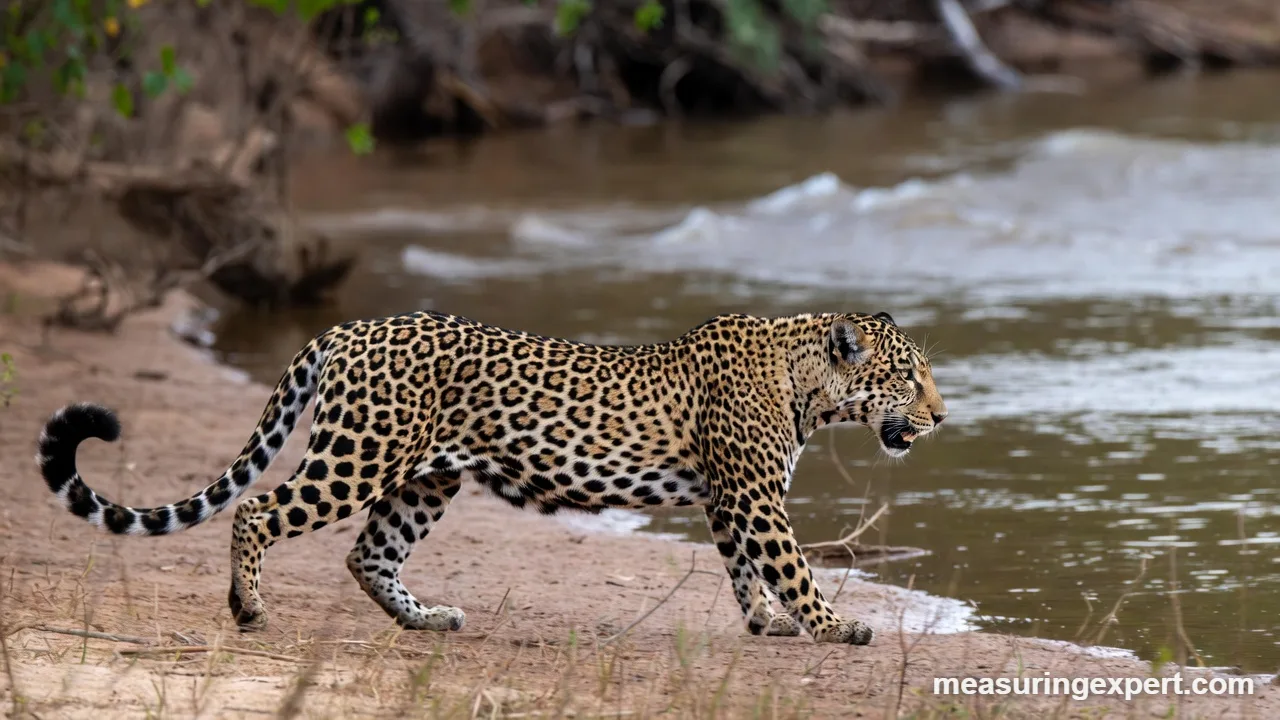
How fast is a jaguar? Its top speed is usually quoted as about 50 mph (80 km/h), and the San Diego Zoo Wildlife Alliance lists a top speed of up to 62 mph (100 km/h). However, a jaguar holds that pace only for a short charge of roughly 23 to 98 feet (7 to 30 m), because it is an ambush hunter, not a distance runner.
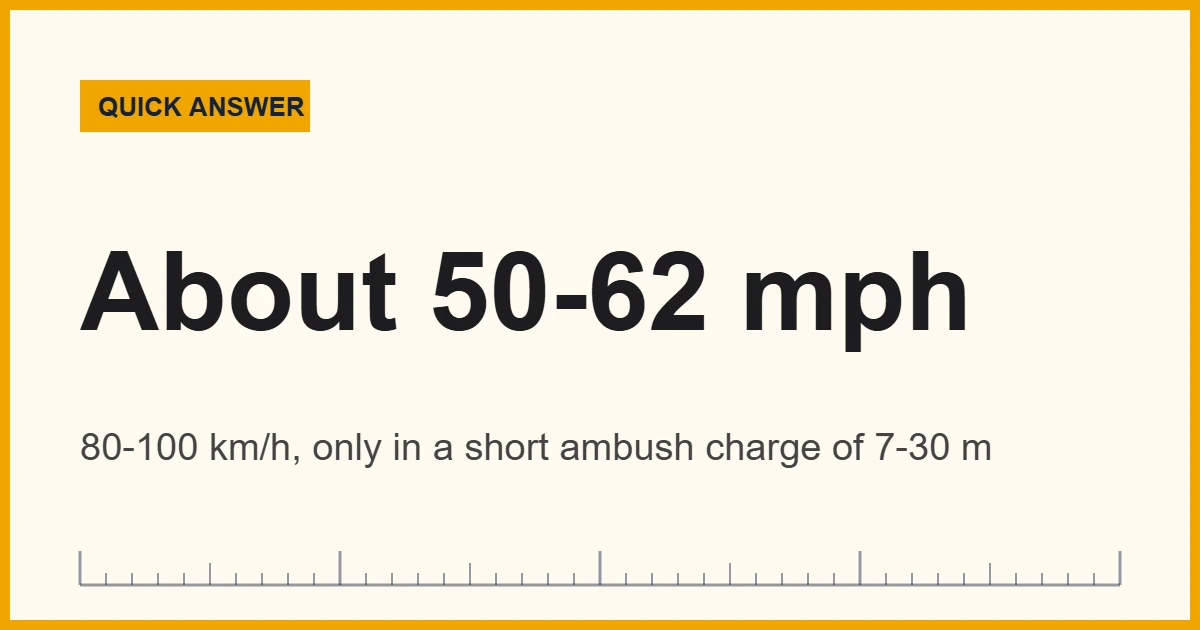
So what does that jaguar speed mean in everyday terms? At 50 mph, a jaguar covers about 73 feet (22.4 m) every second. Admittedly, that sounds dramatic. Still, the number tells only half the story, since no scientist has clocked a wild jaguar’s top sprint with a GPS collar or a radar gun. Instead, the figures you see come from field observation and estimates, so treat them as a range rather than a precise reading.
Convert Jaguar Speed to km/h, m/s and Knots
First, enter any speed below to convert it. The box starts at 50 mph, the most widely repeated jaguar speed estimate. You can also type 62 to see the zoo figure, or try another cat from the comparison table further down.
The jaguar (Panthera onca) is the largest cat in the Americas. For example, adults weigh about 126 to 249 pounds (57 to 113 kg), according to the San Diego Zoo Wildlife Alliance jaguar fact sheet, and their range runs from Mexico to Argentina. Because they live mostly in dense forest and wetlands, they rarely need open-ground speed. In fact, the same fact sheet notes that jaguars tire quickly at top speed and do not usually chase prey down.
Jaguar Speed Chart: mph, km/h, m/s and ft/s
This chart converts the two published jaguar speed figures, plus a few slower values for context. First, every value starts from the exact definition of a mile (1.609344 km). Next, the results are rounded to two decimals.
| Speed (mph) | km/h | m/s | ft/s | Knots | What it means |
|---|---|---|---|---|---|
| 20 | 32.19 | 8.94 | 29.33 | 17.38 | Easy bounding pace |
| 30 | 48.28 | 13.41 | 44.00 | 26.07 | Fast run |
| 40 | 64.37 | 17.88 | 58.67 | 34.76 | Hard sprint |
| 50 | 80.47 | 22.35 | 73.33 | 43.45 | Common estimate |
| 62 | 99.78 | 27.72 | 90.93 | 53.88 | Zoo fact sheet maximum |
For a sense of scale, a jaguar running 50 mph needs only about 1.3 seconds to cover 98 feet (30 m), the far end of its typical charge. For other animals in the same speed cluster, see how fast a horse can run.
How Fast Is a Jaguar Compared With Other Big Cats?
Comparing cats is tricky, because the figures come from different methods. For instance, some numbers are field estimates, while others come from GPS collars. Therefore, the table below names the source for each value.
| Cat | Top speed | Source and method |
|---|---|---|
| Jaguar | Up to 62 mph (100 km/h), short distance; often quoted as about 50 mph (80 km/h) | San Diego Zoo Wildlife Alliance fact sheet (estimate) |
| Cheetah | 70 mph (112 km/h) top, lasting about 20 seconds; average chase about 40 mph (64 km/h) | San Diego Zoo Wildlife Alliance fact sheet |
| Cheetah (measured) | 23.8 m/s, about 53 mph (85.7 km/h) | GPS collars in the wild (Wilson et al., Nature, 2018) |
| Lion (measured) | 20.6 m/s, about 46 mph (74.2 km/h) | GPS collars in the wild (Wilson et al., Nature, 2018) |
| Leopard | About 36 mph (58 km/h) in short bursts | PBS Nature leopard profile |
Overall, the cheetah is clearly the fastest of these cats. Meanwhile, the measured lion figure is a useful reality check. In the 2018 GPS-collar study, the fastest lion reached 20.6 m/s, about 46 mph. As a result, a jaguar figure of 62 mph would put a heavier, stockier forest cat well ahead of a measured lion, so the lower 50 mph estimate, or even less, may be closer to real life. For a full breakdown of lion running speed, see how fast a lion can run.
How Fast Is a Jaguar When It Hunts From Ambush?
A jaguar does not need marathon stamina, because it rarely chases anything far. Instead, it stalks close, waits under cover, and then charges over a few body lengths. Specifically, the San Diego Zoo fact sheet puts that charge at about 23 to 98 feet (7 to 30 m), and it says jaguars prefer to wait in ambush rather than run prey down.
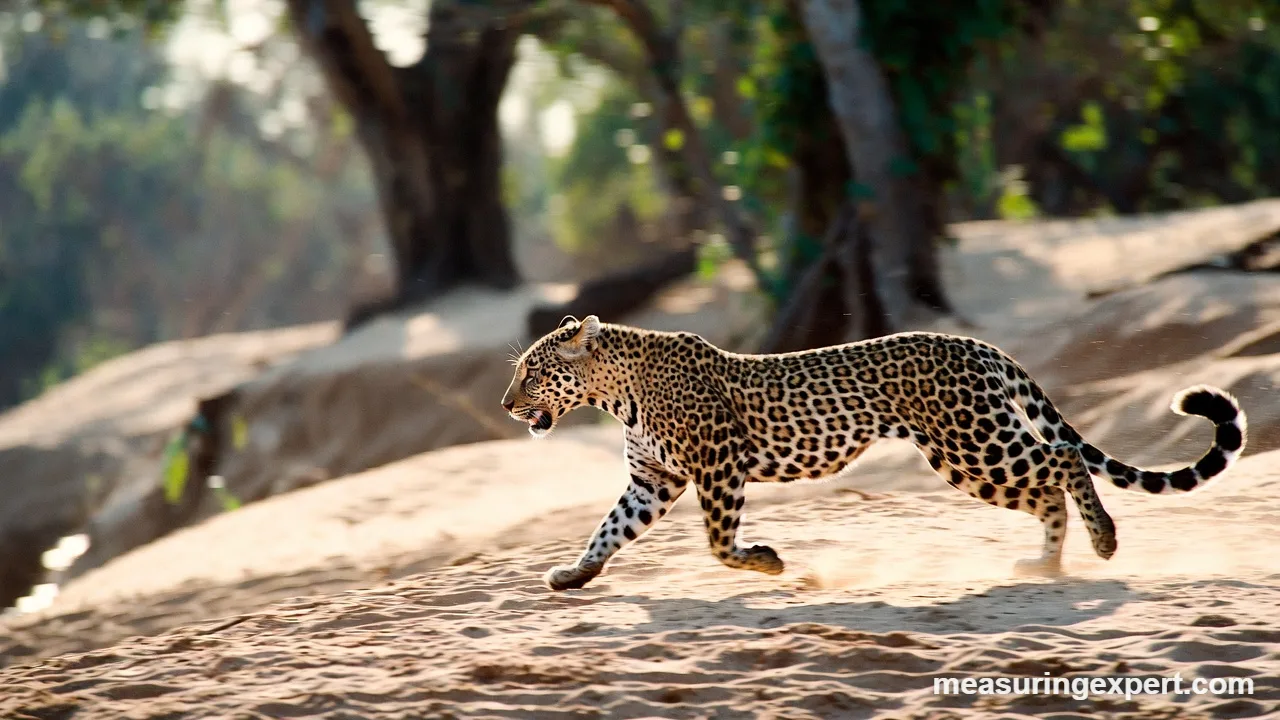
Above all, power matters more than pace in that short burst. For instance, the World Wildlife Fund describes the jaguar’s bite as the strongest of all the cats, strong enough to pierce turtle shells and crocodile hides. Jaguars also swim and climb well, so they can hunt along rivers, where a long sprint would be useless anyway.
Jaguar speed over the first few strides
In other words, acceleration is what actually wins a jaguar its meal. However, nobody has published a measured 0-to-top-speed figure for wild jaguars. So any claim about exact acceleration times is a guess. What we do know is the stride: the zoo fact sheet lists a stride of about 20 inches (50 cm), and at 50 mph the cat would close short gaps in well under two seconds.
Night hunting and cover
Moreover, jaguars hunt mostly at night, according to the same fact sheet. As a result, darkness, dense plants and water all favor a short rush over a long chase. In short, the jaguar is built like a sprinter in a weight class of its own, not like a distance runner.
Top Jaguar Speed vs Chase Speed vs Cruising Speed
People often mix up three different numbers when they compare animal speeds. So this table separates them.
| Term | What it means | Jaguar example |
|---|---|---|
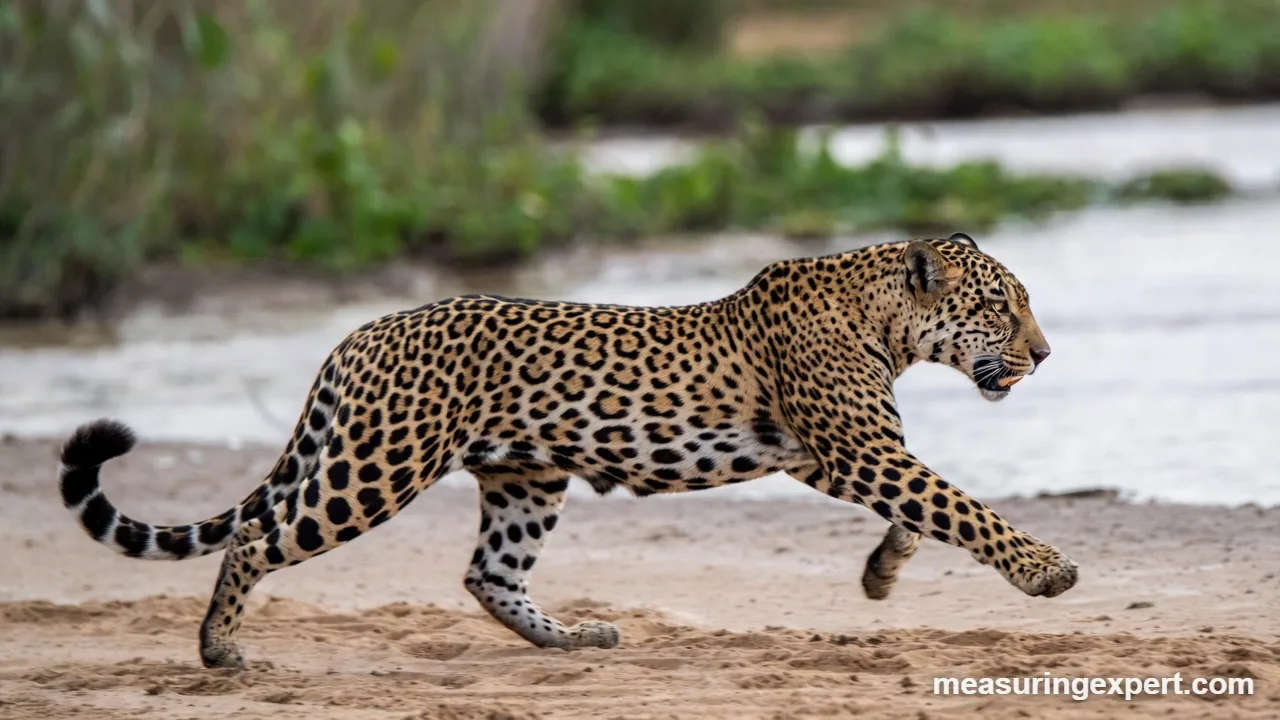
| Top speed | The fastest pace for a second or two | About 50 to 62 mph (80 to 100 km/h), estimated |
| Chase or charge speed | The average pace over a whole attack | Lower than top speed; not measured for jaguars |
| Travel speed | The pace while patrolling territory | A walk, much slower than a sprint |
| mph vs km/h | 1 mph = 1.609344 km/h exactly | 50 mph = 80.47 km/h |
| Knots | Nautical miles per hour; 1 knot = 1.852 km/h | 50 mph = 43.45 knots |
How to Estimate an Animal’s Speed Yourself
You cannot time a wild jaguar safely, but you can use the same method on a pet, a horse or a video clip. Here is the basic distance-over-time approach.
- Mark a known distance. Measure a straight stretch with a tape measure or a measuring wheel, for example 100 feet (30.48 m).
- Record the run. Film from the side at a fixed spot, so both marks stay in the frame.
- Find the time. Step through the video frame by frame and note when the animal crosses each mark.
- Divide distance by time. For example, 100 feet in 2 seconds is 50 feet per second.
- Convert the result. Enter it in the converter above as ft/s to get mph, km/h and m/s.
- Repeat and average. Run several trials, because a single run can mislead you.
A radar speed gun gives a quicker reading on a straight run toward or away from you. Even so, it reads low when the animal moves at an angle to the beam.
Tools for Watching and Timing Wildlife Speed
You do not need special gear to learn about jaguar speed, but two tools help if you like to watch or time animals. For example, binoculars let you follow fast movement from a safe distance at a zoo or on a wildlife trip. Similarly, a sports radar gun measures the speed of a dog, a horse or a ball moving straight toward you.


As an Amazon Associate, Measuring Expert earns from qualifying purchases.
Do and Don’t When Reading Animal Speed Claims
Do
- Check who published the number.
- Look for the method: GPS collar, video or estimate.
- Compare cats with figures from the same kind of study.
- Convert units with the exact mile definition.
- Remember that sprints last seconds.
Don’t
- Treat “up to” figures as typical pace.
- Assume a heavier cat must be faster.
- Mix knots with miles per hour.
- Trust a single video timing.
- Approach a wild cat to watch it run.
Honest Limits of Jaguar Speed Figures
In fact, every published jaguar speed is an estimate. Researchers have collared lions and cheetahs on open ground, yet jaguars hunt in forest and at night, where clean speed readings are hard to get. Moreover, sources round heavily: 100 km/h becomes 62 mph, and 80 km/h becomes 50 mph. In addition, individual cats differ by age, size and fitness. So the honest answer is a range, roughly 50 to 62 mph in the sources, with real sprints possibly slower.
When Accuracy Really Matters
For a school project or a trivia night, “about 50 mph” is fine. On the other hand, precise figures matter in three cases. First, scientific writing should cite the source and method for every number. Second, safety planning in jaguar country should assume the cat can reach you in a second or two. Finally, comparisons between animals should use matching methods, as on our pages on how fast a wolf runs and how fast a kangaroo can run.
Jaguar Speed FAQs
What is the top jaguar speed?
Sources give about 50 mph (80 km/h), and the San Diego Zoo Wildlife Alliance lists up to 62 mph (100 km/h) over a short distance. No one has measured it precisely.
How fast is a jaguar in km/h?
About 80 km/h for the common 50 mph estimate, and up to 100 km/h for the zoo fact sheet figure.
Is a jaguar faster than a cheetah?
No. The cheetah is the fastest land animal, with a top speed of about 70 mph (112 km/h) on the San Diego Zoo fact sheet.
How does jaguar speed compare with a lion?
Overall, they are in a similar range. GPS collars measured a wild lion at 20.6 m/s, about 46 mph, while jaguar figures are estimates of 50 to 62 mph.
Is a jaguar faster than a leopard?
Possibly. PBS Nature gives leopards about 36 mph (58 km/h) in short bursts, but neither cat has a precise measured top speed.
How long can a jaguar run at top speed?
Only briefly. Jaguars tire quickly at top speed and usually charge about 23 to 98 feet (7 to 30 m).
Do jaguars chase their prey?
Rarely. Instead, jaguars stalk and ambush, then finish prey with a powerful bite instead of running it down.
How fast is a jaguar in meters per second?
About 22.35 m/s at 50 mph and about 27.72 m/s at 62 mph.
Can a human outrun a jaguar?
No. Even the low estimate is far faster than any human sprinter, so never try to run from a big cat.
Can jaguars swim fast?
Jaguars are strong swimmers and often travel along rivers, but there is no reliable published swimming speed.
The Bottom Line on Jaguar Speed
To sum up, a jaguar can reach roughly 50 mph (80 km/h), and one respected zoo source says up to 62 mph (100 km/h), but only for a few seconds. That burst is all it needs, because the jaguar wins by ambush and bite, not by endurance. Also, treat every jaguar figure as an estimate, and use the converter above when you need the number in km/h, m/s or knots.
2 thoughts on “How Fast Is a Jaguar? Jaguar Speed in mph, km/h and m/s”