

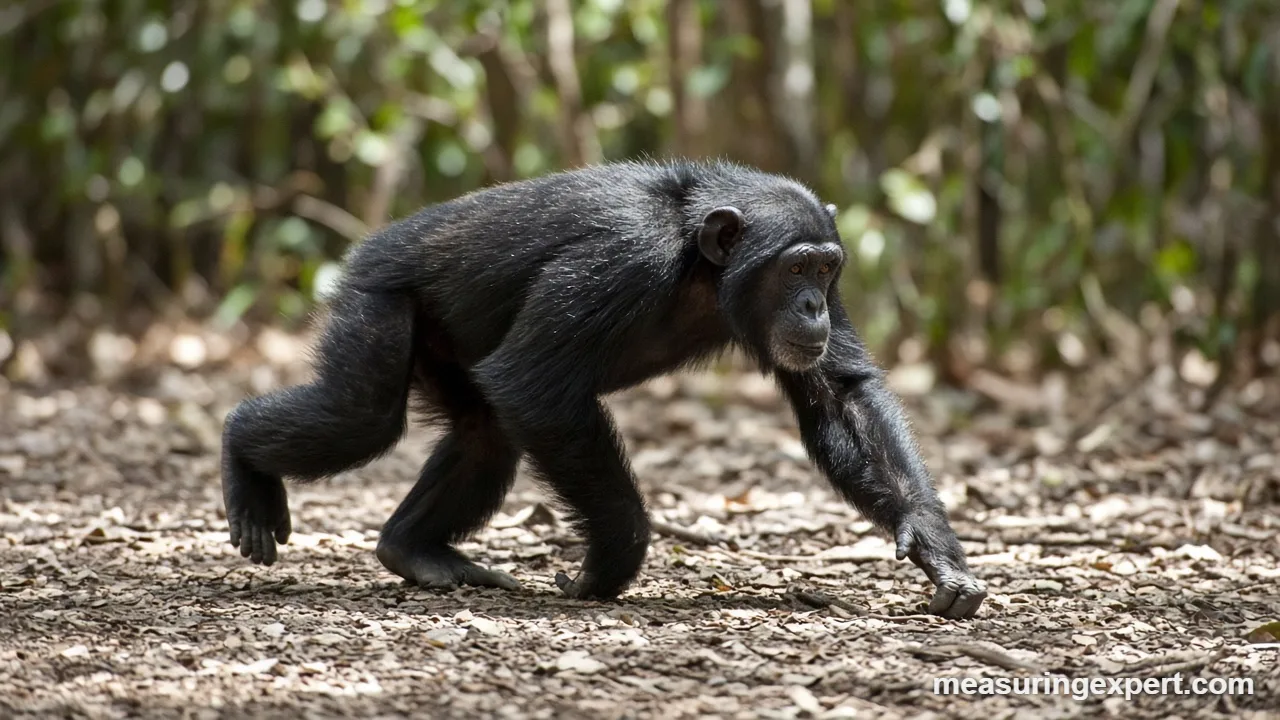
Chimpanzee speed tops out at roughly 25 mph (about 40 km/h, or 11 m/s) in a short sprint on all fours. However, that popular figure is an estimate, not a lab measurement. For comparison, Usain Bolt peaked at about 27.8 mph (44.7 km/h), so a chimp easily outruns almost any ordinary person.
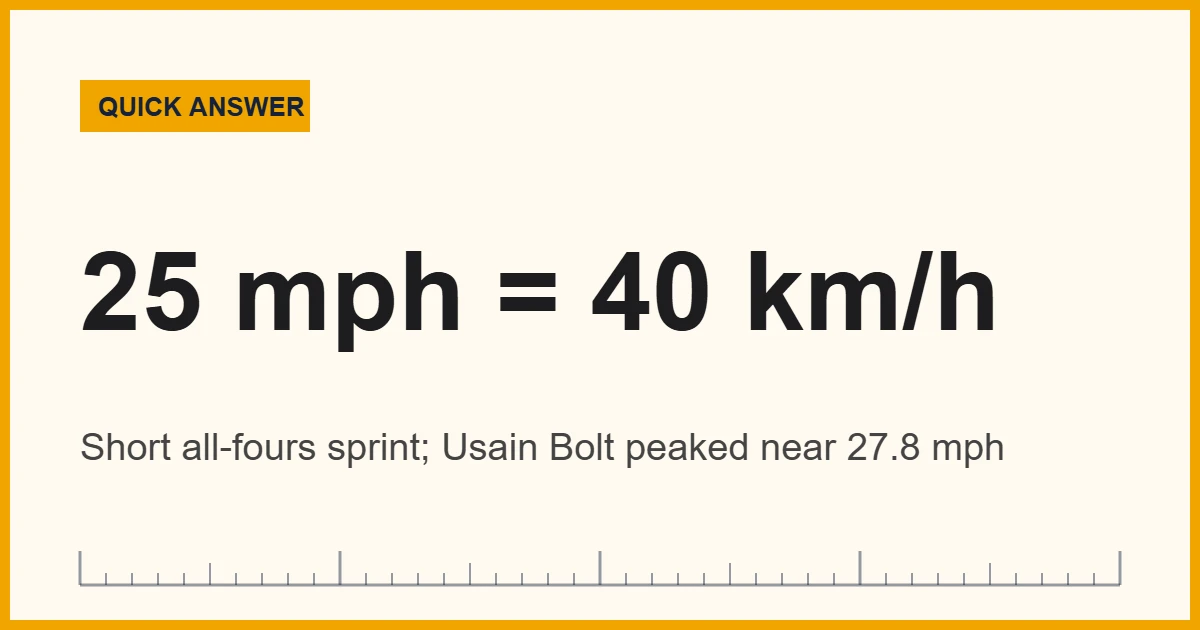
Convert Chimpanzee Speed to km/h, m/s or Knots
The converter starts at 25 mph, the figure most sources quote. You can type any other value, for example a speed you timed yourself, and it shows the same pace in other units. It also uses the exact definition 1 mile = 1.609344 km.
Chimpanzees (Pan troglodytes) look slow when they amble along on their knuckles. Yet when a chimp needs to move, it shifts into a bounding gallop that leaves people far behind. That burst is short, though. In fact, chimps are built for power and climbing, not for long chases.
The weight of a chimp also surprises people. According to the University of Michigan’s Animal Diversity Web, wild males weigh about 34 to 70 kg (75 to 154 lb) and females about 26 to 50 kg (57 to 110 lb). Standing upright, they reach about 1 to 1.7 m (3.3 to 5.6 ft). So a chimp is smaller than most adults, but much stronger for its size.
Chimpanzee Speed vs Humans and Other Primates
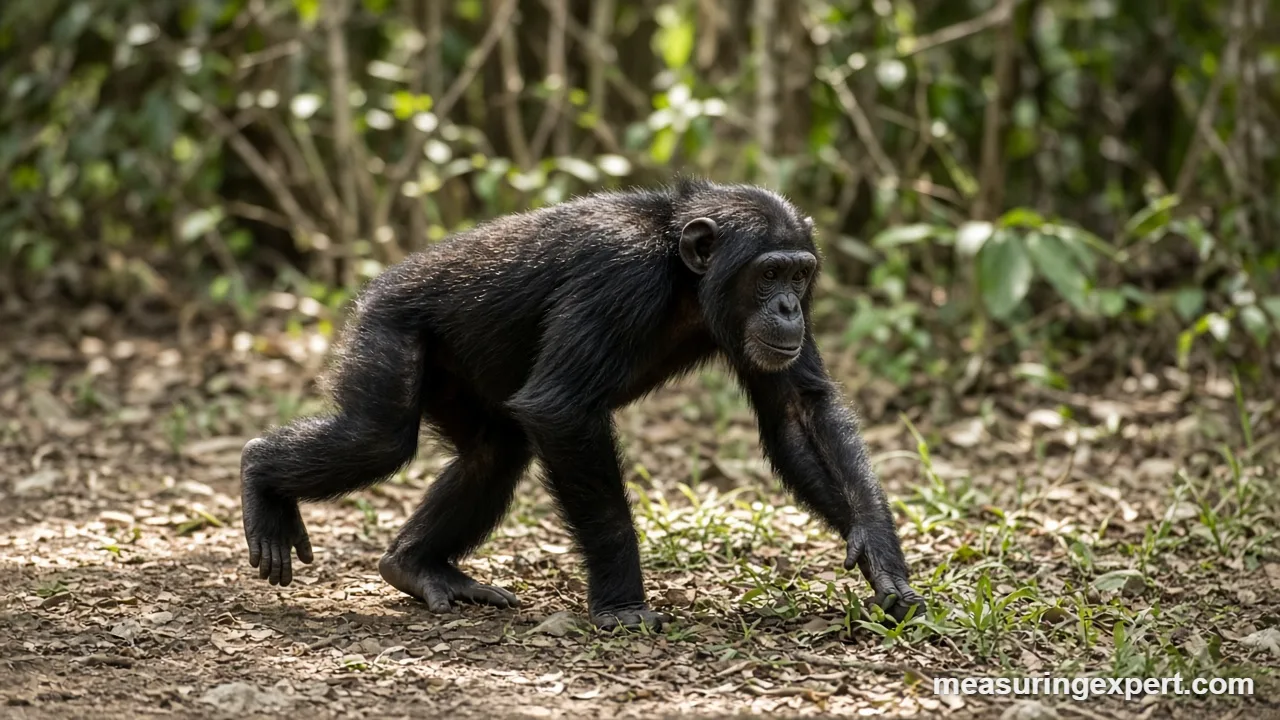
The table puts chimpanzee speed next to people and other primates. The animal values are commonly cited top speeds, so treat them as rough guides. The human values, by contrast, come from timed races.
| Runner | Top speed (mph) | Top speed (km/h) | m/s |
|---|---|---|---|
| Patas monkey (often called the fastest primate) | about 34 | about 55 | 15.3 |
| Usain Bolt, peak (Berlin 2009) | 27.8 | 44.7 | 12.4 |
| Chimpanzee, short sprint | about 25 | about 40 | 11.2 |
| Usain Bolt, 100 m average | 23.35 | 37.58 | 10.44 |
| Gorilla, short charge | about 20 to 25 | about 32 to 40 | 8.9 to 11.2 |
| Recreational runner, race pace | 4.5 to 6 | 7 to 9.5 | 2.0 to 2.7 |
In other words, only elite sprinters come close to a chimp, and only for a few seconds. Our full guide on how fast a human can run explains where the Bolt figures come from. Similarly, the chimp’s bigger cousin is covered in how fast a gorilla can run.
Recommended Tools for Timing Animal Speed
You do not need a lab to estimate how fast an animal moves. First, a laser rangefinder gives you the distance. Next, a stopwatch or a radar gun gives you the time or the speed directly. Also, a rangefinder with a built-in inclinometer helps on sloped ground.


As an Amazon Associate, Measuring Expert earns from qualifying purchases.
Why Chimpanzee Speed Is So High for Its Size
Chimps are not just small, hairy people. Their muscles work differently. A 2017 study in the Proceedings of the National Academy of Sciences, summarized by ScienceDaily, found that chimp muscle makes about 1.35 times more force and power than human muscle of the same size. That is far less than the “five times stronger” myth, but it is still a real edge.
The same team also found that chimps have roughly twice the share of fast-twitch fibers that humans have. These fibers contract quickly and powerfully, so they suit jumps, climbs and sprints. Human muscle, meanwhile, leans toward slow-twitch fibers, which favor endurance. As a result, a chimp wins the first few seconds of a race, while a fit person wins a long one.
Four limbs instead of two
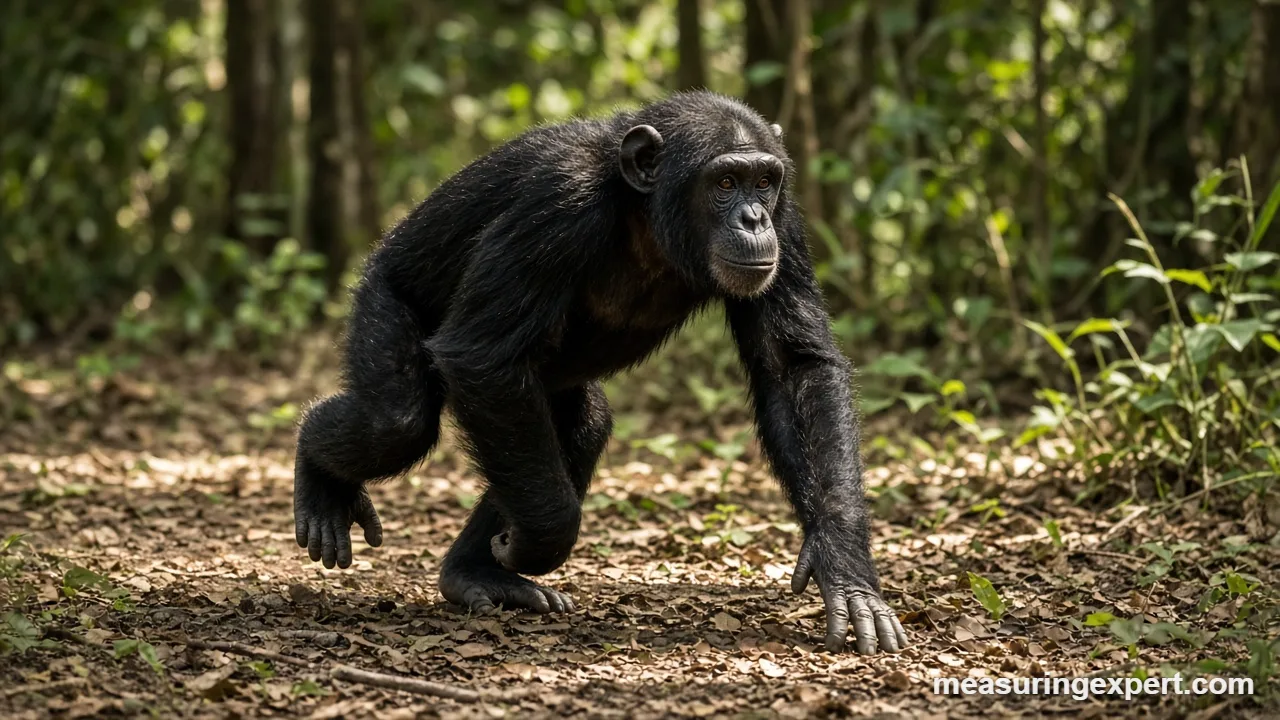
Chimps can walk upright for short stretches. When they run fast, however, they drop to all fours. Their long arms, which span about 1.5 times their height, add reach to every bound. Because their weight rests on the knuckles, they also keep their fingers free of the ground.
Chimpanzee Speed: Sprint vs Everyday Pace
Most of the time, chimps move slowly. Animal Diversity Web reports that males travel about 4.9 km (3.0 mi) a day and females about 3.0 km (1.9 mi). So a chimp spends far more time walking, climbing and resting than running.
| Situation | What the chimp does | Typical pace |
|---|---|---|
| Daily foraging | Knuckle-walks between food trees | Slow walk |
| Display or chase within the group | Short charge on all fours | Fast, a few seconds |
| Escape from danger | Sprints to the nearest tree and climbs | Up to the top sprint estimate |
| Hunting monkeys | Climbs and chases mostly through the canopy | Speed limited by branches |
For example, if a chimp could hold 25 mph, it would cover 100 m in about 9 seconds. In reality, it rarely needs to run that far. Instead, it usually heads for a tree.
How to Measure an Animal’s Speed
Researchers rarely clock wild chimps with radar. Still, the method below works for any animal you can film or watch safely, for example a pet dog or a horse in a paddock.
- Mark a straight course. Pick two landmarks the animal will pass, such as fence posts.
- Measure the distance. Use a laser rangefinder or a long tape between the two marks.
- Record the run. Film from the side, or start and stop a stopwatch as the animal passes each mark.
- Find the time. On video, count frames between the marks and divide by the frame rate.
- Divide distance by time. For example, 30 m in 3.0 s is 10 m/s.
- Convert the result. Enter it in the converter above: 10 m/s is 36 km/h, or about 22.4 mph.
Longer courses give better results, because a small timing error matters less. In addition, a side-on camera avoids the distortion you get when the animal runs toward you. Our page on how fast a horse can run shows how race timing handles this.
Do and Don’t Around Chimpanzees
Do
- Watch chimps only from a safe distance or behind barriers.
- Follow guide and park rules on chimp treks.
- Check what a speed figure measures: burst or average.
- Quote speeds in both mph and km/h.
Don’t
- Assume you can outrun an agitated chimp.
- Try to approach, feed or film chimps up close.
- Treat one viral video as proof of top speed.
- Compare sprint figures with endurance paces.
Chimpanzee Speed Claims We Corrected
An earlier version of this page repeated several claims that do not hold up. Here is what we changed and why.
- “Chimps run 25 mph in dense forest.” Thick roots and vines slow any runner, so top speeds happen on open ground or trails.
- “Chimps have denser bones than humans.” We found no solid source for this, so we removed it. Their strength, instead, comes mainly from muscle makeup.
- “Lemurs top out at 12 mph.” Lemur species vary a lot, and we could not confirm that number.
- “Males are always faster.” Males are larger and stronger on average. Even so, no study we found timed male and female sprints.
Honest Limits of Chimpanzee Speed Figures
No peer-reviewed study we found clocked a wild chimp’s top sprint with radar or timing gates. The 25 mph (40 km/h) value, therefore, is a widely repeated estimate based on observation. It may be a little high or a little low. Individual chimps also differ by age, size, health and terrain, much like people do. Meanwhile, the human figures in our table come from official race timing, so they are far more precise. Keep that gap in mind whenever you compare the two.
When Chimpanzee Speed Really Matters
For most readers, chimpanzee speed is a fun fact. However, it matters for people who work near chimps or visit them in the wild. Sanctuary staff, researchers and trekkers all plan for an animal that can close a gap in seconds. That is why parks set minimum viewing distances and why zoos use moats and barriers.
Frequently Asked Questions
What is the top chimpanzee speed?
The commonly cited top speed is about 25 mph, or roughly 40 km/h, in a short sprint on all fours.
Can a human outrun a chimpanzee?
Over a short sprint, almost never. Only elite sprinters reach similar speeds. Over long distances, however, a fit person would likely keep going after a chimp tires.
Is chimpanzee speed faster than gorilla speed?
They are similar. Gorillas are often quoted at about 20 to 25 mph (32 to 40 km/h) in short charges.
How fast is 25 mph in km/h?
25 mph equals about 40.23 km/h, or 11.18 m/s.
Do chimpanzees run on two legs?
They can walk upright for short distances. When they run fast, they switch to all fours.
Why are chimpanzees so strong?
Their muscle makes about 1.35 times more force and power than human muscle of the same size, partly because it has about twice the share of fast-twitch fibers.
How far do chimpanzees travel each day?
Males travel about 4.9 km (3.0 mi) a day and females about 3.0 km (1.9 mi), mostly at a walking pace.
Which primate is the fastest?
The patas monkey is often called the fastest primate, at about 34 mph (55 km/h).
How was chimpanzee speed measured?
Mostly by observation. We found no published study that timed a wild chimp’s top sprint with radar or timing gates.
How long could a chimp hold its top speed?
Only a few seconds. Chimps rely on fast-twitch muscle, which tires quickly, so they sprint briefly and then climb.
Chimpanzee Speed: The Bottom Line
To sum up, a chimpanzee can sprint at roughly 25 mph (40 km/h), which beats nearly every person on Earth. That speed lasts only seconds, though, and it comes from powerful fast-twitch muscle rather than endurance.
Finally, remember that the chimp figure is an estimate, while human records come from precise timing. If you want to compare other runners, the converter at the top of this page handles mph, km/h, m/s, feet per second and knots.