

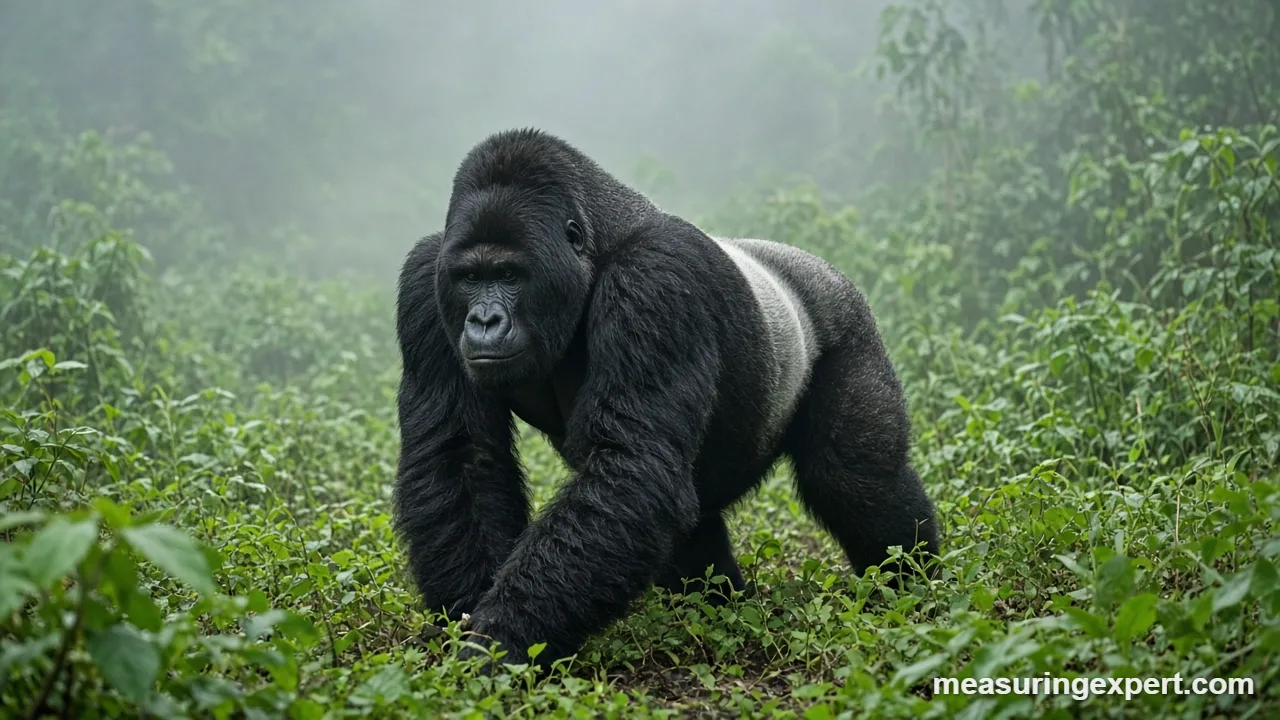
Gorilla speed is usually quoted at about 20 to 25 mph (32 to 40 km/h) in a short charge on all fours. However, no study has clocked a running gorilla with radar, so treat that range as an estimate. For comparison, a chimpanzee sprints at a similar pace, while Usain Bolt peaked near 27.8 mph (44.7 km/h).
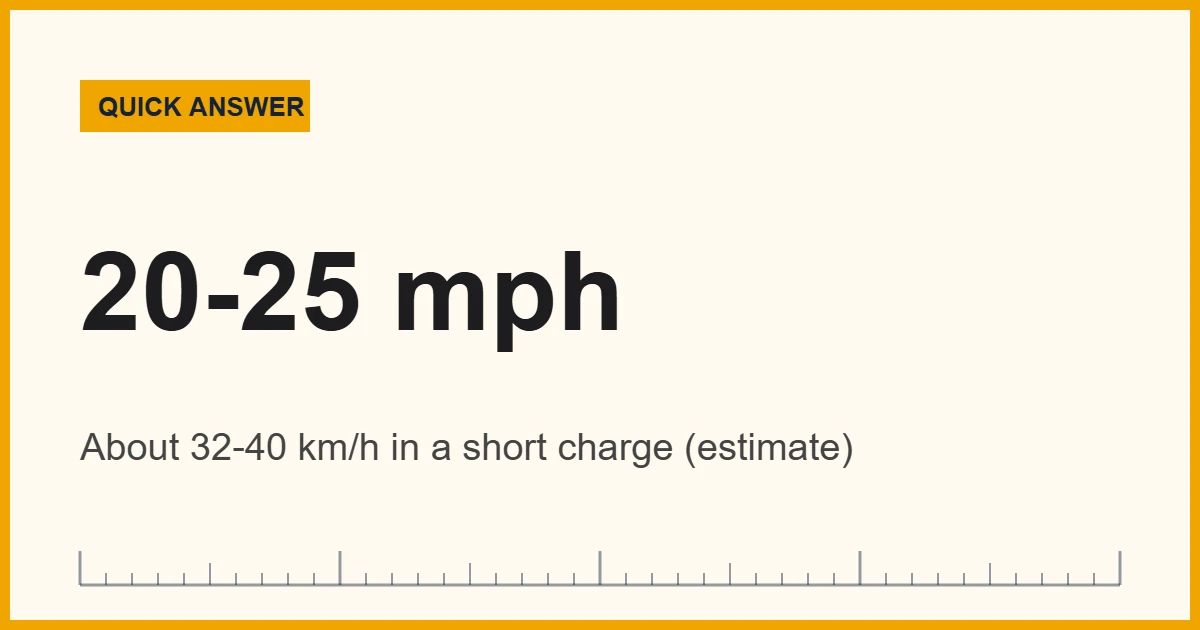
Turn Gorilla Speed Into km/h, m/s or Knots
The converter opens at 20 mph, the low end of the usual estimate. Type 25 to see the high end, or enter any speed you have timed yourself. It also uses the exact definition 1 mile = 1.609344 km, so the results are not rounded guesses.
Gorillas are the largest living primates. According to the Smithsonian’s National Zoo, adult male western lowland gorillas average about 300 lb (136 kg) and can reach 500 lb (227 kg). Males also stand up to 6 ft (1.8 m) tall. Females, by contrast, are much smaller, at roughly 150 to 200 lb (68 to 91 kg).
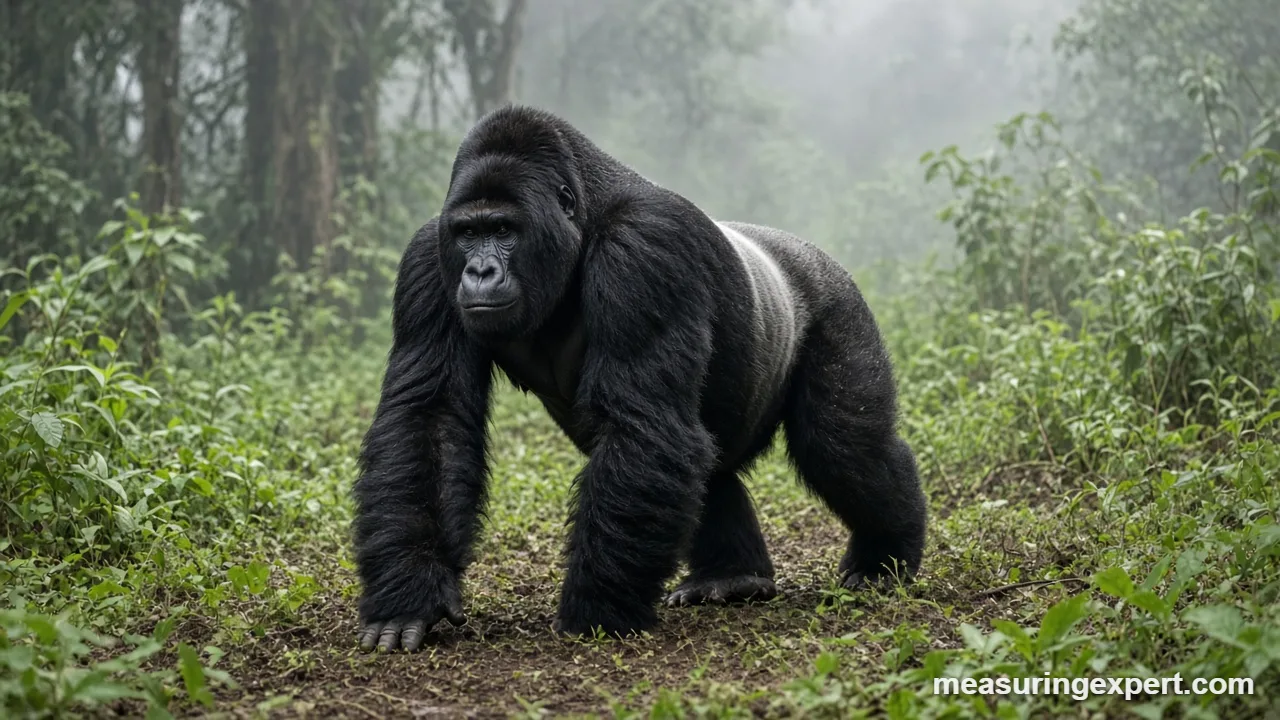
Most of the time, however, that bulk moves slowly. Typically, gorillas knuckle-walk on all fours, resting their weight on the backs of curled fingers. Yet a silverback can explode into a charge when he feels threatened. So the real question is not cruising pace but how fast that burst gets, and how sure anyone can be about the number.
Where the 20-25 mph Gorilla Speed Estimate Comes From
We looked for a measured top speed and did not find one. For example, the Smithsonian page above describes how gorillas walk and how far they travel, but it gives no running speed. Similarly, the San Diego Zoo Wildlife Alliance fact sheet describes bluff charges and running displays without timing them.
Instead, the 20 to 25 mph figure appears in popular articles, zoo talks and wildlife books. In fact, it likely comes from field observers who watched charges over known distances. That is, of course, a reasonable way to estimate speed. Still, it is not the same as a radar reading or timing gates.
In short, the honest answer is a range, not a single value. A charging adult probably reaches somewhere in the low-to-mid 20s in mph for a few seconds. Anything more precise than that, such as “exactly 25 mph”, claims more than the evidence supports.
Gorilla Speed vs Humans and Chimpanzees
The table sets gorilla speed beside people and its closest ape cousin. First, the human values come from official race timing. The ape values, by contrast, are commonly cited estimates, so read them as rough guides.
| Runner | mph | km/h | m/s | How solid is the figure? |
|---|---|---|---|---|
| Usain Bolt, peak speed (Berlin 2009) | 27.8 | 44.7 | 12.4 | Measured (split timing) |
| Gorilla, short charge | 20 to 25 | 32 to 40 | 8.9 to 11.2 | Estimate, not timed |
| Chimpanzee, short sprint | about 25 | about 40 | about 11.2 | Estimate, not timed |
| Usain Bolt, 100 m average (9.58 s) | 23.35 | 37.58 | 10.44 | Measured (official time) |
| Fit adult, all-out sprint | about 12 to 15 | about 19 to 24 | about 5.4 to 6.7 | Typical range |
| Easy jog | about 5 to 6 | about 8 to 10 | about 2.2 to 2.7 | Typical range |
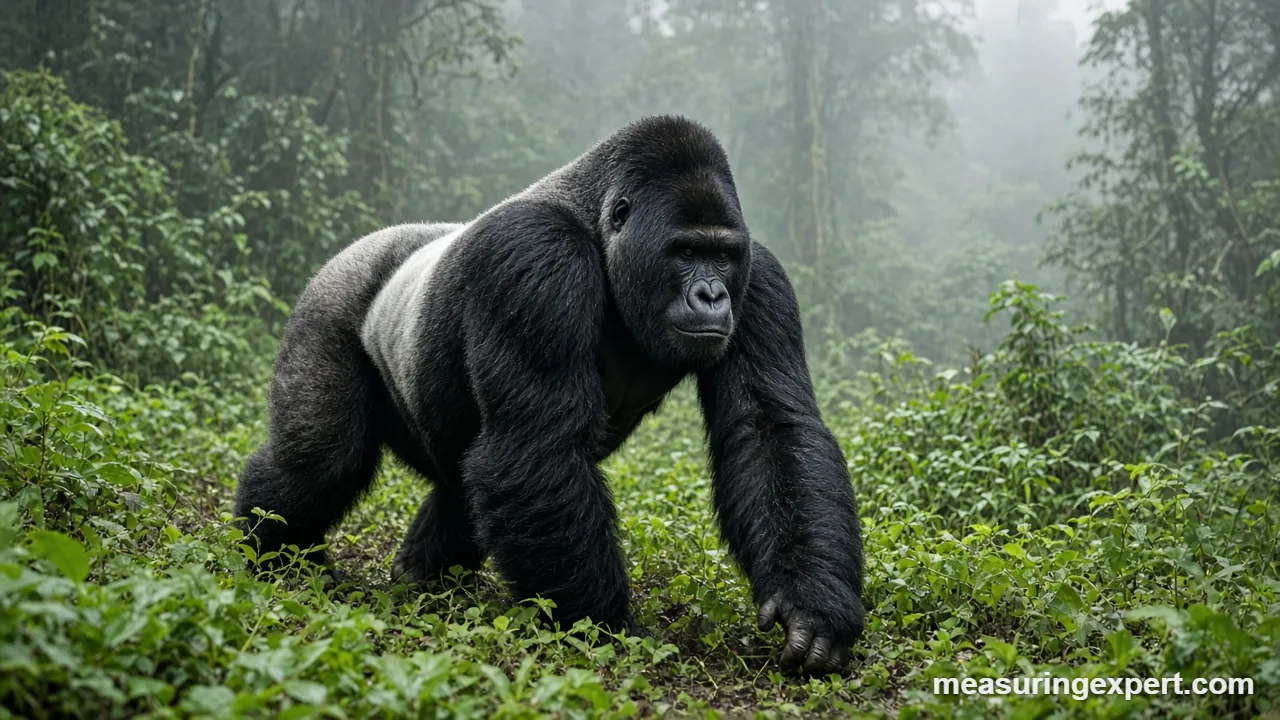
So a charging gorilla is roughly as quick as a chimpanzee and faster than almost any untrained person. Indeed, only elite sprinters match it, and only for a few seconds. Our guide to chimpanzee speed explains why the chimp figure is also an estimate. Likewise, the page on how fast a human can run shows where the Bolt numbers come from.
Quick mph to km/h Chart for Animal Speeds
This chart covers the speeds you meet when you compare apes and people. In addition, each value uses the exact mile definition, rounded to one decimal place. You can also print it or save it as a quick reference.
| mph | km/h | m/s | Example |
|---|---|---|---|
| 5 | 8.0 | 2.24 | Easy jog |
| 10 | 16.1 | 4.47 | Steady run |
| 15 | 24.1 | 6.71 | Fast amateur sprint |
| 20 | 32.2 | 8.94 | Low end of gorilla charge |
| 23.35 | 37.6 | 10.44 | Bolt’s 100 m average |
| 25 | 40.2 | 11.18 | High end of gorilla charge |
| 27.8 | 44.7 | 12.43 | Bolt’s peak speed |
| 30 | 48.3 | 13.41 | Faster than any person |
| 40 | 64.4 | 17.88 | Racing greyhound range |
Recommended Tools for Timing Animal Speed
You cannot time a wild gorilla safely, but the same tools work for dogs, horses or your own sprints. First, a rangefinder sets an accurate distance. Next, a stopwatch or a radar gun captures the time or the speed itself. Finally, binoculars help you watch from a safe distance.


As an Amazon Associate, Measuring Expert earns from qualifying purchases.
Why a 300 lb Ape Can Still Sprint
In general, size slows an animal down. Gorillas, however, have a few traits that help them in short bursts.
- Four-limb drive. In a charge, the long arms push off as well as the legs. Moreover, a male’s arm span reaches about 8 ft (2.4 m), so each bound covers a lot of ground.
- Powerful muscle. Research on chimpanzees, a close relative, found about twice the share of fast-twitch fibers that human muscle has. Gorilla muscle has been studied less, but it shares the same ape build for sudden effort.
- Short distances. A charge often lasts only a few seconds and may stop short of the target. As a result, the gorilla never needs to hold top speed for long.
Above all, that last point matters. At 40 km/h, a gorilla would cover 100 m in about 9 seconds. In practice, though, a bluff charge usually covers only a few meters before the animal stops, slaps the ground or turns away.
Gorilla Speed in Daily Life: Burst vs Travel
Still, top speed tells only part of the story. Most of a gorilla’s day goes to feeding and resting, so its travel pace is slow.
| Situation | What happens | Typical pace |
|---|---|---|
| Daily foraging | Knuckle-walks between food plants | Slow walk; under 1 mi (1.6 km) a day for many groups |
| Moving to a new feeding area | Group walks in a loose line | Steady walk; about 1 to 3 km (0.6 to 1.9 mi) a day |
| Display or bluff charge | Silverback runs at a rival or threat, then stops | Fast burst, a few seconds |
| Escape | Group flees into thick cover | Fast, but limited by vegetation |
The Smithsonian notes that western lowland gorillas usually travel less than 1 mile (1.6 km) a day. Meanwhile, the San Diego Zoo fact sheet gives about 1 to 3 km (0.6 to 1.9 mi) a day, depending on food and group size. Either way, gorillas are walkers, not runners.
How to Estimate an Animal’s Running Speed
Field researchers rarely put radar on wild apes. Instead, they often estimate speed from distance and time. You can use the same method for any animal you can watch safely, such as a dog in a park.
- Pick two fixed marks, such as fence posts, along a straight path.
- Measure the distance between them with a rangefinder or a long tape.
- Film the run from the side, or time it with a stopwatch as the animal passes each mark.
- Count the video frames between the marks and divide by the frame rate to get the time in seconds.
- Divide the distance by the time. For example, 20 m in 2.0 s is 10 m/s.
- Enter the result in the converter above. In this example, 10 m/s is 36 km/h, or about 22.4 mph.
Longer runs give better numbers, because a small timing error matters less. In addition, a side-on view avoids the error you get when an animal runs toward the camera.
Do and Don’t Around Gorillas
Do
- Keep the distance your guide or park sets.
- Stay calm and look down if a gorilla charges.
- Check whether a speed figure is a burst or an average.
- Give speeds in both mph and km/h.
Don’t
- Try to outrun a charging gorilla.
- Stare at, approach or feed a gorilla.
- Treat one viral video as proof of top speed.
- Compare a short burst with a marathon pace.
Gorilla Speed Claims We Corrected
An earlier version of this page repeated several claims that do not hold up. Here is what we changed.
- “Gorillas lift 10 times their body weight.” We found no measurement behind this, so we removed it.
- An age-by-speed table. The old page listed speeds for young, adult and senior gorillas. No source supports those numbers, so the table is gone.
- “Most humans sprint at 10 to 12 mph.” That is closer to a fast run. A fit adult’s all-out sprint is more like 12 to 15 mph.
- “Dense bones” as the reason for speed. We could not confirm it. Besides, muscle, not bone, drives sprinting.
- “Troops of up to 30.” For one thing, group size varies by species. In fact, the Smithsonian says western lowland groups average about five gorillas.
Honest Limits of Gorilla Speed Estimates
Every gorilla speed you read online, including ours, rests on observation rather than instruments. Because no timed study exists, the true figure could sit a little below 20 mph or a little above 25 mph. Individual animals also differ by age, size, health and ground conditions.
The human figures in our table, on the other hand, come from official timing to a hundredth of a second. So keep that gap in mind whenever you compare the two. Also note that most charges happen in forest, where roots and vines slow any runner.
When Gorilla Speed Really Matters
For most readers, gorilla speed is a fun fact. However, it matters to trekkers, rangers, researchers and zoo keepers. A gorilla can close a gap of several meters in about a second, so parks set minimum viewing distances and zoos use moats and barriers.
Gorilla Speed FAQs
What is the top gorilla speed?
The usual estimate is about 20 to 25 mph, or 32 to 40 km/h, in a short charge on all fours. No study has timed it with instruments.
Can a human outrun a gorilla?
Over a short sprint, almost never. Only elite sprinters reach similar speeds. Over a long distance, however, a fit person would probably keep going after a gorilla stops.
Is gorilla speed faster than chimpanzee speed?
In practice, they are similar. Chimpanzees are usually quoted at about 25 mph, which sits at the top of the gorilla range.
How fast is 25 mph in km/h?
25 mph equals about 40.2 km/h, or 11.2 m/s, using 1 mile = 1.609344 km.
How fast is 20 mph in km/h?
20 mph equals about 32.2 km/h, or 8.9 m/s.
Do gorillas run on two legs?
They can stand and take a few steps upright, especially during displays. When they run fast, they drop to all fours and knuckle-walk.
How long can a gorilla keep up its top speed?
Only a few seconds. After all, charges are short bursts, and gorillas are built for power, not endurance.
Is a silverback faster than a female?
No study we found compared them. Silverbacks are the ones that charge, so most speed reports describe adult males.
How far does a gorilla travel in a day?
Usually less than 1 mile (1.6 km) for western lowland gorillas, according to the Smithsonian. Some groups travel up to about 3 km (1.9 mi).
Why does gorilla speed vary between sources?
Mostly because the figure is an estimate from observation, not a timed measurement. For instance, some sources round it, and others mix up mph and km/h.
The Bottom Line
Gorilla speed in a charge is best described as about 20 to 25 mph (32 to 40 km/h), held for only a few seconds. As a result, a gorilla is about as fast as a chimpanzee and faster than nearly every person. Still, the range is an estimate, so use it as a guide rather than a precise record.
Sources: Smithsonian’s National Zoo and Conservation Biology Institute; San Diego Zoo Wildlife Alliance fact sheets. Speed conversions use the exact definition 1 mile = 1.609344 km.