

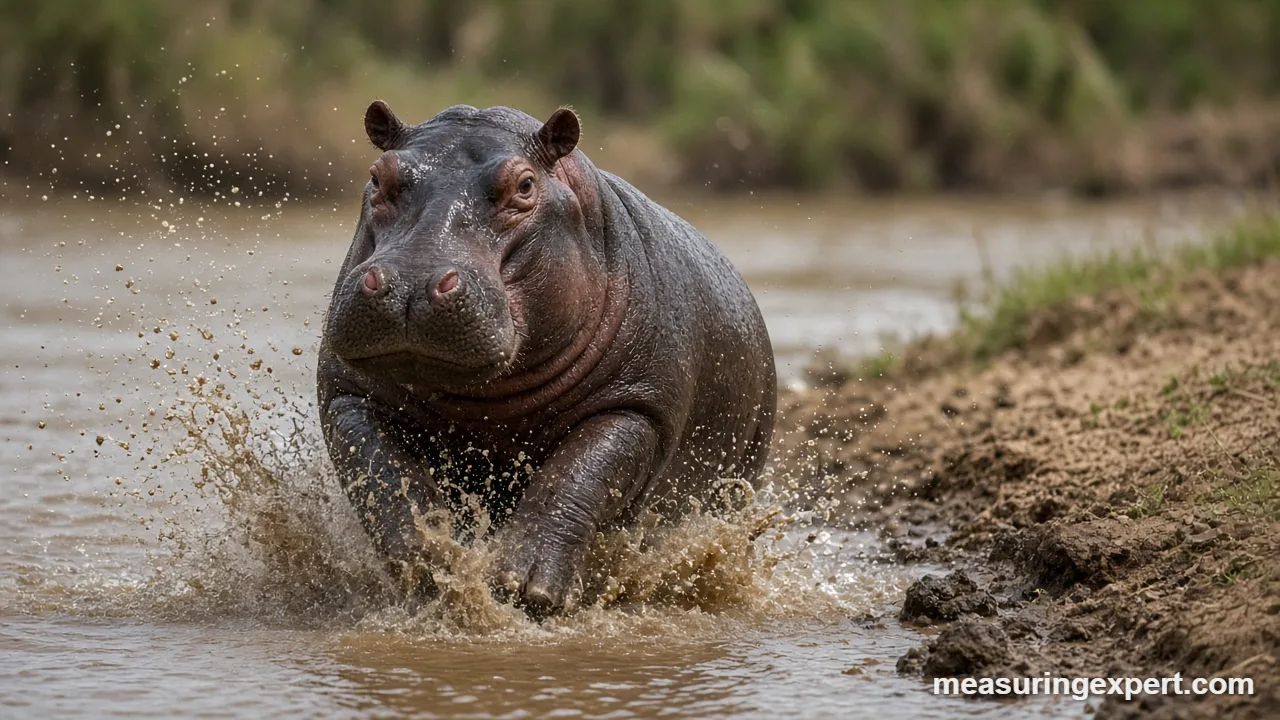
Hippo speed on land is usually given as about 30 km/h (19 mph) in short bursts, and some sources say up to 35 km/h (22 mph). However, nobody has published a calibrated measurement of that top speed. Underwater, hippos do not swim; instead, they bounce along the bottom at roughly 1.7 to 2.5 km/h (1 to 1.6 mph).
A hippo looks like the last animal that should be quick. Adult females weigh up to about 1,360 kg (3,000 lb), and big males can be much heavier. Even so, a startled or angry hippo can cover open ground faster than almost any person can run. That is why guides in Africa treat the strip of land between a hippo and its water as a no-go zone.
So where does the 30 km/h number come from? For one thing, it appears in zoo fact sheets and wildlife guides. For example, the San Diego Zoo Wildlife Alliance library hippo fact sheet says an agitated hippo “can charge at over 30 km/hr”, and National Geographic gives up to 22 mph over short distances. In contrast, a 2024 gait study points out that these top speeds have never been properly measured.
Below, you will find a converter, the sources behind each figure, what new research says about how hippos run, and how they move underwater. Finally, there is a plain comparison with elephants, rhinos and people.
Convert Hippo Speed to mph, m/s and Knots
First, enter any speed in kilometers per hour. The converter then shows it in miles per hour, meters per second, feet per second and knots, so you can compare a hippo with any other animal or vehicle.
Where the 30 km/h Hippo Speed Figure Comes From
Most articles repeat one number; however, the sources do not agree exactly. Here is what each one actually says, converted with 1 mile = 1.609344 km.
| Source | What it says | Converted |
|---|---|---|
| San Diego Zoo Wildlife Alliance fact sheet (citing Coughlin and Fish 2009) | can charge at over 30 km/h | over 18.6 mph |
| National Geographic | up to 22 mph over short distances | about 35.4 km/h |
| Hutchinson and Pringle, PeerJ 2024 | claims of up to about 8 m/s (about 30 km/h) lack documented measurements | 8 m/s = 28.8 km/h = 17.9 mph |
In short, 30 km/h (about 19 mph) is a reasonable working figure for a short charge. Still, treat it as an estimate for now. Because no study has clocked a wild hippo at full speed with calibrated equipment, the true peak could be a bit lower or higher.
Do Hippos Really Run? What the Gait Research Shows
For years, many biologists assumed that hippos, like elephants, never get all four feet off the ground at once. In 2024, however, John Hutchinson and Eva Pringle of the Royal Veterinary College published the first detailed study of how hippos move on land. They analyzed 169 strides from 46 trials, covering 32 different hippos filmed in zoos and in the wild.
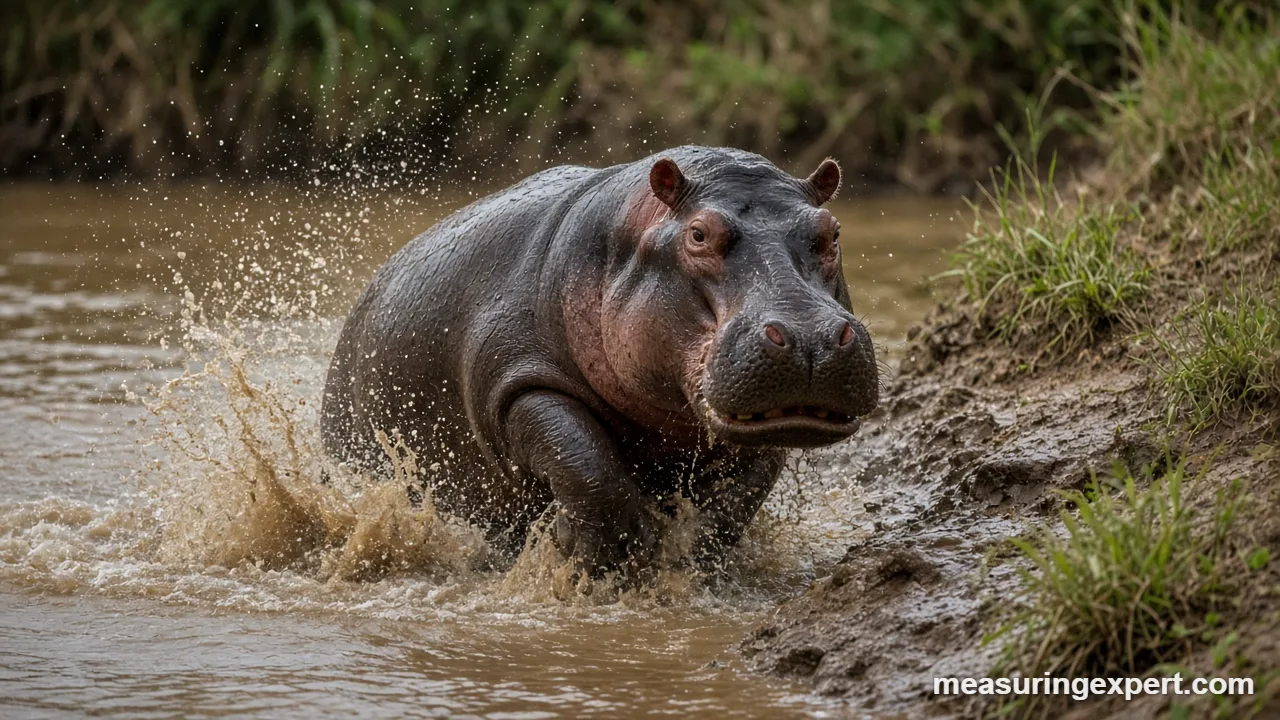
First, the study found that hippos trot at every speed. In other words, diagonal legs move together, whether the animal is strolling or charging. Second, the researchers saw no gallop at all. Third, and most surprising, several fast trots showed brief moments when all four feet were in the air. According to Live Science, those airborne moments last up to about 0.3 seconds.
Similarly, duty factor tells the same story. This number is the share of each stride that a foot spends on the ground. Walking hippos scored about 0.75 to 0.94, while running hippos dropped to about 0.36 to 0.58. A value under 0.5 is a classic sign of running, not fast walking. You can read the full open-access paper at PeerJ.
| People often confuse | Hippo | Elephant |
|---|---|---|
| Fast gait | Running trot | Fast amble (a stepping gait) |
| All four feet off the ground? | Yes, briefly, in some fast trots | No, never |
| Measured top speed | Not measured; about 30 km/h is estimated | About 24.5 km/h (15.2 mph), measured |
One limit applies here, though. Because the videos had no calibration objects, the team could not calculate actual speeds. Therefore, the study explains how hippos run, but it does not settle hippo speed itself.
Hippo Speed Underwater: Walking, Not Swimming
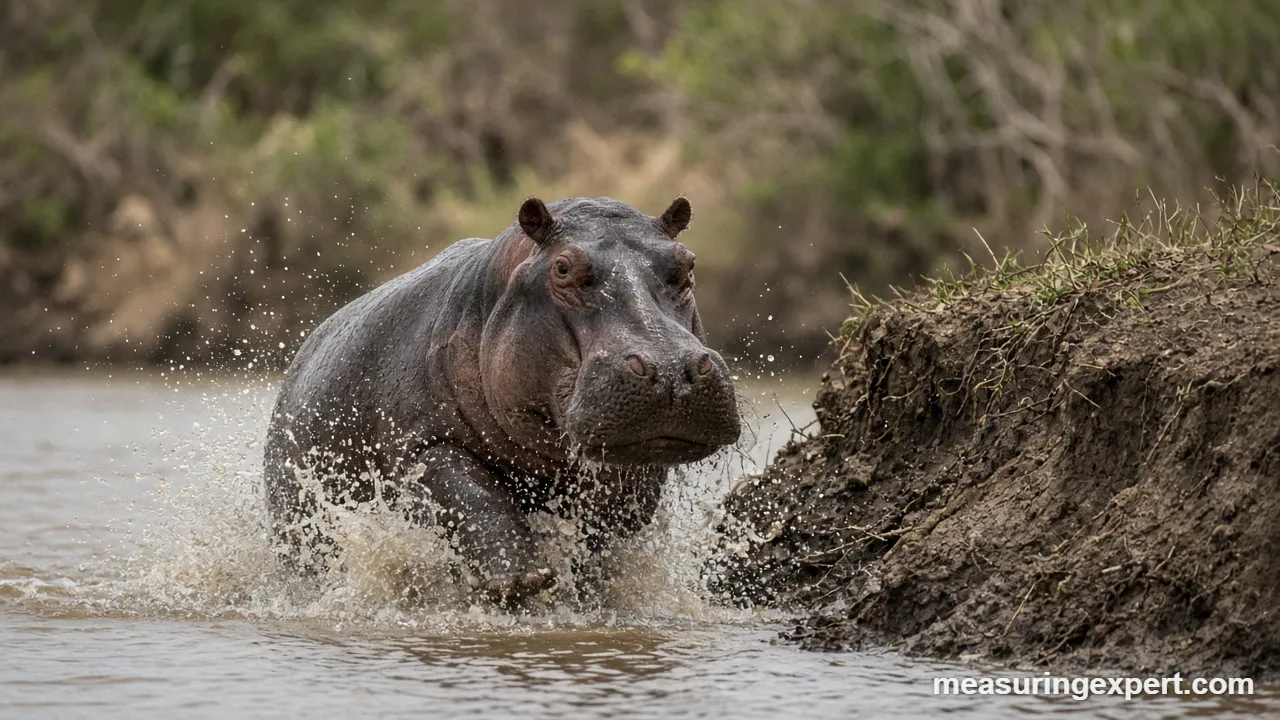
Hippos spend most of the day in rivers and lakes, yet they cannot swim. After all, their bodies are too dense to float easily. Instead, they push off the bottom and glide, a little like an astronaut bouncing on the Moon.
For example, biologists Coughlin and Fish filmed two adult female hippos, each about 1,360 kg, in the deep pool at Adventure Aquarium in New Jersey. Their 2009 study in the Journal of Mammalogy measured the following:
- Average underwater speed: 0.47 m/s, or about 1.7 km/h (1.05 mph).
- Range: 0.22 to 0.62 m/s, which is about 0.8 to 2.2 km/h.
- Peak speed while gliding: 0.70 m/s, or about 2.5 km/h (1.57 mph).
- Gait: a slow, gallop-like bounce with long floating phases and usually one foot touching the bottom at a time.
Meanwhile, the San Diego Zoo fact sheet notes that an adult can stay under for about 5 minutes, although a typical dive lasts around 104 seconds. Some websites claim hippos “swim” at 8 km/h (5 mph). However, we could not find a measurement behind that number, so the measured zoo values above are the safer guide. Wild hippos in fast rivers may of course move faster with the current.
Recommended Tools for Measuring Hippo Speed From a Safe Distance
You can estimate how fast an animal moves without getting close. First, a laser rangefinder gives you the distance between two landmarks. Next, a stopwatch times the crossing. Finally, binoculars let you watch from a vehicle or viewpoint well away from the water. These picks are based on manufacturer specs and buyer reports.


As an Amazon Associate, Measuring Expert earns from qualifying purchases.
Hippo Speed Compared With Other Animals
The old version of this page listed elephants at 40 km/h and called hippos slower. That was also wrong. Measured elephants are slower than the usual hippo estimate, as the table shows.
| Animal | Top speed | Status of the figure |
|---|---|---|
| Hippo (land) | about 30 km/h (19 mph) | estimate; never calibrated |
| Hippo (underwater) | about 1.7 to 2.5 km/h (1 to 1.6 mph) | measured in a zoo pool |
| Elephant | about 24.5 km/h (15.2 mph) | measured (Asian elephant) |
| Rhino | about 40 to 50 km/h (25 to 31 mph) | field estimates |
| Usain Bolt, peak | about 44.7 km/h (27.8 mph) | measured during the 2009 world record |
| Usain Bolt, 100 m average | about 37.6 km/h (23.4 mph) | 100 m in 9.58 s |
For the details behind those numbers, see our guides to how fast elephants are, rhino speed in a charge and how fast a human can run.
So could you outrun a hippo? An elite sprinter might, for a few seconds. Most people, however, run far slower than 30 km/h. At that pace, a hippo covers 100 meters in about 12 seconds, which is faster than nearly every recreational runner.
How to Estimate an Animal’s Speed
Researchers and safari guides use the same simple idea: speed equals distance divided by time. Here is how to apply it to a hippo, or to any animal, from a safe place.
- Pick two fixed landmarks. Choose a tree and a rock, for example, along the animal’s likely path.
- Measure the gap. Use a laser rangefinder from your vehicle, or pace the distance later when no animals are near.
- Time the crossing. Start a stopwatch as the animal passes the first landmark and stop it at the second.
- Divide distance by time. For instance, 25 meters in 3 seconds is 8.33 m/s.
- Convert the result. Enter the value in the converter above; 8.33 m/s is about 30 km/h or 18.6 mph.
Do and Don’t Near Hippos
Do
- Watch from a vehicle or a raised viewpoint.
- Follow your guide’s instructions at every stop.
- Give hippos a clear route back to the water.
- Take extra care at dusk and after dark.
Don’t
- Stand between a hippo and its river or lake.
- Assume a calm-looking hippo is slow or harmless.
- Approach mothers with calves.
- Paddle close to a pod in a canoe or kayak.
Honest Limits of Hippo Speed Figures
In fact, every number on this page has a different level of certainty. The underwater speeds come from just two zoo hippos in a still pool, so wild animals in rivers may differ. Similarly, the 30 km/h land figure is a widely repeated estimate, not a timed measurement. The gait study tells us hippos can briefly leave the ground, but it could not convert its videos into speeds.
Speed also varies, of course, with age, size, ground and motivation. For instance, a young hippo on firm ground may well move differently from a heavy male in mud. Finally, short charges are not the same as sustained running. At night, hippos usually walk at a steady pace along trails 3 to 5 km (1.9 to 3.1 miles) long to reach grazing areas.
When Accuracy Really Matters
For trivia or homework, “about 30 km/h” is fine. On a safari or a river trip, however, the exact figure matters less than distance. Because a hippo can close a gap quickly, you need room and an exit, not a faster pair of shoes. In addition, hippos are most dangerous when they feel cut off from water or when a calf is nearby.
Frequently Asked Questions
How fast can a hippo run on land?
Hippos are usually said to run about 30 km/h (19 mph) in short bursts. National Geographic gives up to 22 mph (about 35 km/h). Neither figure comes from a calibrated measurement.
What is the top hippo speed in mph?
The common estimate is about 19 mph, which is 30 km/h. Some sources go as high as 22 mph.
Can a human outrun a hippo?
Most people cannot. An elite sprinter like Usain Bolt peaked near 44.7 km/h (27.8 mph), but typical runners are far slower than 30 km/h.
Can hippos swim?
No. Hippos are too dense to float well, so they walk and bounce along the bottom of rivers and lakes instead of swimming.
What is hippo speed underwater?
In a 2009 zoo study, hippos moved underwater at an average of 0.47 m/s (about 1.7 km/h) and peaked at 0.70 m/s (about 2.5 km/h).
Do hippos get all four feet off the ground?
Sometimes. A 2024 study found brief moments in fast trots when all four feet were in the air, lasting up to about 0.3 seconds.
Do hippos gallop?
No. The 2024 gait study found that hippos trot at all speeds and saw no galloping.
Is a hippo faster than an elephant?
Probably. The fastest measured elephant reached about 24.5 km/h (15.2 mph), while hippos are estimated at about 30 km/h.
How long can a hippo stay underwater?
An adult hippo can stay under for about 5 minutes, although a typical dive lasts closer to 104 seconds.
How is hippo speed measured?
Speed is distance divided by time. In practice, observers time a hippo between two landmarks a known distance apart, but no calibrated top-speed study exists yet.
Hippo Speed: The Bottom Line
To sum up, hippo speed on land is best described as about 30 km/h (19 mph) in a short charge, with some sources saying up to 22 mph. That figure is an estimate. Meanwhile, research shows hippos trot rather than gallop and can briefly go airborne, which makes them more athletic than elephants.
Underwater, on the other hand, they bounce along the bottom at only about 1.7 to 2.5 km/h. Finally, if you want to compare any of these numbers with other animals, the converter at the top of this page does the math for you.