

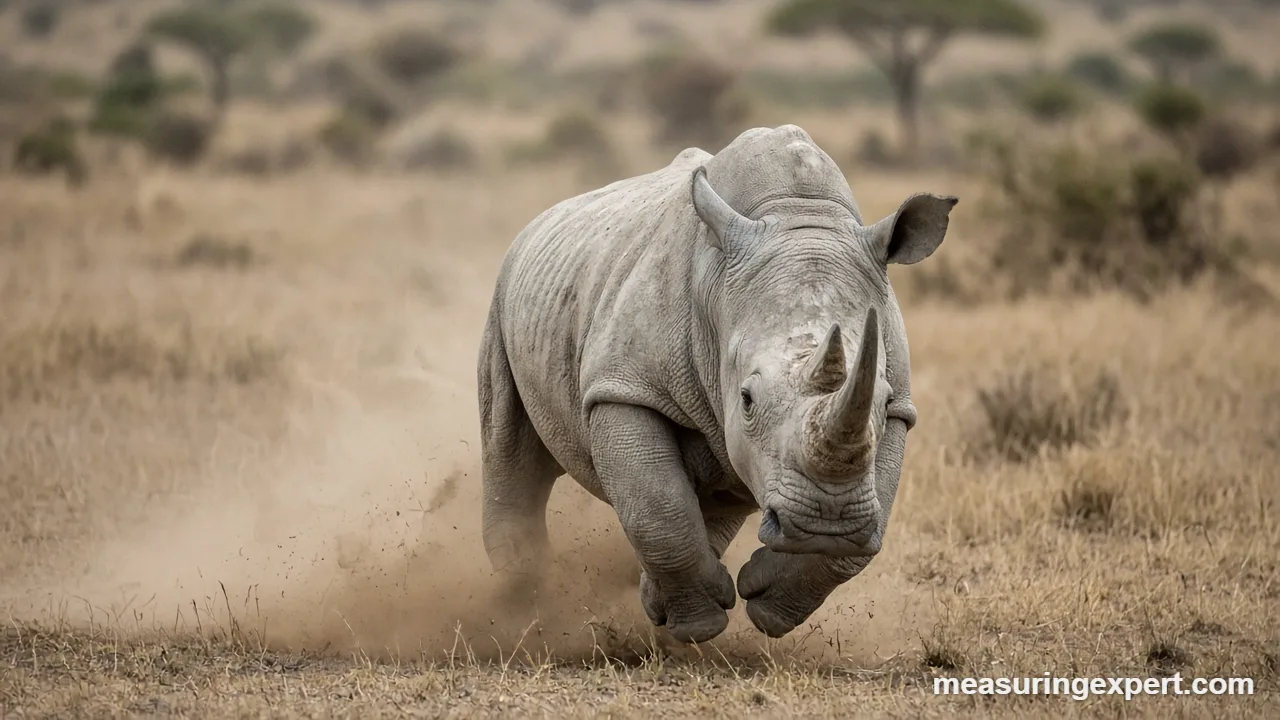
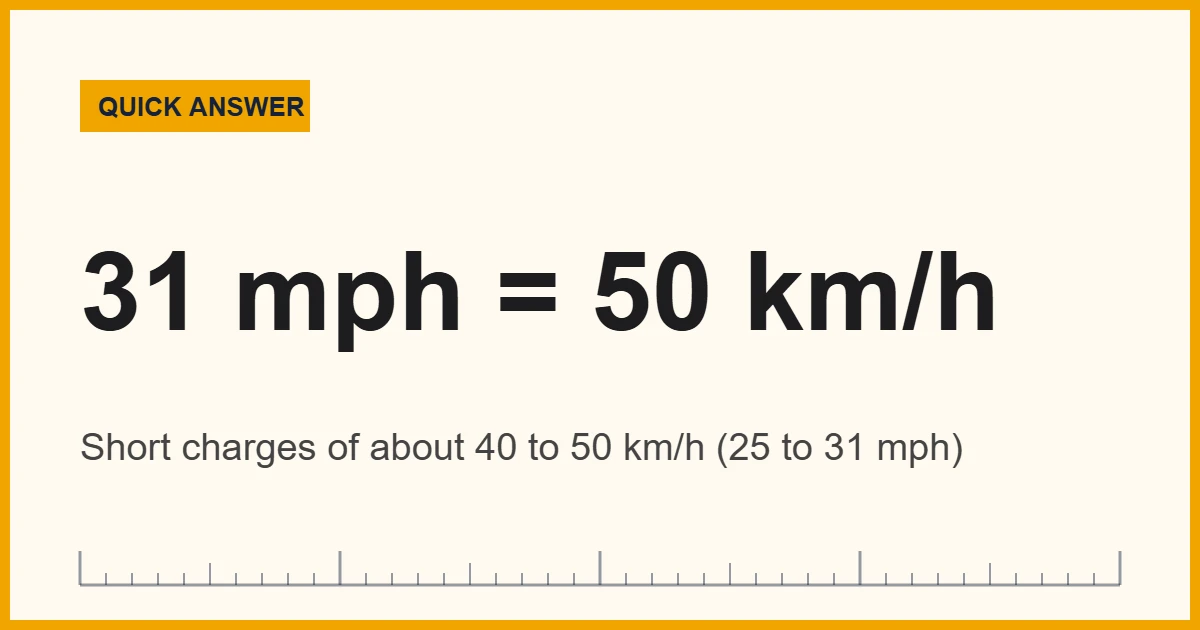
Rhino speed in a full charge is roughly 40 to 50 km/h (25 to 31 mph), and some estimates for the black rhino reach about 55 km/h (34 mph). However, rhinos hold that pace only for short bursts. A white rhino can also keep up about 24 km/h (15 mph) for several kilometers.
Convert Rhino Speed to mph, m/s or Knots
To start, enter a speed in kilometers per hour below. The converter then shows the same rhino speed in miles per hour, meters per second, feet per second and knots, so you can compare it with any other animal or vehicle.
At first glance, a rhino looks built for pushing, not sprinting. Even so, an adult that weighs as much as a small car can accelerate into a gallop and close a gap faster than most people expect. For that reason, safari guides keep vehicles between guests and rhinos, and walking safaris stay well downwind.
First, it helps to know that there are five living rhino species. According to WWF, two live in Africa (black and white rhinos) and three live in Asia (greater one-horned, Javan and Sumatran). However, most published speed figures come from the two African species and the greater one-horned rhino. In contrast, the Javan and Sumatran rhinos are so rare and so hidden in forest that nobody has a reliable top-speed figure for them.
So what does 50 km/h mean in practice? At that pace, a rhino covers 100 meters in about 7.2 seconds. As a result, it would beat any human sprinter over a short dash.
Rhino Speed by Species
Because published figures vary from source to source, the table gives ranges. In addition, the weights come from conservation group fact sheets and are converted with 1 kg = 2.2046 lb.
| Species | Typical top speed | Adult weight | Where it lives |
|---|---|---|---|
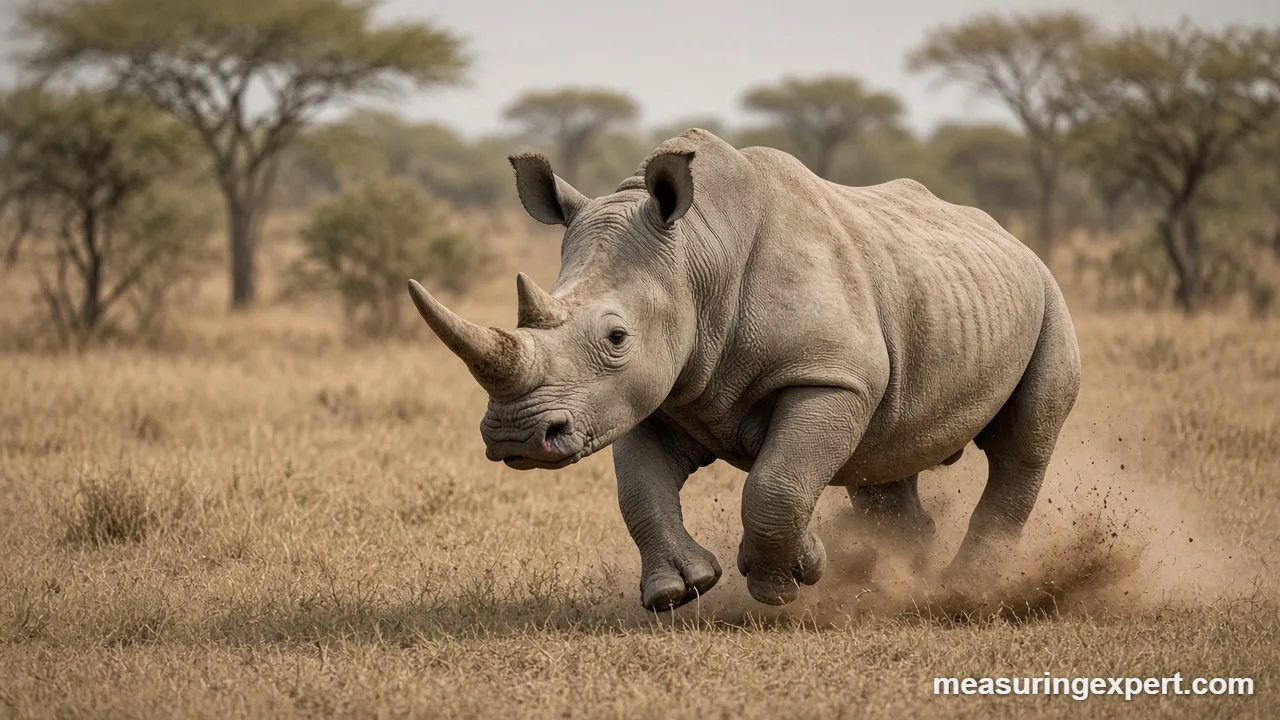
| Black rhino | up to about 50 km/h (31 mph); some estimates 55 km/h (34 mph) | 800 to 1,350 kg (1,764 to 2,976 lb) | Eastern and southern Africa |
| White rhino | 40 to 50 km/h (25 to 31 mph) in short spurts | 1,440 to 3,600 kg (3,175 to 7,937 lb) | Southern and eastern Africa |
| Greater one-horned rhino | up to about 40 km/h (25 mph) | 1,800 to 2,700 kg (3,968 to 5,952 lb) | India and Nepal |
| Javan rhino | no reliable measurement | not well documented | Java, Indonesia |
| Sumatran rhino | no reliable measurement | smallest living rhino | Sumatra and Borneo |
The conservation charity Helping Rhinos lists the black rhino at up to 50 km/h and the greater one-horned rhino at up to 40 km/h. Meanwhile, the Toronto Zoo says a white rhino gallops in short spurts at 40 km/h and holds about 24 km/h for at least 5 km.
Recommended Tools for Measuring Animal Speed
Of course, you cannot clock a charging rhino yourself, and you should not try. Still, the same tools that researchers and guides use work on safer subjects. First, binoculars let you watch from a distance. Next, a laser rangefinder measures how far an animal or landmark is. Finally, a radar gun reads speed directly on balls, bikes and cars.


As an Amazon Associate, Measuring Expert earns from qualifying purchases.
Rhino Speed Compared With Other Animals
Next to famous sprinters, a rhino sits in the middle of the pack. For example, it is far slower than a cheetah or a racehorse. Yet it is clearly faster than an elephant and faster than the quickest human ever timed.
| Runner | Top speed | Source of the figure |
|---|---|---|
| Cheetah (wild) | 93 km/h (58 mph) | GPS collars, Wilson et al. 2013 |
| Thoroughbred racehorse | 70.76 km/h (43.97 mph) | Guinness record, Winning Brew, 2008 |
| Rhino | 40 to 55 km/h (25 to 34 mph) | Field estimates |
| Usain Bolt (peak) | about 44.7 km/h (27.8 mph) | 2009 world record race |
| Asian elephant | about 24 km/h (15 mph) | Hutchinson et al. 2003 |
For more detail on the other runners, see how fast a horse can run and how fast humans can run. Similarly, another heavy African grazer that surprises people is covered in how fast a hippo can run.
Also, the elephant figure deserves a comment. In a 2003 study reported by ScienceDaily, fast elephants topped out near 15 mph. Moreover, they never left the ground with all four feet. Rhinos, by contrast, can break into a true gallop.
Rhino Speed: Sprint vs Cruising Pace
In practice, people often mix up two different numbers. First, there is the burst a rhino reaches in a charge. Second, there is the pace it can hold while it moves across its range.
| People often confuse | What it really means | Typical value |
|---|---|---|
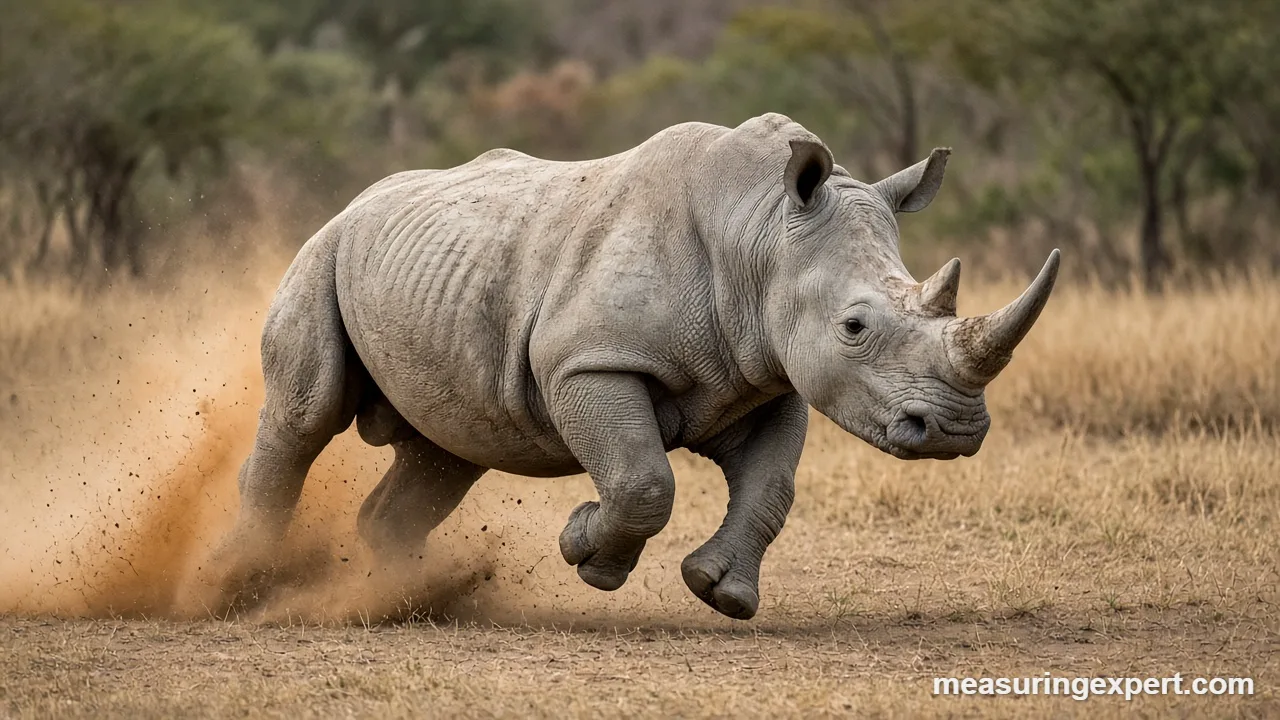
| Top speed (charge) | A short gallop, often over less than a few hundred meters | 40 to 50 km/h (25 to 31 mph) |
| Sustained pace | A steady trot an animal can hold for kilometers | about 24 km/h (15 mph) for a white rhino |
| km/h vs mph | Two units for the same speed; 1 mph = 1.609344 km/h exactly | 50 km/h = 31.07 mph |
At the sustained pace of 24 km/h, a white rhino would cover 5 km in about 12.5 minutes. In short, a rhino is not only a sprinter; it also has real stamina.
Why Rhino Speed Is Higher Than It Looks
For one thing, a rhino has short, thick legs that carry its weight on three toes per foot. In addition, its huge shoulder and hip muscles power each stride. Because the animal is so heavy, it also carries a lot of momentum once it gets going. That is why turning or stopping takes it longer than speeding up.
What Changes a Rhino’s Speed
- Species and size. Lighter black rhinos are usually described as the most agile.
- Ground. For example, open grassland allows a full gallop, while thick bush or marsh slows any rhino down.
- Heat. Rhinos rest in shade and wallow in mud on hot days, so long runs in the midday sun are rare.
- Age and health. Finally, calves and injured animals cannot match a healthy adult.
How to Measure an Animal’s Speed (Rhino Speed Included)
Field biologists rarely use a radar gun on a rhino. Instead, they work out speed from distance and time, just as you can with the converter above.
- Pick two fixed landmarks. Choose points the animal will pass, for example two trees or posts.
- Measure the distance between them. A laser rangefinder or a GPS track gives the distance in meters.
- Record the run on video. Then use a phone or camera from a safe spot, ideally inside a vehicle.
- Count the time. Next, step through the video frame by frame and note when the animal passes each landmark.
- Divide distance by time. This gives meters per second; then multiply by 3.6 to get km/h.
- Convert the result. Enter the km/h value in the converter to see it in mph, ft/s or knots.
For example, if a rhino covers 50 meters in 4 seconds, its speed is 12.5 m/s, or 45 km/h (about 28 mph). In addition, researchers use GPS collars, which log position many times per second, as in the cheetah study above.
Do and Don’t Around Fast Rhinos
Do
- Stay in the vehicle unless a guide says otherwise.
- Keep at least the distance your guide sets.
- Also watch the ears and tail for signs of stress.
- Use binoculars or a zoom lens for close views.
Don’t
- Assume a big animal must be slow.
- Try to outrun a rhino on open ground.
- Get between a mother and her calf.
- Approach on foot to get a better photo.
Honest Limits of Rhino Speed Figures
Every rhino speed you read online, including the ones here, is an estimate. After all, very few rhinos have been timed with radar or GPS during a full charge. Instead, most numbers come from guides, rangers and older field notes. Therefore, different sources quote anything from 40 to 55 km/h. In addition, rounding adds more spread, because 50 km/h becomes 31 mph in one source and 30 mph in another. So treat the ranges as realistic bands, not exact records.
When Accuracy Really Matters
For example, for a school project, a figure of about 50 km/h is close enough. On a walking safari, however, the exact number matters less than the fact that you cannot outrun a rhino. Similarly, for vehicle-based tours, guides plan distances around how fast a rhino could close the gap.
Frequently Asked Questions
What is the top rhino speed?
Most sources put a charging rhino at about 40 to 50 km/h (25 to 31 mph). Some estimates for black rhinos reach about 55 km/h (34 mph).
How fast can a rhino run in mph?
A rhino can run about 25 to 31 mph in a short charge. The highest commonly quoted figure is about 34 mph for the black rhino.
Which rhino is the fastest?
The black rhino is usually described as the fastest and most agile species. The white rhino is close behind, and the greater one-horned rhino is a little slower.
Can a human outrun a rhino?
No. Usain Bolt peaked at about 44.7 km/h (27.8 mph) for a few seconds, and most people run far slower. A charging rhino can match or beat that.
Is rhino speed faster than an elephant’s?
Yes. Elephants top out near 24 km/h (15 mph), while rhinos can reach roughly twice that in a gallop.
How long can a rhino keep running?
The top speed lasts only a short burst. However, a white rhino can hold about 24 km/h (15 mph) for at least 5 km, according to the Toronto Zoo.
How fast is a rhino in meters per second?
At 50 km/h, a rhino moves about 13.9 meters per second, or about 45.6 feet per second.
Do baby rhinos run as fast as adults?
Not usually. Calves can run with their mothers within days of birth, but they lack the size and strength of a healthy adult.
How heavy is a rhino?
Black rhinos weigh about 800 to 1,350 kg (1,764 to 2,976 lb). White rhinos are much heavier, with large adults reaching about 3,600 kg (7,937 lb).
Why is rhino speed hard to measure?
Rhinos are dangerous to approach, rare in the wild, and rarely run on a measured course. As a result, most figures are field estimates rather than timed records.
Rhino Speed: The Bottom Line
To sum up, a rhino can charge at about 40 to 50 km/h (25 to 31 mph), and the black rhino may reach about 55 km/h (34 mph). As a result, it is faster than any human and much faster than an elephant, although well behind a racehorse or a cheetah.
Finally, remember that these are estimates from the field. Use the converter above to turn any speed into mph, m/s or knots, and keep a safe distance from the real thing.
1 thought on “How Fast Can a Rhino Run? Rhino Speed by Species, Explained”