

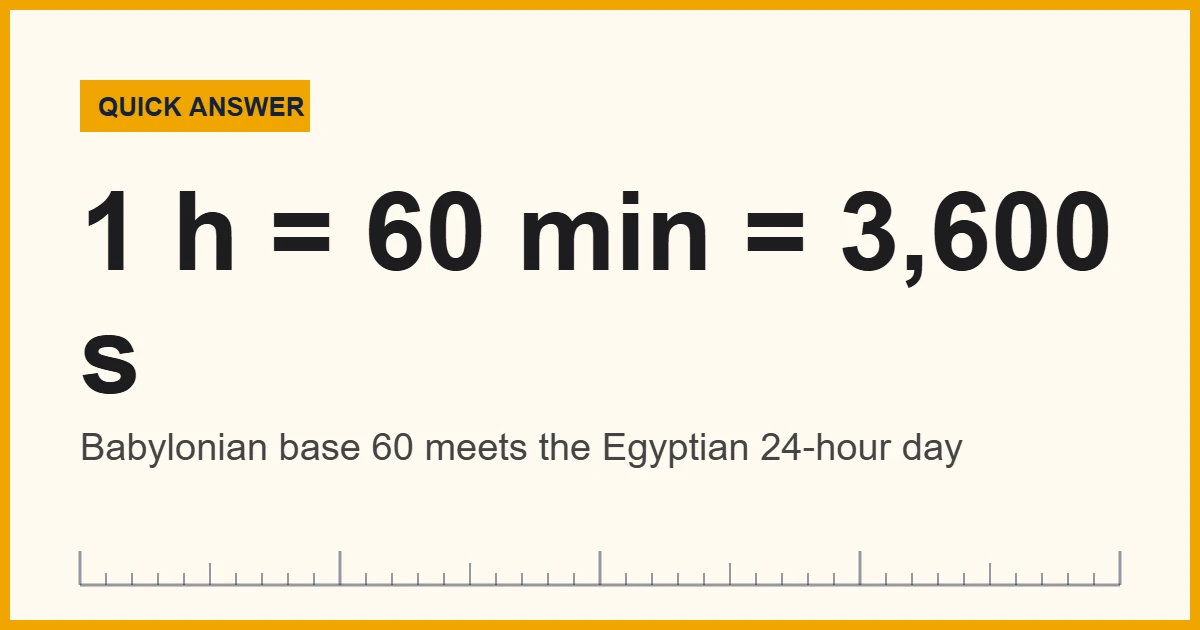
We measure time in 60s because of the ancient Babylonians, who did their math in base 60 about 4,000 years ago. Sixty splits evenly by 1, 2, 3, 4, 5, 6, 10, 12, 15, 20 and 30, so fractions stay clean. Later, Greek astronomers cut hours into 60 minutes and 60 seconds, while Egypt gave us 24 hours.
Convert Time in 60s: Seconds, Minutes and Hours
Enter any amount and pick a unit. The converter then multiplies or divides by 60 (and by 24 for days), so you can see the base-60 steps for your own numbers.
Almost everything else we measure has gone decimal. Meters split into 100 centimeters, liters into 1,000 milliliters, and money into 100 cents. Clocks, however, still count 60 seconds to the minute, 60 minutes to the hour and 24 hours to the day. So why does time hold out?
In short: two ancient number habits met and never left. Mesopotamian scribes worked in base 60, and Egyptian timekeepers split the day into 12 hours of light and 12 of darkness. Greek astronomers then joined the two ideas, and medieval clockmakers finally put them on a dial.
For a clear account of that chain, see the Scientific American explainer on hours, minutes and seconds. Below, you will also find the math behind 60, how decimal time failed, and how atomic clocks define the second today.
Why We Count Time in 60s: The Short History
The story runs over roughly 3,500 years, and no single person invented it. Instead, each culture added one piece, as the timeline shows.
| When | Who | What they added |
|---|---|---|
| 3rd millennium BC | Sumerians | Counting and accounting in base 60 |
| About 2000 BC | Babylonians | A full place-value system in base 60, used for astronomy |
| About 1500 BC | Egyptians | 12 hours of daylight (sundials) and 12 of night (star clocks), so 24 in total |
| 147-127 BC | Hipparchus | 24 equal “equinoctial” hours for astronomy |
| About AD 150 | Ptolemy | Each degree split into 60 first small parts and 60 second small parts |
| 14th century | European clockmakers | Mechanical clocks that made equal hours part of daily life |
| Late 16th century | Clockmakers | Minute markings on clock faces |
For more context on how early cultures measured length, weight and volume, see our guide to ancient measurement systems.
Recommended Clocks and Timers for Everyday Timing
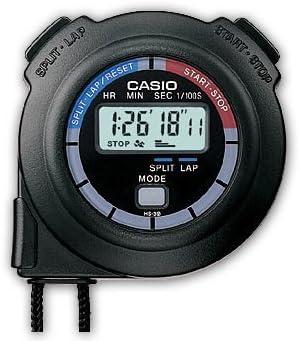
You do not need special gear to count in 60s, but a reliable clock helps. For example, radio-controlled “atomic” wall clocks set themselves from the NIST WWVB signal in Colorado, so they stay within a second of official US time. Meanwhile, a handheld stopwatch is handy for lab work, sports and cooking, because it shows minutes, seconds and hundredths together.




As an Amazon Associate, Measuring Expert earns from qualifying purchases.
Key Takeaways
- We keep time in 60s because Babylonian astronomers worked in base 60.
- Sixty is the smallest number that divides evenly by 1, 2, 3, 4, 5 and 6.
- Egypt, not Babylon, gave us 24 hours: 12 for daylight and 12 for night.
- “Minute” and “second” come from Latin for the first and second small parts.
- One day has 24 x 60 x 60 = 86,400 seconds.
- France tried a 10-hour decimal day in 1793 but dropped it within two years.
- Today, cesium atoms, not the sky, define the length of a second.
Why Time in 60s Divides So Neatly
The main reason is arithmetic. Because 60 has 12 divisors, you can cut an hour into halves, thirds, quarters, fifths, sixths, tenths or twelfths and always land on a whole number of minutes. By contrast, 100 has only 9 divisors, and you cannot split it into thirds without a repeating decimal.
| Fraction of an hour | Minutes (base 60) | Decimal-hour equivalent |
|---|---|---|
| 1/2 | 30 | 0.5 |
| 1/3 | 20 | 0.333… |
| 1/4 | 15 | 0.25 |
| 1/5 | 12 | 0.2 |
| 1/6 | 10 | 0.1666… |
| 1/12 | 5 | 0.08333… |
Historians also offer a second, more physical idea. You can count to 12 on one hand by touching your thumb to the three segments of each finger. Then, if the five fingers of your other hand track each dozen, you reach 5 x 12 = 60. A third theory says base 60 grew out of the merging of two older counting systems, one based on 10 and one on 6 or 12. In any case, all three ideas point to the same useful number.
Where the 24-Hour Day Came From
Base 60 explains minutes and seconds, but not the 24 hours. For that, we have to look at Egypt. Around 1500 BC, Egyptian timekeepers divided daylight into 12 parts with shadow clocks. Similarly, they tracked the night with 12 groups of rising stars, so the full day ended up with 24 hours.
Those early hours were not equal, though. A summer daylight hour ran longer than a winter one, because the 12 parts stretched or shrank with the length of the day. Hipparchus proposed 24 equal hours for astronomy, yet most people kept using seasonal hours for centuries. Only when mechanical clocks spread through Europe in the 14th century did equal hours become normal. Our explainer on how clocks measure time covers how those mechanisms work.
Meanwhile, the words came from astronomy. Ptolemy wrote about splitting a degree into 60 parts and then 60 smaller parts. In Latin, these became partes minutae primae (first small parts) and partes minutae secundae (second small parts). Over time, the names shortened to “minute” and “second”, and clocks borrowed them for the hour.
Time in 60s vs Decimal Time
People have tried to make time decimal. The best-known attempt came from Revolutionary France, which introduced a 10-hour day in 1793, with 100 decimal minutes per hour and 100 decimal seconds per minute. However, the public never warmed to it, and France dropped mandatory decimal time in 1795. The metric meter and gram, by contrast, stuck.
| Feature | Base-60 time (today) | French decimal time (1793) |
|---|---|---|
| Hours per day | 24 | 10 |
| Minutes per hour | 60 | 100 |
| Seconds per minute | 60 | 100 |
| Seconds per day | 86,400 | 100,000 |
| One “hour” in today’s units | 60 minutes | 2.4 hours (144 minutes) |
| One “minute” in today’s units | 60 seconds | 86.4 seconds |
| One “second” in today’s units | 1 second | 0.864 seconds |
Why did it fail? First, every clock in the country would have needed replacing. Next, decimal hours made thirds and quarters of the day awkward. Finally, astronomers and navigators already shared tables built on base 60, so switching would have cut France off from everyone else.
How to Convert Time in 60s by Hand
Mixed base-60 math trips people up because a calculator works in base 10. Use these steps when you need to add times or turn minutes into a decimal.
- Write each time in hours, minutes and seconds. For example, 1 h 45 min 30 s.
- Turn everything into seconds. Multiply hours by 3,600 and minutes by 60, then add the seconds: 3,600 + 2,700 + 30 = 6,330 s.
- Do your math in seconds. Add, subtract or average in that one unit, since it avoids carrying errors.
- Divide by 3,600 for whole hours. Next, take what is left and divide it by 60 for minutes.
- Keep the remainder as seconds. As a result, 6,330 s comes back as 1 h 45 min 30 s.
- For decimal hours, divide the minutes by 60. So 45 minutes is 0.75 h, not 0.45 h.
If you prefer, the converter above does these steps for any amount. You can also check daily totals in our guide to how many seconds are in a day.
The Modern Second: Atomic Clocks and Leap Seconds
For most of history, the second was a fraction of the day: 1/86,400 of it. However, Earth’s spin is not perfectly steady, so scientists needed something better. Since 1967, the international system has tied the second to atoms. The BIPM, which maintains the SI, fixes the cesium-133 frequency at exactly 9,192,631,770 hertz, so one second is that many cycles of cesium radiation.
Because atomic seconds are steady and Earth is not, the two scales drift apart. To keep them close, timekeepers have added leap seconds. According to NIST, 27 leap seconds have gone into UTC since 1972, and the last one came on December 31, 2016. In 2022, the General Conference on Weights and Measures decided to raise the allowed gap between atomic and Earth time in or before 2035. In other words, leap seconds are on their way out.
Even so, the 60-60-24 structure stays. Atomic clocks simply count cesium cycles into seconds, and then the old Babylonian and Egyptian steps take over.
Do and Don’t When Working With Base-60 Time
Do
- Convert to seconds before adding long lists of times.
- Write durations as h:mm:ss to avoid confusion.
- Remember that 0.5 h is 30 minutes, not 50.
- Check whether a clock or app shows decimal hours.
- Use a radio-controlled clock if you need the exact time.
Don’t
- Type 1.30 into a calculator and expect 90 minutes.
- Assume every hour in history had 60 equal minutes.
- Mix arcminutes with time minutes in navigation.
- Forget the 24 when you jump from hours to days.
- Rely on a phone with location services off for precise time.
Honest Limits of the Base-60 Story
Much of this history is reconstructed from clay tablets, sundials and later Greek texts. As a result, historians agree on the broad chain (Sumerian and Babylonian base 60, Egyptian 12-hour halves, Greek astronomy) but still debate why the Sumerians chose 60 in the first place. The finger-counting and merged-system theories are reasonable guesses, not proven facts. Also, a real day is not exactly 86,400 atomic seconds; it varies by a few thousandths of a second as Earth’s spin speeds up and slows down. For daily life, however, these details make no visible difference.
When Precise Time Really Matters
For cooking or a workout, a phone clock is plenty. On the other hand, some systems depend on split-second accuracy. GPS satellites carry atomic clocks, because a timing error of one microsecond shifts a position by about 300 meters. Stock exchanges, power grids and phone networks also time-stamp events to fractions of a second. In those fields, engineers follow UTC from national labs such as NIST rather than a wall clock.
Frequently Asked Questions
Why do we measure time in 60s instead of 100s?
We inherited base 60 from Babylonian astronomers. It divides evenly into many more fractions than 100 does, and a French attempt at decimal time in 1793 never caught on.
Who decided there are 60 minutes in an hour?
No single person did. Babylonians used base 60, Ptolemy split degrees into 60 minutes and 60 seconds, and medieval astronomers and clockmakers later applied the same split to the hour.
Why are there 24 hours in a day?
Ancient Egyptians divided daylight into 12 hours and night into 12 hours. Together, that gave 24 hours, which Greek astronomers later made equal in length.
Why is time in 60s still used today?
Changing would mean replacing every clock and timetable, and base 60 still splits nicely into halves, thirds and quarters. In addition, navigation and astronomy share the same base-60 angles.
Where do the words minute and second come from?
They come from Latin. The first division of a degree or hour was the first small part, and the next was the second small part.
How many seconds are in a day?
A day has 24 x 60 x 60 = 86,400 seconds, or 1,440 minutes.
Did anyone try to change time in 60s to decimal time?
Yes. Revolutionary France introduced a 10-hour day with 100-minute hours in 1793. It proved unpopular, and mandatory use ended in 1795.
Is a second still based on the day?
No. Since 1967 the SI second has been defined by cesium-133 atoms, with a fixed frequency of exactly 9,192,631,770 hertz.
Are leap seconds being removed?
Yes. In 2022 the CGPM decided to widen the allowed gap between atomic and Earth time in or before 2035, which ends routine leap seconds. The last one was added on December 31, 2016.
Does time in 60s affect angles too?
Yes. A degree has 60 arcminutes and each arcminute has 60 arcseconds. Both systems come from the same Babylonian astronomy.
Time in 60s: The Bottom Line
To sum up, we split hours and minutes into 60 because Babylonian astronomers loved a number that divides cleanly, and Egyptians gave us 12 hours of day and 12 of night. Greek astronomy joined the two, and mechanical clocks then made the system part of daily life.
Decimal time had its chance and lost, while atomic clocks now define the second itself. So the next time you glance at a clock, you are reading a 4,000-year-old number system. For quick conversions, finally, use the converter at the top of this page.