

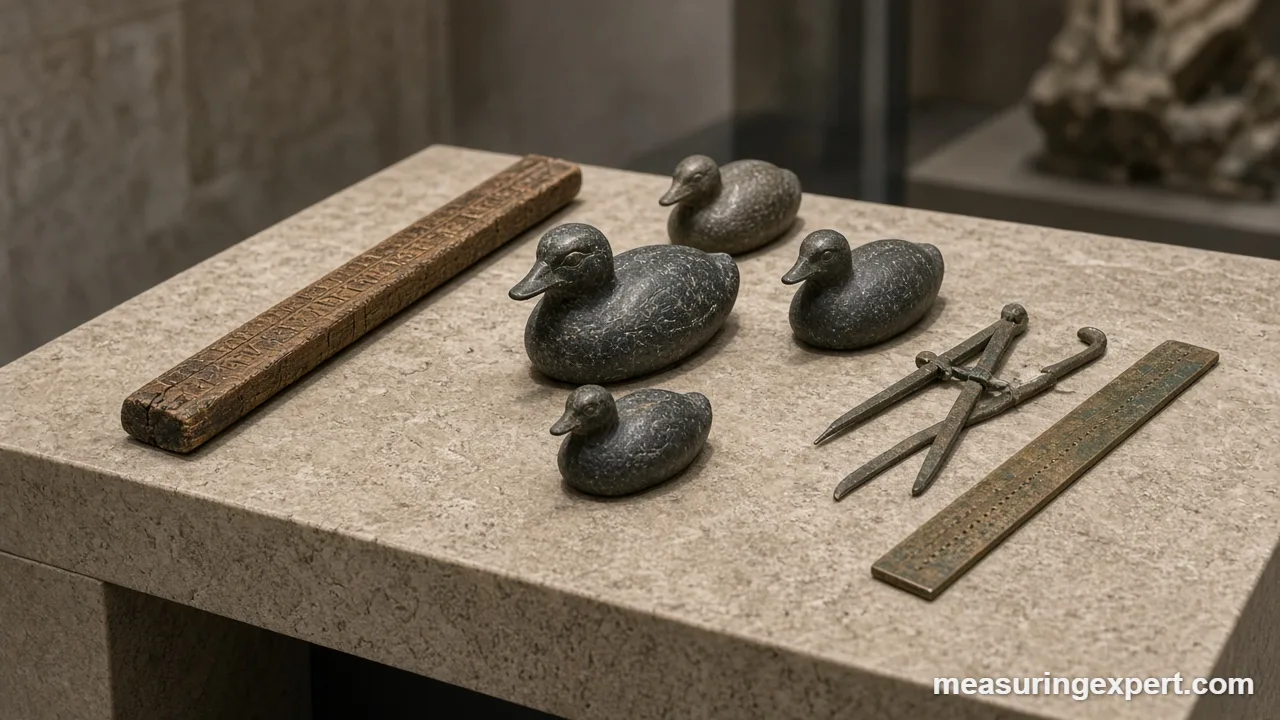
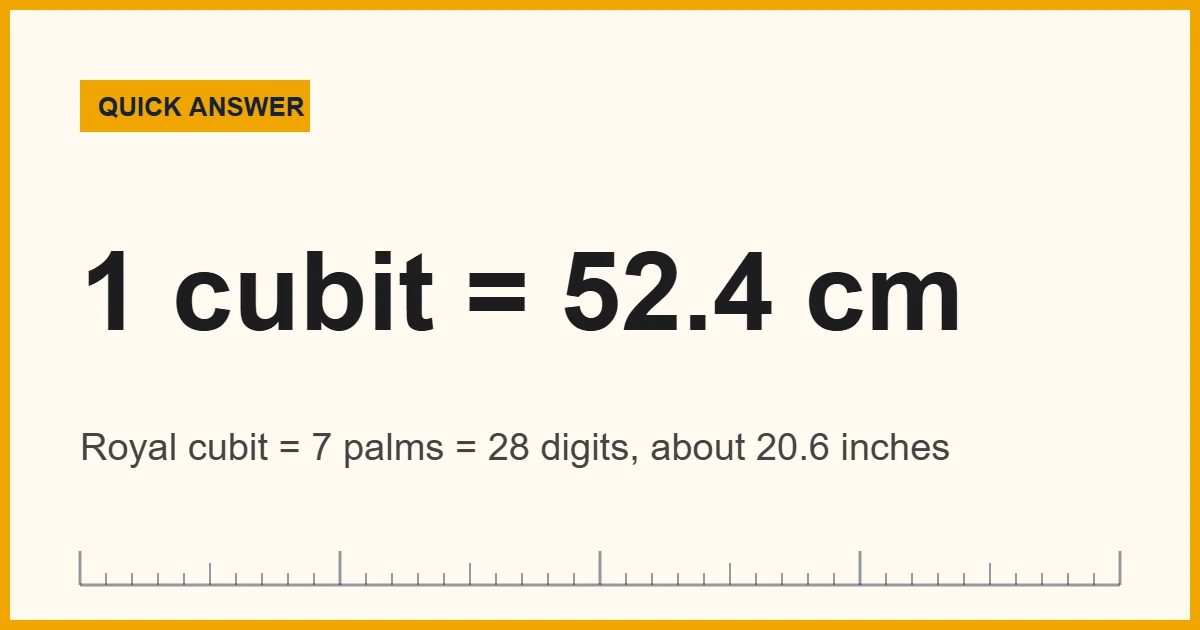
Ancient measurements began with the human body and grew into state standards. Egypt used the royal cubit (about 52.4 cm, or 20.6 inches), Mesopotamia counted shekels and minas in base 60, Rome gave us the foot, the inch and the mile, and the Indus Valley used carefully cut stone weights.
Long before rulers, scales and the metric system, people still had to build walls, share out grain and trade copper. So they measured with what they had: forearms, hands, fingers and footsteps. Over time, however, kings and city officials learned that a forearm changes from person to person. As a result, they made master rods and official weights, kept copies in temples and markets, and punished cheats.
The Short Version
Here is the short version. The Egyptian royal cubit ran from the elbow to the fingertips and split into 7 palms or 28 digits, so one digit is about 1.87 cm (0.74 in). Mesopotamian scribes counted in sixties: 60 shekels made a mina of roughly 500 g (1.1 lb), and 60 minas made a talent of about 30 kg (66 lb). Roman builders used a foot of about 29.6 cm (11.65 in), split into 12 unciae, the word that became “inch”. Meanwhile, the Indus Valley cities used stone weights that doubled in size, 1, 2, 4, 8, 16 and up, with a common weight of about 13.7 g.
In short: every ancient system mixed body-based lengths with official copies that kept trade and building honest, and several of those units still echo in the feet, inches and miles Americans use today.
For the Egyptian figures, we rely on University College London’s Digital Egypt guide to length units, which lists the cubit at about 52 cm with its palms and fingers. Similarly, the team at Harappa.com describes the Indus cubical weights and their doubling ratios.
Below, you will find a converter, a comparison table, a tour of each civilization, a method for converting old units yourself, and the honest limits of these numbers.
Convert Ancient Measurements to Inches and Centimeters
Enter a length in centimeters, such as 52.4 for an Egyptian royal cubit or 29.6 for a Roman foot. The converter then shows inches, feet and meters using the exact definition of 1 inch = 2.54 cm. Because no ancient unit has an exact modern value, start from the best estimate in the tables below.
Recommended Measuring Tools for Exploring Old Units
You do not need a museum to get a feel for a cubit. A long steel rule or a tape that shows both inches and centimeters lets you mark out a cubit, a Roman foot or a pace on the floor. In addition, a small digital scale helps you feel what a 13.7 g Indus weight or a 27 g Roman uncia is like. The picks below include two steel rules, an inch/metric tape, a soft tailor tape for body-based units and two pocket scales. We chose them from manufacturer specs and buyer reports, not lab tests.



As an Amazon Associate, Measuring Expert earns from qualifying purchases.
- The Egyptian royal cubit was about 52.4 cm (20.6 in): 7 palms or 28 digits.
- Mesopotamia counted in sixties: 60 shekels to a mina, 60 minas to a talent.
- A Roman foot was about 29.6 cm, a little shorter than today’s 30.48 cm foot.
- Our words “inch” and “ounce” both come from the Latin uncia, meaning one twelfth.
- The Roman mile was 1,000 paces, about 1,480 m or 0.92 of a modern mile.
- Indus weights doubled in size, with a common unit of about 13.7 g.
- All modern values for these units are estimates from surviving rods and weights.
Why Ancient Measurements Started With the Body
Everyone carries a forearm, a hand and a foot, so these made natural rulers. For example, a cubit ran from the elbow to the tip of the middle finger. A palm was the width of four fingers, and a pace was a double step. As a result, these units were easy to explain and easy to check roughly.
The trouble, of course, is that bodies vary. For instance, a tall builder and a short one would mark out different cubits. Therefore, early states chose one official length and copied it onto wood or stone rods. From then on, the rod, not the arm, became the standard. In other words, the idea behind a modern reference standard is thousands of years old. Our guide to the science of measurement explains how that same idea works today with constants of nature instead of rods.
Ancient Measurements at a Glance
This table compares the main units side by side. Also, keep in mind that each value is a typical modern estimate, rounded, because real rods and weights differ slightly from place to place and century to century.
| Civilization | Unit | What it measured | Approx. metric | Approx. US |
|---|---|---|---|---|
| Egypt | Royal cubit (meh) | Length | 52.4 cm | 20.6 in |
| Egypt | Deben | Weight (New Kingdom) | 91 g | 3.2 oz |
| Egypt | Hekat | Grain volume | 4.8 L | 1.27 US gal |
| Mesopotamia | Cubit (kush) | Length | about 50 cm | about 19.7 in |
| Mesopotamia | Mina | Weight (60 shekels) | about 500 g | about 1.1 lb |
| Rome | Foot (pes) | Length | 29.6 cm | 11.65 in |
| Rome | Mile (mille passus) | Distance | 1,480 m | 0.92 mi |
| Rome | Pound (libra) | Weight | about 327 g | about 11.5 oz |
| Indus Valley | 16-unit cube weight | Weight | about 13.7 g | about 0.48 oz |
Egypt: The Royal Cubit, Its Palms and Its Digits
Egyptian builders laid out temples and pyramids with the royal cubit, called meh. It split into 7 palms, and each palm split into 4 digits, so a cubit held 28 digits. With a cubit of about 52.4 cm, a palm comes to roughly 7.49 cm (2.95 in) and a digit to about 1.87 cm (0.74 in). Egyptians also used a shorter cubit of 6 palms, about 45 cm (17.7 in).
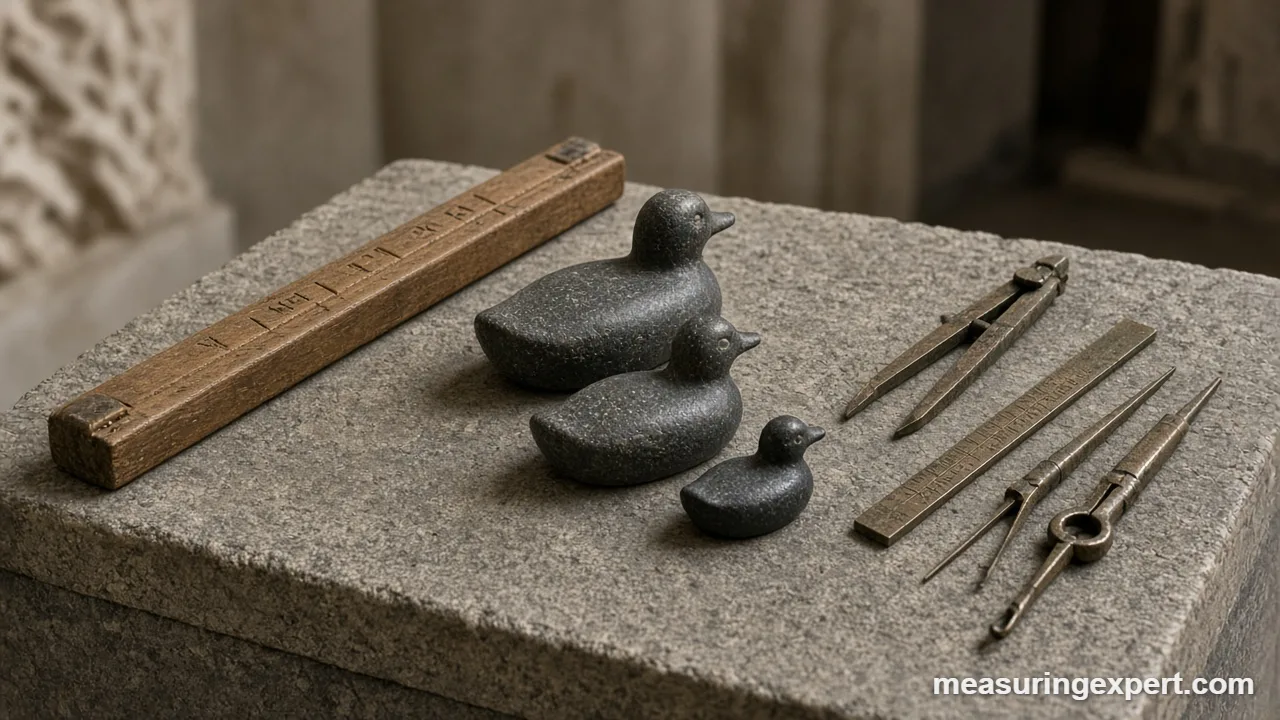
For longer distances, surveyors used a cord of 100 cubits, roughly 52 m (172 ft). For travel along the Nile, the river unit (iteru) equaled 20,000 cubits, about 10.5 km or 6.5 miles. Meanwhile, scribes and architects kept cubit rods of wood or stone, marked with palms and digits, much like a modern folding rule.
In addition, weight and volume had their own units. In the New Kingdom, a deben weighed about 91 g (3.2 oz) and split into 10 kite of about 9.1 g. For grain, the hekat held about 4.8 liters (1.27 US gallons), and the smaller hin held about 0.48 liters (16.2 US fluid ounces). Because farmers paid taxes in grain, these volume units carried real weight in daily life.
Mesopotamia: Base 60, the Shekel and the Mina
In Sumer and later Babylon, scribes counted in base 60, a system we still use for minutes, seconds and the 360 degrees of a circle. Likewise, their weights followed the same pattern. First, about 60 shekels made one mina. Next, 60 minas made one talent. With a shekel of roughly 8.3 g, a mina comes to about 500 g (1.1 lb) and a talent to about 30 kg (66 lb).
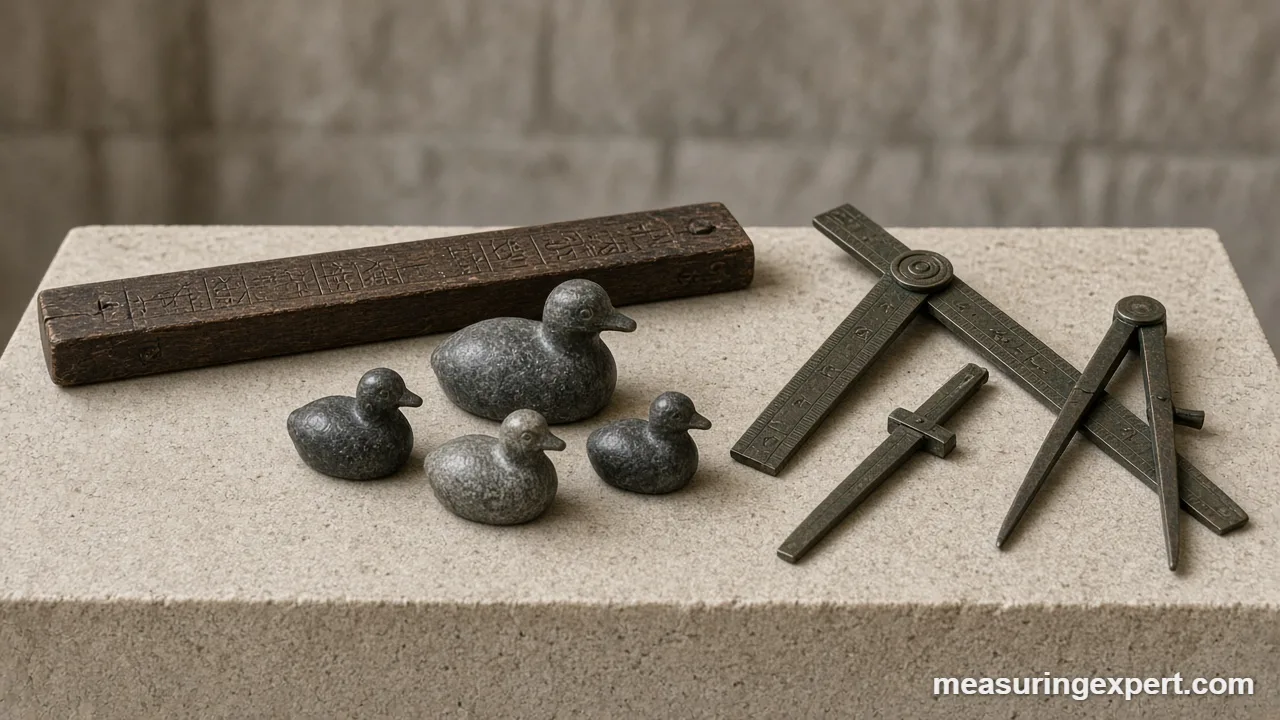
The Mesopotamian cubit (kush) was close to 50 cm (19.7 in), though estimates differ by a few centimeters between cities and periods. Meanwhile, the sila, a common volume unit for grain and beer rations, held roughly 1 liter, a little over a US quart. In practice, merchants carried stone weights shaped like ducks or loaves, and temples kept reference sets so that buyers could check a seller’s weights.
Because base 60 divides evenly by 2, 3, 4, 5, 6, 10, 12, 15, 20 and 30, it made fractions easy. As a result, a scribe could split a mina into thirds or quarters without messy remainders, which helped with rations, wages and taxes.
Rome: Ancient Measurements That Still Shape Ours
Roman engineers used the foot (pes) of about 29.6 cm (11.65 in) for roads, aqueducts and forts. They split it into 12 unciae of about 2.47 cm each, and “uncia” is the root of our word inch. Five feet made a pace (passus) of about 1.48 m, and 1,000 paces, mille passus, made a Roman mile of about 1,480 m. That is 0.92 of a modern mile, or roughly 4,856 ft.
Similarly, weight followed the same twelves. The Roman pound (libra) weighed about 327 g (11.5 oz), and it, too, split into 12 unciae of about 27.3 g. As a result, that second uncia gave English the word ounce. In fact, the abbreviation “lb” comes straight from libra. For liquids, the amphora equaled one cubic Roman foot, about 25.9 liters or 6.85 US gallons.
The old version of this page claimed the Roman foot measured volume and weight too. That is not right: the foot measured length, and the cubic foot defined the amphora. Similarly, Rome borrowed its 12-hour day and night from older Egyptian and Babylonian practice rather than inventing it.
The Indus Valley: Stone Weights in a Doubling Series
Cities such as Harappa and Mohenjo-daro, from about 2600 to 1900 BCE, used small cube-shaped weights cut mostly from chert. The smallest weighed about 0.856 g. After that, sizes doubled: 1, 2, 4, 8, 16, 32 and 64 units. Larger weights then switched to decimal steps. The most common one, at 16 units, weighed about 13.7 g (0.48 oz).
Above all, what stands out is the consistency. Weights from sites hundreds of miles apart match closely, which suggests a shared standard for trade and perhaps taxes. For length, meanwhile, scholars point to marked scales of shell and bronze. One proposed unit, sometimes called the Indus inch, measured about 3.35 cm (1.32 in).
So the Indus cities, like Egypt and Mesopotamia, show that ancient measurements were not crude guesses. They solved the same problem with official objects that anyone could compare against.
China and the First Imperial Standard
When the Qin dynasty unified China in 221 BCE, the new emperor ordered one set of weights and measures for the whole country. Next, officials cast bronze standard weights and measuring vessels, often inscribed with the decree. Later, under the Han, the chi (foot) measured about 23.1 cm (9.1 in). In fact, ancient measurements across every culture on this page follow one pattern: unity in measurement follows unity in government.
How to Convert Ancient Measurements Yourself
- Identify the unit and the period. A cubit in Old Kingdom Egypt is not the same as a cubit in Babylon or in the Bible.
- Find a modern estimate. Use a museum, university or archaeology source that states the value in centimeters or grams.
- Convert to metric first. Multiply the count of units by the estimate, for example 10 cubits x 52.4 cm = 524 cm.
- Convert to US units. Divide centimeters by 2.54 to get inches, or enter the number in the converter above.
- Round honestly. Keep two or three significant figures, because the estimate itself is never exact.
- State the range. When it matters, give a range, such as “about 52 to 53 cm”, instead of a single number.
English land surveyors used a later body-free length, the rod of 16.5 feet (5.0292 m), which is roughly 9.6 Egyptian cubits. Our page on what a rod measurement is covers how it fits with chains, furlongs and acres.
Do and Don’t When Reading Old Units
Do
- Check which city and century a unit comes from.
- Cite the source of every modern estimate.
- Give US and metric values side by side.
- Round to the precision the evidence supports.
Don’t
- Assume one cubit fits all cultures.
- Quote four decimal places for a carved rod.
- Mix up a Roman mile with a modern mile.
- Confuse the weight ounce with the fluid ounce.
Honest Limits of Ancient Measurements
Every modern value on this page is an estimate. For example, surviving cubit rods differ by a few millimeters, and some are ceremonial copies rather than working tools. Likewise, stone weights wear down, chip or pick up dirt over thousands of years. Researchers therefore average many objects and still disagree a little. For instance, you will see the royal cubit given anywhere from about 52.3 to 52.9 cm, and the Roman foot from about 29.4 to 29.7 cm. Use these numbers to understand the past, not to cut a part to size.
When to Ask a Specialist
If you are writing a thesis, restoring a historic building or dating an object, a single rounded value is not enough. Instead, ask an archaeologist, a museum curator or a historian of science. After all, they can tell you which rods or weights come from your site and how much they vary. Also, for modern legal measurements in trade, the rules come from your state weights and measures office, not from history.
Ancient Measurements FAQs
How long is an Egyptian royal cubit?
About 52.4 cm, or 20.6 inches. Surviving rods range from roughly 52.3 to 52.9 cm. It split into 7 palms or 28 digits.
What were the main ancient measurements of length?
The cubit, the palm, the digit, the foot and the pace. Most came from the human body, and states later fixed them with official rods.
Where does the word inch come from?
From the Latin uncia, meaning one twelfth. A Roman foot held 12 unciae, and the word also gave us ounce.
How long was a Roman mile?
A Roman mile was 1,000 paces of 5 Roman feet, about 1,480 m. That is about 0.92 of a modern mile.
Which ancient measurements used base 60?
Mesopotamian ones. 60 shekels made a mina and 60 minas made a talent. We still use base 60 for time and angles.
How heavy was a mina?
Roughly 500 g, or about 1.1 lb, though the value changed between cities and periods.
What units did the Indus Valley Civilization use?
Cube-shaped stone weights that doubled in size from about 0.856 g, plus marked scales for length. The common 16-unit weight was about 13.7 g.
Are ancient measurements still used today?
Some survive in name. The foot, inch, ounce, pound and mile all trace back to Roman units, and base 60 survives in clocks and degrees.
Why did ancient units vary so much?
They started with body parts, and each city kept its own master copies. Without a shared reference, values drifted over time.
How accurate are modern values for ancient measurements?
They are estimates from surviving rods and weights, usually good to a few percent. Treat them as typical values, not exact ones.
Ancient Measurements: The Bottom Line
Ancient measurements tell a clear story. People started with forearms, hands and steps, and then states fixed those lengths with official rods and stone weights. Egypt had the 52.4 cm royal cubit, Mesopotamia its base-60 shekels and minas, Rome its foot, pound and mile, and the Indus Valley its doubling weights.
Finally, remember that every modern figure is an estimate. Use the converter above to turn a cubit or a Roman foot into inches, and always give a range when precision matters.