
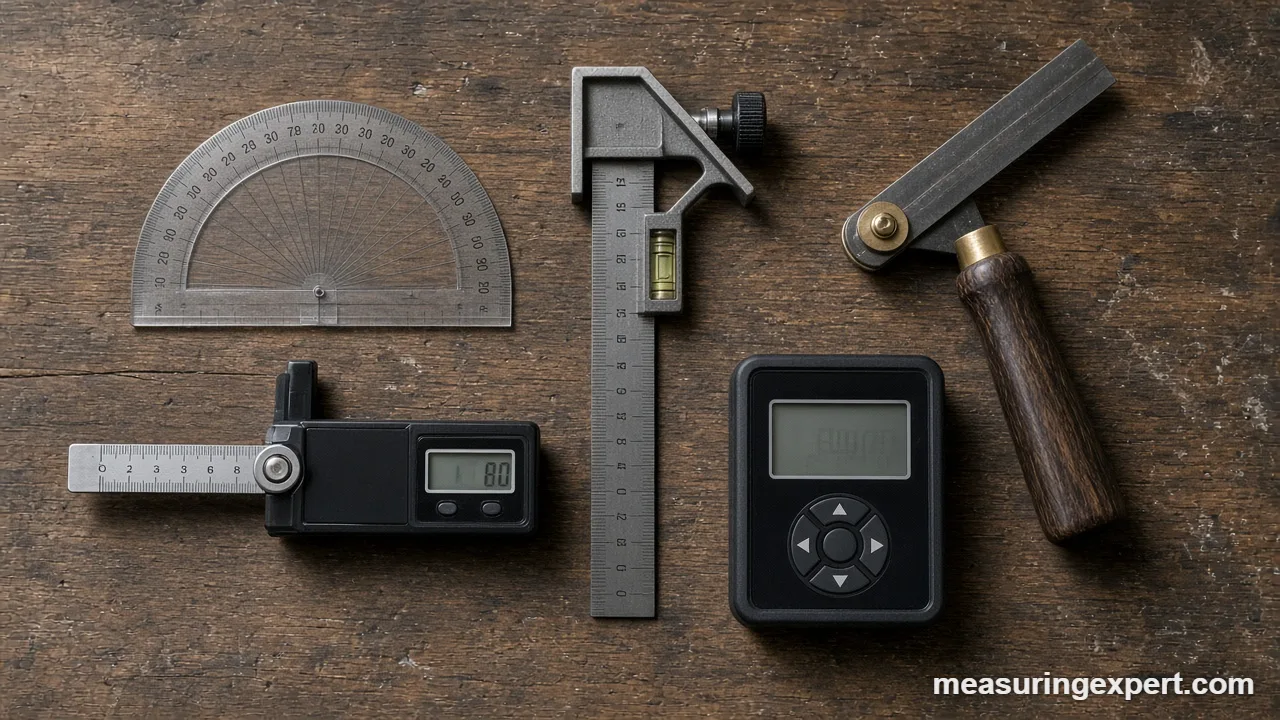
The best tools for measuring angles depend on the job. For example, a digital angle gauge sets saw blades, a protractor or angle finder copies corners, and an inclinometer reads slope from level. Meanwhile, a vernier bevel protractor reads to 5 minutes of arc, and a theodolite lays out land and buildings.
An angle is just the amount of turn between two lines. Even so, a small angle error grows fast with distance. For instance, a cut that is off by 1 degree drifts about 2.1 inches (53 mm) over a 10 ft board. That is why the right tool matters more than how carefully you squint at a scale.
Most tools for measuring angles fall into three groups. First, contact tools such as protractors, bevels and angle finders measure the angle between two edges. Second, gravity tools such as inclinometers and digital angle gauges measure tilt from true level. Finally, optical tools such as theodolites measure angles to distant points, so surveyors and builders can lay out large sites.
In short: buy one gravity tool and one contact tool, and you can handle almost every angle in a home shop. In addition, add a precision bevel protractor if you machine metal, and hire a surveyor for property lines.
Angles also have official units. The US National Institute of Standards and Technology (NIST) explains in its guide to units outside the SI that 1 degree equals pi/180 radian, and that minutes and seconds of arc are accepted for use with the SI. As a result, every tool below reports in degrees, even if it also shows percent grade or roof pitch.
Convert Angles, Percent Grade and Roof Pitch
First, enter a reading from any angle tool below. The converter then shows the same slope in degrees, percent grade and pitch (rise per 12 units of run), so you can match a gauge to a plan or a building code.
Recommended Tools for Measuring Angles
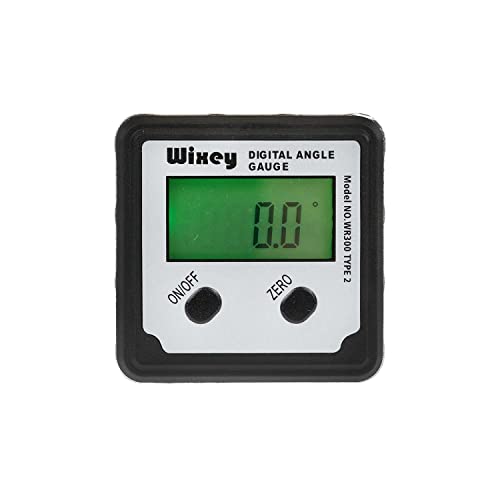
These picks cover the main jobs: setting blade bevels, copying wall corners and checking slope. We chose them based on manufacturer specs and buyer reports, favoring established tool brands. Also, check each listing for resolution, accuracy and whether the tool has a magnetic base.



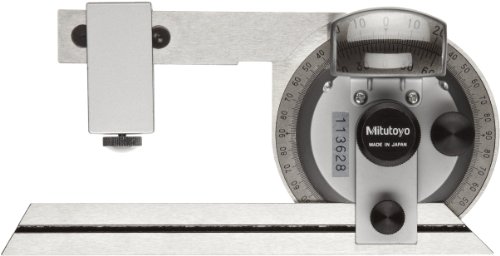
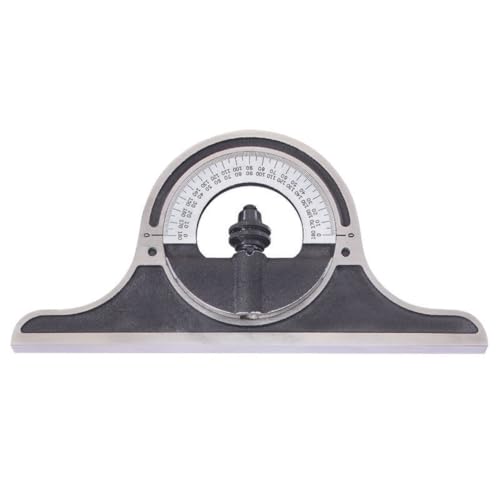
As an Amazon Associate, Measuring Expert earns from qualifying purchases.
Key Takeaways
- Contact tools measure the angle between two edges, while gravity tools measure tilt from level.
- A digital angle gauge is the most useful single tool for saw and drill press setups.
- A sliding bevel copies an angle without a number, so it never adds reading error.
- A vernier bevel protractor reads to 5 minutes of arc, or 1/12 of a degree.
- Theodolites read to seconds of arc and suit surveying, not furniture.
- Degrees, percent grade and pitch describe the same slope in different ways.
- Always check a tool with the reversal test before trusting a critical cut.
Tools for Measuring Angles Compared
This table sums up what each tool does well. Resolution is the smallest step the tool can show, so it is not the same thing as accuracy. Instead, accuracy tells you how close that reading is to the true angle.
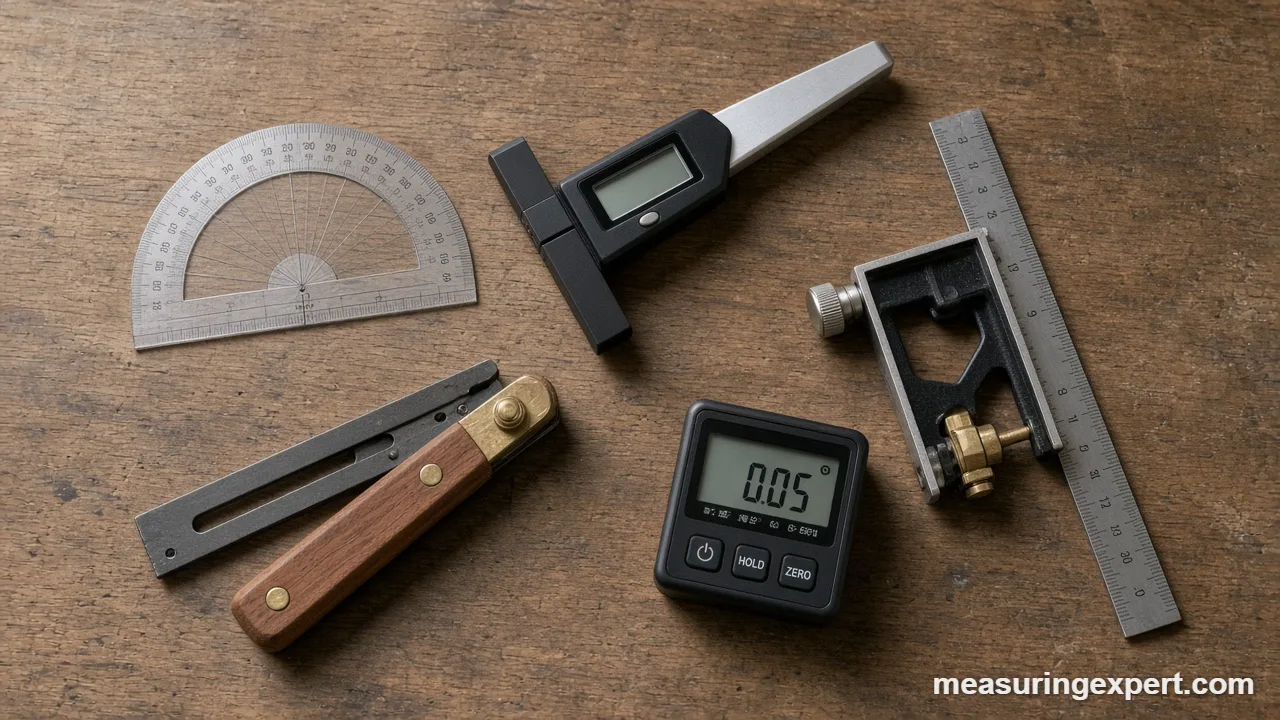
| Tool | What it measures | Typical resolution | Best for |
|---|---|---|---|
| School protractor | Angle on paper or a flat part | 1° | Drawings, homework, layout |
| Vernier bevel protractor | Angle between two faces | 5 minutes (1/12°) | Machining, inspection |
| Digital angle gauge | Tilt from level or from a zeroed surface | 0.1° (often 0.05°) | Saw blades, drill press tables |
| Digital angle finder (two arms) | Inside and outside corners | 0.1° | Trim, crown molding, framing |
| Inclinometer or slope level | Tilt from gravity | 0.1° to 1° | Drainage, ramps, roofs |
| Combination square | Fixed 90° and 45° | Fixed angles only | Marking and checking square |
| Sliding bevel | Copies any angle | No scale | Transferring angles to a saw |
| Theodolite | Horizontal and vertical angles to targets | 1 to 20 seconds of arc | Surveying, site layout |
Protractors: The Simplest Tools for Measuring Angles
A protractor is the simplest of all tools for measuring angles. It is a half or full circle with a degree scale, and you line its center mark up with the corner. Because the scale only has 1 degree marks, it suits drawings and rough layout, not precision cuts.
A bevel protractor adds a blade that swings on a dial and locks in place. Better models carry a vernier scale, so you can read to 5 minutes of arc. Machinists therefore use them to check dovetails, chamfers and fixture angles. For a full walkthrough of the parts and the vernier scale, see our guide on what a bevel protractor is and how to read one.
Metal protractors with a long arm are also handy in carpentry. The longer arm averages out small bumps in the edge, and so it gives a steadier reading than a short plastic one.
Digital Angle Gauges and Digital Angle Finders
A digital angle gauge is a small cube with a magnetic base and an electronic tilt sensor. First, you set it on the saw table and press zero. Next, you stick it to the blade and tilt the blade until the display shows the angle you want. Many models list an accuracy of plus or minus 0.1 or 0.2 degrees, so check the spec before you buy.
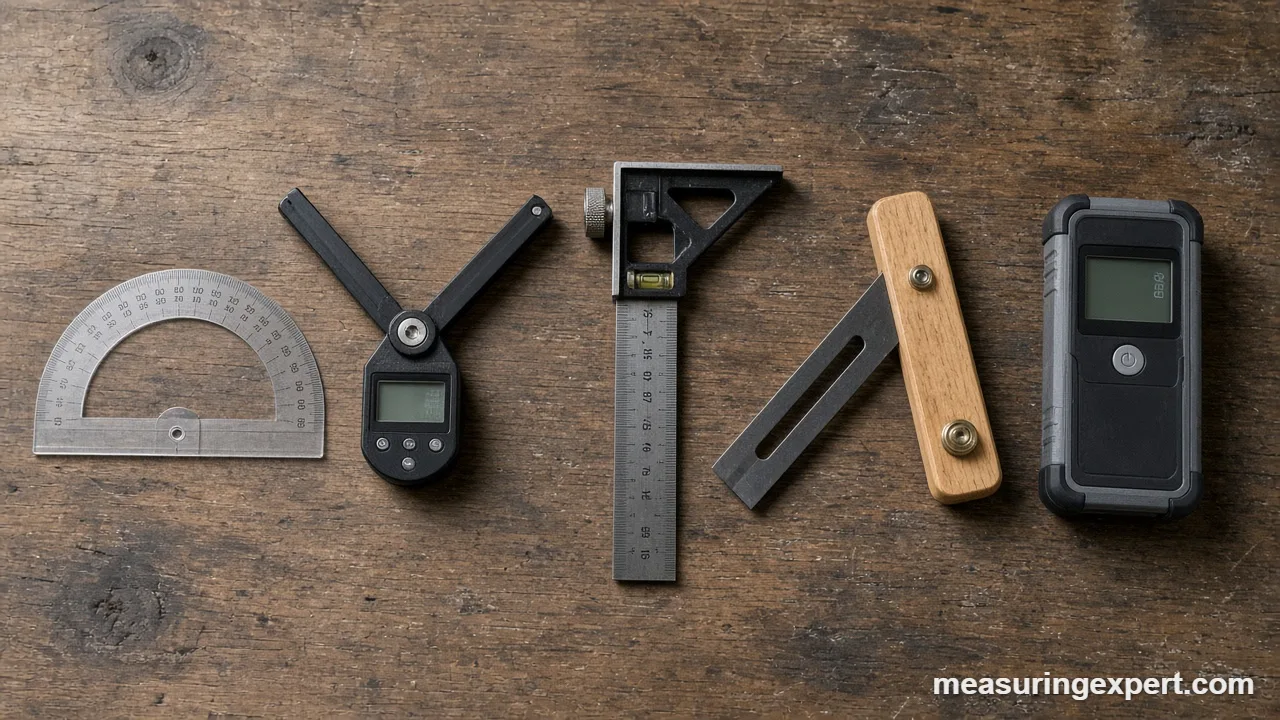
A digital angle finder, however, looks different. It has two long arms joined at a hinge, with a display that shows the angle between them. Because of that, it is the better tool for measuring a wall corner before you cut trim. Some models also show the miter and bevel settings for crown molding.
Both types need fresh batteries and a quick zero check. However, they remove the guesswork of reading small marks, and a hold button lets you read the value away from awkward spots.
Inclinometers vs Angle Finders: Which Tools for Measuring Angles Read What
People often mix these tools up, because many products combine both functions. In fact, the key difference is the reference. One tool measures against gravity, while the other measures against a second surface.
| Feature | Inclinometer / angle gauge | Angle finder / bevel |
|---|---|---|
| Reference | True level (gravity) | Another edge or face |
| Typical question | How steep is this ramp? | What is the angle of this corner? |
| Works on a vertical wall corner? | No | Yes |
| Shows percent grade or pitch? | Often | Rarely |
| Main error source | A tilted base or a bad zero | Bent arms or a loose hinge |
So, if you need slope for a deck, a drain or an accessible ramp, use an inclinometer. For example, the 1:12 slope common for ramps is about 4.76 degrees, or 8.3 percent grade. If you need the angle between two walls, use an angle finder instead.
Squares and Sliding Bevels
In contrast, a combination square reads only 90 and 45 degrees. Even so, those two angles cover most marking jobs, and a good square stays true for decades. A speed square adds a degree scale along its edge, which makes it a quick way to mark rafter cuts.
A sliding bevel has no scale at all. Instead, you set its blade against an existing angle, lock it and carry that angle to the saw or the workpiece. Because you never convert the angle to a number, you also never add a reading error. Many carpenters therefore keep a bevel next to their digital gauge.
Goniometers and Theodolites for Specialist Work
A goniometer is any instrument built to measure angles, but the name usually refers to two things. In clinics, a physical therapist uses a hinged goniometer to measure how far a joint bends. In labs, a goniometer holds a sample or crystal at precise angles. Our article on what a goniometer is and how it works covers both uses.
A theodolite sits on a tripod and measures horizontal and vertical angles to distant targets through a telescope. Construction models often read to 5 or 20 seconds of arc, and survey models read finer. If you want to try one, follow our steps on how to use a theodolite for setup, leveling and reading.
How to Use Tools for Measuring Angles Accurately
In general, these steps work with any of the tools above. In addition, the converter at the top of the page turns your reading into percent grade or pitch.
- Pick the right reference. Decide whether you need the angle between two surfaces or the tilt from level. Use an angle finder or bevel for the first and an inclinometer for the second.
- Clean and check the surfaces. Wipe off dust, glue and burrs, because a small chip under a gauge can add a full degree of error.
- Zero or calibrate the tool. Set a digital gauge on a flat reference surface and press zero, or check a protractor against a known square corner.
- Seat the tool firmly. Press the base or arms flat against both surfaces, keeping the tool square to the edge and not twisted.
- Read the angle straight on. Look at the scale from directly in front to avoid parallax, or press hold on a digital gauge and read it away from the work.
- Repeat and reverse. Take the reading again after flipping the tool end for end. Average the two values if they differ.
- Record the result with units. Write down the angle with its unit, such as degrees, percent grade or pitch, and convert it in the calculator above if needed.
Do and Don’t
Do
- Zero a digital gauge on the surface you measure from.
- Check new tools for measuring angles against a known square.
- Read scales from straight in front of the mark.
- Store tools flat, in a case, away from heat.
Don’t
- Assume a wall corner is exactly 90 degrees.
- Confuse percent grade with degrees.
- Drop a protractor or bevel and keep using it unchecked.
- Trust a phone app for structural or safety work.
Keeping Your Tools for Measuring Angles Accurate
Every angle tool can drift. A drop can bend a protractor blade, and a dirty base can tilt a digital gauge. Fortunately, the reversal test catches most problems in under a minute. Read a surface, turn the tool end for end on the same spot, and read again. Half of any difference is the tool error.
For squares, draw a line along the blade, flip the square over and draw a second line from the same point. If the two lines spread apart, the square is out. Our guide on how to calibrate angle tools explains each check in detail, including recalibrating digital gauges.
Honest Limits of Angle Measurement
No tool is better than the surface it sits on. For example, rough lumber, warped sheet goods and wavy drywall all change the reading by more than a good gauge’s rated accuracy. Similarly, a display that shows 0.05 degree steps does not make the reading accurate to 0.05 degrees.
Temperature and batteries also matter. Electronic sensors can drift when they move from a cold truck to a warm room, so give them a few minutes. Finally, published accuracy figures usually apply near 0 and 90 degrees, and some gauges lose accuracy in between.
When to Call a Professional
First, hire a licensed land surveyor for property lines, grading plans and building layout, since those angles carry legal weight. For roof framing, stairs and ramps that must meet code, ask a builder or inspector to check your numbers. Likewise, send precision protractors and levels to an accredited calibration lab when your work needs a traceable certificate.
Frequently Asked Questions
What are the best tools for measuring angles?
For most people, the best tools for measuring angles are a digital angle gauge, an angle finder with folding arms, a protractor and a sliding bevel. Pros add a vernier bevel protractor for machining and a theodolite for land and building layout.
What tool measures angles most accurately?
A theodolite or total station is the most accurate common choice, with readings to a few seconds of arc. On a workbench, a vernier bevel protractor reads to 5 minutes of arc, which is 1/12 of a degree.
Is a digital angle finder better than a protractor?
It is faster and easier to read, and it can measure tilt against gravity. However, a plain protractor never needs batteries or calibration, so it remains a good backup and the simpler choice for drawings.
What is the difference between an angle finder and an inclinometer?
An angle finder measures the angle between two surfaces with two arms. An inclinometer measures tilt relative to gravity, so it reads slope against true level instead of against another edge.
Which tools for measuring angles do woodworkers use?
Woodworkers mostly use a combination square for 90 and 45 degrees, a sliding bevel to copy angles, a digital angle gauge to set saw blades, and a miter protractor or angle finder for crown and trim.
How do you measure an angle without a protractor?
Measure the rise and run of the slope with a tape, divide rise by run, and take the arctangent. For example, a 6 in rise over 12 in of run is 26.57 degrees. The calculator above does this for you.
How do you convert degrees to percent grade?
Take the tangent of the angle and multiply by 100. A 45 degree slope is 100 percent grade, and a 10 degree slope is about 17.6 percent. Percent grade is not the same as degrees divided by 90.
Can a phone app replace tools for measuring angles?
A phone app works for rough checks, such as hanging a picture. However, phone sensors drift, cases add tilt, and the short edge limits accuracy, so use a real gauge for saw setups, framing or anything structural.
How do you check tools for measuring angles for accuracy?
Use the reversal test. Read a surface, turn the tool end for end on the same spot, and read again. If the two readings differ, the tool has an error of about half that difference.
What angle should a ladder be set at?
OSHA says the foot of a leaning ladder should sit about one quarter of its working length from the wall. That works out to about 75.5 degrees from the ground, the familiar 4 to 1 rule.
Bottom Line
Start with a digital angle gauge and a sliding bevel, and you will cover saw setups and copied angles. Then add an angle finder for trim and an inclinometer for slopes, because each tool answers a different question.
Above all, check every tool with the reversal test, measure the real corner instead of assuming 90 degrees, and convert units with the calculator at the top. That way, your tools for measuring angles will give you cuts that fit the first time.
1 thought on “Best Tools for Measuring Angles: Protractors, Gauges and More”