

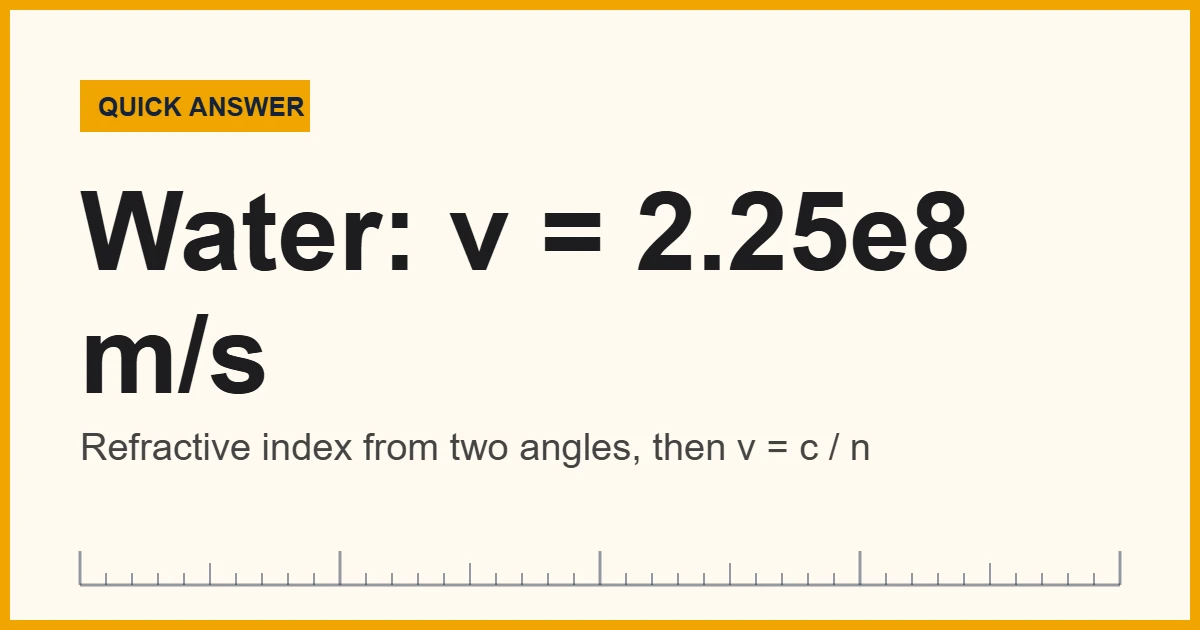
Snell’s law lets you find the speed of light in a material in two steps. First, measure the angles and use n1 sin(theta1) = n2 sin(theta2) to get the refractive index n. Then divide: v = c / n. For water (n = 1.333), that gives about 2.25 x 10^8 m/s.
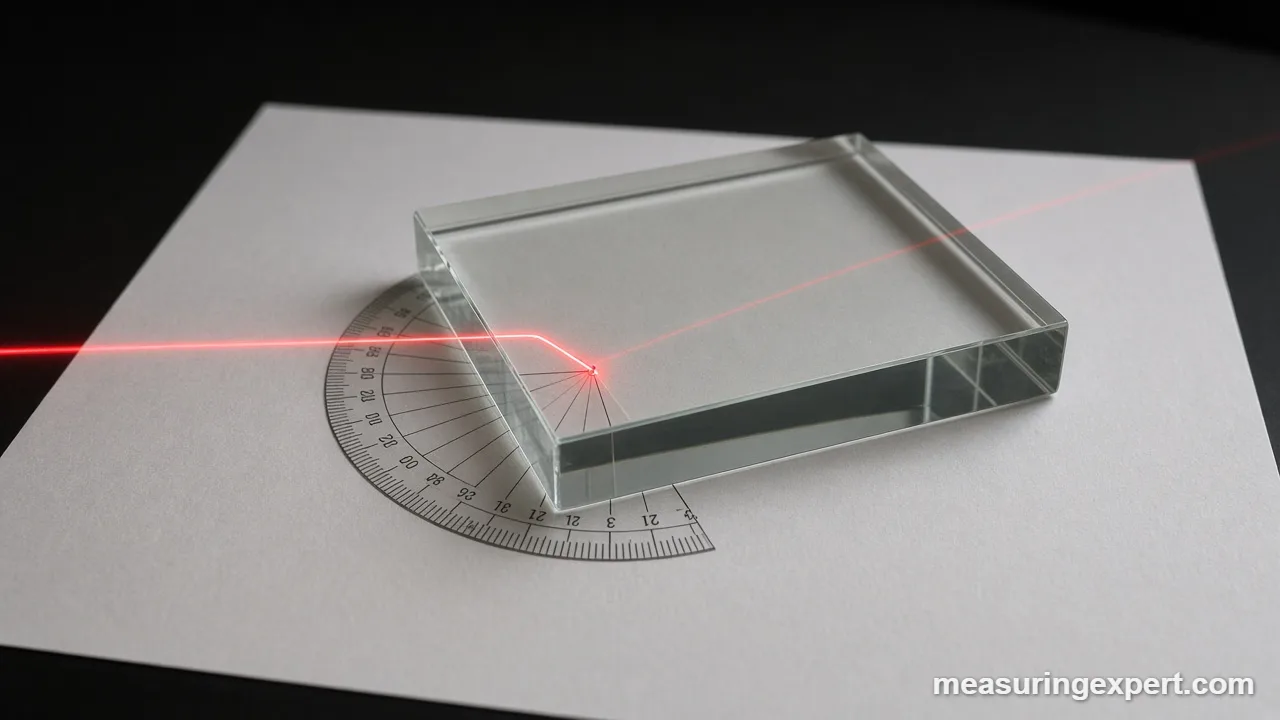
Light slows down when it enters glass, water or plastic, and that slowdown is exactly what bends a beam at the surface. So if you can measure how much the beam bends, you can work out how fast light travels inside the material. Instead of a stopwatch, you need a protractor, a straight beam and a little trigonometry.
The method has two parts. First, Snell’s law links the angle of the incoming ray and the angle of the bent ray to the refractive indices of the two materials. Next, the refractive index tells you the speed, because n is simply the ratio of the speed of light in a vacuum to the speed in the material. For example, glass with n = 1.5 carries light at about two thirds of its vacuum speed, roughly 2.0 x 10^8 m/s.
In short: measure two angles, calculate n, then divide c by n.
Also, the value of c itself is not something you need to measure. In fact, the US National Institute of Standards and Technology (NIST) explains that the 1983 definition of the meter fixed the speed of light at 299,792,458 m/s in a vacuum. That exact number is the c in every calculation on this page.
Below, you will find the converter, the worked examples for water and glass, a table of common materials, and finally a simple glass block experiment you can do at a kitchen table or in a school lab.
Convert the Speed of Light in a Material
Once Snell’s law gives you a speed in meters per second, type it below to see it in kilometers per hour, miles per hour and feet per second. The default value is the speed of light in water, c / 1.333.
To get the m/s value in the first place, divide 299,792,458 by your refractive index. For instance, 299,792,458 / 1.52 gives about 197,231,880 m/s for crown glass.
Recommended Tools for Measuring Refractive Index
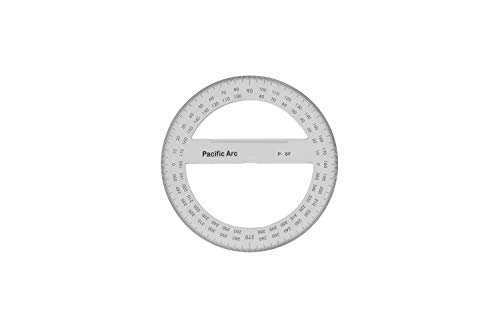
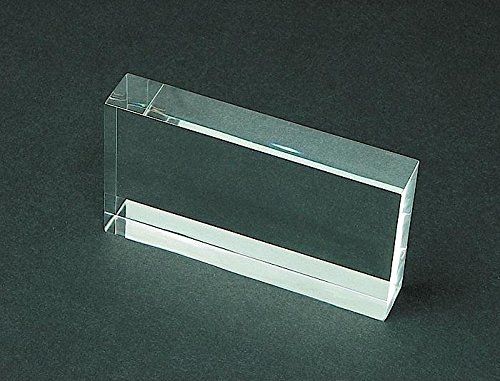
You can run the experiment with pins and paper. However, a polished glass or acrylic block, a clear protractor and a ray box make the angles much easier to read. In addition, look for a block with flat, polished faces, since rough edges scatter the beam. Also choose a protractor with fine 1-degree marks, because a half-degree reading error changes the result noticeably.


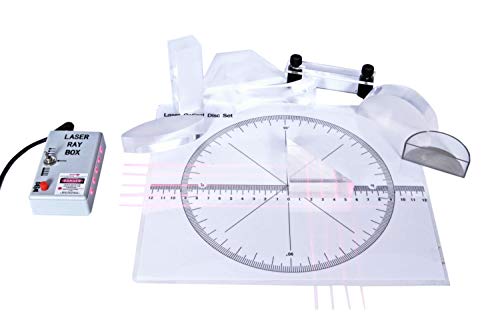
As an Amazon Associate, Measuring Expert earns from qualifying purchases.
Refractive Index and Snell’s Law: Key Takeaways
- Snell’s law: n1 sin(theta1) = n2 sin(theta2), with both angles measured from the normal.
- The refractive index is a speed ratio: n = c / v, so v = c / n.
- The speed of light in a vacuum is exactly 299,792,458 m/s by definition.
- Water (n = 1.333) slows light to about 2.25 x 10^8 m/s, or 75% of c.
- Ordinary glass (n about 1.5) slows light to about 2.0 x 10^8 m/s.
- A glass block, pins and a protractor are enough to measure n within a few percent.
- Frequency stays the same across the boundary; speed and wavelength both drop.
What Snell’s Law Says
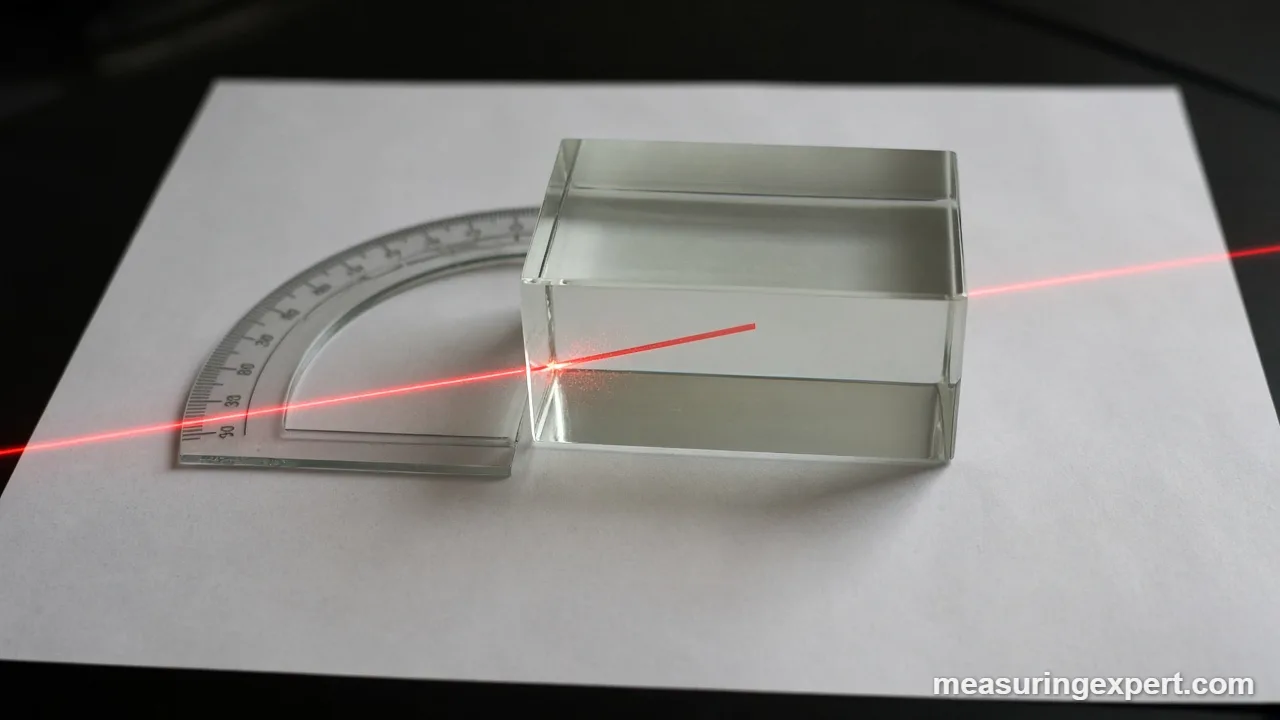
When a ray of light crosses from one transparent material into another, it changes direction. Snell’s law describes that change with one short equation:
n1 x sin(theta1) = n2 x sin(theta2)
Here, n1 and n2 are the refractive indices of the first and second materials. Meanwhile, theta1 is the angle of incidence and theta2 is the angle of refraction. Importantly, both angles are measured from the normal, an imaginary line drawn at 90 degrees to the surface, and not from the surface itself. In fact, this is the most common mistake in homework and in the lab.
The rule also makes intuitive sense once you picture a car driving at an angle from pavement onto sand. First, the wheel that hits the sand slows down, so the car swings toward the normal. Similarly, light that enters a slower material bends toward the normal, and light that enters a faster material bends away from it. For example, the OpenStax physics textbook covers the same idea in its chapter on the law of refraction, along with a table of indices for common materials.
If the first material is air, n1 is 1.000293, which you can round to 1 for almost any practical purpose. As a result, the equation simplifies to n2 = sin(theta1) / sin(theta2). That simple ratio, then, is what you calculate in the experiment further down.
From Refractive Index to Speed: v = c / n
The refractive index is not an arbitrary number. Instead, by definition, it is the ratio of the speed of light in a vacuum to the speed of light in the material:
n = c / v, so v = c / n
Therefore, a material with n = 2 carries light at exactly half of c, and a material with n = 1.25 carries it at 80% of c. Because n is always greater than 1 for ordinary materials, light always travels slower in them than in a vacuum.
Put the two equations together and you get a direct path from angles to speed. First, Snell’s law gives n2 from the measured angles. Then, v2 = c / n2. If you prefer one step, you can also write the ratio of speeds directly: v1 / v2 = sin(theta1) / sin(theta2). In other words, the sines of the angles are in the same ratio as the speeds.
Worked Examples: Refractive Index to Light Speed
Example 1: water, refractive index 1.333
Fresh water at 20 C (68 F) has a refractive index of 1.333. So v = 299,792,458 / 1.333 = about 224,900,569 m/s, or roughly 2.25 x 10^8 m/s. That is about 224,901 km/s or 139,747 miles per second, which is 75% of the vacuum speed.
You can also check the angle side. A ray that hits still water at 45 degrees from the normal bends to about 32.0 degrees, because sin(45) / 1.333 = 0.530 and the inverse sine of 0.530 is 32.0 degrees.
Example 2: glass, refractive index from two angles
Suppose a beam enters a glass block from air at 40.0 degrees and you measure the refracted angle as 25.4 degrees. Then n = sin(40.0) / sin(25.4) = 0.6428 / 0.4289 = 1.499. Next, v = 299,792,458 / 1.499 = about 2.0 x 10^8 m/s. Typical window or lab glass, after all, sits close to n = 1.5, so this result is right on target.
Example 3: from water into glass
Snell’s law also works when neither material is air. For instance, a ray in water (n = 1.333) hits glass (n = 1.5) at 30 degrees. Then sin(theta2) = 1.333 x sin(30) / 1.5 = 0.444, so theta2 is about 26.4 degrees. As a result, the ray bends only slightly, because the two speeds are close: about 2.25 x 10^8 m/s in water against 2.0 x 10^8 m/s in glass.
Refractive Index and Speed of Light in Common Materials
This table uses the refractive indices from the OpenStax table (liquids at 20 C, solids at 0 C) and divides the exact value of c by each one. Because the index varies slightly with color, treat the last digit as approximate.
| Material | Refractive index n | Speed (m/s) | Speed (mi/s) | Share of c |
|---|---|---|---|---|
| Vacuum | 1 (exact) | 299,792,458 | 186,282 | 100% |
| Air (0 C, 1 atm) | 1.000293 | 2.9970 x 10^8 | 186,228 | 99.97% |
| Ice | 1.309 | 2.290 x 10^8 | 142,309 | 76.4% |
| Water | 1.333 | 2.249 x 10^8 | 139,747 | 75.0% |
| Ethanol | 1.361 | 2.203 x 10^8 | 136,872 | 73.5% |
| Plexiglas (acrylic) | 1.51 | 1.985 x 10^8 | 123,366 | 66.2% |
| Crown glass | 1.52 | 1.972 x 10^8 | 122,554 | 65.8% |
| Flint glass | 1.66 | 1.806 x 10^8 | 112,218 | 60.2% |
| Diamond | 2.419 | 1.239 x 10^8 | 77,008 | 41.3% |
For more on the vacuum value and what it looks like in miles per hour, see our page on how fast the speed of light is.
What Changes at the Boundary and What Stays the Same
Many students assume that everything about the light changes when it slows down. However, one property stays fixed. This table separates the quantities people often mix up.
| Quantity | Changes in glass or water? | Why |
|---|---|---|
| Speed v | Yes, drops to c / n | The material slows the wave. |
| Wavelength | Yes, drops to (vacuum wavelength) / n | Same number of waves per second, but each one is shorter. |
| Frequency | No | Set by the source; the boundary cannot add or remove waves. |
| Direction | Yes, unless the ray hits along the normal | Snell’s law; a ray at 0 degrees goes straight through. |
| Color you see | No | Color follows frequency, which stays fixed. |
Similarly, a related idea is the angle of deviation, which is how far the ray turns from its original path. For a prism, that angle depends on the refractive index too, and our guide to the angle of deviation shows how to measure it.
How to Measure Refractive Index With a Glass Block
This classic pin experiment needs a rectangular glass or acrylic block, a sheet of paper on a corkboard, four pins, a sharp pencil, a ruler and a protractor. A ray box is optional, but it also makes the beam easier to follow.
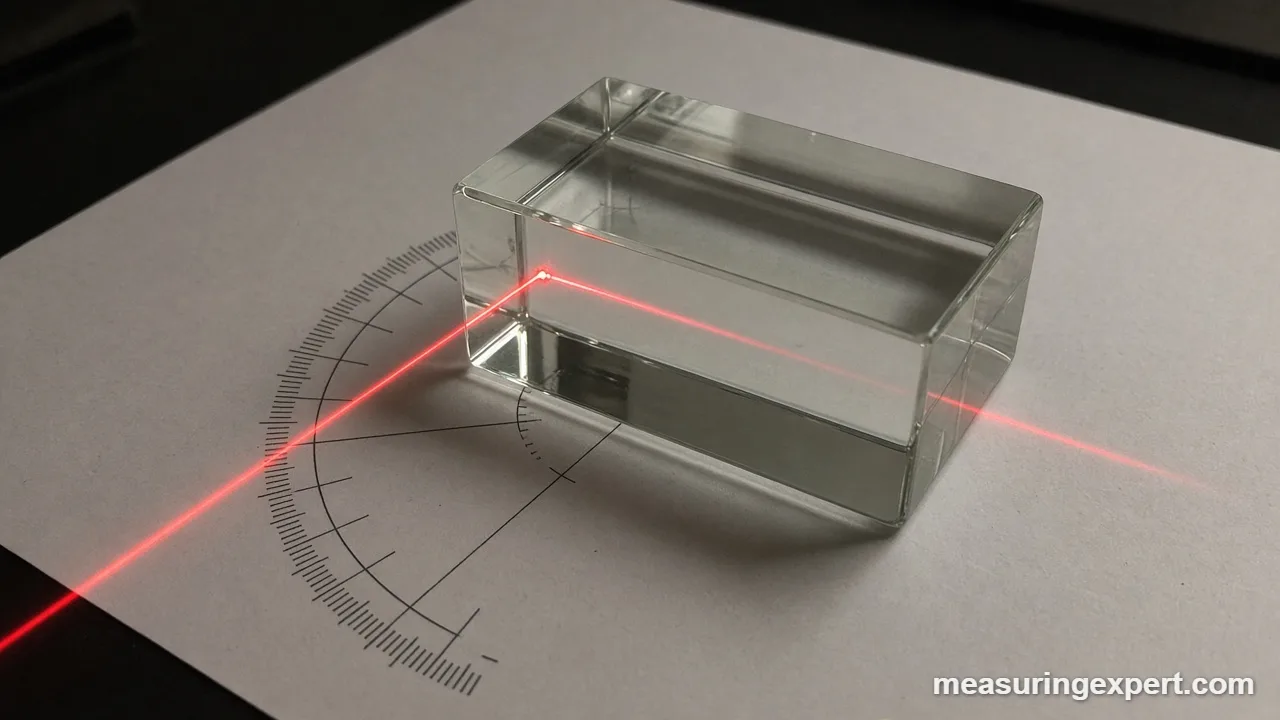
- Trace the block. Place the block on the paper and draw around it with a sharp pencil, then lift it off.
- Draw the normal. Pick a point on one long edge and draw a line at 90 degrees to that edge with the protractor.
- Draw the incident ray. Draw a line meeting the normal at your chosen angle, for example 40 degrees, and push two pins into it about 5 cm (2 in) apart.
- Put the block back. Line it up exactly with the outline you traced.
- Sight through the opposite face. Look through the block and push two more pins so that all four appear in one straight line.
- Join the exit points. Remove the block, draw the exit ray through the last two pins, and connect the entry point to the exit point. That line is the refracted ray.
- Measure theta2. Read the angle between the refracted ray and the normal with the protractor.
- Calculate n and v. Work out n = sin(theta1) / sin(theta2), then v = 299,792,458 / n, and enter the result in the converter above.
Sample Refractive Index Readings
Next, repeat the steps at several angles and average the results. Here is a sample set of readings for a block with n close to 1.5:
| Incident angle | Refracted angle | n = sin(i) / sin(r) | v = c / n (m/s) |
|---|---|---|---|
| 20 degrees | 13.2 degrees | 1.498 | 2.001 x 10^8 |
| 30 degrees | 19.5 degrees | 1.498 | 2.001 x 10^8 |
| 40 degrees | 25.4 degrees | 1.499 | 2.000 x 10^8 |
| 50 degrees | 30.7 degrees | 1.500 | 1.998 x 10^8 |
| 60 degrees | 35.3 degrees | 1.499 | 2.000 x 10^8 |
These are illustrative readings, so your own numbers will scatter more. Even so, if your average lands between 1.45 and 1.55, the method is working. For more ways to read angles cleanly, our roundup of tools for measuring angles compares protractors, digital angle gauges and more.
Do and Don’t for Snell’s Law Measurements
Do
- Measure both angles from the normal.
- Use a sharp pencil and a thin, straight beam.
- Take readings at several angles and average them.
- Keep your calculator in degree mode.
- Write down the color or wavelength of light you used.
Don’t
- Measure angles from the surface of the block.
- Rely on one reading near 0 degrees, where small errors dominate.
- Let the block shift after you trace it.
- Expect four significant figures from a school protractor.
- Look into a laser beam or its reflections.
Honest Limits of the Method
The math is exact, but your measurement is not. A half-degree error matters more than most people expect: at 40 degrees incidence, reading 25.9 or 24.9 degrees instead of 25.4 moves n from 1.499 to 1.472 or 1.527. As a result, that is close to a 2% swing in the speed. In addition, the index depends on color, so red light and blue light give slightly different answers in the same glass. For example, this effect, called dispersion, is why prisms make rainbows.
Temperature also shifts the index slightly, especially for liquids. Meanwhile, cheap acrylic blocks can have curved or scratched faces that bend the beam twice. So a careful school experiment usually gets within a few percent of the true value, which is a good result for a protractor, but it will not match a lab instrument.
When to Use a Professional Lab
For coursework and curiosity, a glass block is plenty. However, if you need a refractive index to three or four decimals, for example to identify a gemstone, check optical glass, or test the sugar or alcohol content of a liquid, use a calibrated refractometer or send the sample to an accredited optics or materials lab. Gemologists, for instance, use refractometers because the difference between two stones can be smaller than a protractor can resolve.
Frequently Asked Questions
How do you use Snell’s law to find the speed of light?
Measure the angle of incidence and the angle of refraction from the normal, then calculate n = sin(theta1) / sin(theta2) when light enters from air. Finally, divide the vacuum speed by n: v = 299,792,458 / n meters per second.
What is the formula for the speed of light in a medium?
The formula is v = c / n, where c is 299,792,458 m/s and n is the refractive index of the medium.
What is the speed of light in water?
With n = 1.333, light travels at about 2.25 x 10^8 m/s in water, which is about 224,900 km/s or 75% of its vacuum speed.
What is the speed of light in glass?
Ordinary glass has n of about 1.5, so light travels at about 2.0 x 10^8 m/s. Crown glass (n = 1.52) gives about 1.97 x 10^8 m/s.
Are Snell’s law angles measured from the surface or the normal?
Always from the normal, the line at 90 degrees to the surface. Measuring from the surface gives the complement of the correct angle and a wrong answer.
Can the refractive index be less than 1?
For visible light in ordinary transparent materials, no. Air is about 1.0003 and everything denser is higher, so light always travels slower than c in these materials.
Does the frequency of light change when it slows down?
No. The frequency stays the same; only the speed and the wavelength drop, both by the factor n.
Why does the refractive index change with the color of light?
The refractive index depends on wavelength, an effect called dispersion. Most glass has a slightly higher index for blue light, so blue light travels a little slower and bends a little more.
What is the critical angle in Snell’s law?
It is the incident angle, inside the slower material, at which the refracted ray skims along the surface. From water into air it is about 48.6 degrees, and from glass with n = 1.5 it is about 41.8 degrees. Beyond it, all the light reflects back.
Do I need to measure the speed of light in a vacuum myself?
No. Since 1983, the speed of light in a vacuum has been fixed at exactly 299,792,458 m/s by the definition of the meter, so you only need to measure the refractive index.
Snell’s Law and Light Speed: The Bottom Line
To sum up, finding the speed of light in a material comes down to two equations. Snell’s law turns two measured angles into a refractive index, and v = c / n turns that index into a speed. For example, water gives about 2.25 x 10^8 m/s and glass about 2.0 x 10^8 m/s.
Finally, the measurement is only as good as your angles, so measure from the normal, repeat at several angles, and average. Then drop your result into the converter at the top of the page to see it in km/h, mph or feet per second.
1 thought on “How to Use Snell’s Law to Find the Speed of Light in a Material”