

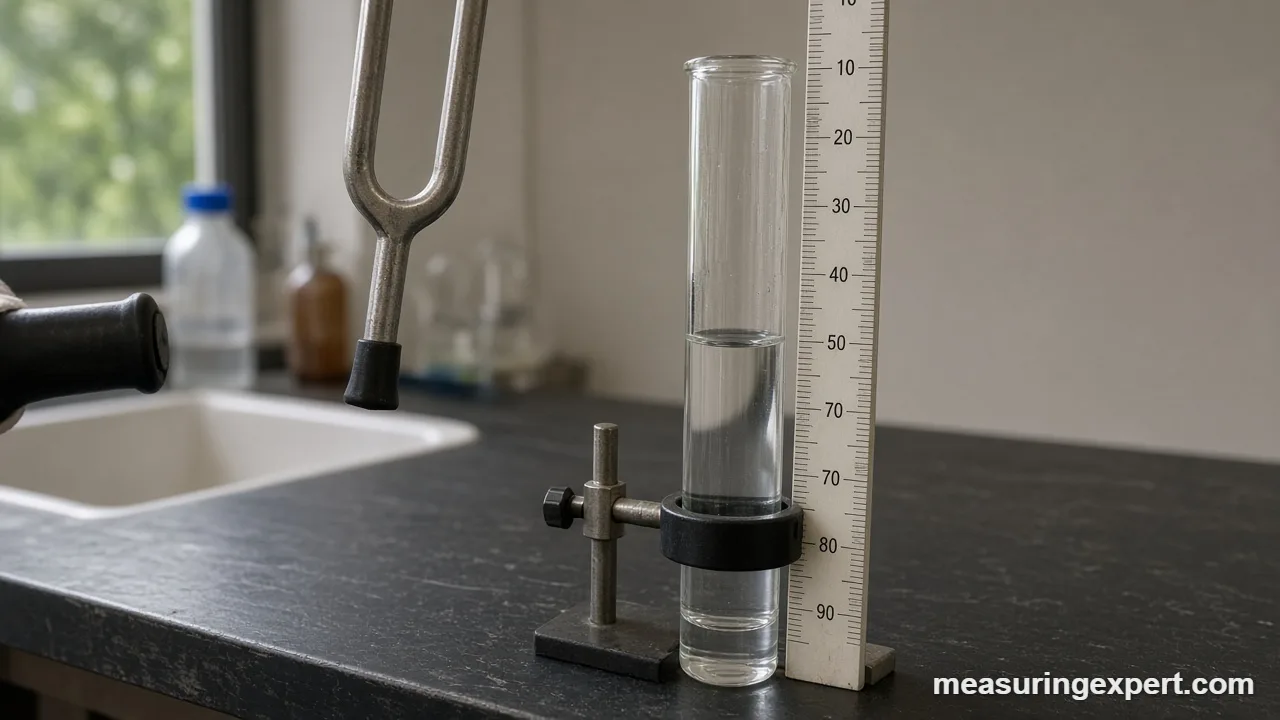
To measure speed of sound, divide a known distance by the time sound needs to cover it. For example, an echo from a wall 85 m (279 ft) away that returns in 0.50 s gives 2 x 85 / 0.50 = 340 m/s. In dry air at 20 C (68 F), expect about 343 m/s, or 767 mph.
Sound feels instant across a room, yet it is surprisingly slow. Light crosses a football field in well under a microsecond, while sound needs about a third of a second. That gap is exactly what makes the speed of sound easy to measure at home, in a classroom or in a lab, because ordinary clocks and phones can catch it.
In short: every method on this page finds either a time delay over a known distance (echo, two microphones, thunder, phone apps) or a wavelength at a known frequency (resonance tube, Kundt’s tube). Then you use v = d / t or v = f x wavelength. As a result, the six methods differ mainly in how they measure time or wavelength, and therefore in how accurate they can be.
For a quick real-world check, the US National Weather Service explains that the sound of thunder takes about 5 seconds to travel a mile. Similarly, the free phyphox app from RWTH Aachen University offers an acoustic stopwatch experiment that finds the speed of sound with two phones and a tape measure.
This guide focuses on methods, not reference values. So if you only want the number for a given temperature, our page on how fast the speed of sound is lists values in m/s, mph and km/h. Here, instead, you will get the setups, the formulas, worked examples and the mistakes that throw results off.
Convert Your Measured Speed of Sound
Once you have a result in meters per second, enter it below to see it in km/h, mph, feet per second and knots. The default, 343 m/s, is the textbook value for dry air at 20 C (68 F), so you can compare your own result against it.
Also, keep the air temperature in mind. Sound speeds up by about 0.6 m/s for every degree Celsius, so a result of 337 m/s on a 10 C (50 F) day is right on target.
Recommended Tools to Measure Speed of Sound
You do not need a lab to get a good result. Still, a few simple tools make each method more accurate. First, a set of tuning forks gives known frequencies for the resonance tube. Next, a laser distance measurer or long tape sets your distance precisely. Finally, a stopwatch with lap timing helps with the echo-clap method.


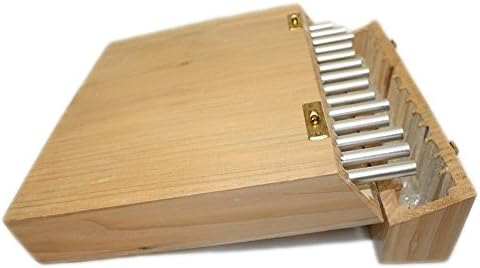
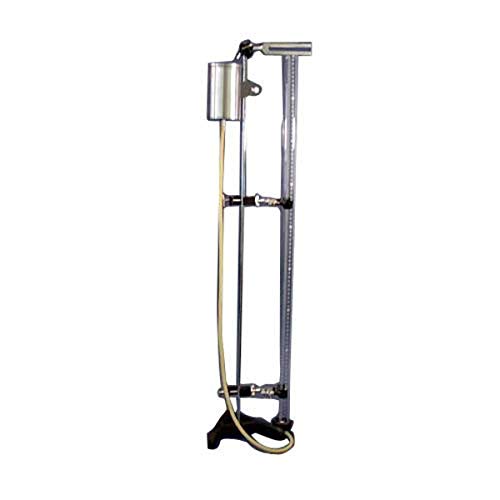

As an Amazon Associate, Measuring Expert earns from qualifying purchases.
- Every method uses v = d / t (distance over time) or v = f x wavelength.
- Expect about 343 m/s (1,125 ft/s, 767 mph) in dry air at 20 C (68 F).
- The echo method doubles the distance, because sound travels out and back.
- A quarter-wave resonance tube uses v = 4f(L + 0.3d), where d is the tube diameter.
- Kundt’s tube powder heaps sit half a wavelength apart, so v = 2 f x spacing.
- Thunder rule: about 5 seconds per mile, or about 3 seconds per kilometer.
- Always record the air temperature, since it changes the answer more than most timing errors.
The Two Formulas Behind Every Method
Sound is a pressure wave, so you can describe it in two ways. On the one hand, it is a disturbance that moves a certain distance in a certain time. On the other hand, it is a wave with a frequency and a wavelength. Because both descriptions hold at once, you can pick whichever is easier to measure.
Time of flight: v = d / t (echo: v = 2d / t)Wave method: v = f x wavelength
For example, a 512 Hz tuning fork in 20 C air makes a wavelength of 343 / 512 = 0.670 m (26.4 in). Likewise, sound covering 1,000 m in 2.92 s moves at 1,000 / 2.92 = 342 m/s. Both routes give the same physical quantity, so one method can check another.
Six Ways to Measure Speed of Sound Compared
Each method trades simplicity for accuracy. In general, the more precisely you can measure time or wavelength, the closer you get to the true value.
| Method | What you measure | Formula | Typical accuracy | Best for |
|---|---|---|---|---|
| Echo (clap timing) | Round-trip time to a wall | v = 2d / t | About 5 to 10% (hand timing) | Outdoor class demo |
| Two microphones | Delay between two mics | v = d / delta t | About 1% or better | School and university labs |
| Resonance tube (quarter-wave) | Air column length at resonance | v = 4f(L + 0.3d) | About 1 to 2% | Classic physics practical |
| Kundt’s tube | Spacing of powder heaps | v = 2 f x spacing | About 2 to 5% | Visual wave demo |
| Lightning and thunder | Flash-to-bang delay | d = v x t (estimate) | Rough only | Storm distance estimate |
| Smartphone app | Delay between two phones | v = 2d / (tA – tB) | About 1 to 3% | Home and classroom |
These accuracy ranges are typical for careful student work, not guarantees. Your own result depends on your distance, your timing and the air conditions.
Echo Method: Measure Speed of Sound With a Wall
The echo method is the oldest and simplest approach. You stand a measured distance from a large flat wall, make a sharp sound, and time the echo. Since the sound travels to the wall and back, the path is twice the distance.
However, a single clap at 85 m returns in only about half a second, and human reaction time is often 0.1 to 0.2 s. That error alone can spoil the result. So instead of timing one echo, clap in rhythm so that each clap lands exactly on the echo of the previous one. Then a partner times 20 intervals.
For example, suppose 20 intervals take 10.0 s at 85 m. Each interval is then 0.50 s, so v = 2 x 85 / 0.50 = 340 m/s. In addition, repeating the run three times and averaging cuts the random error further.
Two-Microphone Timing
This method removes the human from the clock. You place two microphones in a straight line with the sound source and connect both to a data logger, an oscilloscope or a computer sound card. Then a sharp click passes the first microphone and, a moment later, the second.
The software shows the delay between the two spikes. For example, with the microphones 1.00 m apart, a delay of 2.92 ms gives 1.00 / 0.00292 = 342 m/s. Notice that you never need to know when the click started, because only the difference matters.
Resolution sets the limit here. A sound card that samples at 48 kHz records one point every 0.0208 ms. Therefore, at 1 m spacing, a one-sample error is about 0.7%. As a result, a wider spacing such as 2 or 3 m improves accuracy, as long as the room does not add echoes that blur the second spike.
How to Measure Speed of Sound With a Resonance Tube
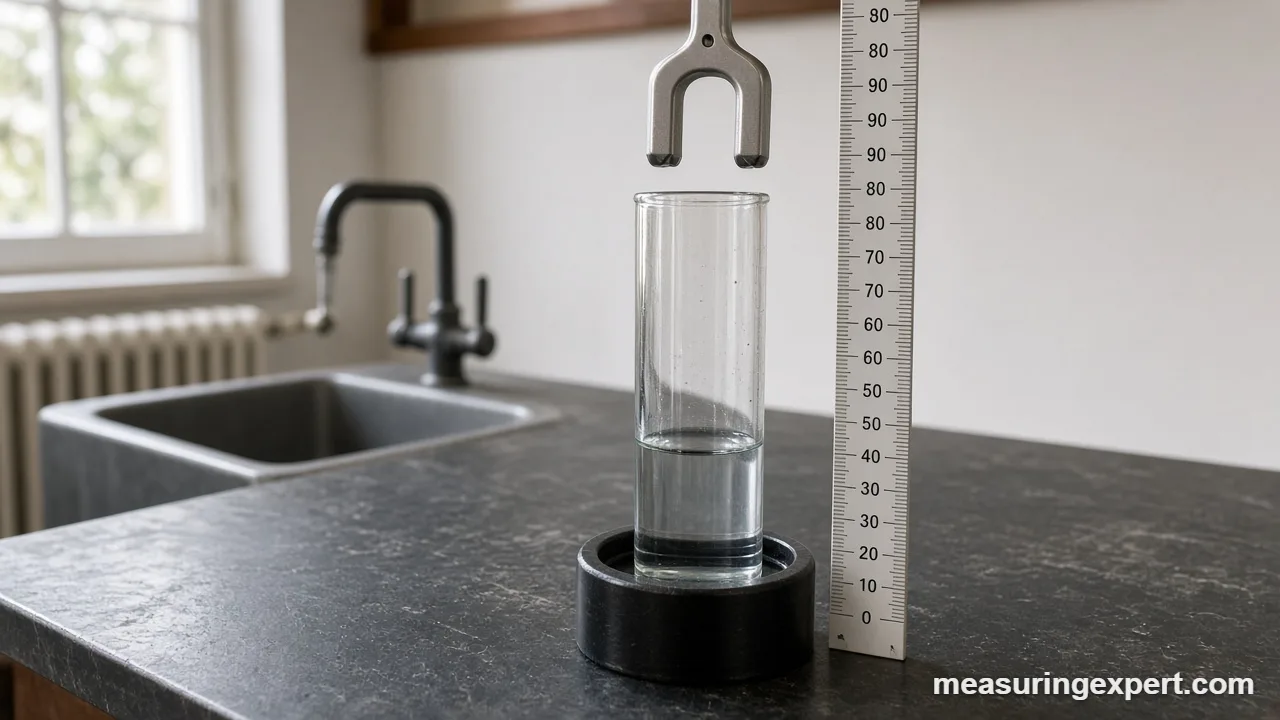
The resonance tube is the classic school practical. It uses a tube that is open at the top and closed at the bottom by water. When the air column is a quarter of a wavelength long, the sound from a tuning fork suddenly gets much louder.
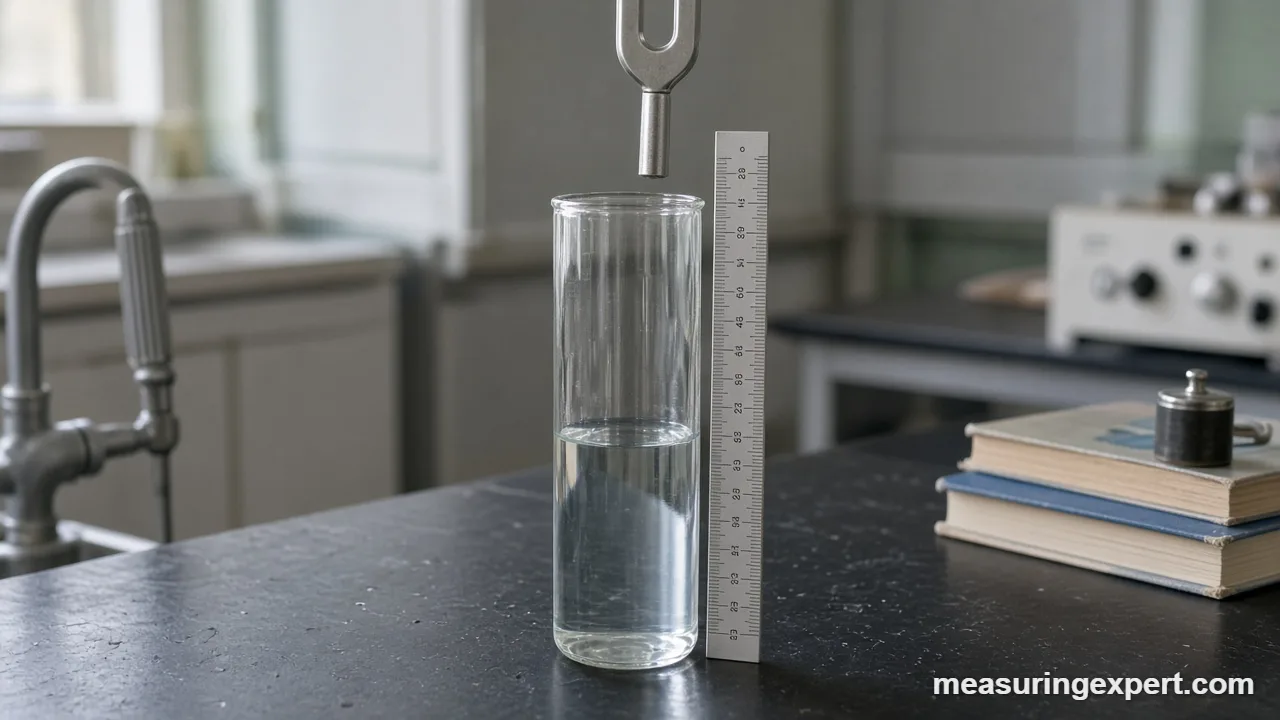
- Set up the tube. Stand a glass or plastic tube in a tall cylinder of water so you can raise and lower it, and measure its inside diameter d.
- Strike a tuning fork. Tap a fork of known frequency, such as 512 Hz, on a rubber pad, never on the bench.
- Hold it over the open end. Keep the prongs level with the tube mouth, about 1 cm (0.4 in) above it.
- Find the loudest point. Slowly raise the tube from low in the water until the sound swells to a maximum.
- Measure the air column. Record L, the length from the water surface to the top of the tube.
- Apply the end correction. Calculate v = 4f(L + 0.3d), then repeat with a second fork to check your result.
For example, a 512 Hz fork in a tube 3.0 cm wide resonates at L = 15.8 cm. So v = 4 x 512 x (0.158 + 0.009) = 342 m/s. The extra 0.3d is the end correction: the vibrating air reaches slightly past the open end, so the true quarter-wave is a little longer than the tube.
Use the Second Resonance to Cancel the End Correction
Better still, keep raising the tube to find the second resonance, at three quarters of a wavelength. In the same example it appears near 49.3 cm. Because the two lengths differ by exactly half a wavelength, v = 2f(L2 – L1) = 2 x 512 x 0.335 = 343 m/s, and the end correction cancels out.
Kundt’s Tube: See the Sound Waves
Kundt’s tube makes standing waves visible. You sprinkle a light powder, such as cork dust or lycopodium, along a sealed horizontal glass tube. Then a speaker or a vibrating rod at one end drives the air at a fixed frequency.
At the right frequency, the air inside forms a standing wave. Consequently, the powder dances at the antinodes and settles into neat heaps at the nodes. Neighboring heaps sit half a wavelength apart, so v = 2 x f x spacing. For example, with a 2,000 Hz tone and heaps 8.6 cm apart, v = 2 x 2,000 x 0.086 = 344 m/s.
Meanwhile, in August Kundt’s original 1866 version, a rubbed metal rod drove the tube. By comparing the heap spacing with the rod length, he could also find the speed of sound in the metal itself. To improve accuracy today, measure across several heaps at once, for instance the distance spanning 6 gaps, and divide by 6.
Lightning and Thunder: A Rough Field Estimate
A storm gives you a free experiment. The flash reaches you almost instantly, because the speed of light is roughly 874,000 times faster, while the thunder travels at the speed of sound. So the delay tells you the distance, if you trust the speed, or the speed, if you know the distance.
The National Weather Service rule is about 5 seconds per mile. Similarly, the metric rule is about 3 seconds per kilometer. For example, a 10-second delay means the strike was about 3.4 km, or 2.1 miles, away. With 343 m/s the exact figures are 4.7 s per mile and 2.9 s per km, so the rules round slightly.
Smartphone Apps That Measure Speed of Sound
Phones have accurate clocks and good microphones, so they make excellent timers. In particular, the phyphox acoustic stopwatch works with two phones. Each phone starts its timer on one loud sound and stops on the next.
First, place the phones a measured distance d apart, say 5.00 m (16.4 ft). Next, one person claps beside phone A, and then a second person claps beside phone B. Phone A times from its own clap until it hears clap B, while phone B times from hearing clap A until its own clap. As a result, the difference tA – tB equals 2d / v. A difference of 0.0292 s gives 2 x 5.00 / 0.0292 = 342 m/s.
Also, single-phone echo apps exist, but they suffer from the same short-delay problem as hand timing. So a longer distance and several repeats help either way. If you want to measure how loud a sound is rather than how fast it travels, our guide on how to measure sound volume covers sound level meters and dB apps.
Temperature Correction for Your Result
Temperature is the biggest single factor in air. Warm air molecules move faster, so they pass the wave along more quickly. A handy approximation for dry air is v = 331.3 + 0.606T, with T in degrees Celsius.
| Air temperature | Speed (m/s) | Speed (mph) | Speed (ft/s) |
|---|---|---|---|
| 0 C (32 F) | 331.3 | 741.1 | 1,086.9 |
| 10 C (50 F) | 337.3 | 754.5 | 1,106.7 |
| 20 C (68 F) | 343.2 | 767.7 | 1,126.0 |
| 25 C (77 F) | 346.1 | 774.3 | 1,135.6 |
| 30 C (86 F) | 349.0 | 780.7 | 1,145.1 |
The table uses v = 331.3 x square root of (1 + T / 273.15) for dry air. Humidity raises the speed slightly, typically by less than 0.5%, while air pressure on its own has almost no effect.
Do and Don’t When You Measure Speed of Sound
Do
- Record the air temperature for every run.
- Use the longest distance your setup allows.
- Time many intervals and divide, rather than one.
- Repeat each measurement at least three times.
- Check your answer against the temperature table.
Don’t
- Forget to double the distance for an echo.
- Skip the end correction on a resonance tube.
- Strike tuning forks on hard surfaces.
- Stand near other walls that add stray echoes.
- Count thunder when you should be indoors.
Honest Limits of Each Method
No home method will match a lab instrument, and that is fine for learning. Even so, it helps to know where the error comes from. Hand timing is the weakest link, which is why the echo method rarely beats 5%. In contrast, microphones and phones remove reaction time, so their limit is sample rate and distance.
Wave methods have their own catches. For instance, a resonance tube depends on judging the loudest point by ear, and the end correction is itself an approximation. Likewise, Kundt’s tube heaps have fuzzy edges. Finally, wind outdoors adds to or subtracts from the speed along its direction, so measure on a calm day or average runs in both directions.
When You Need a Professional Measurement
Classroom methods are perfect for learning physics. However, some jobs need certified results. For example, ultrasonic flaw detection, sonar calibration, medical ultrasound and building acoustics all rely on calibrated equipment and trained technicians. In those cases, contact an accredited calibration lab or an acoustical consultant instead of relying on a DIY setup.
Frequently Asked Questions
What is the easiest way to measure speed of sound?
The easiest way is the echo method: clap in rhythm with the echo from a wall at a known distance, time 20 intervals, and use v = 2d / t.
Why do you double the distance in the echo method?
Because the sound travels to the wall and then back to you, the total path is twice the distance to the wall.
What is the formula for a resonance tube?
For a tube closed at one end, the first resonance gives v = 4f(L + 0.3d), where f is the frequency, L the air column length and d the tube diameter.
Can I measure speed of sound with my phone?
Yes. The free phyphox app has an acoustic stopwatch that uses two phones a measured distance apart, and it usually lands within a few percent.
How does Kundt’s tube measure the speed of sound?
Powder in the tube gathers at the nodes of a standing wave. Neighboring heaps sit half a wavelength apart, so v = 2 x frequency x heap spacing.
How many seconds per mile is thunder?
About 5 seconds per mile, or about 3 seconds per kilometer. The exact value at 20 C is 4.7 seconds per mile.
Does temperature affect how I measure speed of sound?
It does not change the method, but it changes the answer by about 0.6 m/s per degree Celsius, so always record the temperature.
What result should I expect at room temperature?
In dry air at 20 C (68 F), expect about 343 m/s, which is about 1,125 ft/s or 767 mph.
Why is my result too low or too high?
The usual causes are reaction-time errors, forgetting to double an echo path, a missing end correction, stray echoes, wind or an unrecorded temperature.
Is the speed of sound faster in water and steel?
Yes. Sound travels roughly 1,480 m/s in water and around 5,000 to 6,000 m/s in steel, because those materials are much stiffer than air.
Measure Speed of Sound: The Bottom Line
To sum up, every method boils down to distance over time or frequency times wavelength. The echo and thunder methods are quick but rough, while two microphones, a resonance tube or a pair of phones can get you within a percent or two of the true value.
So pick the method that fits your tools, record the temperature, and compare your number with the converter above. Then, for the values themselves at different temperatures and in other materials, see our speed of sound reference guide.