

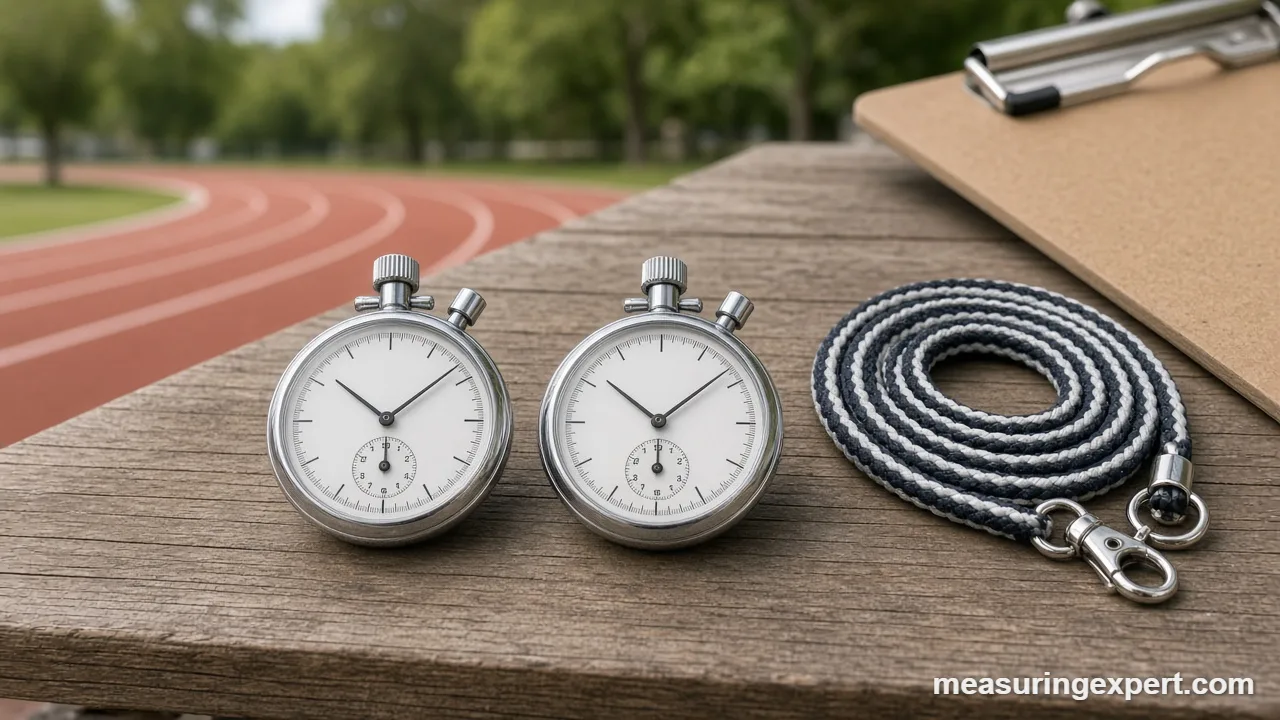
The best mechanical stopwatch for most buyers is the Hanhart 122-05S, a German-made 1/5 s addition stopwatch with a 30-minute register. Even so, the right choice depends on dial resolution, register length, split or addition functions, and whether you need the higher accuracy of a quartz digital.
In short: choose the Hanhart for a lifetime tool, the TFA Dostmann 38.1022 for a lower-cost branded wind-up, the SXJ505 for coaching, and the round-dial 0.2 s model as a budget starter.
As an Amazon Associate, Measuring Expert earns from qualifying purchases. Our picks are based on research, specifications and owner feedback, not paid placement.
Best Overall
Best Value Brand
Best Budget
Quick Answer: The Best Mechanical Stopwatch for Each Job
- Lifetime tool: Hanhart 122-05S, with a German addition movement and a 30-minute register.
- Branded value: TFA Dostmann 38.1022, with 13 jewels and a pause function.
- Coaching on the track: SXJ505 handheld, a classic sports pattern with a large dial.
- Long sessions: the boxed handheld model, which the seller rates at up to 6 hours per wind.
- Classroom labs: a handheld chronograph that shows reading error on a sweeping hand.
- Tight budget: the round-dial 0.2 s stopwatch with a 60-second sweep.
- Need 0.01 s or lap memory? buy a quartz digital instead; see our best stopwatch guide.
On This Page
- Comparison table
- The 6 picks, reviewed
- How we chose
- 1/5 s, 1/10 s and decimal-minute dials
- Registers, split hands and flyback
- Mechanical vs digital accuracy
- How to time an event
- Decimal minutes converter
- Winding and care
- Honest limits
- FAQ
- Bottom line
Best Mechanical Stopwatch Comparison Table
First, decide who will hold the stopwatch and how long your events run. Then, use the table to jump to each review. Note that this roundup covers wind-up models only, because few branded mechanical stopwatches are still sold on Amazon today.
| # | Image | Product | Best For | Standout Feature | Amazon |
|---|---|---|---|---|---|
| 1 |  | Hanhart 122-05S (1/5 s) | Officials and collectors | German-made addition movement with a 30-minute register | View |
| 2 |  | TFA Dostmann 38.1022 | Coaches and teachers | 13-jewel movement, crown start/stop, side reset | View |
| 3 | 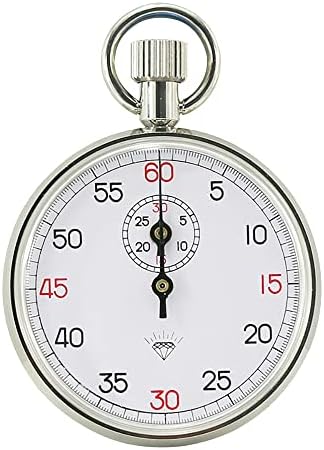 | SXJ505 Mechanical Stopwatch | Track and swim coaches | Classic SXJ sports-pattern handheld chronograph | View |
| 4 |  | Mechanical Stopwatch with Box | Referees and PE teachers | Storage box; listing quotes up to 6 hours per wind | View |
| 5 |  | Handheld Chronograph Stopwatch | Science classrooms | Analog sweep hand that makes elapsed time visible | View |
| 6 |  | Round-Dial 0.2 s Stopwatch | Beginners on a budget | 60-second sweep dial marked in 0.2 s steps | View |
The 6 Best Mechanical Stopwatch Picks, Reviewed
Each pick below fills a different role. So, read the “Best for” line first, and then compare the dial details with the events you time. Where a seller gives few specs, we say so plainly and tell you what to check.
Best Overall
1. Hanhart 122-05S Addition Stopwatch (1/5 s)
Best for: Officials, collectors and anyone who wants a serviceable German movement that will last decades.
The Hanhart 122-05S is our best mechanical stopwatch overall, and it is the only pick here from a maker that still builds stopwatch movements in Germany. Hanhart sells it as an “Additionsstopper”, which means addition or integration timing. In practice, you start, stop and restart the hand without a reset, so the dial adds up several runs into one total. That suits timing a game clock that stops for fouls, or a lab run with pauses.
On the measuring side, the main dial reads in 1/5 s steps, so each tick is 0.2 s. Meanwhile, a small register counts up to 30 minutes. According to Hanhart’s catalog page for the 122 addition stopwatch, the movement uses a pin-lever escapement with 7 jewels in a chrome-plated brass case 55 mm (2.2 in) wide. It weighs 120 g (4.2 oz), so it sits solidly in the palm. In addition, Hanhart describes the case as protected against shock, dust and water, though it gives no formal rating.
- Dial resolution: 1/5 s (0.2 s)
- Minute register: 30 minutes
- Function: addition (start, stop, restart, then reset)
- Movement: pin-lever escapement, 7 jewels
- Case: chrome-plated brass, 55 mm (2.2 in), 120 g (4.2 oz)
Pros
- Genuine German stopwatch maker with service support
- Addition function totals interrupted runs
- Heavy brass case and clear 30-minute register
Cons
- Costs far more than every other pick
- No split hand for lap times
- 1/5 s steps are coarser than a 1/10 s dial
Skip it if: you need lap or split times, or you only time a few sprints a year.
Best Value Brand
2. TFA Dostmann 38.1022 Mechanical Stopwatch
Best for: Coaches and teachers who want a branded wind-up stopwatch with documented specs at a moderate cost.
TFA Dostmann is a German instrument brand, and its 38.1022 is a classic two-control design. You press the crown to start and stop, and a side pusher resets the hand. Also, TFA notes that a time-out is possible, so you can pause the hand and then resume the same run. As a result, it works for interrupted timing in the same way as the Hanhart, at a much lower cost.
According to TFA’s product page, the movement has 13 jewels and reads in 1/5 s steps, with a maximum measuring time of 30 minutes. The stainless steel case is 50 mm (2 in) across and weighs 98 g (3.5 oz). Finally, it ships with a neck strap and a carry bag, which helps on a track infield.
- Dial resolution: 1/5 s (0.2 s)
- Measuring range: 30 minutes
- Controls: crown start/stop, side reset pusher, time-out
- Movement: 13 jewels, hand-wound
- Case: stainless steel, 50 mm (2 in), 98 g (3.5 oz)
Pros
- Clear, published specs from the maker
- Time-out lets you pause and resume
- Lanyard and bag included
Cons
- Only 30 minutes per run
- No split hand
- Stock can be patchy on Amazon
Skip it if: you time events longer than 30 minutes or need lap splits.
Best for Coaches
3. SXJ505 Handheld Mechanical Stopwatch
Best for: Track and swim coaches who want a classic sports-pattern wind-up timer without paying collector prices.
The SXJ505 follows the familiar sports stopwatch pattern: a large seconds dial, a smaller minute register and a crown that winds the spring and works the hand. For a coach, that layout is quick to read at arm’s length, because the sweep hand shows motion even from the side of a lane. However, the listing gives few hard specs, so treat it as a practical trainer rather than a reference instrument.
Before you rely on it, check two things on arrival. First, count the dial graduations between 0 and 1 to confirm whether it reads in 1/5 s or 1/10 s. Next, run it beside a phone clock for 10 minutes and note the gap. For the full method, see the how-to steps later in this guide. If it drifts by more than a second or two over that span, ask for an exchange.
- Type: hand-wound mechanical, no battery
- Format: handheld sports chronograph
- Model code: SXJ505 (per listing)
Pros
- No battery to die mid-meet
- Classic large dial reads well at a distance
- Much cheaper than European brands
Cons
- Few published specs from the seller
- Unknown service support
- Accuracy varies from unit to unit
Skip it if: you need a traceable calibration certificate or a known-brand warranty.
Best for Long Sessions
4. Handheld Mechanical Stopwatch with Storage Box
Best for: Referees and gym teachers who time several events per session and want a case for the bag.
This handheld model stands out for two listing details. First, it ships in a storage box, which protects the crystal and crown in a kit bag. Second, the seller states that it runs for up to 6 hours, which suggests a full wind can cover a long training block. For context, NIST lists 3 hours as a typical minimum run for a mechanical stopwatch between windings, so 6 hours would be generous.
Still, those are seller claims, not maker data, so test the run time yourself. Wind it fully, start it, and check the hand after a few hours. Also, confirm the dial graduation and the size of the minute register before a real event. In short, it is a practical box-and-go timer for referees, as long as you verify it first.
- Type: hand-wound mechanical, no battery
- Run time: up to 6 hours per wind (seller claim)
- Storage box included
Pros
- Storage box protects it between uses
- Long run per wind, per the seller
- No batteries to carry
Cons
- Specs come from the seller, not a maker
- No brand service network
- Box adds bulk in a small bag
Skip it if: you want maker specs and a service network, or a pocket-size timer.
Best for Classrooms
5. Handheld Chronograph Mechanical Stopwatch for Sports
Best for: Science teachers who want students to see time pass on a sweeping hand, for example in pendulum labs.
An analog stopwatch teaches something a digital display hides. Students can watch the hand sweep, so they see that time is continuous and that a reading falls between marks. As a result, this kind of handheld chronograph suits pendulum and free-fall labs, where the lesson is partly about measurement error. It also needs no batteries, so a class set stays ready in a drawer.
The listing describes it simply as a handheld chronograph timer for sports. Therefore, check the dial resolution when it arrives, and teach students to read to the nearest graduation. For instance, on a 1/5 s dial, the honest reading is to the nearest 0.2 s. For a related lab, see our guide on how to measure the speed of sound.
- Type: hand-wound mechanical, no battery
- Format: handheld chronograph
- Use: sports and general timing (per listing)
Pros
- Visible sweep hand helps teach reading error
- No batteries for a class set
- Simple crown operation
Cons
- Thin listing details
- No lap or split memory
- Unit-to-unit accuracy can vary
Skip it if: students need lap memory or 0.01 s readings for a lab report.
Best Budget
6. Round-Dial 0.2 s Mechanical Stopwatch (60-Second Dial)
Best for: Beginners and hobbyists who want the simplest wind-up timer with a 60-second sweep and 0.2 s marks.
This round-dial stopwatch is the simplest pick and the easiest to read. Its listing states a 60-second main dial marked in 0.2 s steps, which is the classic 1/5 s layout. So one full sweep equals one minute, and each small mark equals one fifth of a second. That is plenty for timing intervals, rest periods or a resting heart rate count.
Because the listing gives few other details, look closely at the minute register and the crown when it arrives. Also, wind it gently until you feel firm resistance, and never force it past that point. If you mainly want to learn how a mechanical stopwatch works, this is a low-risk place to start.
- Main dial: 60 seconds per sweep (per listing)
- Resolution: 0.2 s (1/5 s) marks
- Type: hand-wound mechanical, no battery
Pros
- Classic 1/5 s dial is easy to learn
- Lowest-cost way into mechanical timing
- No battery needed
Cons
- Few published specs
- Unknown long-term durability
- No split or addition function listed
Skip it if: you need decimal-minute readings or a brand-backed warranty.
How We Chose the Best Mechanical Stopwatch
We did not run hands-on tests. Instead, our picks are research-based. First, we searched for wind-up stopwatches that are actually in stock on Amazon, and we checked that each listing still loads. Next, we read maker pages where they exist, such as the Hanhart and TFA Dostmann catalogs. Then, we compared those specs with the stopwatch guidance in NIST Special Publication 960-12.
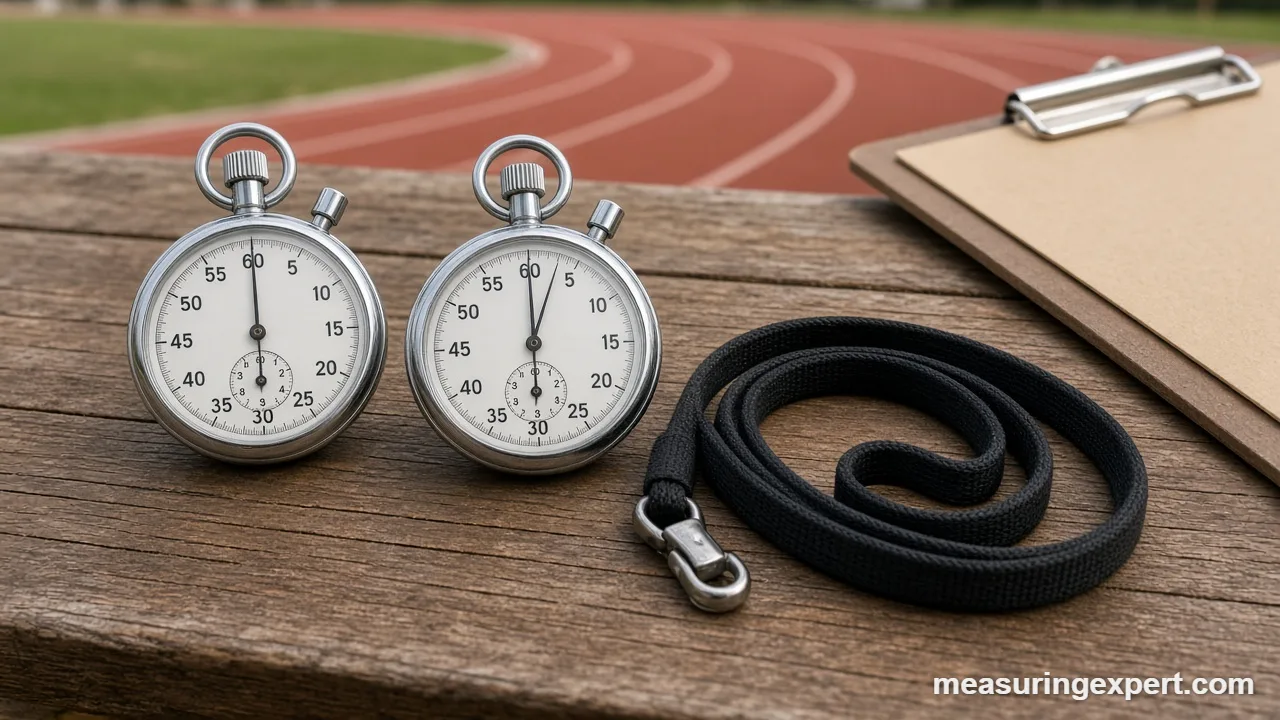
We weighed five things. Specifically, we looked at dial resolution, register length, special functions such as addition or split timing, build and service support, and how clearly the seller documents the product. In addition, we cut any listing that was really a quartz digital in a retro case, because those are not mechanical. Finally, we kept the list short, since branded mechanical stopwatches are now a niche item and only a handful render on Amazon. As a result, this roundup has fewer picks than our usual ten.
Notably, several big stopwatch names now sell almost only digital models. For example, current Ultrak and Accusplit stopwatches on Amazon are quartz units with lap memory. We cover those in our separate guide to the best stopwatch, so this page sticks to spring-driven movements.
Reading the Dial: 1/5 s, 1/10 s and Decimal Minutes
A mechanical stopwatch cannot show a finer step than its balance wheel beats. That is the key fact behind every dial. According to NIST, a common analog stopwatch balance oscillates 2.5 times per second, which produces 5 ticks per second. So the hand jumps in 1/5 s (0.2 s) steps, and the dial carries five marks per second.
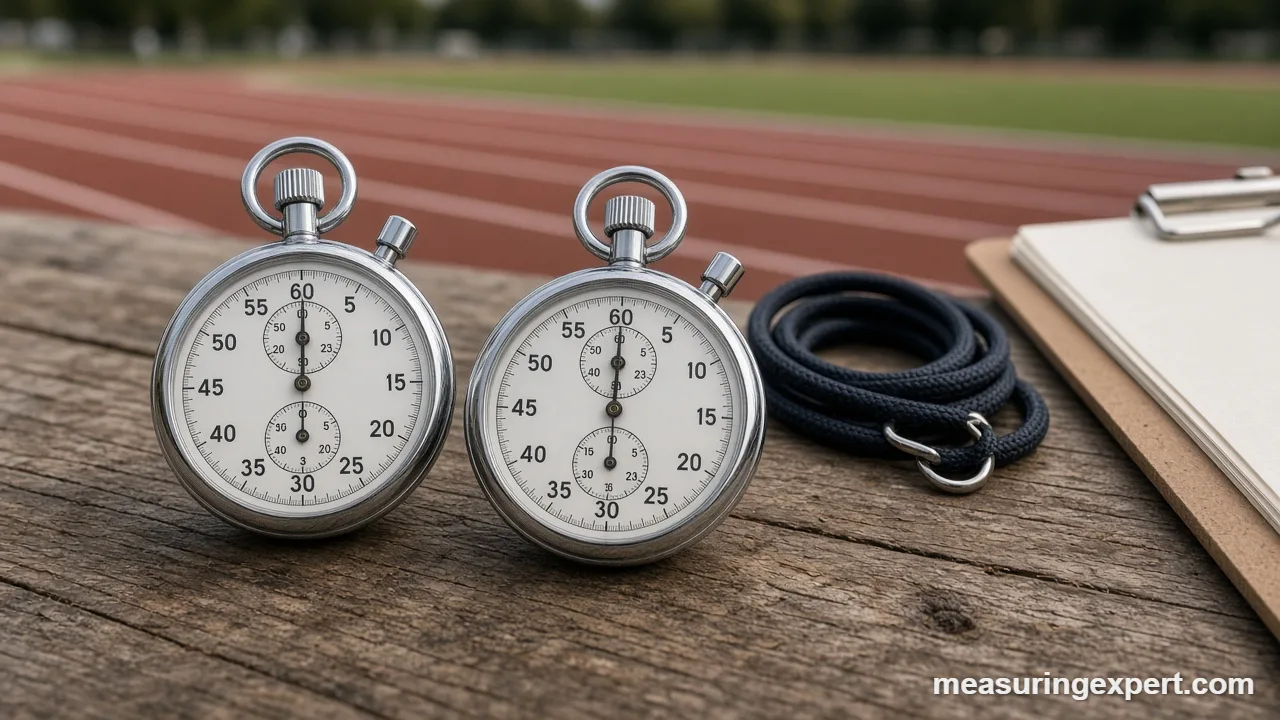
A 1/10 s stopwatch, by contrast, needs a balance that beats twice as fast, at 10 ticks per second. Therefore, it resolves 0.1 s, but the faster balance runs down the spring sooner and costs more to make. Hanhart, for instance, still lists a crown-operated 1/10 s model with pulse and breathing scales for medical use.
A decimal-minute dial works differently. Instead of 60 seconds, the main dial is split into 100 parts of a minute. Each mark therefore equals 0.01 min, or 0.6 s. Industrial engineers used these dials, often on Heuer-style and Hanhart-style stopwatches, for time-and-motion studies, because decimal minutes add and average without base-60 math. If you buy a vintage decimal stopwatch, use the converter below to translate readings into seconds.
| Dial type | Smallest step | Ticks per second | Typical use |
|---|---|---|---|
| 1/5 s (60-second dial) | 0.2 s | 5 | Sports, general timing, refereeing |
| 1/10 s (30- or 60-second dial) | 0.1 s | 10 | Sprints, motorsport, medical pulse counts |
| Decimal minute (1/100 min) | 0.01 min = 0.6 s | Varies by movement | Industrial time study, work sampling |
Minute Registers, Split Hands, Addition and Flyback
The small subdial is the minute register, and it sets your longest single run. A 30-minute register counts half an hour before it starts over, while a 60-minute register covers a full hour. So, for a 5K run or a half of youth soccer, 30 minutes is enough. However, for a long lab session or a full meeting, look for 60 minutes. Some stopwatches also add an hour counter.
Next, check the timing functions, because the names can confuse buyers:
- Single action: one button starts, stops and resets in turn. It is the simplest layout.
- Addition (integration): start, stop and restart without a reset, so the hand totals several runs. Hanhart and TFA both offer this.
- Split hand (rattrapante): a second hand rides over the first. Press the split button to freeze it for a lap, and press again so it jumps back and catches up.
- Flyback: one press resets the hand to zero and restarts it at once, which suits back-to-back heats.
In short, a split hand is the only mechanical way to read a lap while the main run continues. Meanwhile, addition timing suits stop-start games. To work out a pace from a lap time, our 8-minute mile guide shows the math.
Why a Digital Beats the Best Mechanical Stopwatch on Accuracy
Even the best mechanical stopwatch loses to an inexpensive quartz digital on raw accuracy. The reason is the time base. A quartz stopwatch counts a crystal that vibrates at 32,768 Hz, while a mechanical one counts a balance wheel at a few beats per second. As a result, the quartz unit has finer resolution and far less drift.
The numbers in NIST SP 960-12, Stopwatch and Timer Calibrations make the gap clear:
- Resolution: analog stopwatches commonly resolve 0.2 s, while digitals commonly show 0.01 s.
- Drift: in a NIST sample, about 70 percent of quartz watches kept time within 1 s per day.
- Tolerance: NIST Handbook 105-5 sets a stopwatch tolerance of plus or minus 0.02 percent, about 2 s over a 3-hour test.
- State rules: one state code NIST cites allows 15 s per 24 hours for mechanical units but only 9 s for quartz.
Still, the human thumb often matters more than either movement. NIST found that operator reaction errors usually averaged within 100 ms, with worst cases above 700 ms. On a 10-second sprint, a 0.1 s reaction error is already 1 percent. Therefore, for short events, your technique decides the result more than the dial does. For longer events, however, the movement’s drift starts to dominate.
How to Time an Event With a Mechanical Stopwatch
- Wind the crown gently until you feel firm resistance, and then stop.
- Press reset so both the seconds hand and the minute register sit at zero.
- Rest your thumb on the crown or start pusher, and watch the start signal, not the athlete.
- Press firmly at the signal, then follow the event instead of the dial.
- Stop on the finish, and keep your eye level with the dial to avoid parallax.
- Read the minute register first, then the seconds hand to the nearest mark.
- Write the time down before you reset, and note the dial resolution next to it.
Also, practice with a known time signal before a real event. For example, start and stop on a phone clock’s minute change ten times, and note how far off you are. That simple drill shows your personal reaction error.
Decimal Minutes to Seconds Converter
Use this converter for decimal-minute dials, or to turn any reading into seconds or hours. For instance, a reading of 0.25 min on a decimal dial equals 15 s.
Winding and Care for Your Best Mechanical Stopwatch
A spring-driven stopwatch needs a little routine, but it rewards you with decades of use. NIST notes that a mechanical stopwatch should typically run at least three hours without rewinding, so a full wind before each session is enough. Above all, never force the crown past firm resistance.
For servicing, a watchmaker can clean and adjust the movement every few years. In contrast, cheap unbranded movements are rarely worth a full service, so treat them as replaceable. Meanwhile, a Hanhart can go back to its maker.
Honest Limits of Wind-Up Timing
A mechanical stopwatch is charming, durable and battery-free. However, it has limits you should accept before you buy:
- It cannot store laps, so you must write each split down by hand.
- Its best resolution is usually 0.1 s or 0.2 s, never 0.01 s.
- Its rate can change with position, temperature and how fully it is wound.
- Low-cost listings rarely publish specs, so quality varies widely.
So, if a result decides a qualifying time or a lab grade, use a quartz digital or an electronic timing system. On the other hand, for practice, refereeing or simple enjoyment of a fine instrument, a wind-up stopwatch is a fine choice.
Best Mechanical Stopwatch FAQ
What is the best mechanical stopwatch for most people?
The Hanhart 122-05S is our top pick. It has a German addition movement, a 1/5 s dial and a 30-minute register, and its maker still services it.
Is a mechanical stopwatch as accurate as a digital one?
No. A quartz digital counts a 32,768 Hz crystal and commonly reads 0.01 s, while a mechanical stopwatch commonly reads 0.2 s and drifts more over a day.
What does 1/5 second mean on a stopwatch dial?
It means the hand moves in 0.2 s steps, so each second has five marks. The balance wheel beats five times per second to produce those steps.
Is a 1/10 second mechanical stopwatch better than 1/5 second?
It reads twice as finely, at 0.1 s. However, the faster balance usually costs more, and human reaction time still adds about 0.1 s of error.
What is a decimal-minute stopwatch?
Its dial splits one minute into 100 parts, so each mark is 0.01 min, or 0.6 s. Industrial engineers used it because decimal minutes are easy to add and average.
What is a split hand on a stopwatch?
A split hand, or rattrapante, is a second hand that you can freeze for a lap while the main hand keeps running. Press again and it jumps back to catch up.
How long does a mechanical stopwatch run on one wind?
NIST lists a typical minimum of three hours without rewinding. Some sellers claim longer runs, so wind fully before each session to be safe.
Does the best mechanical stopwatch need batteries?
No. A wound mainspring powers it, so it never needs a battery. That makes it handy in cold weather and remote places where batteries fail.
How do I check my stopwatch accuracy at home?
Start and stop it against a trusted time signal, such as an online atomic clock, over at least an hour. Then divide the difference by the elapsed time to get the error.
Can I still buy a Heuer mechanical stopwatch?
New Heuer stopwatches are no longer common, so most are vintage pieces sold by collectors. For a new wind-up stopwatch from a heritage maker, look at Hanhart instead.
Bottom Line on the Best Mechanical Stopwatch
For a stopwatch that will outlast its owner, the Hanhart 122-05S is the one to get. It pairs a 1/5 s dial and a 30-minute register with an addition function, and Hanhart still services its movements. If the cost is too high, the TFA Dostmann 38.1022 is the sensible branded alternative, while the SXJ505 and the round-dial 0.2 s model cover casual coaching and practice. Finally, if your results must hold up to 0.01 s, choose a quartz digital instead.
Black Friday is coming: shop the deals with Prime
1 thought on “Best Mechanical Stopwatch for 2026: Wind-Up Picks, Dials and Accuracy Explained”