

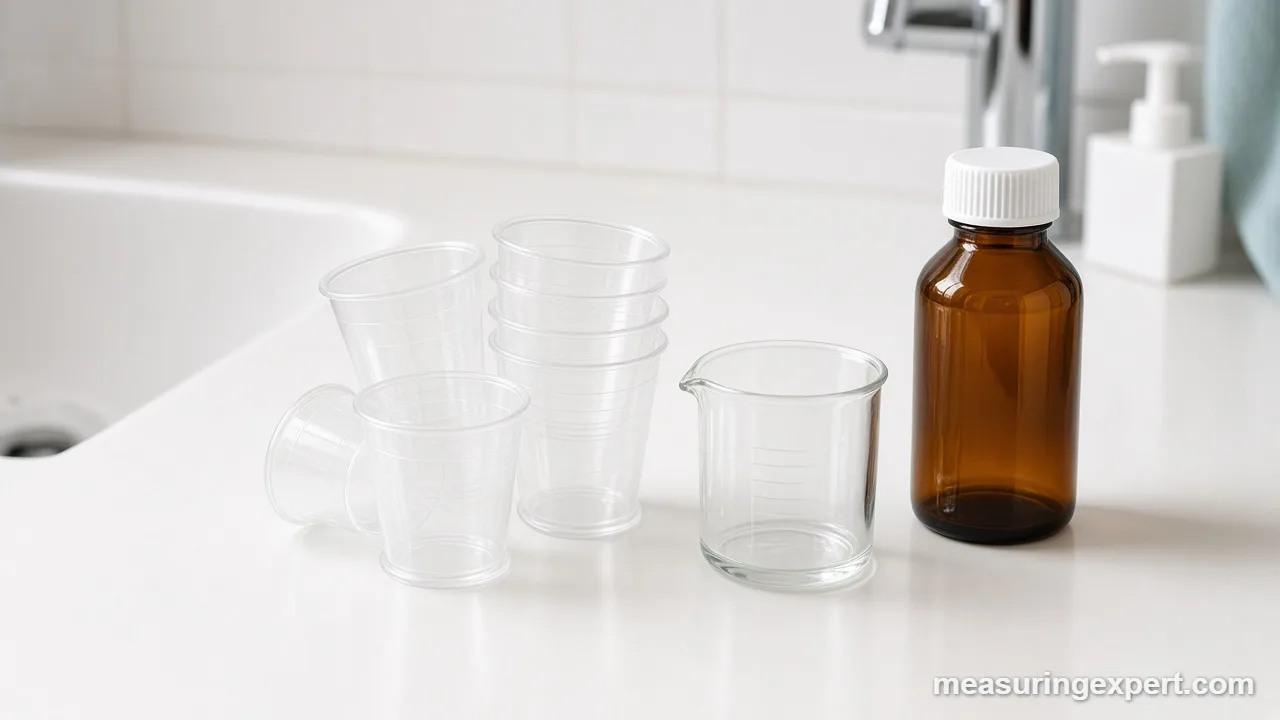
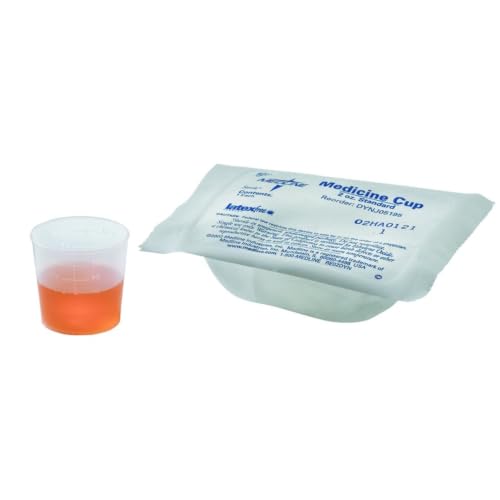
The best dose measuring cup is the one packed with your medicine. For a spare, the Dynarex 4258 is our top pick: a clear 1 oz (30 mL) cup with easy-to-read mL and cc lines. What decides the choice is clear mL markings, a size close to the amount you measure, and whether you need sterile, bulk or reusable.
In short: grab Dynarex or ReliMedPro cups as spares, a dosing spoon for older kids, and keep reusable kitchen minis for cooking only.
As an Amazon Associate, Measuring Expert earns from qualifying purchases. Our picks are based on research, specifications and owner feedback, not paid placement.
Best Overall

Best Budget

Best Sterile
Best Dose Measuring Cup Picks by Need
- Overall: Dynarex 4258, a clear 1 oz cup with mL and cc lines.
- Budget: ReliMedPro 100-pack, the same 30 mL format for less per cup.
- Sterile: Medline 2 oz sterile cup for clinical tasks.
- Bulk: Perfect Stix box of 2,000 for care homes and crafters.
- Reusable: OXO Mini Angled cup, read from above (kitchen use).
- Glass: King Arthur Mini Measure for recipes.
- Flexible: iSi Flex-it silicone cup for thick liquids.
On This Page
- Comparison table
- The picks, reviewed
- How we chose
- Why mL markings matter
- Cup, spoon or syringe
- Reading a 30 mL cup
- How to measure with a cup
- mL converter
- Cleaning and reuse
- Do and don’t
- Honest limits
- FAQ
- Bottom line
Side-by-Side Comparison
First, decide whether you need a medicine cup, a dosing spoon or a kitchen mini measure. Then use the table to jump to the full review.
| # | Product | Best For | Standout Feature | Amazon |
|---|---|---|---|---|
| 1 | Dynarex 4258 Medicine Cup | Home medicine cabinets and caregivers who want spare graduated cups | Easy-to-read cc and mL lines | View |
| 2 | ReliMedPro Medicine Cups | Families who want a stack of disposable graduated cups | Graduated 30 mL cups, 100 per pack | View |
| 3 | Medline Sterile 2 oz Cup | Wound care, clinics and anyone who needs a sterile cup | Sterile, 2 oz capacity | View |
| 4 | Perfect Stix Medicine Cups | Care homes, busy households and resin crafters who go through cups quickly | Bulk box of 2,000 graduated cups | View |
| 5 | OXO Mini Angled Measuring Cup | Supplements, cooking and anyone who wants a reusable small cup | Read the lines from above | View |
| 6 | King Arthur Mini Measure | Bakers and home cooks who want a heavy glass mini measure | Heavyweight glass, liquid and dry | View |
| 7 | iSi Flex-it Mini Measuring Cup | Pouring thick liquids such as honey or syrup without spills | Squeezable silicone body | View |
The 7 Best Dose Measuring Cup Picks, Reviewed
Note that the first four picks are medical cups. After that come reusable kitchen minis, which are great for recipes but are not medicine devices.
Best Overall
1. Dynarex 4258 Medicine Cup, 1 oz
Best for: Home medicine cabinets and caregivers who want spare graduated cups.
The Dynarex 4258 is the classic clear 1 oz plastic medicine cup that you see in clinics, sold here in a pack of 100. Dynarex is a long-standing medical supply brand, and the listing calls out easy-to-read cc and mL graduations. Because 1 cc equals 1 mL, both scales point to the same volume, so there is no unit to convert.
In short, this is the spare cup to keep next to the bottle when the original cup goes missing. However, it is still a general cup. So if your medicine came with its own device, use that one first. In addition, a 30 mL cup is coarse for small amounts, so pair it with an oral syringe when the label asks for only a few milliliters.
- Capacity: 1 oz (about 30 mL)
- Scales: cc and mL graduations
- Pack size: 100 cups
- Made by: Dynarex, a medical supply brand
Pros
- Clear mL and cc lines
- Pack of 100 covers months of use
- Familiar clinic-style shape
Cons
- Printed lines are coarse for small amounts
- Single-use plastic adds waste
Skip it if: you only need one or two cups, or the dose is a small fraction of a milliliter.
Best Budget
2. ReliMedPro Disposable Medicine Cups, 1 oz (30 mL), 100 Pack
Best for: Families who want a stack of disposable graduated cups.
ReliMedPro sells the same 1 oz (30 mL) graduated cup format in a 100-pack, with bigger packs also available. As a result, it is an easy way to keep a clean cup for every bottle in the house. The cups suit liquid medicine, mouthwash and sorting pills for the day.
Also, a fresh cup for each use avoids washing and cross-contamination between products. On the other hand, the graduations on any 30 mL disposable cup are spaced for whole milliliters or more, so they suit larger amounts better than tiny ones. For that reason, keep an oral syringe nearby for small volumes.
- Capacity: 1 oz (30 mL)
- Graduated plastic cup
- Pack size: 100 (larger packs listed)
- Uses: liquids, pills, mouthwash
Pros
- Low cost per cup
- Same 30 mL format as clinic cups
- Easy to keep one per medicine
Cons
- Not as well known as Dynarex or Medline
- Disposable, so more plastic waste
Skip it if: you prefer a reusable cup you can wash and keep.
Best Sterile
3. Medline Sterile Graduated Plastic Medicine Cup, 2 oz
Best for: Wound care, clinics and anyone who needs a sterile cup.
Medline is one of the largest US medical suppliers, and this 2 oz cup comes sterile, which is unusual for a medicine cup. The listing describes it as sturdy, durable and single-use, sold as a case of 100. Moreover, the larger 2 oz size gives more headroom for liquid and dry medication.
Still, a sterile cup matters most for clinical tasks, such as holding saline for wound care. For a bottle of cough syrup at home, a non-sterile cup works fine. In addition, the bigger cup spreads its lines further apart at the top, so it is not a better choice for small amounts.
- Capacity: 2 oz (about 60 mL)
- Sterile, single-use
- Graduated plastic
- Case of 100
Pros
- Sterile from the pack
- Twice the capacity of a standard cup
- Trusted medical brand
Cons
- Overkill for everyday home use
- Single-use by design
Skip it if: you just need a spare cup for over-the-counter syrups at home.
Best Bulk
4. Perfect Stix Graduated Plastic Medicine Cups, 1 oz, 2000 Count

Best for: Care homes, busy households and resin crafters who go through cups quickly.
Perfect Stix specializes in disposable supplies, and this box holds 2,000 graduated 1 oz plastic cups. The listing names mixed pills, medication measuring, resin mixing and mouthwash as uses. As a result, it suits a care facility, a school nurse office or a crafter who mixes small batches of resin every day.
However, 2,000 cups is far more than most households will ever use. Similarly to the other 30 mL cups here, the lines work best for amounts of several milliliters. So small liquid doses still call for an oral syringe.
- Capacity: 1 oz (about 30 mL)
- Graduated plastic
- Box of 2,000 (a 5,000 box is also listed)
- Uses listed: pills, medicine, resin, mouthwash
Pros
- Low cost per cup in bulk
- Same 1 oz format as clinic cups
- Handy for crafts as well as medicine
Cons
- Huge box for a small home
- Lesser-known brand than Dynarex or Medline
Skip it if: you need fewer than a few hundred cups a year.
Best Reusable
5. OXO Good Grips Mini Angled Measuring Cup, 2 oz

Best for: Supplements, cooking and anyone who wants a reusable small cup.
The OXO Mini Angled Measuring Cup holds 2 oz, and its angled ramp lets you read the markings from above while you pour. According to OXO, that means you do not have to bend down or lift the cup to eye level. As a result, it is the easiest reusable small cup to read on a busy counter.
However, this is a kitchen tool, not a medicine device. So keep it for recipes, liquid supplements or the herbal syrups you make yourself, and still use the device that came with any medicine. For more reusable options, our herbal measuring cup guide covers sets for tinctures and teas.
- Capacity: 2 oz (about 60 mL)
- Angled ramp read from above
- Reusable plastic cup
- Brand: OXO Good Grips
Pros
- No crouching to read the line
- Reusable for years
- Sturdy, easy-grip shape
Cons
- Kitchen tool, not a medicine device
- Lines are hard to read at the very bottom
Skip it if: you need a cup for medicine that came with its own device.
Best Glass
6. King Arthur Baking Company Mini Measure Shot Glass, Set of 2

Best for: Bakers and home cooks who want a heavy glass mini measure.
King Arthur Baking Company sells this mini measure as a heavyweight glass shot glass with measuring lines, packed as a set of 2. The listing says it handles liquid and dry ingredients for precise recipe prep. Because glass does not stain or hold odors, it is a good pick for vanilla, oils and strong flavors.
Also, a heavy base keeps the glass steady on a flat counter, which helps when you read the line at eye level. Even so, it belongs in the kitchen drawer rather than the medicine cabinet. In short, buy it for cooking, and keep medicine with its own device.
- Material: heavyweight glass
- Set of 2
- For liquid and dry ingredients
- Brand: King Arthur Baking Company
Pros
- Glass resists stains and smells
- Heavy base stays put
- Two glasses in the set
Cons
- Breaks if dropped
- Not a medicine device
Skip it if: you want something unbreakable for a kid-friendly kitchen.
Best Flexible
7. iSi Flex-it Silicone Mini Measuring Cup, 2 oz

Best for: Pouring thick liquids such as honey or syrup without spills.
iSi is a long-running Austrian kitchen brand, and its Flex-it mini measuring cup holds 2 oz in a soft silicone body. You can pinch the rim into a spout and pour cleanly, which is handy with thick liquids such as honey and syrup that cling to rigid cups. Our guide to measuring volume in mL explains why the unit matters as much as the cup.
On the other hand, a soft cup can flex while you hold it, which changes the level. Therefore, set it on a flat surface before you read the line. For medicine, the same rule applies as with any kitchen measure: use the device that came with the bottle.
- Capacity: 2 oz (about 60 mL)
- Material: silicone
- Squeezable rim for pouring
- Brand: iSi
Pros
- Pinch spout for clean pours
- Will not shatter
- Easy to scrape out thick liquids
Cons
- Flexes if you hold it while reading
- Not a medicine device
Skip it if: you need rigid walls for steady readings in your hand.
How We Chose the Best Dose Measuring Cup Picks
To be clear, we did not run hands-on tests. Instead, our picks are research-based. First, we listed graduated cups, dosing spoons and mini measures from established medical and housewares brands. Next, we checked each listing for capacity, scale units and material, and we kept only facts we could confirm. Then we read owner feedback for common complaints, such as faded print or flimsy walls.
In addition, we followed public guidance. The American Academy of Pediatrics, through its HealthyChildren.org page on liquid medicines, tells parents to use the dosing tool that comes with the medicine and to prefer mL. We also read the FDA guidance on dosage delivery devices for over-the-counter liquid drugs, which covers calibrated cups, droppers, syringes and spoons.
- Clear mL lines that stay readable once liquid is in the cup.
- Right-sized capacity, mostly 30 to 60 mL.
- Known brands with a track record in medical or kitchen gear.
- Distinct uses, so each pick solves a different problem.
Why mL Markings Matter More Than the Cup
Above all, the unit on the cup has to match the unit on the label. The FDA guidance says device markings should use the same units as the directions, with standard abbreviations such as “mL.” It also asks makers to avoid extra markings that could confuse people, and to keep the device close in size to the largest labeled dose.
Likewise, the AAP advice is direct: never use household teaspoons or tablespoons for medicine. Kitchen spoons vary a lot in size, so a “teaspoon” from a drawer is a guess. As a result, the safest habit is simple. Use the device that came with the medicine, and if none came with it, ask your pharmacist for one marked in mL.
Cup, Spoon or Syringe: Which Best Dose Measuring Cup Type Fits?
Each device has a sweet spot. So the right one depends on the amount you measure and on who takes it. Here is how the common types compare.
| Device | Typical capacity | Strength | Weak spot |
|---|---|---|---|
| Graduated medicine cup | 30 to 60 mL | Fast to fill and easy to drink from | Coarse for small amounts |
| Dosing spoon (tube) | Up to about 10 mL | Tall column, easy for older kids | Spills with squirmy toddlers |
| Oral syringe | 1 to 10 mL | Usually the most accurate, per the AAP | Takes practice; caps are a choking risk |
| Kitchen mini measure | About 30 to 90 mL | Reusable for recipes | Not a medicine device |
In short, the AAP page notes that oral syringes are usually the most accurate option, especially below 5 mL. For that reason, many families keep both a cup and a syringe. Our guide to the best dosage syringe compares oral syringes for kids and pets.
Reading a 30 mL Cup: Lines, Meniscus and Resolution
A medicine cup is a small graduated cylinder with sloped walls. So the same reading rules apply. First, set the cup on a flat, level surface. Next, crouch until your eye is level with the line you want. Finally, read the bottom of the curved liquid surface, called the meniscus, against the line.
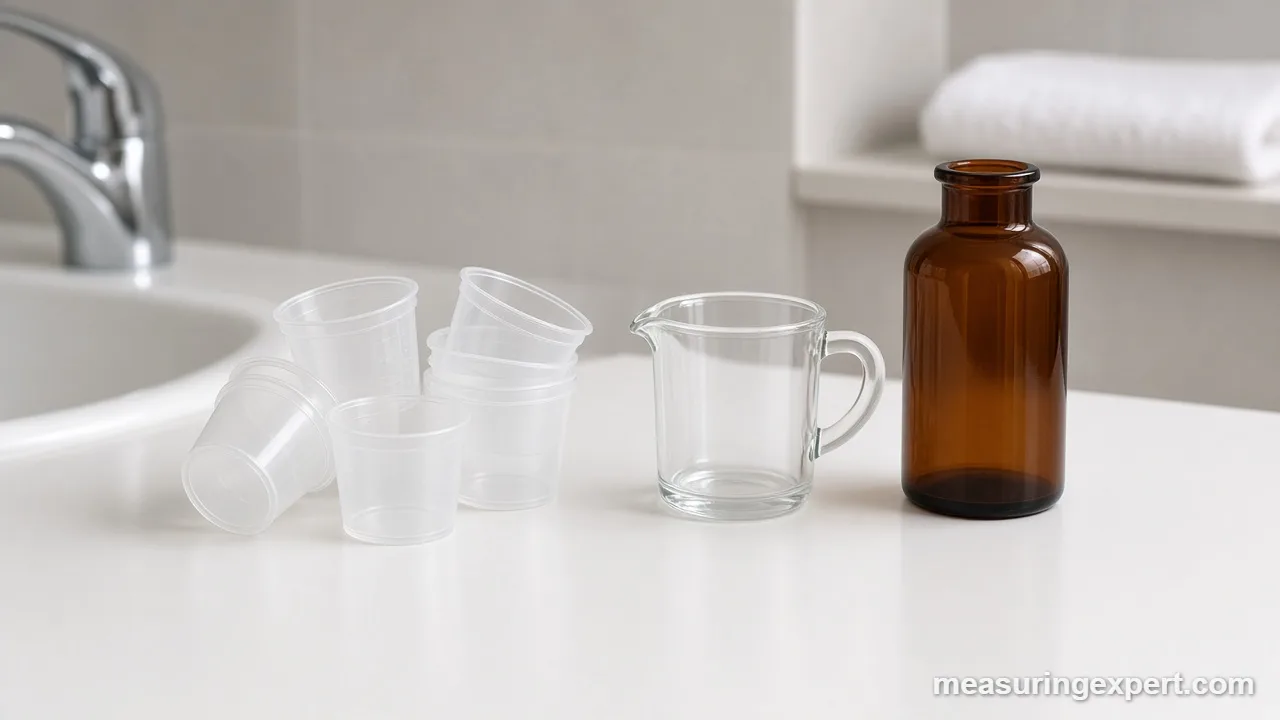
Resolution is the gap between two lines. On a wide cup, that gap covers more volume, so a small tilt or a misread changes the amount more. In contrast, a narrow spoon or syringe stretches each milliliter over more height. That is why a 30 mL cup suits larger amounts, while small amounts belong in a syringe.
The cc and mL Scales Are the Same
Many cups print both cc and mL. One cubic centimeter equals one milliliter exactly, so the two scales line up. Some cups also show ounces, teaspoons or tablespoons. However, the FDA guidance warns against extra markings, so focus only on the mL scale.
How to Use the Best Dose Measuring Cup Step by Step
These steps cover the measuring side only. Instead, your doctor or pharmacist decides the amount.
- Check the label and confirm the amount in mL with your pharmacist if anything is unclear.
- Pick the device that came with the medicine, or else a clean cup marked in mL.
- Shake the bottle if the label says so, then set the cup on a flat, level surface.
- Pour slowly and stop a little below the line, then add the rest drop by drop.
- Bend down so your eye is level with the line and read the bottom of the meniscus.
- After the dose, rinse the cup and store it with that medicine only.
Also, note the time after each dose on a chart. That way, two caregivers will not repeat it by mistake.
mL, Teaspoon and Ounce Converter
Older labels and recipes sometimes say “tsp” or “oz.” Use this converter only to understand those units, and still measure medicine in mL with its own device. A US teaspoon is about 4.93 mL, and a US fluid ounce is about 29.57 mL, so a “1 oz / 30 mL” cup rounds slightly. For background, see what tsp means.
Cleaning, Reuse and When to Toss a Dose Cup
First, follow the maker’s intent. Disposable cups, such as the Medline sterile cup, are single-use by design, so throw them out after one use. Reusable cups and spoons, on the other hand, need a rinse in warm water and mild soap right after use, then a full air-dry.
Next, replace any cup whose lines have faded or whose walls have cracked. Also, keep one device per medicine, and never move a cup from resin or paint back to medicine. Finally, store cups with lids or in a clean bag so dust stays out.
Medicine Cup Do and Don’t
What a Best Dose Measuring Cup Cannot Do
Of course, even the best dose measuring cup cannot fix a wrong amount on a label or a misread decimal. In addition, a wide 30 mL cup is simply coarse for small volumes, so its lines cannot resolve fractions of a milliliter. Similarly, thick syrups cling to the walls, so some liquid stays behind after you pour. Moreover, printed lines can sit slightly off on cheap cups. For that reason, the device that came with the medicine remains the reference.
Best Dose Measuring Cup FAQ
What is the best dose measuring cup for liquid medicine?
The best dose measuring cup is the one that came with your medicine. For a spare, the Dynarex 4258 is our pick because it has clear mL and cc lines. Even so, check the label and ask your pharmacist which device to use.
Is 30 mL the same as 1 ounce?
Almost. One US fluid ounce is about 29.57 mL, so cups labeled 1 oz / 30 mL round the value slightly. For medicine, read the mL scale and ignore the ounce marks.
How do I read a dose measuring cup accurately?
Set the cup on a flat, level surface, bring your eye level with the line, and read the bottom of the curved liquid surface. Do not hold the cup in the air while you read it.
Is a cup or an oral syringe more accurate?
According to the AAP advice on HealthyChildren.org, an oral syringe is usually the most accurate option, especially for amounts under 5 mL. A cup works well for larger amounts.
Why should I measure medicine in mL?
The AAP recommends mL because it removes the guesswork of teaspoons and tablespoons. In addition, FDA guidance asks that device markings match the units on the label.
Can I use a kitchen spoon instead of the best dose measuring cup?
No. The AAP advises never to use household teaspoons or tablespoons for medicine, because their size varies. Use the device that came with the medicine or ask a pharmacist for one.
Can I reuse a disposable medicine cup?
Disposable cups are made for single use, and sterile cups in particular should be thrown away after one use. If you want to wash and reuse a cup, choose a reusable one and keep it for one product.
What does cc mean on the best dose measuring cup?
Cc stands for cubic centimeter. One cc equals exactly one mL, so the cc and mL scales on a cup show the same volume.
Which best dose measuring cup size should I buy?
For most homes, a 1 oz (30 mL) cup covers everyday needs, and a 2 oz cup gives more headroom. For small amounts, a syringe or dosing spoon is the better tool.
Can I use a medicine cup for resin or paint?
Yes, graduated cups work well for small resin, epoxy and paint batches. However, label those cups for crafts and never use them for medicine afterward.
Bottom Line: Our Best Dose Measuring Cup Pick
For most homes, the Dynarex 4258 Medicine Cup is the best dose measuring cup to keep as a spare. It is clear, it reads in mL and cc, and a pack lasts for months. Still, the device that came with the medicine always comes first, and small amounts call for a syringe.