

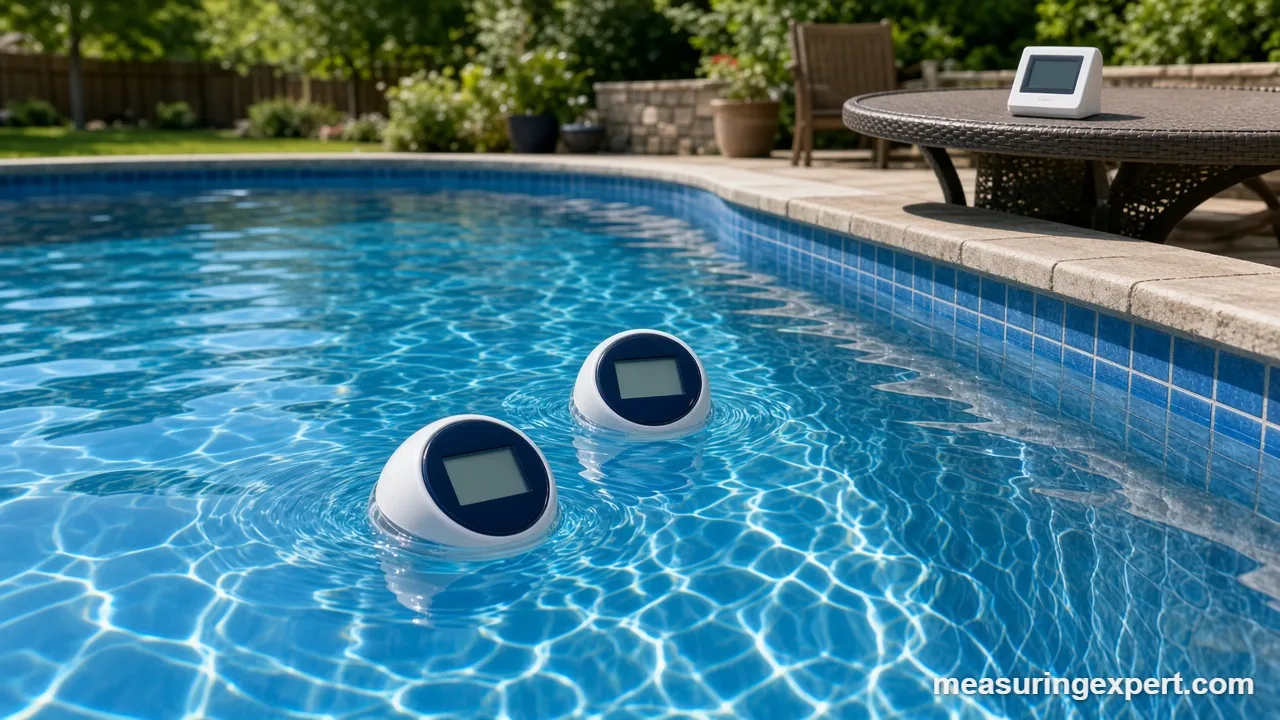
The best pool thermometer for most homes is the TempPro TempAir wireless model, because its floating sensor sends readings to a backlit indoor screen with a listed accuracy of 0.9 F. Your choice comes down to three things: where you want to read it, how precise it must be, and whether you need phone alerts.
In short: get the TempPro wireless for an indoor readout, the Inkbird for a pool plus a spa, the GoveeLife P1 for phone checks, and a Poolmaster pocket thermometer as a cheap backup.
As an Amazon Associate, Measuring Expert earns from qualifying purchases. Our picks are based on research, specifications and owner feedback, not paid placement.
Best Overall

Best Budget

Best Smart

Quick Answer: The Best Pool Thermometer by Need
- Read it from the kitchen: TempPro TempAir wireless, with a backlit indoor receiver.
- Pool plus hot tub on one screen: Inkbird wireless set, which shows up to three sensors.
- Check it from your phone: GoveeLife WiFi Pool Thermometer P1.
- Never change a battery: TempPro TempAir solar float.
- Zero electronics: Pentair R141036 analog tube thermometer.
- Cheap spot checks: Poolmaster 18305 pocket thermometer.
On This Page
- Comparison table
- The 7 picks, reviewed
- How we chose
- Floating, wireless or Wi-Fi
- Specs that matter
- Hot tub safety and the 104 F limit
- How to read pool temperature
- F to C converter
- Care and accuracy checks
- Honest limits
- FAQ
- Bottom line
Best Pool Thermometer Comparison Table
First, decide where you want to see the number: at the pool, on a counter, or on a phone. That single choice narrows the best pool thermometer for you more than any spec. Then, scan the table and jump to the review that fits.
| # | Product | Best For | Standout Feature | Amazon |
|---|---|---|---|---|
| 1 | TempPro TempAir Wireless Pool Thermometer | Most pool owners | Floating sensor plus backlit indoor receiver | View |
| 2 | Inkbird Wireless Pool Thermometer with Indoor Receiver | Pool plus hot tub | One receiver can show up to 3 sensors | View |
| 3 | GoveeLife WiFi Pool Thermometer P1 | Phone checks and alerts | Wi-Fi link to a phone app | View |
| 4 | TempPro TempAir Solar Pool Thermometer | No battery swaps | Solar-charged built-in battery | View |
| 5 | Baldr Wireless Rechargeable Pool Thermometer | Dual large screens | Rechargeable with two large displays | View |
| 6 | Pentair R141036 Tube Thermometer | No batteries at all | Tube thermometer in an ABS case with a cord | View |
| 7 | Poolmaster 18305 Pocket Thermometer | Quick spot checks | Built-in water pocket holds the sample | View |
The 7 Best Pool Thermometer Picks, Reviewed
To start with, each pick below fills a different job, from a counter display to a plain analog float. So, read the “Best for” line first, and then match the specs to your pool. That way, the best pool thermometer for you is the one that fits how you check the water.
Best Overall
1. TempPro TempAir Wireless Pool Thermometer
Best for: pool owners who want the water temperature on a kitchen counter, not just at the pool edge.
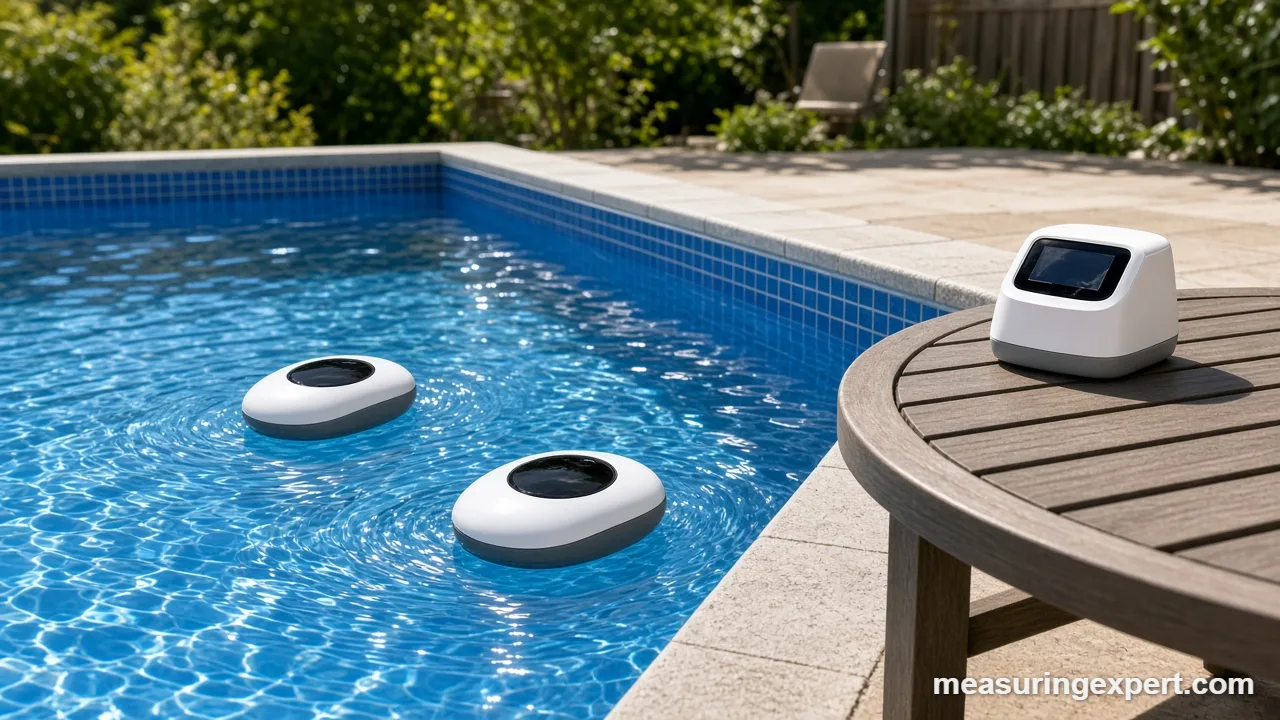
The TempPro TempAir wireless pool thermometer is our best pool thermometer for most homes. In short, a sealed sensor floats in the water and sends its reading to a backlit receiver indoors. So, you can check the pool before you change into a swimsuit.
On the measuring side, TempPro lists an accuracy of plus or minus 0.9 F (0.5 C) for its TempAir PLUS wireless pool models, which is tighter than most analog floats. Also, the maker quotes a transmission range of up to 500 ft (150 m) in open air. Walls, fences and metal will shorten that, though, so keep the receiver near a window that faces the pool.
- Accuracy: plus or minus 0.9 F (0.5 C), per TempPro
- Range: up to 500 ft (150 m) with no obstructions
- IPX8 waterproof floating sensor
- Backlit LCD indoor receiver
Pros
- Reading visible from inside the house
- Tight listed accuracy for a home unit
- Long open-air range
Cons
- No phone app or remote alerts
- Range drops through walls and metal
- Receiver needs its own batteries
Skip it if: you want phone alerts while away from home, or you only need a quick check now and then.
Best for Pool and Spa
2. Inkbird Wireless Pool Thermometer with Indoor Receiver
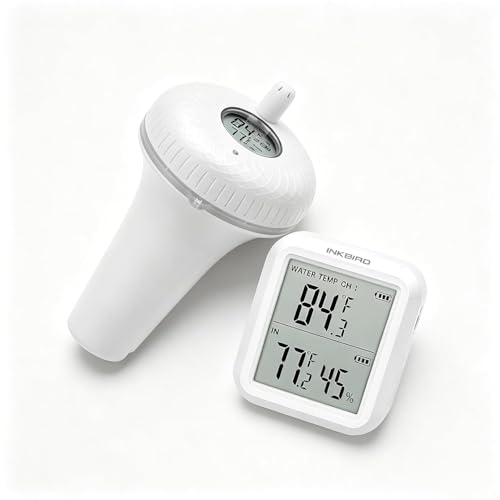
Best for: homes with a pool and a hot tub, or a pool and a pond, that want one display for all of them.
Inkbird is best known for brewing and grilling controllers, yet its pool sets follow the same idea. Specifically, a floating sensor transmits to an indoor monitor with a large LCD. In addition, Inkbird’s IBS-P series receivers can show up to three sensors, so one screen can cover a pool, a spa and a cold plunge.
For accuracy, Inkbird lists plus or minus 1.8 F (1.0 C) with a 0.1 degree display resolution. In other words, the screen shows tenths, but the true value can sit up to 1.8 F away. Still, that is close enough for comfort and for staying under a hot tub limit, as long as you leave a small margin.
- Accuracy: plus or minus 1.8 F (1.0 C), per Inkbird
- Display resolution: 0.1 F / 0.1 C
- Sensor range: -40 to 158 F (-40 to 70 C)
- Receiver shows up to 3 sensors, with max and min
- F and C toggle on the receiver
Pros
- One display for several bodies of water
- Wide sensor range for cold plunges
- Max and min memory on the receiver
Cons
- Looser listed accuracy than TempPro
- No app on the receiver-only version
- Several versions exist, so check the listing
Skip it if: you need the tightest accuracy, or you want phone notifications.
Best Smart Wi-Fi
3. GoveeLife WiFi Pool Thermometer P1
Best for: owners who want to see the pool temperature on a phone from work or while traveling.
The GoveeLife P1 is the best pool thermometer here for smart Wi-Fi use. Instead of a counter display, it sends readings to your home network, so the temperature shows up in a phone app. As a result, you can see whether a heater or solar cover is doing its job without walking outside.
However, Govee did not have a public spec page we could open, so we do not list an accuracy figure here. Before you buy, therefore, check the listing for the accuracy, the battery type and whether a separate hub is needed. Also note that Wi-Fi sensors depend on a 2.4 GHz signal reaching the yard.
- Connection: Wi-Fi to a phone app, per the product listing
- Floating sensor for pools and spas
- Also sold as a two-sensor set
Pros
- Remote reading from anywhere with internet
- Check heater results without going outside
- Good fit for vacation homes
Cons
- No published accuracy figure we could verify
- Needs a solid Wi-Fi signal near the pool
- Depends on the maker’s app staying supported
Skip it if: your Wi-Fi does not reach the pool, or you dislike adding devices to an app.
Best Solar
4. TempPro TempAir Solar Pool Thermometer

Best for: sunny outdoor pools where you never want to open a sealed float to change batteries.
This TempPro float charges a built-in battery from sunlight, so you never open it to swap cells. Consequently, the seal stays intact, and a sealed float is the best defense against water leaks. TempPro also states that its solar TempAir models refresh the reading every 5 seconds.
Likewise, accuracy matches its wireless sibling at plus or minus 0.9 F (0.5 C), per TempPro. On the other hand, solar charging needs real sun. Therefore, a shaded or covered pool may drain the cell faster than the sun refills it.
- Solar-charged rechargeable battery
- Accuracy: plus or minus 0.9 F (0.5 C), per TempPro
- IPX8 waterproof floating body
- Reading refresh about every 5 seconds
Pros
- No battery changes
- Fast refresh rate
- Sealed body with no battery door
Cons
- Weak in heavy shade or under covers
- Built-in battery is not user replaceable
- Same brand as our top pick, so less variety
Skip it if: your pool sits in shade most of the day or stays covered for long periods.
Best Rechargeable
5. Baldr Wireless Rechargeable Pool Thermometer
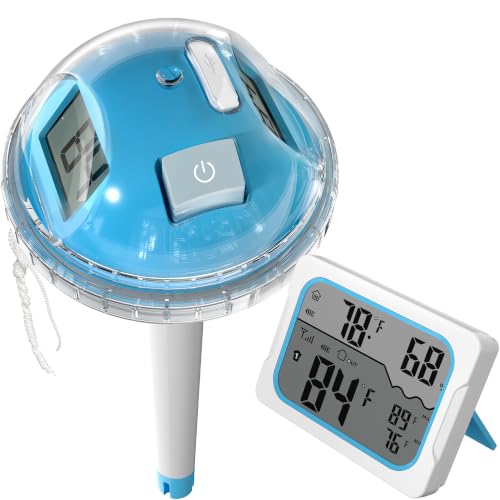
Best for: above-ground and in-ground pool owners who want large digits at the pool and on a remote screen.
First of all, Baldr makes weather stations and kitchen thermometers, and this set adds a pool float. According to the listing, it pairs a rechargeable float with dual large screens, so the reading is easy to see both at the water and on the remote display.
In contrast to the solar TempPro, a rechargeable float does not need direct sun. Instead, you top it up now and then. Since Baldr’s own site did not list this exact model, we only describe what the listing states, so check its accuracy figure before you rely on it near a hot tub limit.
- Rechargeable floating sensor, per the listing
- Dual large screens for the float and remote display
- Made for in-ground and above-ground pools
Pros
- No disposable batteries
- Large digits on both screens
- Works in shade, unlike solar floats
Cons
- Accuracy not stated on a spec page we could open
- You must remember to recharge it
- No Wi-Fi or app
Skip it if: you want a verified accuracy number, or you dislike charging devices.
Best Analog Float
6. Pentair R141036 Tube Thermometer

Best for: anyone who wants a simple analog float that never needs power or pairing.
By contrast, the Pentair R141036 is a classic analog pool thermometer. According to its listing, it holds a tube thermometer inside an ABS case with a 3 ft (0.9 m) cord, so you can tie it to a ladder or skimmer and let it hang in the water.
An analog float measures by liquid expansion, so it has no batteries, no radio and no app. Accordingly, it keeps working for years. The trade-off is reading precision: you read a scale by eye, usually in whole-degree or 2 F steps, and sun glare can make that hard. Also, read it in the water, because the column starts moving as soon as you lift it out.
- Analog tube thermometer in an ABS case
- 3 ft (0.9 m) tie cord
- No batteries or pairing needed
Pros
- Nothing to charge or replace
- Pentair is a major pool equipment brand
- Easy to tie in a fixed spot
Cons
- Harder to read precisely than a digital display
- You must walk to the pool to read it
- Scale can fade in strong sun over time
Skip it if: you want to read the pool from inside, or you need tenths of a degree.
Best Budget
7. Poolmaster 18305 Pocket Thermometer
Best for: spot checks of a hot tub or a second opinion on a digital float, for very little money.
The Poolmaster 18305 is a 9 5/8 in (24.4 cm) pocket thermometer. Poolmaster describes it as injection molded and shatter resistant, with large Fahrenheit and Celsius markings. As a budget best pool thermometer, its smartest feature is an integrated pocket at the base that holds a water sample, so the reading holds steady for a moment after you lift it out.
Because it is cheap and simple, it also makes a good check thermometer. For example, if your wireless float reads 104 F in the hot tub, dip this one too. If the two disagree by more than a couple of degrees, then one of them is off, and you know to look closer.
- Length: 9 5/8 in (24.4 cm)
- F and C scales
- Injection-molded, shatter-resistant body
- Integrated water pocket for the sample
Pros
- Very low cost
- Handy second check for digital floats
- Holds a water sample while you read
Cons
- Must be read by eye
- Not meant to float full time
- No remote readout
Skip it if: you want to monitor the pool all day without walking outside.
How We Chose the Best Pool Thermometer Picks
To be clear, we did not run hands-on tests. Instead, we compared maker spec pages and product listings, read owner feedback for patterns, and weighed each model against real pool and spa jobs. In particular, we scored five points.
- Accuracy: a published plus or minus figure, ideally 1.8 F (1 C) or better.
- Readout: at the pool, on an indoor receiver, or in a phone app.
- Sealing and power: IPX7 or IPX8 floats, and solar, rechargeable or long-life batteries.
- Range: enough radio range to reach the house through a wall or two.
- Brand: established makers only, with no more than two picks per brand.
For specs, we used maker pages where we could open them, such as the Inkbird IBS-P02R spec page and the TempPro TP211B spec page. Where a maker page was not available, we only repeat what the listing itself states. For safety limits, we relied on the CDC and the CPSC, which we cite in the hot tub section below.
Besides pool water, do you also want a thermometer for the house or the grill? Our best smart thermometer guide covers app-connected models for other jobs.
Floating Analog, Wireless or Smart Wi-Fi?
Every best pool thermometer on our list falls into one of three broad groups. Each one answers a different question: how often you check, and where you want to see the number.
| Type | Where you read it | Typical accuracy | Power | Best for |
|---|---|---|---|---|
| Floating analog | At the pool | Read by eye, about 1 to 2 F | None | Simple, no-fuss checks |
| Wireless with indoor display | On a counter screen | 0.9 to 1.8 F listed | AAA, solar or rechargeable | Daily checks from the house |
| Smart Wi-Fi sensor | Phone app, anywhere | Varies by maker | Battery, plus a hub on some | Alerts, history, second homes |
Floating Analog Thermometers
An analog float uses a liquid column, usually alcohol based, that rises as the water warms. For instance, Poolmaster’s Magnifier Floating Thermometer has a scale that tops out at 120 F (50 C). Because there is no battery, these floats last for years. On the downside, you must walk to the pool and read a small scale in bright sun.
Wireless Floats with an Indoor Display
Next, a wireless set splits the job in two. A sealed digital float measures the water, and a radio link carries the reading to a receiver inside. As a result, you can check the pool from the kitchen. Most sets also show indoor temperature, and some keep max and min values for the day.
Smart Wi-Fi Pool Sensors
Finally, a smart sensor puts the reading on your phone. Some models reach your router directly, while others need a hub that stays plugged in. For example, Inkbird’s IBS-M2 gateway supports 2.4 GHz Wi-Fi only and has no built-in battery. So, check your Wi-Fi band and an outlet location before you buy.
Best Pool Thermometer Specs Explained
In general, spec sheets use a handful of terms that are easy to mix up. So, here is what each one means for pool water.
- Accuracy: how far the reading may sit from the true value. For example, plus or minus 1.8 F means a 104.0 F reading could be anywhere from 102.2 F to 105.8 F.
- Resolution: the smallest step on the display, such as 0.1 F. Fine resolution does not make a unit more accurate; it only shows more digits.
- Range: the span of temperatures the sensor can measure. Most digital floats cover from below freezing to well above hot tub temperatures.
- Transmission range: the open-air radio distance, such as 300 ft (91 m) or 500 ft (150 m). In practice, walls and metal cut this down.
- IP rating: IPX7 means the float survives temporary immersion, while IPX8 means it is rated for continuous immersion beyond 1 m, as defined by the maker.
- Refresh rate: how often the reading updates. For instance, TempPro lists 5 seconds for its solar floats and 50 seconds for the TP211B.
When you shop for the best pool thermometer, accuracy matters most near limits. In a pool, a 1 F error barely changes comfort. In a hot tub near 104 F, though, the margin really counts.
Hot Tub Safety and the 104 F Limit
Hot tubs are where even the best pool thermometer becomes a safety tool, not just a comfort gadget. The CDC’s guidance on staying healthy in hot tubs says water should not be higher than 104 F (40 C). Similarly, the CPSC warning on hot tub temperatures says the water should never exceed 104 F, and it calls 100 F (37.8 C) safe for a healthy adult.
In addition, both agencies add extra caution for some groups. Specifically, the CDC says children under 5 should not use hot tubs, and pregnant users should talk to a healthcare provider first. Meanwhile, the CPSC suggests special caution for young children.
In practice, subtract your thermometer’s accuracy from the limit. For instance, with a plus or minus 1.8 F unit, aim for 102 F or lower on the display. With a plus or minus 0.9 F unit, about 103 F leaves the same margin.
How to Read Pool Temperature with the Best Pool Thermometer
- Tie the float to a ladder or rail so it sits away from jets, heaters and skimmers.
- Let it sit in the water for at least 10 minutes so the sensor matches the water.
- Run the pump for a while first, so warm surface water mixes with the cooler water below.
- Read the display or the analog scale at eye level, and note the value in F or C.
- For a hot tub, compare the reading with 104 F (40 C) and subtract the accuracy margin.
- Check the float against a second thermometer once a season and log any difference.
Also, take readings at about the same time each day, since sun and air temperature swing the surface layer. For a fair trend, log morning values, after the pump has run.
Pool Temperature Converter (F, C and K)
Often, a heater shows Celsius while your float shows Fahrenheit. So, use this converter to switch between the two before you set a target.
For reference, C = (F – 32) x 5/9, and F = C x 9/5 + 32. Thus, the 104 F hot tub limit is exactly 40 C. A temperature difference converts more simply: 1 C equals 1.8 F, so a plus or minus 0.5 C spec is the same as plus or minus 0.9 F.
Care, Placement and Accuracy Checks
First, place the float where the water mixes well. Return jets, heater outlets and skimmers all read warmer or cooler than the main pool, so tie the float a few feet away from them. Next, keep the radio path short; a receiver on a window sill facing the pool usually works best.
Second, check the accuracy of your best pool thermometer once a season. To do this, fill a bucket with pool water, put your float and a second thermometer in it, and wait a few minutes. If they disagree by more than their combined accuracy, then test both in an ice-water slurry, which should read 32 F (0 C).
Of course, temperature is only one part of water care. Since warm water uses up chlorine faster, also test sanitizer and pH often; our best chemical tester guide covers strips, drop kits and digital meters. Likewise, if you are sizing a heater, start with our guide on how to measure pool volume.
Do
- Tie the float so it cannot drift into the skimmer.
- Rinse it with fresh water when you close the pool.
- Store it indoors over winter, out of freezing weather.
Don’t
- Open a sealed IPX8 float unless the maker tells you to.
- Leave a solar float in a dark shed for months.
- Rely on a spa panel alone near 104 F.
Honest Limits of the Best Pool Thermometer
Admittedly, not even the best pool thermometer reads the whole pool. Instead, it reads the water right around its sensor, which is near the surface. For example, on a still, sunny afternoon, that top layer can be several degrees warmer than the deep end.
Also, listed accuracy is the maker’s claim, not a certified calibration. Over time, sensors can drift, batteries can weaken, and sun can fade analog scales. In short, treat any single reading as a good estimate, and use a second thermometer whenever safety is at stake.
Best Pool Thermometer FAQ
What is the best pool thermometer for most people?
For most homes, the TempPro TempAir wireless pool thermometer is the best pick. It floats in the pool and shows the reading on a backlit indoor receiver, with a listed accuracy of plus or minus 0.9 F (0.5 C).
How accurate is the best pool thermometer?
Digital floats usually list plus or minus 0.9 F to 1.8 F (0.5 C to 1 C). Analog floats are read by eye, often in 2 F steps, so a reading within 1 to 2 F of the true value is typical.
What is the maximum safe hot tub temperature?
Both the CDC and the CPSC say hot tub water should not go above 104 F (40 C). The CPSC also notes that 100 F (37.8 C) is considered safe for a healthy adult.
Can I use the best pool thermometer in a hot tub?
Yes, most floating pool thermometers also work in hot tubs. Keep the true reading under 104 F, and subtract your thermometer’s accuracy margin, for example aim for 102 F or lower on a plus or minus 1.8 F unit.
Do Wi-Fi pool thermometers need a hub?
Some do and some connect directly. For example, Inkbird sells pool sensors with a separate Wi-Fi gateway that must stay plugged in, and its gateway supports 2.4 GHz Wi-Fi only. Check the listing before you buy.
Where should a pool thermometer float?
Tie it away from return jets, heater outlets and skimmers. Those spots read warmer or cooler than the main body of water, so a spot near the middle of the pool gives a fairer average.
Why does my pool thermometer read higher in the afternoon?
Sun warms the top layer of water first. A float sits near the surface, so on a still, sunny day it can read warmer than the water a few feet down. Run the pump for a while to mix the water before you read.
How do I check if my best pool thermometer is accurate?
Place it in a bucket of pool water next to a second thermometer, wait a few minutes, and compare. For a stricter test, use a slurry of crushed ice and water, which should read 32 F (0 C).
Is a solar pool thermometer better than a battery one?
A solar float never needs a battery change, so its seal stays closed. However, it needs real sun, so a shaded or covered pool may suit a battery or rechargeable model better.
Should I convert pool temperatures between F and C?
Yes, if your thermometer and your heater use different scales. Use C = (F – 32) x 5/9. For example, 82 F is about 27.8 C, and 104 F is exactly 40 C.
Bottom Line on the Best Pool Thermometer
For most pools, the TempPro TempAir Wireless Pool Thermometer is the one to get. Above all, it puts an accurate reading on a backlit screen inside the house. Next, add a Poolmaster pocket thermometer as a cheap second check. However, if you want alerts on your phone, the GoveeLife P1 is the smarter choice, and the Inkbird set suits a pool plus a hot tub.
1 thought on “7 Best Pool Thermometers for Pools and Hot Tubs (2026)”