

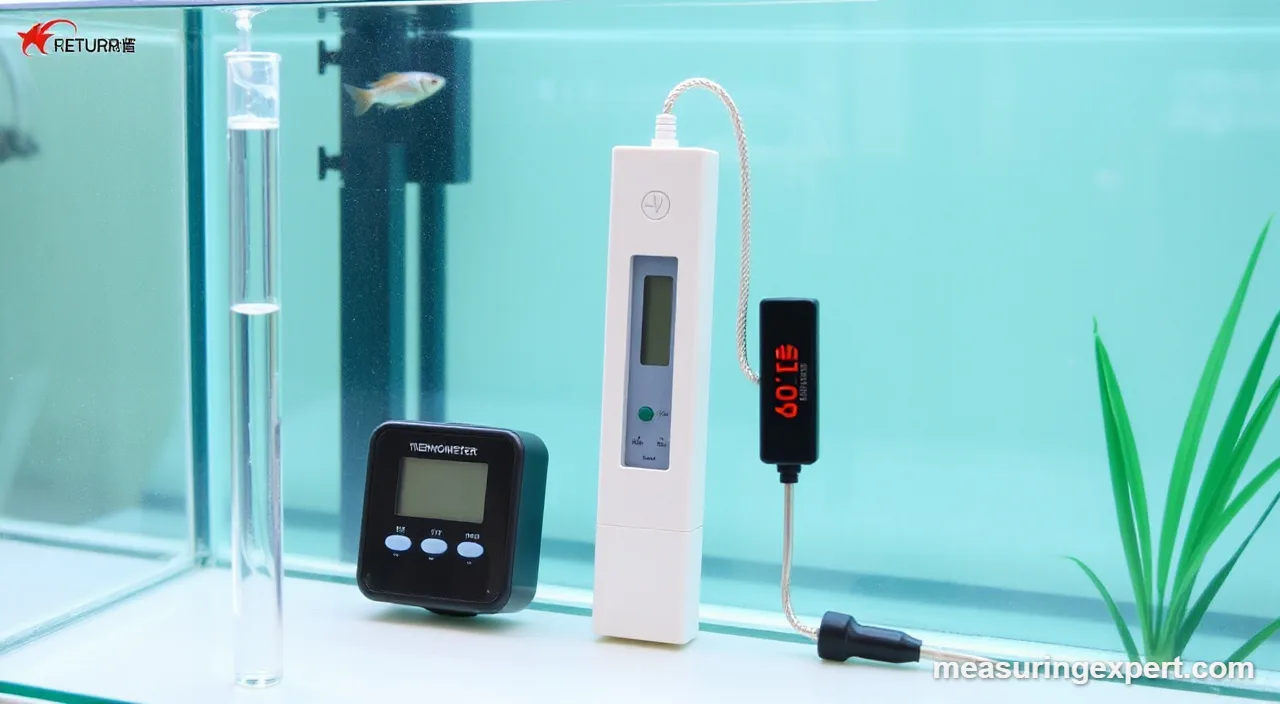
The best aquarium thermometer for most tanks is the Zacro digital probe thermometer, because it reads the water itself, spans -50 to 70 C (-58 to 158 F) and costs little to replace. However, your tank decides the rest: add an Inkbird controller if you run a heater or chiller, or keep a glass floater as a backup.
In short: buy the Zacro probe thermometer for everyday monitoring, the JUWEL 4.0 for a tighter stated accuracy, and the Inkbird ITC-308S if you also need to switch a heater and a chiller.
As an Amazon Associate, Measuring Expert earns from qualifying purchases. Our picks are based on research, specifications and owner feedback, not paid placement.
Best Overall

Best Accuracy

Best Heat and Cool

Quick Answer: Which Best Aquarium Thermometer Fits Your Tank?
- Most tanks: the Zacro digital probe, which reads the water directly.
- Tightest stated tolerance: the JUWEL 4.0 at 0.5 C.
- Heater control: the Inkbird ITC-308 with a calibration offset.
- Heater plus chiller (reef): the Inkbird ITC-308S with a replaceable 2 m probe.
- Nano tank glance: the PAIZOO LED stick-on, as a secondary check.
- Battery-free backup: the HOMSFOU glass floaters.
On This Page
- Comparison table
- The 6 picks, reviewed
- How we chose
- Aquarium thermometer types
- Target temperatures
- How to place and check one
- Accuracy and care
- FAQ
- Bottom line
Best Aquarium Thermometer Comparison at a Glance
| # | Product | Best For | Standout Feature | Amazon |
|---|---|---|---|---|
| 1 | Zacro ZDT1D Digital Aquarium Thermometer | Everyday freshwater and saltwater monitoring | Submersible probe, -50 to 70 C range | View |
| 2 | JUWEL Digital Thermometer 4.0 | Tanks where a tighter tolerance matters | 0.5 C stated accuracy, 100 cm cable | View |
| 3 | Inkbird ITC-308 Digital Temperature Controller | Replacing a heater dial with a measured setpoint | Fixed probe, calibration offset, two outlets | View |
| 4 | Inkbird ITC-308S Temperature Controller | Reef and cold-water tanks that need heating and cooling | Removable 2 m probe, 10 A relays | View |
| 5 | PAIZOO Fish Tank Digital Thermometer (LED) | Nano tanks and a quick glance from across the room | LED display, +/-0.9 F stated accuracy | View |
| 6 | HOMSFOU Glass Floating Thermometer Set (4 Pack) | A battery-free backup and a cross-check | 4 glass floaters with suction cups | View |
The 6 Best Aquarium Thermometer Picks, Reviewed
In short, a good aquarium thermometer tells you the water temperature in a form you can trust at a glance. This list also covers digital probes, controllers, stick-on LEDs and glass floaters. For pond-style or swimming-pool water, see our best pool thermometer guide instead.
Best Overall
1. Zacro ZDT1D Digital Aquarium Thermometer
Best for: keepers who want a simple, cheap, water-reading digital thermometer on every tank.
In fact, the Zacro digital thermometer is a plain tool done well. According to the manual listing, it measures from -50 C to 70 C (-58 F to 158 F), and it switches between Celsius and Fahrenheit with one button. That range is far wider than any aquarium needs, so you never reach the limit.
In addition, a probe sits in the water on a short cable, while the display stays outside. As a result, it reads the water instead of the glass. Also, the same manual lists a 2-second response time and a 2-inch (5.08 cm) immersion depth, and the unit runs on one LR44 button cell.
- Range: -50 to 70 C (-58 to 158 F)
- Accuracy: within 1 C or 1 F, per the manual page; resolution 0.1
- Response time: 2 seconds
- Power: one LR44 button cell (included)
- Suction cup for the display plus a small cup for the probe wire
Pros
- Reads the water, not the glass
- One-button C/F switch
- Very wide range
- Simple and inexpensive to duplicate across tanks
Cons
- Cable length is not stated on the pages we found
- Reviewers report no backlight
- Accuracy is stated as a loose 1 degree, so verify it
Skip it if: you want a tighter stated tolerance; the JUWEL below quotes 0.5 C.
Best Stated Accuracy
2. JUWEL Digital Thermometer 4.0
Best for: keepers of sensitive fish or planted tanks who want a documented accuracy figure from a known aquarium maker.
The JUWEL Digital Thermometer 4.0 states a measuring range of 0 to 40 C and an accuracy of 0.5 C, according to the JUWEL product page. Therefore, it is the tightest stated tolerance on this list. Also, the range is plenty for freshwater and seawater tanks.
Moreover, it has a large LCD with a Celsius/Fahrenheit button on the back and runs on one AAA battery, which is not included. However, the maker page contradicts itself on mounting: one line says the unit attaches outside the tank, while another mentions two suction cups for use inside. Therefore, check the box contents before you plan your layout.
- Range: 0 to 40 C (32 to 104 F)
- Accuracy: 0.5 C, per the maker
- Cable: 100 cm (about 39 in.)
- Power: one AAA battery (not included)
- Suited to freshwater and seawater, per the maker
Pros
- Best stated accuracy here
- Long 100 cm cable
- C/F switch on the back
- Maker documentation
Cons
- Range tops out at 40 C
- Battery is not included
- The maker page is unclear about mounting
Skip it if: you need a range outside 0 to 40 C or want an unambiguous mounting description.
Best Heater Controller
3. Inkbird ITC-308 Digital Temperature Controller

Best for: owners who want the heater switched by a measured probe instead of the heater’s own thermostat.
First, the Inkbird ITC-308 is a controller, not a stand-alone thermometer. For example, your heater plugs into it, the probe goes in the water, and the unit switches power to hold your setpoint. Moreover, per the Inkbird page, it supports a temperature calibration offset, plus high and low alarms and a sensor-fault alert.
However, the probe is rated IP68 while the unit itself is not splash-proof. Therefore, mount the controller above the waterline and keep drips away from the sockets. Because it reads and displays the water temperature continuously, it also doubles as a very visible thermometer.
- Control range: -50 to 120 C (-58 to 248 F)
- Accuracy: 1 C / 2 F; display resolution 0.1 below 100 degrees
- Load: 120 VAC, 10 A; the page lists 1200 W in the specs table and 1100 W in the feature list
- Integrated NTC probe, IP68; the controller body is not waterproof
- Heating and cooling relays; 1-year warranty
Pros
- Calibration offset corrects probe error
- Alarms for high, low and sensor faults
- Doubles as a clear temperature display
Cons
- Probe is fixed to the unit
- The maker page lists two different wattage figures
- Needs a wall outlet and dry mounting
Skip it if: you only want a read-out; a plain thermometer costs far less.
Best for Heater and Chiller
4. Inkbird ITC-308S Temperature Controller
Best for: reef keepers and breeders who run both a heater and a fan or chiller and want one device to manage them.
Similarly, the ITC-308S is the plug-in-probe version of the same idea. Also, according to the Inkbird page, the NTC sensor is included on a 2 m (6.56 ft) cable, and it can be replaced if it fails. The page lists a range of -50 to 99 C, accuracy of 1 C (or 1 F up to 160 F) and 0.1 resolution.
Moreover, it switches two sets of equipment, with separate heating and cooling differentials. In addition, it offers calibration, high and low alarms, and compressor delay for chillers. Finally, reef guides advise placing controller probes in a high-flow area, such as a sump return, so the reading reflects the whole system.
- Range: -50 to 99 C (-58 to 210 F)
- Accuracy: 1 C (-50 to 70 C); resolution 0.1
- Output: 10 A, 1100 to 2400 W depending on mains voltage
- Probe: NTC, 2 m (6.56 ft), replaceable
- 1-year warranty, per the maker
Pros
- Removable probe is easy to replace
- Handles heating and cooling in one unit
- Calibration offset and alarms
Cons
- Overkill for a small freshwater tank
- Needs dry mounting and wiring care
- Stated accuracy is 1 C
Skip it if: you run a single heater on a small tank; the ITC-308 or a plain thermometer is enough.
Best Stick-On
5. PAIZOO Fish Tank Digital Thermometer (LED)
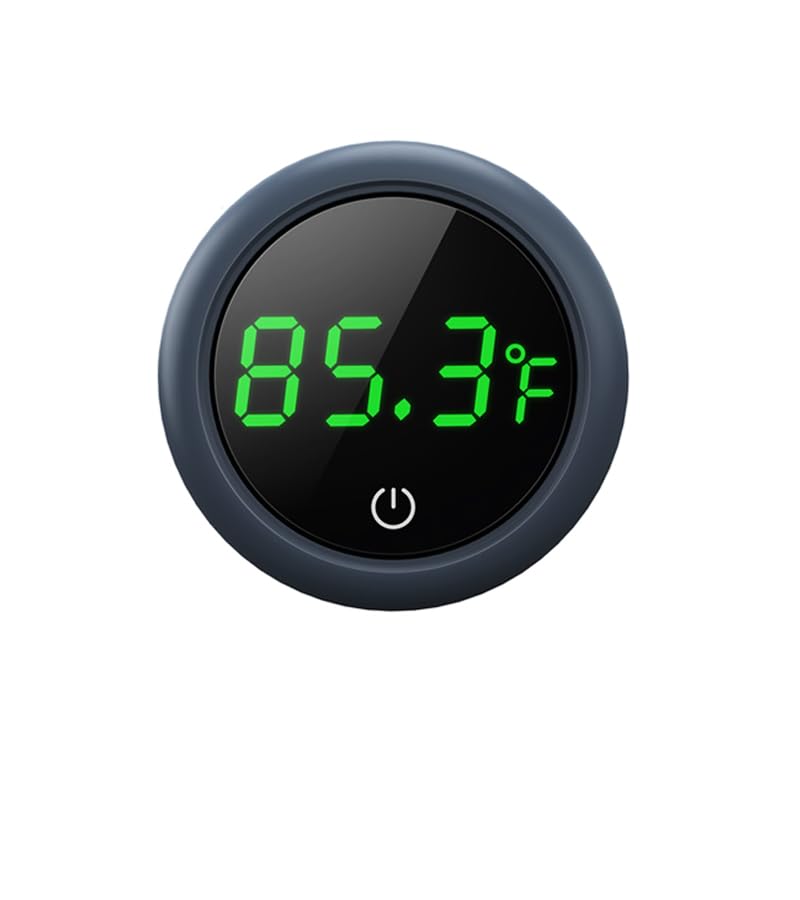
Best for: owners of small tanks who want a bright, cordless display on the glass.
In contrast, the PAIZOO ATDH-1 is a stick-on LED thermometer. For example, the retail listing gives an accuracy of 0.9 F, a 5-second refresh and an upper limit of 140 F. It runs on one CR2032 battery, which is included, and the listing says it is not waterproof and is for indoor use.
However, stick-on units read the glass instead of the water. In fact, reef-keeping guidance calls cheap stick-on LCDs a backup rather than a primary tool. Moreover, one reviewer describes a separate probe, which conflicts with the cordless description, so confirm the design before you buy.
- Accuracy: 0.9 F, per the listing
- Upper limit: 140 F; no lower limit listed
- Power: CR2032 (included)
- Display refresh: 5 seconds
- 12-month warranty, per the listing
Pros
- Bright LED is easy to read
- No cable to route
- Compact on small tanks
Cons
- May lag behind real water changes
- The listing is inconsistent about a probe
- Not waterproof, per the listing
Skip it if: you want to read the water directly; choose a probe model instead.
Best Glass Backup
6. HOMSFOU Glass Floating Thermometer Set (4 Pack)
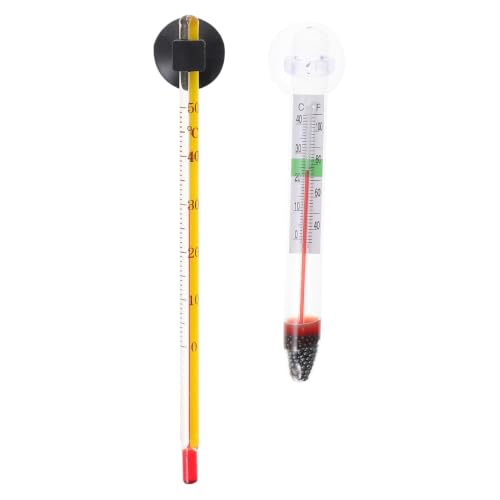
Best for: keepers who want a second, battery-free reading to compare with a digital unit.
Finally, this HOMSFOU set is a four-pack of glass floating thermometers with suction cups, sold for freshwater and saltwater tanks, according to the listing title. Because a glass tube has no battery to die, it never needs a menu. As a result, it is a handy cross-check for a digital probe.
However, we could not find a maker page with the scale range or accuracy, so we do not state either. Therefore, check any glass thermometer against an ice bath before trusting it, as described below.
- Pack: 4 glass thermometers, per the listing title
- Suction cups for mounting
- For freshwater and saltwater, per the listing
- Scale range and accuracy: not verified
Pros
- No battery or electronics
- Four units cover several tanks or a spare
- Good independent cross-check
Cons
- Scale and accuracy are not documented
- Small scale is harder to read
- Glass can break
Skip it if: you want a maker-documented accuracy or an easy-to-read digital display.
How We Chose the Best Aquarium Thermometer Picks
To be clear, we did not test these units in a tank. Instead, we compared maker pages, manuals and retailer listings. Then we kept products with a stated range, a clear way of reading the water and a use case that differs from the others. Therefore, any spec we could not find is left out, and conflicts on a page are flagged in the review.
- Reads the water: a submerged probe or a floating tube beats a sensor that reads the glass.
- Stated range and accuracy: numbers from the maker, not from a review.
- Distinct job: monitoring, control, stick-on glance or backup.
- Background: for target temperatures and placement we consulted Aquifarm’s freshwater guide, its reef temperature guide and NIST’s ice-point method.
Best Aquarium Thermometer Types: Glass, Digital Probe, Stick-On and Controller
First, each type reads temperature differently. For example, a glass floater and a stick-on LED answer different questions, so it helps to know what each one measures. Next, the table below summarizes the trade-offs.
| Type | Reads | Strength | Watch out for | Examples here |
|---|---|---|---|---|
| Glass floater or suction-cup tube | Water | No battery; independent check | Small scale; breakable | HOMSFOU |
| Digital probe | Water | Easy to read; 0.1 steps | Battery; probe cable | Zacro, JUWEL |
| Stick-on LED or LCD | Glass | Bright, cordless | Lags behind water changes | PAIZOO |
| Controller with probe | Water | Switches heater or chiller | Needs mains power and dry mounting | Inkbird ITC-308, ITC-308S |
In short, put a probe or glass unit in the water for your main reading. Instead, use a stick-on only as a backup, as reef guides advise. Meanwhile, our best glass thermometer guide covers general-purpose glass types in more depth.
Target Temperatures Your Best Aquarium Thermometer Should Show
Next, different tanks need different targets. For example, according to Aquifarm, tropical community tanks run at 75 to 80 F (24 to 27 C), and some species need more specific ranges. Bettas and angelfish do best at 78 to 82 F, while discus prefer 82 to 86 F. In contrast, goldfish and koi live at 65 to 72 F (18 to 22 C) and generally do not need a heater indoors. Finally, mixed reefs sit around 77 to 79 F (25 to 26 C) according to the same site.
| Tank type | Typical range (F) | Typical range (C) |
|---|---|---|
| Tropical community | 75 to 80 | 24 to 27 |
| Betta or angelfish | 78 to 82 | 26 to 28 |
| Discus | 82 to 86 | 28 to 30 |
| Goldfish or koi | 65 to 72 | 18 to 22 |
| Mixed reef | 77 to 79 | 25 to 26 |
However, stability matters as much as the number. Also, Aquifarm advises changes of no more than 2 to 3 F (about 1.5 C) per day in freshwater tanks and 1 to 2 F (0.5 to 1 C) in reefs. Use the converter below when a care sheet quotes the other unit.
These are general figures, so confirm the needs of your own species before you set a heater.
How to Place and Check Your Best Aquarium Thermometer
Because placement changes what you read, follow these steps. Then repeat the check each month.
- Pick the cool side. Mount the sensor on the opposite side of the tank from the heater, which shows whether the filter circulates heat evenly.
- Submerge the probe. Next, keep a digital probe in the water at mid-depth, away from the heater and the filter outlet.
- Use two sensors. Reef guides suggest one in the display tank and one in the sump to catch hot or cold spots.
- Wait for it to settle. Then give the reading a few minutes after any adjustment.
- Compare two readings. For example, a glass floater beside a digital probe quickly reveals a disagreement.
- Log it. Note the reading at the same time each day, then adjust the heater in steps of about 2 F, several hours apart.
The same placement logic applies when you also test chemistry, as in our best salinity tester guide for reef tanks.
Checking the Accuracy of an Aquarium Thermometer
In fact, every thermometer drifts, and stated accuracy is only a starting point. Therefore, a quick ice-point check is a simple way to test one. NIST describes packing an insulated container with crushed ice and water made from distilled, deionized or reverse-osmosis water. Then you place the probe about 2 cm from the wall and roughly 5 cm above the bottom. As a result, the mixture sits at nearly 0 C (32 F), and any difference in the reading is the error.
Also, do not put a battery-powered stick-on display in the bath, since the listing says it is not waterproof. Instead, check only submersible probes and glass tubes. If a controller allows a calibration offset, enter the error you measured. Otherwise, mentally add or subtract the error when you read it. For more detail, our measurement tool calibration guide explains the idea in more detail.
Care tips for any best aquarium thermometer
- First, replace button cells every year, or sooner if the display dims.
- Also, keep controller bodies and plugs dry, and loop the cable so drips run away from the outlet.
- Wipe algae from the probe, because film slows the response.
- Keep a spare, because one failed heater can overheat a tank before you notice.
Also, the MIT cichlid FAQ makes the same point about redundancy. It recommends two half-strength heaters, so a failure changes the temperature more slowly. For general-purpose temperature tools beyond fish tanks, see our best thermometer roundup.
Honest limits
Stated accuracy of 0.5 to 1 degree is fine for fish, although it is not laboratory grade. Moreover, a thermometer reads only where its sensor sits. Therefore, always combine placement, a second sensor and a periodic ice-point check rather than trusting a single number.
Best Aquarium Thermometer FAQ
What is the best aquarium thermometer for most tanks?
A submersible digital probe such as the Zacro is the safest choice because it reads the water directly. In addition, it is inexpensive enough to put on every tank. Pair it with a glass floater if you want a second opinion.
Are stick-on aquarium thermometers accurate?
They can be, but they read the glass rather than the water. As a result, they lag during changes. Reef guides therefore treat them as a backup, not a primary tool.
Where should I put the best aquarium thermometer?
First, place it on the opposite side from the heater, at mid-depth, away from the filter outlet. As a result, this position shows whether heated water is spreading evenly through the tank.
What temperature should a freshwater tropical tank be?
Tropical community tanks typically run at 75 to 80 F (24 to 27 C), according to Aquifarm. However, bettas and angelfish prefer 78 to 82 F, so check your species first.
What temperature should a reef tank be?
Mixed reefs commonly sit at 77 to 79 F (25 to 26 C), per Aquifarm. Also, keep daily swings to about 1 to 2 F (0.5 to 1 C).
Do I need a controller as well as a thermometer?
Not always. For example, a controller such as the Inkbird ITC-308S is useful when you run a heater and a chiller or want a calibration offset. However, for a small tank with one heater, a plain thermometer is enough.
How do I test my aquarium thermometer?
First, use an ice bath. NIST describes a crushed-ice and water mix that sits at nearly 0 C (32 F). Then any difference from that reading is the error of your thermometer.
Are glass aquarium thermometers still worth using?
Yes, as a battery-free cross-check. However, check the scale against an ice bath, and handle them carefully because glass can break.
How often should I replace the battery?
Button cells in digital units often last about a year, but follow the manufacturer guidance. Replace one at the first sign of a dim or erratic display.
Can I use a pool thermometer in an aquarium?
Usually not, because pool models are built for wide, outdoor ranges and bigger bodies of water, and they are not designed for tank use. Instead, see our pool thermometer guide for those jobs.
Bottom Line on the Best Aquarium Thermometer
In short, for most keepers, the best aquarium thermometer is the Zacro digital probe. It reads the water, and it has a very wide range. Instead, choose the JUWEL 4.0 for a stated 0.5 C tolerance, the Inkbird ITC-308S for heater and chiller control, or glass floaters as a battery-free backup. Finally, verify any thermometer with an ice-point check.