

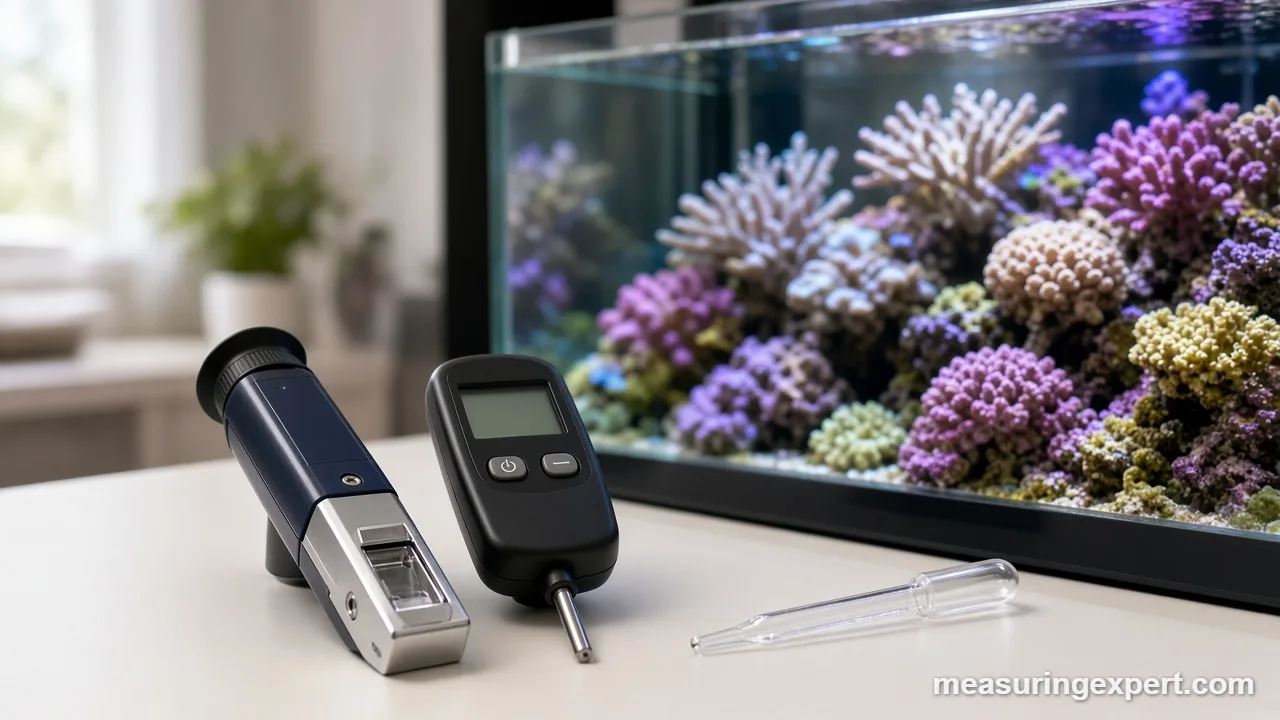
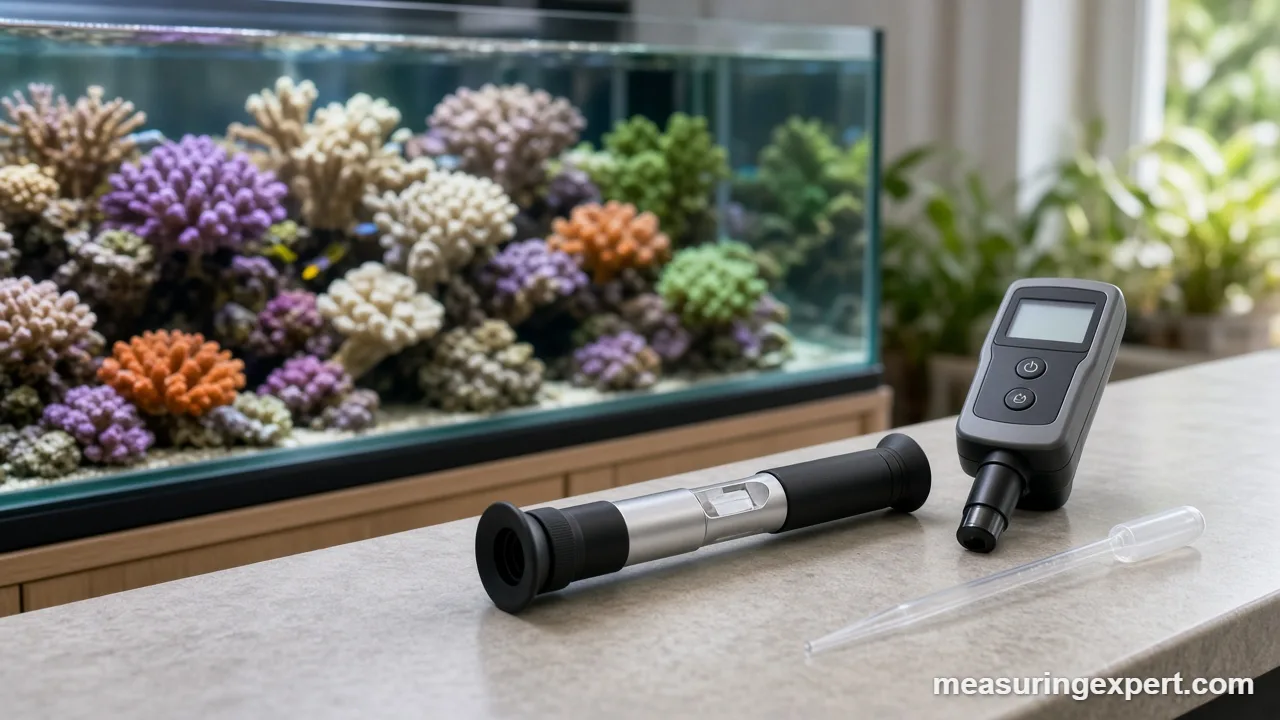
The best salinity tester for most reef and saltwater aquariums is the Milwaukee MA887 digital refractometer. It reads ppt, PSU and specific gravity in about 1.5 seconds with automatic temperature compensation. However, pool owners need a ppm salt test instead, so your water type decides the right tool.
In short: Milwaukee MA887 for reef tanks, Red Sea Seawater Refractometer for an analog reef check, Agriculture Solutions refractometer on a budget, and the Taylor K-2006-SALT kit for saltwater pools.
As an Amazon Associate, Measuring Expert earns from qualifying purchases. Our picks are based on research, specifications and owner feedback, not paid placement.
Best Overall
Best Budget

Best for Pools

Looking for a tester for food, soup or brine in the kitchen instead? That is a different job, so see our guide to the best digital salt tester for food. This page covers water: reef tanks, fish-only marine tanks, brackish setups, koi ponds and saltwater pools.
Best Salinity Tester: Quick Answer
- Reef tank, fast and digital: the Milwaukee MA887 reads 0 to 150 ppt and 1.000 to 1.114 SG with ATC.
- Reef tank, no batteries: the Red Sea Seawater Refractometer is calibrated for natural seawater at 77 F (25 C).
- A pen you dip in the tank: the Hanna HI98319 uses a conductivity probe instead of a prism.
- Tight budget: the Agriculture Solutions refractometer covers 0 to 100 ppt with ATC.
- Brine and general water: the Extech RF20 reads 0 to 100 ppt and comes with calibration fluid.
- Saltwater pool, lab-style: the Taylor K-2006-SALT kit counts salt in 200 ppm drops plus six other tests.
- Quick pool or pond check: AquaChek salt strips cover 400 to 7,000 ppm, while the eSeasonGear SALT-3050 is a waterproof digital meter.
On This Page
- Comparison table
- The 8 picks, reviewed
- How we chose
- Tester types compared
- ppt, PSU, SG and ppm
- Density converter
- How to use a refractometer
- Calibration and care
- Honest limits
- FAQ
- Bottom line
Best Salinity Tester Comparison Table
First, match the tool to your water. Marine tanks need ppt or SG, while pools and ponds read in ppm. Then use the table to jump to the matching review.
| # | Product | Best For | Standout Feature | Amazon |
|---|---|---|---|---|
| 1 | Milwaukee MA887 | Reef tanks | Digital ppt, PSU and SG with ATC | View |
| 2 | Red Sea Seawater Refractometer | Analog reef checks | Calibrated for seawater at 77 F | View |
| 3 | Hanna HI98319 | Dip-and-read testing | Conductivity probe, no prism | View |
| 4 | Agriculture Solutions Refractometer | Budget marine tanks | 0 to 100 ppt with ATC | View |
| 5 | Extech RF20 | Brine and general water | Calibration fluid in the box | View |
| 6 | Taylor K-2006-SALT | Saltwater pools | Salt titration at 200 ppm per drop | View |
| 7 | AquaChek Salt Strips | Quick pool checks | 400 to 7,000 ppm range | View |
| 8 | eSeasonGear SALT-3050 | Pools and koi ponds | Waterproof digital ppm meter | View |
The 8 Best Salinity Tester Picks, Reviewed
We start with the marine tools, because reef keepers need the tightest control. After that come two general refractometers. Finally, we cover three ppm tools for pools and ponds.
Best Overall
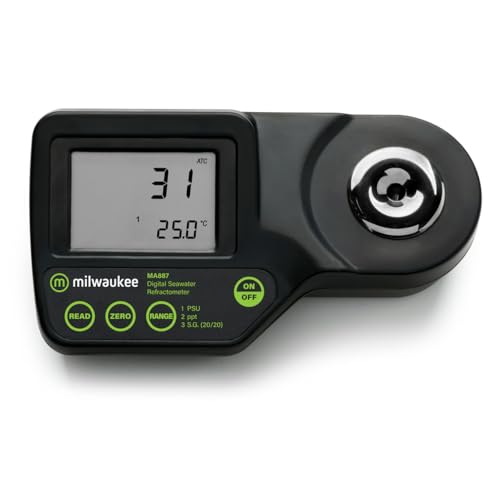
1. Milwaukee MA887 Digital Salinity Refractometer
Best for: reef keepers who want a fast digital number without reading a scale line.
The MA887 is our best salinity tester for marine tanks because it removes guesswork. First, you drop a sample on the steel well; then you press a key and read the result. In addition, it shows salinity in ppt and PSU plus specific gravity, so it fits any guide you follow. As a result, you never have to convert by hand.
On the measuring side, Milwaukee lists a 1 ppt resolution and an accuracy of +/-2 ppt, or +/-0.002 SG. Automatic temperature compensation works from 50 to 104 F (10 to 40 C). Also, you calibrate it with one drop of distilled or deionized water, which is cheap and easy to find.
- Range: 0 to 150 ppt and 1.000 to 1.114 SG, plus a PSU scale
- Accuracy: +/-2 ppt or +/-0.002 SG
- Reading time: about 1.5 seconds from a 100 microliter sample
- Build: IP65 rating, yellow LED light source, 3-minute auto-off
- Power: one 9V battery, rated for about 5,000 readings
Pros
- Also, there is no scale line to interpret
- In addition, three units share one display
- In addition, it calibrates with plain distilled water
Cons
- Whole-ppt steps, so it cannot show 35.4 ppt
- However, it needs a battery, unlike an analog refractometer
Skip it if: you only test a saltwater pool, because a ppm kit like the Taylor below fits that job better.
Best Analog for Reefs
2. Red Sea Seawater Refractometer

Best for: reef keepers who want a battery-free tool tuned to seawater.
Most cheap refractometers are calibrated with sodium chloride brine. Seawater, however, holds a mix of ions, so a brine scale can read off by about 1.5 ppt on a reef sample, according to Red Sea. This model, in contrast, uses a seawater scale. Therefore, it reads absolute salinity directly, without a correction factor.
Red Sea also calibrates it at 77 F (25 C), which is close to normal reef temperature. Standard refractometers, by contrast, are often set at 59 F (15 C). Its ATC handles a few degrees of drift from 77 F; however, Red Sea notes that bigger gaps can add about 1 ppt of error.
- Scale: ppt, built on a natural seawater algorithm
- Focus: reef salinities up to about 40 ppt
- Calibration temperature: 77 F (25 C)
- Temperature compensation: built-in ATC near 77 F
Pros
- Also, there are no batteries or electronics to fail
- Its seawater scale therefore avoids the brine error
- Calibrated at reef temperature
Cons
- However, you still read a line by eye
- Red Sea lists no numeric accuracy
- Also, it has a narrow focus on reef salinity
Skip it if: you struggle to read a blue-white boundary line, since the MA887 shows a number instead.
Best Pen Tester
3. Hanna HI98319 Marine Salinity Tester

Best for: hobbyists who would rather dip a probe than handle droppers and prisms.
Unlike the refractometers here, the HI98319 measures electrical conductivity. More salt means more ions, so the water carries current more easily. The tester then converts that conductivity into salinity, so you get a direct number. Because it reads the water itself, there is, as a result, no line to judge and no prism to clean.
Hanna sells it for marine aquariums, and it also sells 35 ppt calibration solution in single-use sachets (HI70024P). That 35 ppt point sits right at normal seawater, which is a smart place to check a reef tool. However, Hanna’s product page did not load for us during research, so we leave out range and accuracy claims; check the listing before you buy.
- Method: conductivity probe, converted to salinity
- Calibration: 35 ppt solution sachets sold by Hanna
- Use: marine aquariums and seawater samples
Pros
- No reading of lines or shadows
- Also, the calibration point matches reef salinity
- Finally, it is compact enough for a quick tank check
Cons
- However, the probe needs rinsing and gentle care
- We could not confirm full specs from Hanna
- In addition, calibration sachets are an ongoing cost
Skip it if: you want a tool with zero upkeep, because an analog refractometer only needs distilled water.
Best Budget
4. Agriculture Solutions Salinity Refractometer
Best for: new marine tanks and anyone who wants a backup tool for little money.
This handheld optical refractometer is the best salinity tester here for a tight budget. You place two or three drops on the prism, close the cover and look through the eyepiece toward light. Next, you read where the boundary line crosses the 0 to 100 ppt scale. Agriculture Solutions lists ATC from 50 to 86 F (10 to 30 C).
Before use, you zero it with distilled water and the small screwdriver in the case. That said, a general refractometer like this one is usually brine-calibrated, so cross-check it against a 35 ppt reference if you keep corals.
- Range: 0 to 100 ppt
- ATC: 50 to 86 F (10 to 30 C)
- Calibration: distilled water and an adjustment screw
- Kit: hard case, pipette, cloth and screwdriver
Pros
- Also, no batteries are needed
- In addition, it zeroes easily with distilled water
- Also, the wide scale suits brackish and marine water
Cons
- However, scale divisions are small near 35 ppt
- It is likely brine-based, so reef readings can drift
Skip it if: you run a sensitive reef, where the seawater-calibrated Red Sea model is the safer analog choice.
Best for Brine
5. Extech RF20 Salinity Refractometer
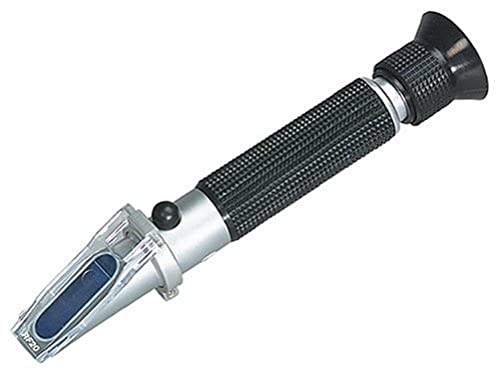
Best for: aquaculture, brine checks and general water work where a 1 ppt step is enough.
Like the budget pick, the RF20 follows the classic handheld design, and Extech is an established test-instrument brand. Its scale runs from 0 to 100 ppt, and ATC covers 10 to 30 C (50 to 86 F). In addition, Extech packs a calibration solution, a pipette and a screwdriver in the case. So you can check it against a reference right away.
Extech lists a maximum resolution of 1 ppt and backs the RF20 with a two-year warranty. For that reason, it suits users who want a known instrument maker behind a simple optical tool.
- Range: 0 to 100 ppt
- ATC: 10 to 30 C (50 to 86 F)
- Resolution: 1 ppt
- Warranty: two years
Pros
- Calibration solution comes in the box
- Also, it has a two-year warranty
- Also, it works without power
Cons
- However, 1 ppt steps are coarse for reef tuning
- However, the scale is general, not seawater specific
Skip it if: you need fine reef control; the MA887 or Red Sea fits that better.
Best for Pools
6. Taylor K-2006-SALT Complete Test Kit
Best for: saltwater pool owners who want salt and chlorine chemistry from one trusted kit.
Pools hold far less salt than the ocean. As a result, a reef refractometer is the wrong tool. Instead, Taylor uses an argentometric titration: you add reagent drop by drop until the color changes. Each drop equals 200 ppm sodium chloride, so you simply count drops and multiply.
In addition, the kit tests free and combined chlorine with FAS-DPD, plus pH, total alkalinity, calcium hardness and cyanuric acid. As a result, you can check the salt cell’s output and the water balance in one session.
- Salt method: argentometric titration, 1 drop = 200 ppm NaCl
- Other tests: free and combined chlorine, pH, alkalinity, hardness, CYA
- Chlorine steps: 0.2 or 0.5 ppm per drop (FAS-DPD)
- Bottles: 0.75 oz reagents, with a 2 oz option
Pros
- Seven tests in one kit
- Drop counting avoids color guessing for salt
- In addition, refills are sold separately
Cons
- However, it takes longer than a strip or meter
- Also, 200 ppm steps are coarse near a target
- Also, reagents age and need replacing
Skip it if: you want a two-minute salt check only; the AquaChek strips are quicker.
Best Quick Check
7. AquaChek Salt Test Strip Titrators

Best for: pool owners who want a simple salt reading between full tests.
For example, these are not ordinary color-matching strips. Each white titrator wicks pool water up a column, and the color change stops at a number you read from a chart. AquaChek lists a range of 400 to 7,000 ppm salt. Therefore, it covers the usual pool range with room to spare.
Because they need no reagents or meters, the strips are handy for a pool bag or a vacation home. However, they are a spot check, so confirm big changes with a titration kit or your pool store.
- Range: 400 to 7,000 ppm sodium chloride
- Format: titrator strips read against a chart
- Pack: 10 strips in this listing
Pros
- No drops, meters or batteries
- In addition, the pool range is wide
- As a result, anyone in the household can use them
Cons
- However, the pack is small, so cost per test adds up
- Also, strips spoil if they get damp
Skip it if: you test weekly all season; the Taylor kit costs less per test over time.
Best for Ponds
8. eSeasonGear SALT-3050 Waterproof Salt Meter

Best for: koi ponds and saltwater pools where you want a digital ppm number.
The SALT-3050 is a waterproof digital salt meter that reads salt in ppm along with water temperature. For example, koi keepers often add salt as a short-term treatment, so a ppm meter helps you dose and then track dilution after water changes. Likewise, pool owners can use it between titration tests.
eSeasonGear sells a 3,000 ppm calibration solution and replacement battery cartridges for this meter. Even so, we could not find a full spec sheet on the maker’s site, so we leave out range and accuracy figures.
- Reads: salt in ppm and water temperature
- Build: waterproof body for poolside use
- Support: 3,000 ppm calibration fluid and spare battery cartridges
Pros
- Instant digital reading
- Also, it is waterproof for wet hands and poolside use
- Also, the maker sells calibration fluid
Cons
- However, it is not suited to reef or seawater levels
- In addition, published specs are limited
Skip it if: you keep marine fish, since seawater needs a ppt tool like the MA887.
How We Chose Each Best Salinity Tester
To be clear, we did not run hands-on tests. Instead, these picks are research-based. We started with the tools reef keepers, pool owners and pond keepers actually use, then narrowed the list with four questions.
- Right scale for the water. Marine tools must read ppt or SG near 35 ppt, while pool and pond tools must read ppm.
- Published specs. We favored makers that list range, resolution, accuracy and ATC on their own pages.
- Easy calibration. A tester you cannot check is a guess, so each pick has a clear calibration route.
- Distinct roles. We avoided near-duplicates and kept to two products per brand at most.
Our sources included the Milwaukee Instruments, Red Sea, Extech, Taylor Technologies, AquaChek, Agriculture Solutions and eSeasonGear product pages. For background, we used NOAA’s ocean salinity facts and the USGS guide to saline water. Owner feedback helped us flag common complaints, such as probe care and hard-to-read scales.
Salinity Tester Types Compared
Every tool below measures salt; however, each one uses a different principle. So, pick the type first and the brand second.
| Type | How it measures | Typical units | Good for | Watch out for |
|---|---|---|---|---|
| Optical refractometer | Bends light through a sample on a prism | ppt, SG | Marine and brackish tanks | Brine vs seawater scale; reading the line |
| Digital refractometer | Same optics, read by a sensor | ppt, PSU, SG | Reef tanks | Battery; whole-number steps |
| Conductivity pen | Measures electrical conductivity | ppt, SG or ppm | Quick tank or pond checks | Probe care and regular calibration |
| Swing-arm hydrometer | Buoyancy of a floating arm | SG | Fish-only tanks on a budget | Air bubbles and temperature errors |
| Titration kit | Counts reagent drops to a color change | ppm NaCl | Saltwater pools | Coarse steps; reagent shelf life |
| Titrator strips | Color column on a strip | ppm NaCl | Quick pool checks | Moisture spoils strips |
Refractometers work because dissolved salt raises the refractive index of water. If you want the physics, our page on Snell’s law and refractive index explains how light bends at a boundary. Meanwhile, conductivity pens rely on ions carrying current, which is why they also respond to other dissolved minerals.
ppt, PSU, SG and ppm: Reading the Numbers
Salinity shows up in four units, and mixing them up causes most dosing mistakes. For that reason, here is what each one means.
- ppt (parts per thousand): grams of salt per kilogram of water. Natural seawater averages about 35 ppt, according to NOAA.
- PSU (practical salinity units): a conductivity-based scale used in oceanography. For aquarium work, 35 PSU and 35 ppt are treated as the same.
- SG (specific gravity): the density of your sample divided by the density of pure water at a stated temperature.
- ppm (parts per million): 1 ppt equals 1,000 ppm. The USGS puts ocean water at about 35,000 ppm, while pools run far lower.
Because SG depends on temperature, the reference pair matters. The table below uses 77 F / 77 F (25 C / 25 C), which matches reef tanks. We computed it from the UNESCO seawater density equation, so treat the last digit as approximate.
| Salinity (ppt) | SG at 77 F / 77 F | Density at 77 F (kg/m3) | Typical use |
|---|---|---|---|
| 10 | 1.0075 | 1,004.6 | Low brackish |
| 20 | 1.0150 | 1,012.1 | Brackish tanks |
| 30 | 1.0226 | 1,019.6 | Low end for marine fish |
| 33 | 1.0249 | 1,021.8 | Fish-only marine |
| 35 | 1.0264 | 1,023.3 | Natural seawater; common reef target |
| 36 | 1.0271 | 1,024.1 | Upper reef range |
For pure water, density at 77 F is about 997 kg/m3. Our explainer on how dense water is covers why that number changes with temperature.
Seawater Density Converter
A refractometer or hydrometer gives you SG. To turn that into density in other units, enter it below as g/mL. For example, an SG of 1.026 is about 1.026 g/mL, or 8.56 lb per US gallon.
Keep in mind, however, that SG is a ratio, so g/mL is only a close stand-in near room temperature.
How to Check Salinity With a Refractometer
These steps work for the analog picks and, with small changes, the MA887. Follow them in order for a repeatable reading.
- First, let the refractometer and sample sit at room temperature for a few minutes.
- Put two or three drops of distilled water on the prism and close the cover.
- Look toward light and turn the screw until the line sits on zero (or press zero on a digital unit).
- Then wipe the prism dry with a soft cloth.
- Take water from mid-depth in the tank, away from the salt mixing area.
- Next, add drops so the prism is fully covered, with no air bubbles.
- Read the line where blue meets white, or read the digital display.
- Finally, rinse with fresh water, dry the prism and write down the result.
Pool and pond owners can skip the prism entirely. Instead, follow the drop or strip directions, and measure your volume first so dosing math works; our guide on how to measure pool volume walks you through it.
Calibration and Care
Even a good tool drifts over time. Therefore, build a short routine around it.
- Zero often: check analog refractometers with distilled water before each session.
- Use a 35 ppt reference: for reefs, a seawater standard catches brine-scale errors that a zero check misses.
- Rinse probes: after each use, flush conductivity probes with fresh water and let them dry.
- Store reagents cool: keep titration kits and strips sealed, out of sun and away from humidity.
- Log results: write down the date, reading and temperature, because trends reveal drift.
Honest Limits of Any Salinity Tester
No single tool is perfect. Still, knowing the weak spots helps you read results calmly.
- A brine-scale refractometer can read about 1.5 ppt off on seawater, according to Red Sea.
- Similarly, conductivity tools see all ions, so minerals and additives can nudge the reading.
- In addition, whole-ppt displays cannot show small changes between 35 and 36 ppt.
- Also, temperature away from the calibration point adds error, even with ATC.
- Finally, pool kits in 200 ppm steps give a range, not an exact value.
So, for a sensitive reef, cross-check with a second method now and then. If you keep brackish fish and need to lower salinity, our post on making water less dense for your fish covers the gradual approach.
Best Salinity Tester FAQ
What is the best salinity tester for a reef tank?
For most reef tanks, the Milwaukee MA887 is the best salinity tester. It reads ppt, PSU and SG in about 1.5 seconds and compensates for temperature from 50 to 104 F.
Which best salinity tester works for a saltwater pool?
Use a ppm tool, such as the Taylor K-2006-SALT kit or AquaChek salt strips. Reef refractometers are built for much higher salinity, so they are a poor fit for pools.
Is a refractometer better than a hydrometer?
Usually, yes. For one thing, a refractometer needs only a few drops and has ATC, while a swing-arm hydrometer is sensitive to bubbles and temperature.
What salinity should a reef tank be?
Many reef keepers aim for natural seawater, which NOAA puts at about 35 ppt. At 77 F that is roughly 1.026 SG.
How often should I calibrate a best salinity tester?
Zero an analog refractometer before each session. Also, check digital tools and pens against a reference solution about once a month, or whenever a reading looks odd.
Can I calibrate a refractometer with tap water?
No. Because tap water contains dissolved minerals, so use distilled or deionized water for the zero point.
Why does my refractometer read high on seawater?
In most cases, general models use a sodium chloride brine scale. Seawater has a different ion mix, so a brine scale can read off by about 1.5 ppt.
Does a best salinity tester work for koi ponds?
Yes, if it reads ppm. A digital salt meter like the eSeasonGear SALT-3050 suits koi ponds better than a marine refractometer.
How do I convert ppt to ppm?
Multiply by 1,000. For example, 35 ppt equals 35,000 ppm, which matches the USGS figure for ocean water.
Can I use a food salt tester for my aquarium?
It is not a good idea. Food salt meters are made for soups and brines, so choose a marine refractometer or salinity pen for tank water.
Bottom Line: Our Best Salinity Tester Pick
For reef and marine tanks, the Milwaukee MA887 is the best salinity tester, thanks to its quick digital ppt, PSU and SG readout with ATC. If you prefer no batteries, choose the Red Sea Seawater Refractometer instead. Meanwhile, saltwater pool owners should start with the Taylor K-2006-SALT kit. Whatever you pick, calibrate it, log your readings and watch the trend.
3 thoughts on “Best Salinity Tester for Reef Tanks, Pools and Ponds (2026)”