

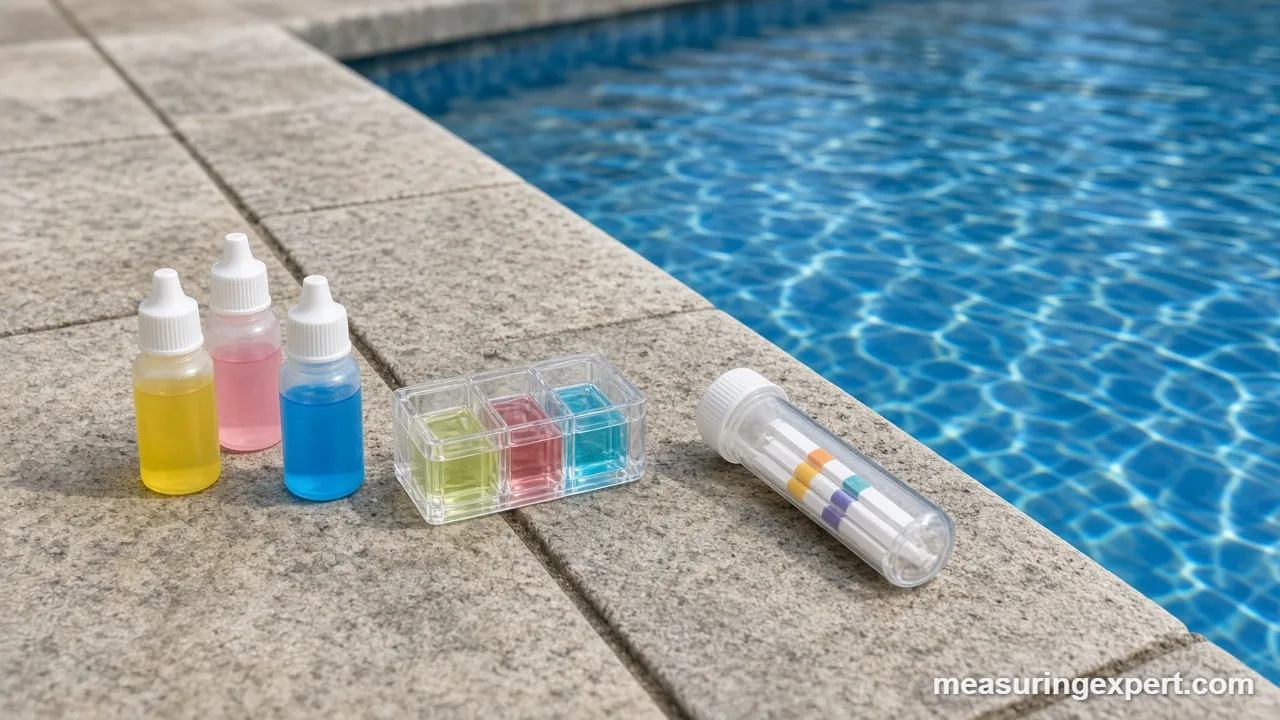
The best chemical tester for most pool owners is the Taylor K-2006C, a FAS-DPD drop kit that reads chlorine in 0.2 ppm steps and covers pH, alkalinity, hardness and stabilizer. However, the right choice depends on your sanitizer (chlorine, salt or bromine) and on whether you want drops, strips or a digital readout.
In short: buy the Taylor K-2006C for exact numbers, EASYTEST strips for quick daily checks, and the ITS eXact EZ if you want a digital screen.
As an Amazon Associate, Measuring Expert earns from qualifying purchases. Our picks are based on research, specifications and owner feedback, not paid placement.
Best Overall

Best Digital

Quick Answer: Which Best Chemical Tester Fits Your Water?
- Chlorine pool, exact numbers: Taylor K-2006C, a FAS-DPD drop kit.
- Digital readout: ITS eXact EZ Master, a photometer with 10 results.
- Daily checks on a budget: EASYTEST 7-Way strips, 150 per bottle.
- Saltwater pool: AquaChek Salt System kit with salt titrators.
- Bromine hot tub: Taylor K-2106 for drops, or AquaChek SPA 6-in-1 strips.
- Basic liquid kit: Poolmaster 5-Way, with Poolmaster Smart Test strips as a backup.
On This Page
- Comparison table
- The 8 picks, reviewed
- How we chose
- Drops vs strips vs photometers
- What to measure and target ranges
- How drop counts become ppm
- Measure your pool volume
- How to take a good sample
- Reagent care and shelf life
- Honest limits
- FAQ
- Bottom line
Best Chemical Tester Comparison Table
First, find your water type in the Best For column. Then jump to the review for the test method and the exact parameters each kit reads.
| # | Product | Best For | Standout Feature | Amazon |
|---|---|---|---|---|
| 1 | Taylor K-2006C | Chlorine pools, owners who want exact numbers | FAS-DPD drop titration, 0.2 ppm chlorine steps | View |
| 2 | ITS eXact EZ Master | Owners who want a digital readout | Photometer reads 10 parameters, no phone needed | View |
| 3 | EASYTEST 7-Way | Quick daily checks on a budget | 7 results per strip, 150 strips per bottle | View |
| 4 | AquaChek Salt System | Saltwater chlorine generator pools | Salt titrators plus Yellow 4-in-1 strips | View |
| 5 | Taylor K-2106 | Bromine hot tubs and spas | FAS-DPD bromine titration in 0.5 ppm steps | View |
| 6 | AquaChek SPA 6-in-1 | Hot tub checks before each soak | Reads bromine or chlorine on one strip | View |
| 7 | Poolmaster 5-Way Kit | New owners who want liquid tests on a budget | Liquid reagents in a carry case | View |
| 8 | Poolmaster Smart Test 6-Way | A spare set for the pool shed | Six readings including total hardness | View |
The 8 Best Chemical Tester Kits, Reviewed
Every pick below is a pool or spa water tester. First, we start with the full drop kit, move to digital and strips, and then cover salt pools and hot tubs.
Best Overall
1. Taylor K-2006C Service Complete FAS-DPD Test Kit
Best for: Chlorine pool owners who want real numbers for every key test, not a color guess.
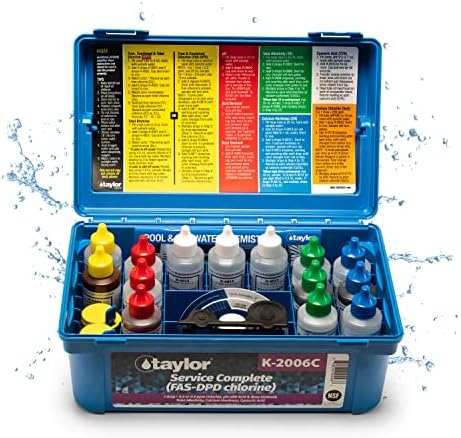
The Taylor K-2006C is our pick as the best chemical tester for most pool owners. First, it uses the FAS-DPD method for chlorine. Instead of matching a shade of pink, you add drops of titrant until the sample turns clear, and then you count the drops. As a result, two people get the same reading, even in poor light.
In addition, the kit covers the full balance panel: free and combined chlorine, pH with acid and base demand, total alkalinity, calcium hardness and cyanuric acid. Each chlorine drop equals 0.2 or 0.5 ppm, depending on the sample size you pick. Also, the “C” version ships with larger 2 oz reagent bottles, so it runs more tests than the standard K-2006 before you need refills.
- Chlorine method: FAS-DPD titration, 1 drop = 0.2 or 0.5 ppm
- Tests: free and combined chlorine, pH, acid/base demand, alkalinity, calcium hardness, cyanuric acid
- pH comparator: 7.0 to 8.0 in 0.2 steps
- Alkalinity and hardness: 1 drop = 10 ppm as CaCO3
- Reagents: 2 oz bottles (more tests than the K-2006)
Pros
- Drop counts remove color-matching errors
- Covers every number a pool store checks
- Also easy to refill reagent by reagent
Cons
- A full test round takes longer than strips
- More parts to learn than strips
- No salt test in this version
Skip it if: You run a bromine hot tub, since the K-2106 below is built for bromine.
Best Digital
2. ITS Pool eXact EZ Photometer Master Pool Test Kit
Best for: Owners and pool techs who want a number on a screen instead of reading colors by eye.
Industrial Test Systems (ITS) makes the eXact EZ, a pocket photometer that reads the color of a test strip reaction with light. So you dip an eXact Strip Micro into the water sample for 20 seconds, remove it, and the meter shows the result. In short, your eyes never judge a color.
In addition, the Master kit covers 10 results: free, total and combined chlorine, pH, total alkalinity, calcium hardness, cyanuric acid, salt (as chloride), copper and phosphate. Also, ITS lists 25 tests for each reagent and NSF/ANSI 50 Level 1 certification. For example, its listed ranges are 0 to 12 ppm free chlorine, 6.4 to 8.4 pH and 80 to 6,700 ppm salt. A separate Bluetooth version exists if you want app logging; this one needs no phone.
- Parameters: free/total/combined chlorine, pH, alkalinity, calcium, CYA, salt, copper, phosphate
- Free chlorine range: 0 to 12 ppm; pH 6.4 to 8.4
- Alkalinity 10 to 200 ppm; calcium 20 to 700 ppm; CYA 1 to 110 ppm
- Certification: NSF/ANSI 50 Level 1
- Kit: photometer, carrying case, dilution kit, 25 tests per reagent
Pros
- No color judgment at all
- Also adds salt, copper and phosphate
- Fast enough for weekly service rounds
Cons
- Higher upfront cost than any drop kit here
- Proprietary strips for refills
- No app logging in this version
Skip it if: You test only chlorine and pH, since strips do that for far less.
Best Budget
3. EASYTEST 7-Way Pool Test Strips, 150 Count
Best for: Owners who want a quick daily check of chlorine and pH between full drop tests.
Strips are the fastest chemical tester you can buy. With the EASYTEST 7-Way, you dip one strip, wait a few seconds, and compare seven pads to the chart on the bottle. Specifically, it reads free chlorine, total chlorine, bromine, pH, total alkalinity, total hardness and cyanuric acid.
Because the bottle holds 150 strips, one pack covers a full season of daily checks. However, strip pads give a range on a color scale, not an exact number. So use them to spot a change, and then confirm with a drop kit before you add a large dose of acid or stabilizer.
- Results: free chlorine, total chlorine, bromine, pH, alkalinity, hardness, cyanuric acid
- Count: 150 strips per bottle
- Read: color chart on the bottle
- Works in pools, spas and hot tubs
Pros
- Seven readings in under a minute
- Large count for daily use
- Also no liquids to spill
Cons
- Color reading is subjective
- Moisture ruins an open bottle
- Coarse steps on CYA and hardness
Skip it if: You need exact values for balancing a new fill, since a titration kit does that better.
Best for Salt Pools
4. AquaChek Salt System Test Kit for Pools and Spas

Best for: Saltwater pool owners who need a salt number and a quick chlorine check from one box.
Of course, salt pools still run on chlorine, but the cell needs the right salt level to make it. Therefore, this AquaChek kit pairs two tests. First, the White salt titrators read sodium chloride from 400 to 7,000 ppm. Second, the Yellow 4-in-1 strips check free chlorine, pH, total alkalinity and cyanuric acid.
Meanwhile, the titrator works like a tiny column: water wicks up the stick, and a color change marks a height you read against a scale. In practice, that is more precise than a color pad. For a meter-based option, see our guide to the best salinity tester.
- Salt range: 400 to 7,000 ppm NaCl (White titrators)
- Strips: free chlorine, pH, total alkalinity, cyanuric acid
- Contents: 25 Yellow 4-in-1 strips and 10 salt titrators, per the listing
- No liquid reagents
Pros
- Covers the salt cell and the basics
- Titrator reads a scale, not a shade
- Also simple for new salt pool owners
Cons
- Only 10 salt tests per box
- No calcium hardness test
- Strip steps are coarse
Skip it if: You already own a digital salt meter and only need chlorine and pH.
Best for Bromine Spas
5. Taylor K-2106 FAS-DPD Bromine Complete Test Kit
Best for: Hot tub owners who sanitize with bromine and want a drop count instead of a color match.
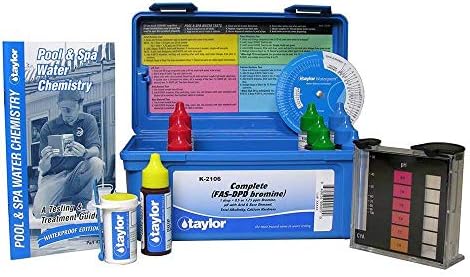
Bromine is common in hot tubs because it holds up well in hot water. However, most chlorine kits are not set up for it. The Taylor K-2106 is the bromine version of the FAS-DPD kit, so you titrate bromine to a clear end point. Each drop equals 0.5 or 1.25 ppm, depending on the sample size.
In addition, it tests pH with acid and base demand, total alkalinity and hardness, at 10 ppm per drop. As a result, one kit covers the full spa check. By comparison, the CDC sets a 4 ppm minimum bromine level for public hot tubs, so a kit with fine steps near that number is useful.
- Bromine method: FAS-DPD titration, 1 drop = 0.5 or 1.25 ppm
- pH: 7.0 to 8.0 comparator with acid/base demand
- Total alkalinity: 1 drop = 10 ppm as CaCO3
- Hardness: 1 drop = 10 ppm as CaCO3
Pros
- Bromine read by drop count
- Covers balance tests for spas
- Also refillable by reagent
Cons
- No cyanuric acid test
- Slower than strips
- Overkill for a chlorine pool
Skip it if: Your spa uses chlorine, since the K-2006C reads chlorine in finer steps.
Best Spa Strips
6. AquaChek SPA 6-in-1 Test Strips, 50 Count

Best for: Hot tub owners who want a fast check before each soak, whatever sanitizer they use.
Notably, spas swing faster than pools because the water is small, hot and shared. So a quick strip before each soak makes sense. The AquaChek SPA 6-in-1 reads total bromine, total chlorine, free chlorine, pH, total alkalinity and total hardness on one strip.
As a result, it works whether your tub runs on bromine or chlorine. However, it gives ranges, not drop counts. Therefore, pair it with a titration kit once a week and use the strips for daily checks. For more on reading pH pads well, see our picks for the best pH test strips.
- Results: total bromine, total chlorine, free chlorine, pH, alkalinity, hardness
- Count: 50 strips
- Read: color chart on the bottle
- Made for spas and hot tubs
Pros
- One strip for bromine or chlorine tubs
- Fast enough for a pre-soak check
- Also includes a hardness pad
Cons
- No cyanuric acid pad
- Smaller count than pool strips
- Color steps are broad
Skip it if: You need exact sanitizer numbers, since the K-2106 does that.
Best Basic Drop Kit
7. Poolmaster 5-Way Pool and Spa Water Test Kit with Case
Best for: New pool owners who want a simple liquid kit for chlorine, pH and alkalinity.
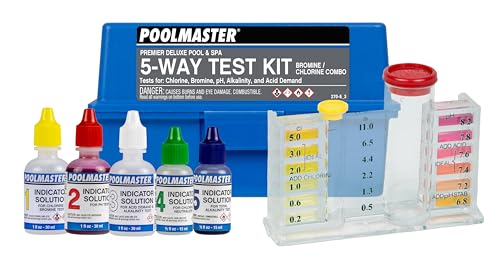
To begin with, the Poolmaster 5-Way is a classic color comparator kit. To use it, you fill the test block, add reagent drops, and match the color to the built-in chart. Specifically, it checks chlorine, bromine, pH, total alkalinity and acid demand.
Unlike the Taylor FAS-DPD kits, the chlorine test is a color match, not a titration. Consequently, readings above the normal pool range are hard to judge. Still, the liquid pH test is clearer than most strips. Overall, it suits owners who test the basics and take a sample to a pool store for a full panel.
- Tests: chlorine, bromine, pH, total alkalinity, acid demand
- Method: liquid reagents with a color comparator block
- Includes a carry case
- Works for pools and spas
Pros
- Simple liquid tests for the basics
- Acid demand helps dose pH down
- Also comes in a tidy case
Cons
- Chlorine read by color match
- No cyanuric acid or hardness test
- Reagents age and need replacing
Skip it if: You want free and combined chlorine split cleanly, since FAS-DPD does that.
Best Backup Strips
8. Poolmaster Smart Test 6-Way Test Strips, 2 Pack
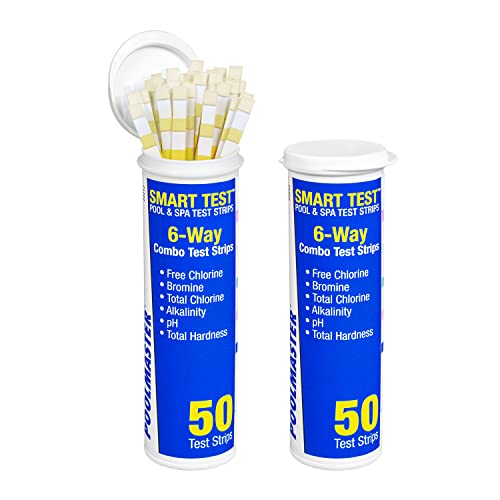
Best for: Owners who want a second set of strips in the pool shed or for a vacation home.
Similarly, the Poolmaster Smart Test 6-Way reads free chlorine, total chlorine, bromine, pH, total alkalinity and total hardness. So it covers the same daily checks as the EASYTEST strips, apart from cyanuric acid. The 2 pack also means you can keep one bottle sealed while you use the other.
Keeping a bottle sealed matters, because humidity slowly spoils open strips. In short, it is a good backup or a starter set for a small above-ground pool. For hardness in more detail, our water hardness test kit guide explains the finer drop tests.
- Results: free chlorine, total chlorine, bromine, pH, alkalinity, total hardness
- Count: 50 strips per bottle, 2 bottles
- Read: color chart on the bottle
- For pools and spas
Pros
- Two bottles, so one stays sealed
- Includes a hardness pad
- Also quick for daily checks
Cons
- No cyanuric acid pad
- Coarse color steps
- Not a replacement for a drop kit
Skip it if: You run an outdoor chlorine pool with stabilizer, since you will need a CYA test too.
How We Chose the Best Chemical Tester Picks
To be clear, we did not test these kits by hand. Instead, our picks are research-based. First, we listed the tests a pool or spa actually needs, using public health targets from the CDC guide for operating pools and hot tubs and the Columbus Public Health water parameter sheet. Next, we compared each kit’s test method, step size and parameter list on maker and dealer spec pages, such as the ITS eXact EZ Master kit page.
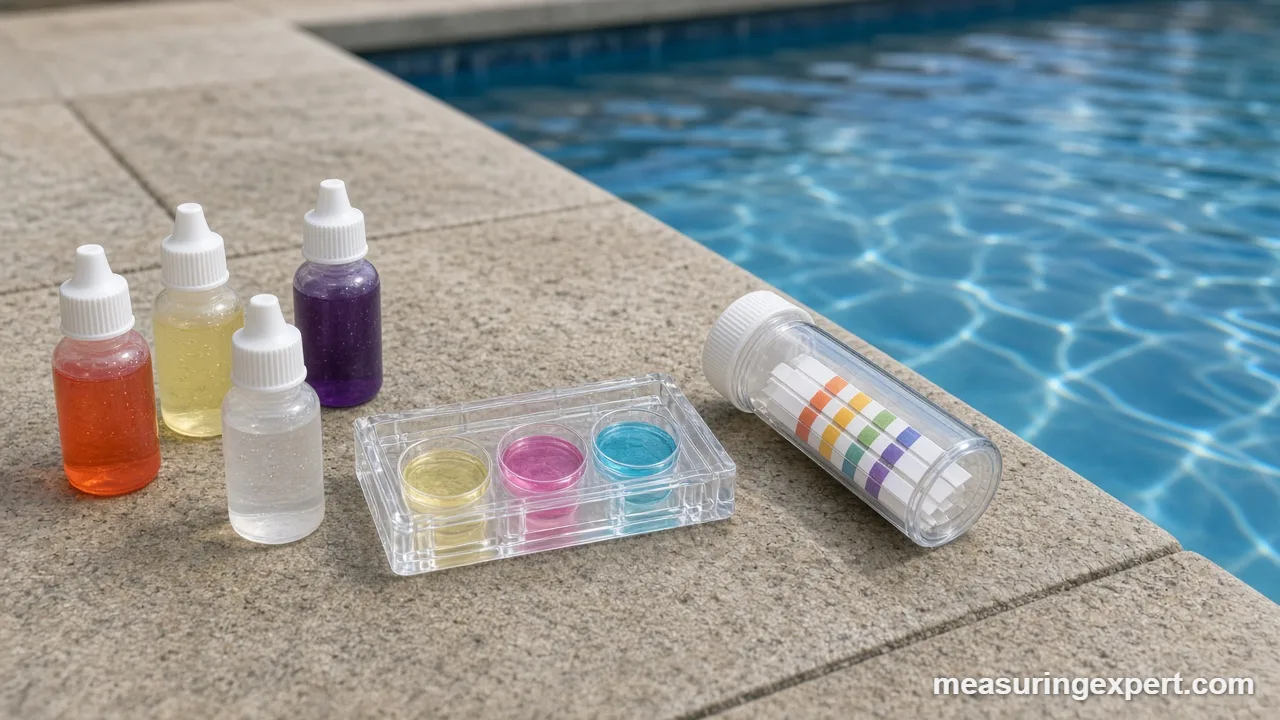
In addition, we weighed owner feedback on how easy each kit is to read and refill. Also, we kept to established brands, allowed at most two products per brand, and dropped near-duplicate strip listings. Finally, we left out drinking water kits, food service sanitizer tape and drug test kits, because this guide covers pool and spa water only.
- Method: titration beats color matching for chlorine and alkalinity.
- Coverage: free chlorine, pH, alkalinity, hardness and stabilizer at a minimum for outdoor pools.
- Step size: finer steps near the target range score higher.
Drops vs Strips vs Photometers: Which Best Chemical Tester Type?
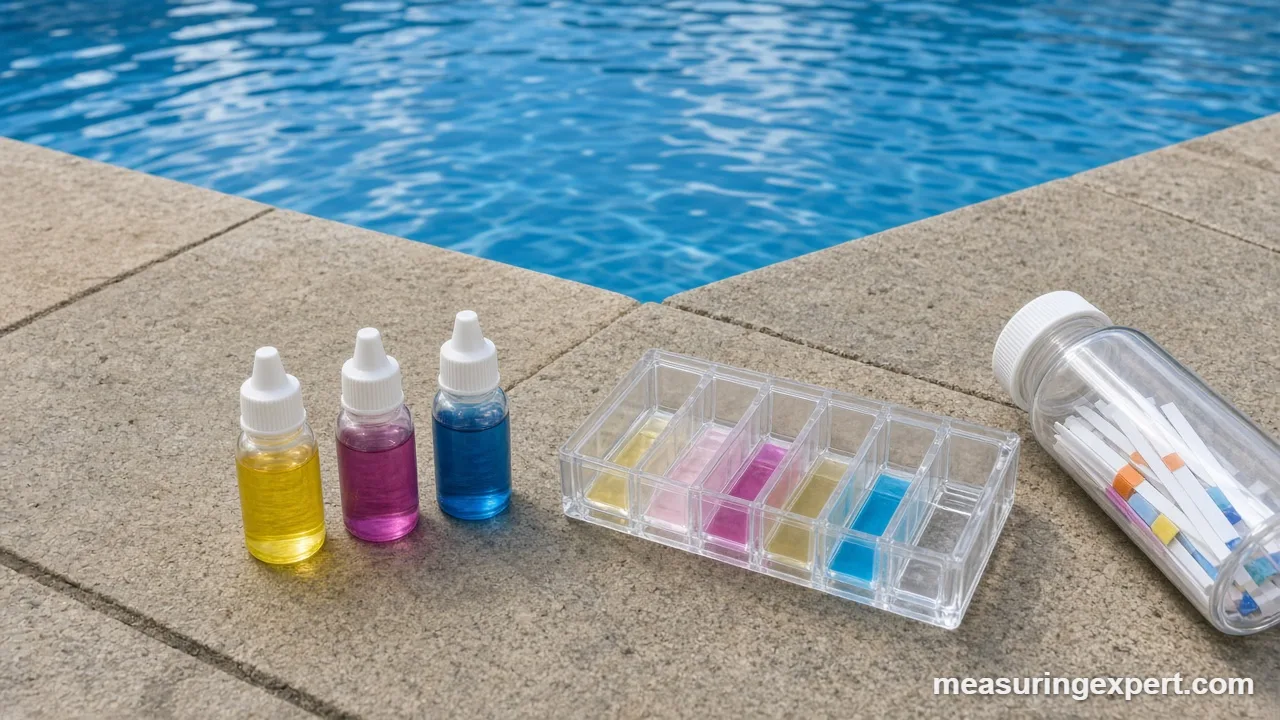
Every pool chemical tester turns a chemical reaction into a number. However, the difference is how the number is read. For example, a titration kit counts drops, a strip asks you to match a color, and a photometer measures light. As a result, the three types differ in precision, speed and cost per test.
| Type | How it reads | Typical step size | Best use |
|---|---|---|---|
| FAS-DPD titration kit | Count drops to a clear end point | 0.2 or 0.5 ppm chlorine per drop | Weekly full balance, troubleshooting |
| Color comparator kit (DPD or OTO) | Match sample color to a chart | Fixed color blocks | Basic chlorine and pH checks |
| Test strips | Match pad colors to a chart | Broad ranges | Fast daily checks |
| Photometer | Meter reads light through the sample | Digital readout | No color judgment, many parameters |
| Salt titrator | Read the height of a color change | Scale on the stick | Salt chlorine generator pools |
In short, most owners do well with a drop kit for weekly balancing plus strips for daily checks. However, if color blindness or poor light makes matching hard, a photometer removes that problem.
What a Pool Chemical Tester Measures (and Target Ranges)
A chemical tester is only useful if you know what number to aim for. So the table below shows the ideal ranges from the Columbus Public Health sheet, with the CDC minimums for sanitizer. Note that ppm means parts per million, which equals milligrams per liter (mg/L) in water.
| Test | Pool target | Spa target | Why it matters |
|---|---|---|---|
| Free chlorine | 2 to 4 ppm (1 ppm minimum) | 3 to 5 ppm (CDC minimum 3 ppm) | Kills germs and algae |
| Combined chlorine | 0 ppm, under 1 ppm | 0 ppm, under 1 ppm | Spent chlorine; causes odor and irritation |
| Bromine | 3 to 5 ppm | 4 to 6 ppm (CDC minimum 4 ppm) | Sanitizer in many hot tubs |
| pH | 7.4 to 7.6 (7.2 to 7.8 limits) | 7.4 to 7.6 | Comfort and sanitizer strength |
| Total alkalinity | 80 to 120 ppm | 80 to 120 ppm | Buffers pH swings |
| Calcium hardness | 200 to 400 ppm | 150 to 250 ppm | Prevents etching or scale |
| Cyanuric acid | 30 to 50 ppm (under 70 ppm) | Usually not used | Shields chlorine from sunlight |
Salt is the exception, though. Instead of a single public health number, follow the range in your salt cell manual, and check it with a salt test or a digital meter. Also, local codes for public pools can differ, so use your health department’s numbers if you run a public or rental pool.
How Drop Counts Become ppm in a Best Chemical Tester Kit
Titration is simple math. In fact, each drop of titrant cancels a known amount of the chemical in a known volume of water. Therefore, the kit prints a factor such as “1 drop = 0.5 ppm,” and you multiply.
- Free chlorine: 12 drops x 0.5 ppm = 6.0 ppm. With the larger sample, 12 drops x 0.2 ppm = 2.4 ppm.
- Total alkalinity: 9 drops x 10 ppm = 90 ppm, which sits inside the 80 to 120 ppm target.
- Calcium hardness: 25 drops x 10 ppm = 250 ppm.
The larger sample gives finer steps because each drop is spread across more water. So use it when you are close to a target, such as holding chlorine in the 2 to 4 ppm band. By contrast, the smaller sample saves reagent when the level is high, for example after a shock.
Measure Your Pool Volume Before You Dose
In short, a test result only becomes a dose once you know how much water you have. For a rectangular pool, multiply length x width x average depth in feet, and then multiply by 7.48 gallons per cubic foot. In metric, multiply meters x meters x meters, and then multiply by 1,000 to get liters.
| Pool | Average depth | Volume (US) | Volume (metric) |
|---|---|---|---|
| 16 x 32 ft (4.88 x 9.75 m) | 4.5 ft (1.37 m) | About 17,235 gal | About 65,240 L |
First, to find the average depth, add the shallow and deep end depths and divide by 2. Also, for a round pool, use 3.14 x radius x radius x average depth x 7.48.
How to Get Reliable Results From the Best Chemical Tester
In practice, most bad readings come from the sample, not the kit. So follow the same routine each time.
- Rinse the sample tube or cup with pool water two or three times.
- Take water from elbow depth, away from return jets, skimmers and chlorine feeders.
- Fill the tube exactly to the line on a flat surface at eye level.
- Add reagent drops with the bottle held straight up, and swirl after each drop.
- Read the color against a white background in daylight, or count drops to the end point.
- Record the result, the date and the time in a log or app.
- Rinse the tubes with tap water and close every bottle right away.
In addition, test at about the same time of day. Sunlight burns off chlorine, so a noon reading is usually lower than a morning one.
Reagent Care and Shelf Life
Reagents and strips age, and as a result, old chemistry reads wrong. For that reason, store kits indoors, away from heat and direct sun, and keep caps tight. Also, never leave a strip bottle open in a humid pump room, because moisture changes the pads before you use them.
- Do: mark the purchase date on each bottle and replace reagents each season.
- Do: buy single refills for the reagents you use most, such as chlorine titrant and pH indicator.
- Don’t: mix reagents between brands; for example, Poolmaster warns its pH indicator is not interchangeable with other kits.
- Don’t: touch strip pads with wet fingers.
Honest Limits of Home Water Testing
A home chemical tester is a good tool, but it has limits. First, strips give ranges, so two people can read the same pad differently. Second, very high chlorine can bleach a DPD sample and give a falsely low or clear reading; dilute the sample if that happens. Third, some tests, such as metals and phosphate, need a photometer or a store test. Finally, none of these kits test drinking water safety, so use a lab or a certified drinking water kit for a well.
Best Chemical Tester FAQ
What is the best chemical tester for a pool?
For most owners, the best chemical tester is a FAS-DPD drop kit such as the Taylor K-2006C. It counts drops to a clear end point, so chlorine, alkalinity and hardness readings do not depend on matching colors.
Are test strips accurate enough?
Strips are fine for daily checks, because they show whether a level is low, normal or high. However, they read in broad color steps, so confirm with a drop kit before a large dose.
What is the best chemical tester for a hot tub?
For a bromine hot tub, the Taylor K-2106 is a strong pick because it titrates bromine in 0.5 ppm steps. For quick checks before each soak, AquaChek SPA 6-in-1 strips also work well.
How often should I test pool water?
Test chlorine and pH two to three times a week for a home pool, and daily in hot weather or heavy use. In addition, test alkalinity, hardness and stabilizer about once a week.
What is the difference between free and total chlorine?
Free chlorine is the active sanitizer. By contrast, total chlorine is free plus combined chlorine, and combined chlorine is spent chlorine that has reacted with sweat and other waste. So total minus free equals combined.
Do I need a special chemical tester for a salt pool?
Yes, you need a salt test as well as a chlorine test. For example, AquaChek salt titrators read 400 to 7,000 ppm, while a digital salinity meter gives a faster reading.
Why does my pool store reading differ from my kit?
Usually, reagent age, sample handling and test method all cause differences. In addition, store photometers and home strips use different chemistry. Therefore, retest with fresh reagents and compare the same parameter by the same method.
How long do test reagents last?
In general, most liquid reagents and strips last about one season once opened, if stored cool and dry. However, check the date on each bottle, and replace any reagent that looks cloudy or discolored.
Is a digital chemical tester worth it?
A photometer is worth it if you struggle to read colors or test many pools. On the other hand, it costs more up front and needs its own strips or reagents, so a drop kit is better value for one pool.
Can a pool chemical tester check drinking water?
No, because pool kits are not built for drinking water safety. Instead, use a certified drinking water kit or a state-certified lab, especially for well water.
Bottom Line: The Best Chemical Tester to Buy
For most pool owners, the Taylor K-2006C Service Complete FAS-DPD Test Kit is the best chemical tester. After all, it turns chlorine, alkalinity and hardness into drop counts, so the result does not depend on your eyes. However, add EASYTEST strips for daily checks, pick the AquaChek Salt System kit for a salt pool, or choose the Taylor K-2106 for a bromine hot tub.