

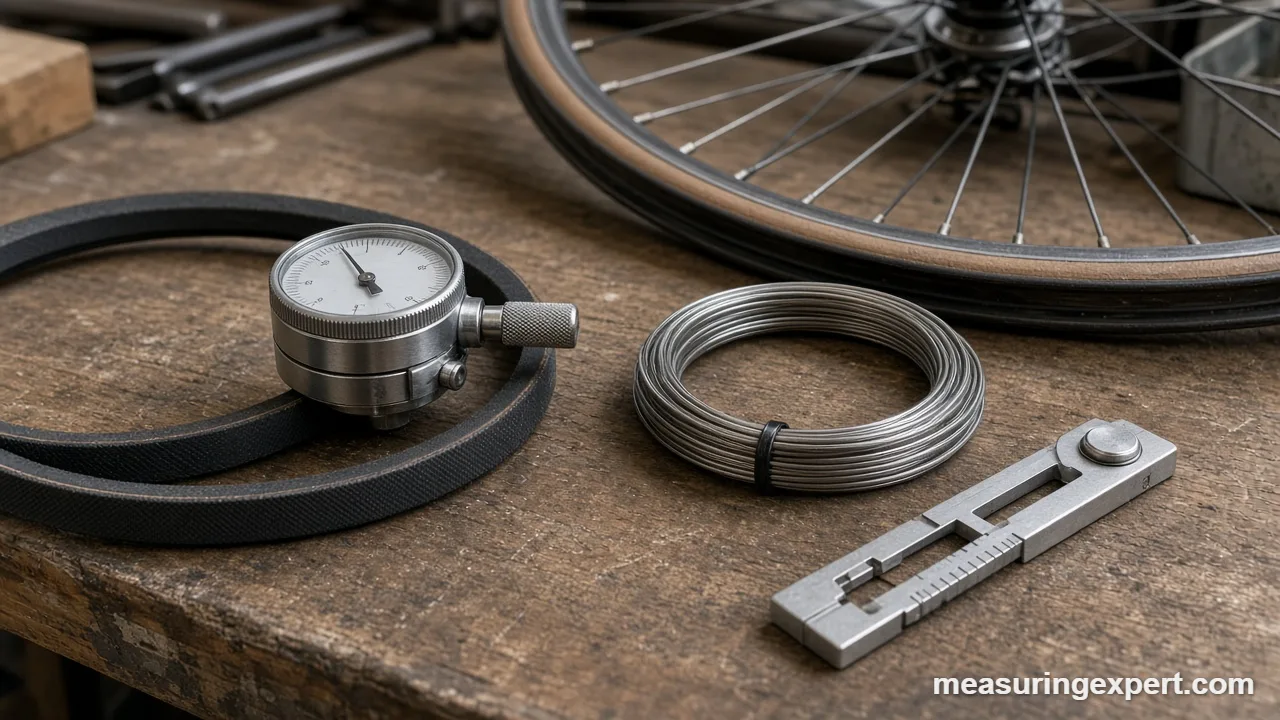
The best tension gauge for most buyers is the Loos PT-1, because it hooks onto stainless cable and shows tension while you adjust it. However, the right tool depends on what you tension: belts, rigging wire, bike spokes or sewing thread each need a different gauge and scale.
In short: get the Loos PT-1 for cable and rigging, the Gates Krikit for car V-belts, and the OTC 6673 for a shop that checks many belt types.
As an Amazon Associate, Measuring Expert earns from qualifying purchases. Our picks are based on research, specifications and owner feedback, not paid placement.
Best Overall

Best Budget
Best Pro

Quick Answer: Best Tension Gauge Picks at a Glance
- Sailboat rigging and cable: Loos PT-1 for 3/32 to 5/32 in wire, or the PT-2 for 3/16 to 1/4 in.
- Car and mower V-belts: Gates Krikit, a 30 to 160 lb pocket gauge.
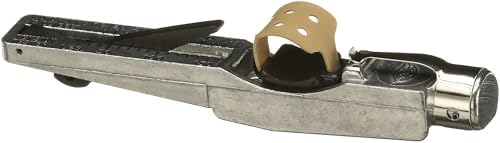
- Professional belt work: OTC 6673, with a 30 to 180 lb dial that also suits timing belts.
- Bicycle wheels: Super B 1501 spoke tension meter.
- Embroidery bobbins: TOWA TM-1, which reads thread pull in grams.
- Motorcycle drive belts: Motion Pro 08-0350 for 10 lb specs.
On This Page
- Comparison table
- The 9 picks, reviewed
- How we chose
- Belt, wire, spoke or thread
- Units, range and accuracy
- Typical target tensions
- How to check belt tension
- Care and calibration
- Do and Don’t
- Honest limits
- FAQ
- Bottom line
Best Tension Gauge Comparison Table
Each pick gets one row below. Next, the reviews explain the ranges, the units and the trade-offs.
| # | Product | Best For | Standout Feature | Amazon |
|---|---|---|---|---|
| 1 | Loos and Co. PT-1 Professional Tension Gauge | Rigging and cable on small to mid-size boats | Hooks onto 3/32, 1/8 and 5/32 in wire and stays put | View |
| 2 | Gates 91107 Krikit V-Belt Tension Gauge | Car, mower and shop V-belts | Pocket-size 30 to 160 lb (15 to 75 kg) scale | View |
| 3 | OTC 6673 Universal Belt Tensioning Gauge | Shops checking serpentine, V and timing belts | Dial reads 30 to 180 lb (130 to 800 N) | View |
| 4 | Loos and Co. PT-2 Professional Tension Gauge | Shrouds and stays on 3/16 to 1/4 in wire | Same hands-off design sized for heavier wire | View |
| 5 | Super B 1501 Spoke Tension Meter | Wheel building and truing | Dial tensiometer for checking spoke balance | View |
| 6 | TOWA TM-1 Bobbin Case Tension Gauge | Embroidery and sewing bobbin tension | Gram scale for L-style bobbin cases | View |
| 7 | Browning 1302546 Belt Tension Checker | Multi-belt V-drives on motors and fans | Span and force scales using the 1/64 deflection rule | View |
| 8 | Gates 7401-0076 Pencil Tension Tester | Small V-belts and synchronous belts | Pencil-style tester with a 30 lb maximum | View |
| 9 | Motion Pro 08-0350 Belt Tension Gauge | Belt-drive motorcycles with a 10 lb spec | Replaces Harley-Davidson tool 40006-85 | View |
The 9 Best Tension Gauge Picks, Reviewed
A tension gauge measures how hard a belt, wire, spoke or thread is pulled. This list therefore covers those four jobs. However, it skips push-pull meters, which live in our best force gauge guide. Likewise, bike and motorcycle chain tools are in our chain tension gauge roundup.
Best Overall
1. Loos and Co. PT-1 Professional Tension Gauge
Best for: Sailors, riggers and anyone who tensions 3/32 to 5/32 in (2.5 to 4 mm) stainless cable.
The PT-1 is our best tension gauge overall because it does one hard job very well. Specifically, it measures the tension in standing rigging and other stainless cable without any guesswork. First, you hook it onto the wire. Next, it holds its position while you turn the turnbuckle, so you can watch the pointer move. As a result, you adjust and read at the same time.
Loos builds the frame from anodized aluminum in the USA. However, the scale is calibrated for 302/304 1×19 stainless wire. On other wire, however, the readings stay repeatable, but the pound values shift. So treat it as a comparison tool on those cables. In addition, Loos rates its standard models at +/-5% and says the Professional models are more accurate.
- Wire sizes: 3/32, 1/8 and 5/32 in (2.5, 3 and 4 mm)
- Calibrated for 302/304 1×19 stainless steel wire
- Hands-off design that stays on the wire during adjustment
- Anodized aluminum frame, made in USA
- Imperial (lb) and metric (kg) versions exist
Pros
- You can read tension while you adjust it, so tuning is faster
- Rugged, corrosion-resistant frame
- Also turns rig tuning into repeatable numbers
Cons
- Covers only three wire sizes
- Scale assumes 1×19 stainless wire
- Overkill for one check, because a rigger can do it once
Skip it if: your boat uses 3/16 in wire or larger, because the PT-2 or PT-3 fits those sizes.
Best Budget
2. Gates 91107 Krikit V-Belt Tension Gauge
Best for: DIY mechanics who want a quick, cheap number for V-belts and V-ribbed belts.
First, you press it on the belt span until it clicks. Then the indicator arm stays at the reading, so you can lift it out and read it.
Gates lists it for V and V-ribbed belts and says it is not for timing belts. Also, the scale reads in both pounds and kilograms. In short, it is a simple way to catch a slack accessory belt before it squeals. However, it is not a precision instrument, so repeat each check two or three times.
- Range: 30 to 160 lb (15 to 75 kg)
- For V-belts and V-ribbed belts; not for timing belts
- Die-cast aluminum body with nylon arm and pad
- Stainless steel pocket clip; weight about 0.12 lb
Pros
- Very low cost for a real gauge
- Also fits in a pocket
- Reading stays put after you lift it
Cons
- Coarse scale
- Not for timing belts
- Hard to seat on short spans, so tight engine bays slow you down
Skip it if: you service timing belts or need tight accuracy, because a dial gauge like the OTC 6673 suits that work better.
Best Pro Belt Gauge
3. OTC 6673 Universal Belt Tensioning Gauge
Best for: Technicians who check many belt types and want a dial reading in pounds or newtons.
The OTC 6673 is a hook-style dial gauge. First, you press the ball so the hook catches the belt. Next, you hold the gauge square to the belt edge and release the ball with a quick snap. Finally, you read the dial against the indicator on the body.
In addition, it covers serpentine belts, V-belts and timing belts, so one tool handles most engine bays. Also, its 30 to 180 lb (130 to 800 N) range matches typical automotive specs.
- Range: 30 to 180 lb (130 to 800 N)
- Belt types: serpentine, V and timing belts
- Dial face read against a body indicator
- Size: 9.1 x 5.4 x 2.3 in; made in USA
Pros
- Wide range in two units
- Also works on timing belts
- Dial is easy to read in a bay
Cons
- Larger than a pocket gauge
- Needs room to hook the belt
- However, it costs more than a Krikit
Skip it if: you only check one mower or car belt a year, because the Krikit does that for far less.
Best for Larger Boats
4. Loos and Co. PT-2 Professional Tension Gauge
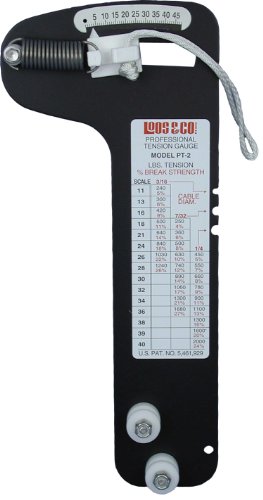
Best for: Owners of mid-size cruisers whose shrouds and forestay use 3/16, 7/32 or 1/4 in (5, 6 or 7 mm) wire.
It works the same way, but instead its slots fit 3/16, 7/32 and 1/4 in wire. Also, Loos makes a PT-3 for 1/4 to 3/8 in wire, so check your wire size with a caliper before you order.
Loos lists the gauge line as made in the USA from corrosion-resistant anodized aluminum. Likewise, the scale assumes 1×19 stainless wire, so other constructions give relative readings.
- Wire sizes: 3/16, 7/32 and 1/4 in (5, 6 and 7 mm)
- Calibrated for 302/304 1×19 stainless steel wire
- Hands-off design with a pointer scale
- Anodized aluminum, made in USA; imperial or metric versions
Pros
- Fits the most common cruiser wire sizes
- Repeatable readings for seasonal re-tuning
- Also suits guy wires and tent cables
Cons
- Wrong size for small dinghies
- Same 1×19 calibration limit as the PT-1
- Also pricier than the smaller model
Skip it if: your rigging is 5/32 in or smaller, because the PT-1 fits that wire.
Best for Bike Spokes
5. Super B 1501 Spoke Tension Meter

Best for: Home mechanics who build or true bicycle wheels and want to even out spoke tension.
A spoke tension meter flexes a spoke between two posts with a calibrated spring. Then the dial shows that deflection. However, the dial number is not kgf. Instead, you look it up on a chart for your spoke material and diameter.
This Super B meter is a dial-type tensiometer for wheel work. Park Tool notes that most rims call for about 100 to 120 kgf (980 to 1,177 N). Also, spokes within +/-20% of the average count as balanced. So a meter like this helps you build wheels that stay true longer.
- Dial-type spoke tensiometer with a spring-loaded deflection post
- Readings convert to kgf with a chart for spoke size and material
- Used during building and truing to compare spokes
- Typical rim target: 100 to 120 kgf (980 to 1,177 N), per Park Tool
Pros
- Turns wheel building into numbers
- Shows weak spokes early, so they get fixed before they loosen
- Compact enough for a home bench
Cons
- Needs a conversion chart for kgf
- Measure spoke diameter first, which takes a caliper
- Less documentation than a Park Tool TM-1
Skip it if: you only replace a broken spoke now and then, because a shop truing check costs less than the tool.
Best for Thread
6. TOWA TM-1 Bobbin Case Tension Gauge
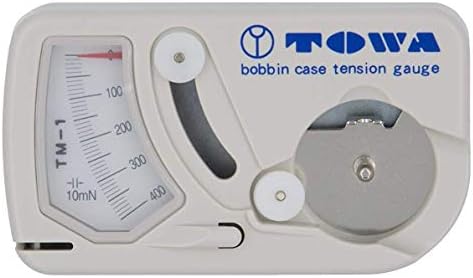
Best for: Embroiderers and sewists who want consistent bobbin tension on L-style bobbin cases.
For example, if the bobbin is too tight, top thread pulls through to the back. On the other hand, if it is too loose, bobbin thread loops on top. So the TOWA gauge measures the pull needed to draw thread from a loaded bobbin case, in grams.
This TM-1 fits the size L bobbins used in most commercial embroidery machines. For example, ColDesi suggests about 240 g for filament bobbin thread and about 220 g for spun thread. Therefore, you can set every case in a shop to the same value. For M-style jumbo cases, TOWA makes the TM-3.
- Fits L-style embroidery bobbin cases
- Reads thread pull in grams
- Guideline targets: about 240 g filament, about 220 g spun (ColDesi)
- TM-3 sibling covers M-style jumbo cases
Pros
- Ends guesswork with the drop test
- Also lets you match every bobbin case
- Small and simple
Cons
- Only fits L-style cases
- Measures bobbin thread, not top thread
- Target values vary by thread and machine
Skip it if: you sew on a drop-in home machine, because its bobbin case style may not fit.
Best for Industrial Drives
7. Browning 1302546 Belt Tension Checker
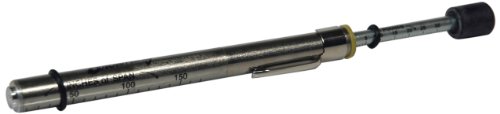
Best for: Maintenance techs who tension V-belt drives on motors, blowers and pumps.
The Browning checker uses the span-deflection method. First, you set one O-ring to the belt span. Next, you push the belt at mid-span until it deflects 1/64 in per inch of span. Then you read the force on the second scale and compare it with Browning’s table.
Overall, it applies up to 33 lb (15 kg). Also, the chart lists minimum and maximum forces by belt section, sheave size and speed. For example, a 64 in span should deflect 1 in. In addition, Browning advises tensioning new belts to the maximum value and used belts to the minimum.
- Force capacity: up to 33 lb (15 kg)
- Span scale (in or cm) and force scale (lb or kg)
- Deflection rule: 1/64 of span
- Tables cover 3L to 8V and 3V/5V belt sections
Pros
- Matches published drive tables
- Also works in inch or metric units
- Steel body survives shop use
Cons
- Two-step reading takes practice at first
- 33 lb cap rules out big 8V belts
- Needs a straight edge on single-belt drives
Skip it if: you work on car accessory belts, because the Krikit or OTC fits that job faster.
Best for Small Belts
8. Gates 7401-0076 Pencil Tension Tester

Best for: Technicians who tension small V-belts and synchronous (timing) belts on light machinery.
The pencil tester is a spring plunger with two sliding rings. First, you push it into the belt at mid-span until the belt deflects the set amount. Then the ring shows the force you used.
Gates lists a maximum deflection force of 30 lb. Also, Gates rates it for small V-belts and synchronous belts. As a result, it pairs well with Gates drive design data, which lists deflection forces for each belt. However, larger industrial belts need a higher-range tester.
- Maximum deflection force: 30 lb
- For small V-belts and synchronous belts
- Pencil-style body with sliding indicator rings
- Uses the span-deflection method
Pros
- Slim enough for tight drives
- Also works on synchronous belts
- Simple spring mechanism
Cons
- 30 lb ceiling
- Reading depends on a steady push, so results vary by hand
- Needs a separate deflection reference
Skip it if: you check heavy multi-belt drives, because the Browning checker has more range and a span scale.
Best for Motorcycles
9. Motion Pro 08-0350 Belt Tension Gauge

Best for: Riders who adjust the secondary drive belt on a belt-drive motorcycle.
Belt-drive motorcycles set tension by deflection under a fixed force. For instance, many models, especially Harley-Davidsons, use a 10 lb (4.54 kg) spec. So this gauge pushes the belt with that force, and you read how far the belt moves on the bike’s window or scale.
Motion Pro says it works with all belt-drive models with a 10 lb spec. Also, the L-shaped pad fits all belt widths. In addition, it replaces the Harley-Davidson OEM tool 40006-85.
- Set for a 10 lb (4.54 kg) belt specification
- L-shaped pad fits all belt widths
- Replaces H-D OEM part 40006-85
- Compact body with a reference scale
Pros
- Cheap fix for a common chore
- Also matches the factory method
- Fits in a saddlebag
Cons
- Only for 10 lb specs
- However, it is not for car or industrial belts
- You still need the deflection target from the manual
Skip it if: your bike uses a chain, because a chain needs a slack check, not a belt force gauge.
How We Chose the Best Tension Gauge Picks
To be clear, we did not test these gauges by hand. Instead, our picks are research-based. First, we sorted tension jobs into four groups: belts, wire and cable, bicycle spokes and sewing thread. Next, we looked for established brands with a published range, a clear method and real support documents. Then, for each pick, we checked specs on manufacturer pages, dealer spec sheets and instruction manuals.
In addition, we weighed owner feedback for common failure points, such as sticky sliders or hard-to-read scales. We also capped each brand at two picks and dropped unbranded listings with no spec sheet.
Sources we opened include the Park Tool spoke tension guide, the Loos tension gauge instruction sheet and the Browning belt tension checker instructions.
Choosing the Best Tension Gauge by Job: Belt, Wire, Spoke or Thread
In general, every tension gauge uses the same idea. It pushes or pulls the material sideways and measures how much force that takes, or how far it moves. However, each material needs a different frame, scale and range. So start with the job, not the brand.
| Gauge type | What it measures | Typical units | Example pick |
|---|---|---|---|
| Rigging / cable gauge | Static tension in stainless wire | lb or kg, via a chart | Loos PT-1, PT-2 |
| Click-style belt gauge | Belt tension on V and V-ribbed belts | lb and kg | Gates Krikit |
| Dial belt gauge | Serpentine, V and timing belt tension | lb and N | OTC 6673 |
| Deflection-force tester | Force to deflect a belt 1/64 in per inch of span | lb or kg | Browning checker, Gates pencil tester |
| Spoke tensiometer | Spoke deflection, converted to kgf | Dial units, then kgf | Super B 1501 |
| Bobbin tension gauge | Pull to draw thread from a bobbin case | grams | TOWA TM-1 |
Best Tension Gauge Specs Explained: Units, Range and Accuracy
Units
Belt and cable gauges read in pounds-force (lbf), kilograms-force (kgf) or newtons (N). One lbf equals about 4.448 N, and one kgf equals 9.80665 N. So the OTC 6673 range of 30 to 180 lb works out to about 133 to 801 N. Meanwhile, bobbin gauges read in grams of pull, which is a much smaller scale.
Range
Ideally, pick a gauge whose range puts your target near the middle. For example, Loos designs its rod gauges for about 5% to 25% of the rod breaking strength. In addition, it quotes +/-5% accuracy at mid-range. As a result, readings near either end of a scale carry more error.
Accuracy and repeatability
Many tension gauges publish no accuracy figure at all. However, repeatability often matters more. If a gauge reads the same spoke the same way every time, you can still balance a wheel.
Material and calibration chart
Similarly, wire gauges and spoke meters need a chart. This is because a thicker or stiffer wire deflects less at the same tension. So measure the wire or spoke diameter with a caliper first; our caliper guide covers good options for that step.
Typical Target Tensions Worth Knowing
First, always use the spec from your manual, sailmaker or rim maker. Still, these published guidelines show the scale of each job, so you know what to expect.
| Job | Typical target | Source |
|---|---|---|
| Bicycle rim spokes | About 100 to 120 kgf (980 to 1,177 N); keep spokes within +/-20% of average | Park Tool |
| Masthead forestay (rod) | About 15% of breaking strength | Loos |
| Masthead shrouds (rod) | About 10% to 12% of breaking strength; never over 25% | Loos |
| Industrial V-belts | Deflect 1/64 in per inch of span at the table force | Browning |
| Motorcycle drive belt | Deflection under 10 lb (4.54 kg), per the bike manual | Motion Pro / OEM |
| Embroidery bobbin thread | About 240 g filament, about 220 g spun | ColDesi |
How to Check Belt Tension With a Tension Gauge
This method fits deflection-type testers such as the Browning checker and the Gates pencil tester. Also, the same logic helps with click and dial gauges.
- Turn off the machine and lock out power so the drive cannot start.
- Measure the belt span between the two pulley contact points, in inches or centimeters.
- Set the span ring to that length, and set the force ring to zero.
- Press the tester square to the belt at mid-span until it deflects 1/64 in per inch of span.
- Remove the tester and read the force at the force ring.
- Compare the reading with the minimum and maximum values in the belt maker’s table.
- Adjust the tension, run the drive briefly, and then check again.
Browning advises tensioning new belts to the maximum table value, because they stretch as they seat. After that, it suggests checks at 8, 24 and 100 hours.
Care and Calibration for a Tension Gauge
Basically, a tension gauge is a spring and a scale, so keep both clean. First, wipe salt and grit off rigging gauges after each use. Next, Loos advises lubricating the slider slot with silicone so it moves freely. Otherwise, a binding slider gives a false reading.
For spoke meters, check calibration against a known reference now and then. For example, Super B offers a calibration tool for its pro meter. Finally, never leave a belt gauge on a belt when you start an engine.
Do and Don’t
Honest Limits: What the Best Tension Gauge Cannot Tell You
Even the best tension gauge reads only static tension at one spot. For example, it cannot show dynamic loads, such as a gust on a shroud or a hard start on a motor. Also, belt gauges assume the belt section in the table. As a result, a worn or wrong-size belt gives a misleading reading.
Likewise, stainless rigging stretches over time, so a reading from last season may not hold. Meanwhile, spoke charts depend on accurate diameter data. In short, a gauge gives you a repeatable number, but judgment still sets the target. For pulling loads in tests, a digital force gauge is the better tool, and for bolt preload, use a torque wrench.
Best Tension Gauge FAQ
What is the best tension gauge for car belts?
For most car owners, the Gates Krikit is the best tension gauge for V-belts and V-ribbed belts, with a 30 to 160 lb scale. However, it is not rated for timing belts. For shop use across serpentine, V and timing belts, the OTC 6673 dial gauge is the stronger choice.
What does a tension gauge measure?
A tension gauge measures how tightly a belt, wire, spoke or thread is pulled. Most models push the material sideways and read the force needed, or the distance it moves. Then a scale or chart converts that into pounds, kilograms, newtons or grams.
Can one tension gauge work on belts, cables and spokes?
No. Instead, each type uses a frame and scale built for one material. For example, a rigging gauge is calibrated for 1×19 stainless wire, while a spoke meter needs a spoke chart. So buy a gauge for the job you do most.
How tight should sailboat rigging be?
For rod rigging, Loos suggests about 15% of breaking strength for a masthead forestay and about 10% to 12% for masthead shrouds. It also says never exceed 25%. Still, start with the setting from your sailmaker or boat designer when one exists.
How much tension should bike spokes have?
Park Tool says most rims call for about 100 to 120 kgf, or 980 to 1,177 N. In addition, spokes within plus or minus 20% of the wheel average count as balanced. Even so, always check the rim maker’s limit first.
Is the best tension gauge for rigging accurate on other wire?
Not in absolute pounds. That is because Loos calibrates its scales for 302/304 1×19 stainless wire. On other wire, the readings stay repeatable, but the pound values differ. So use the gauge to compare shrouds rather than to hit an exact figure.
What is the best tension gauge for bobbin thread?
For L-style embroidery bobbin cases, the TOWA TM-1 is the standard choice. Also, it reads thread pull in grams. ColDesi suggests about 240 g for filament bobbin thread and about 220 g for spun thread as starting points.
How do I convert pounds of tension to newtons?
Multiply pounds-force by about 4.448 to get newtons. For example, 100 lbf is about 445 N. Likewise, multiply kilograms-force by 9.80665 to get newtons, so 100 kgf is about 981 N.
Is a force gauge the same as a tension gauge?
Not quite. First, a force gauge measures a push or pull applied straight along its shaft, which suits lab and product tests. By contrast, a tension gauge reads the tension already in a belt, wire or spoke from the side, often without removing anything.
How often should I check belt tension?
Browning recommends checks after a short run-in, then at 8, 24 and 100 hours, and periodically after that. Also, tension new belts to the maximum table value, because they stretch as they seat. Used belts should sit at the minimum value.
Bottom Line: The Best Tension Gauge for Your Job
Overall, the Loos PT-1 is the best tension gauge for cable and rigging, because it reads tension while you adjust it. However, match the gauge to the material. For example, pick the Gates Krikit or OTC 6673 for belts, the Super B meter for spokes and the TOWA TM-1 for bobbin thread.