

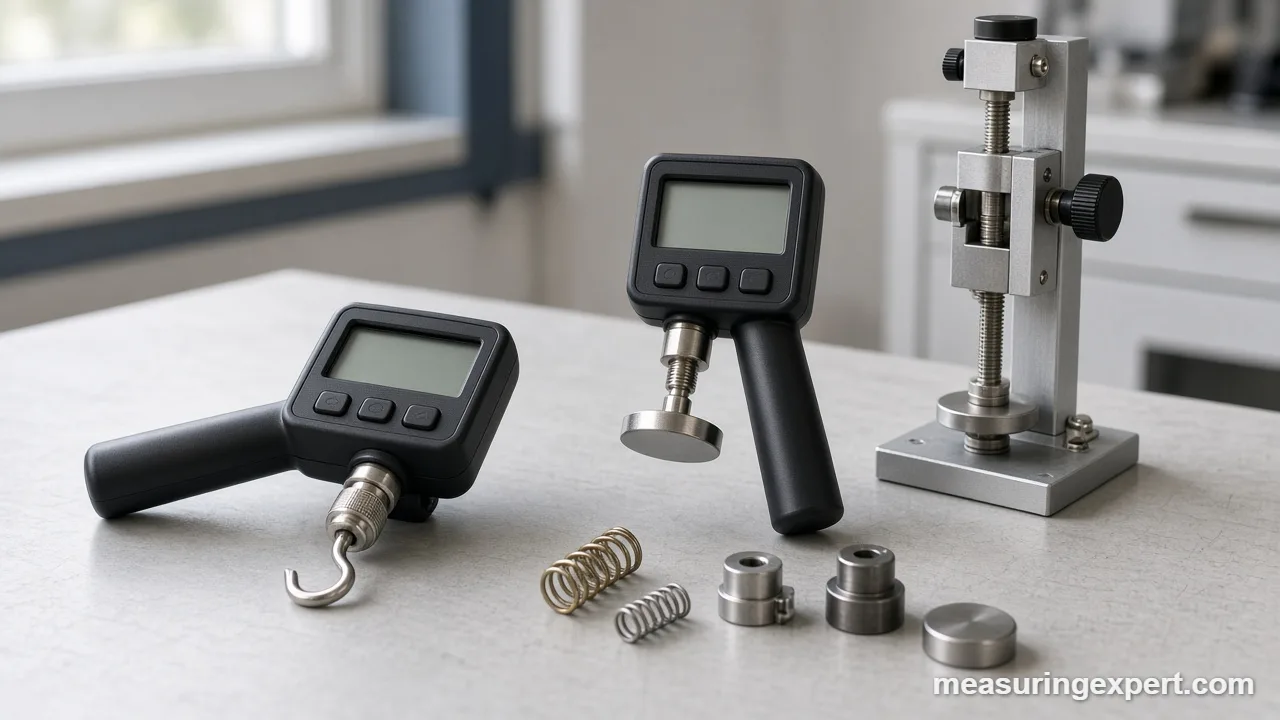
The best force gauge for most shops and labs is the Mark-10 M3-100, because it measures push and pull to 500 N (100 lbf) at +/-0.3% of full scale and logs over USB. Still, the right choice depends on your load range, the accuracy you must prove and whether you need data output.
In short: buy the Mark-10 M3-100 for everyday testing, the Wagner FDX 50 to save money, and the Mark-10 M5-100 when an auditor wants +/-0.1% and statistics.
As an Amazon Associate, Measuring Expert earns from qualifying purchases. Our picks are based on research, specifications and owner feedback, not paid placement.
Best Overall

Best Value

Best Pro

Quick Answer: Which Is the Best Force Gauge for Your Test?
- Mark-10 M3-100 Series 3: Shops and labs that want a dependable 500 N (100 lbf) digital gauge with USB output.
- Wagner Instruments FDX 50 Force Ten: Small shops that need a 50 lbf (250 N) digital gauge with USB and fast peak capture.
- Mark-10 M5-100 Series 5: Labs that need +/-0.1% accuracy, statistics and outputs for automation.
- Extech 475044 High-Capacity Digital Force Gauge: Field technicians who want a 44 lb (196 N) load-cell gauge on AA batteries.
- Extech 475040 Digital Force Gauge: Light-force checks on switches, springs and small parts up to 5 kg (49 N).
- EISCO Labs Acrylic Tubular Spring Scale (30 N / 3 kg): Classrooms and simple pulls where a spring tension gauge is all you need.
- EISCO Push Pull Balance (5 N / 500 g): Younger students who want to see both pushes and pulls on one simple tube.
On This Page
- Picks side by side
- The 7 picks, reviewed
- How we chose
- N, lbf and kgf explained
- Push-pull vs tension gauges
- Specs that matter
- How to take a reading
- Calibration and care
- Honest limits
- FAQ
- Bottom line
Best Force Gauge Picks Side by Side
First, here is every pick in one row each. Then the reviews cover the details.
| # | Product | Best For | Standout Feature | Amazon |
|---|---|---|---|---|
| 1 | Mark-10 M3-100 Series 3 | Most shops and labs | +/-0.3% of full scale, 2,000 Hz sampling | View |
| 2 | Wagner Instruments FDX 50 Force Ten | Value-minded QC work | 1,000/sec peak mode and rechargeable battery | View |
| 3 | Mark-10 M5-100 Series 5 | Labs and audited QC | +/-0.1% accuracy, 7,000 Hz, 1,000-reading memory | View |
| 4 | Extech 475044 High-Capacity Digital Force Gauge | Field checks on AA power | 20 kg (44 lb) capacity, reversible display | View |
| 5 | Extech 475040 Digital Force Gauge | Light loads under 5 kg | 1 g resolution and 10 kg overload | View |
| 6 | EISCO Labs Acrylic Tubular Spring Scale (30 N / 3 kg) | Classrooms and simple pulls | Dual N and g scales, twist zero screw | View |
| 7 | EISCO Push Pull Balance (5 N / 500 g) | Kids and early science | Push and pull on one dual-scale tube | View |
The 7 Best Force Gauge Options, Reviewed
First, we ranked these gauges by how well each one serves a typical buyer. So the all-round digital models come first, and the specialist tools follow. If you also tighten fasteners to a spec, our torque wrench picks cover the twisting side of force.
Best Overall
1. Mark-10 M3-100 Series 3
Best for: quality labs, maintenance shops and engineers who want a real load-cell gauge without paying for advanced features they will not use.
To begin, the Mark-10 Series 3 is the basic model in a line that many test labs already use, and the M3-100 is the 100 lbF (500 N) version. First, Mark-10 rates it at +/-0.3% of full scale, so the worst-case error is about 0.3 lbf (1.3 N) anywhere in the range. In addition, the internal sampling rate is 2,000 Hz, which catches fast break peaks.
Next, resolution is 0.1 lbF, 0.05 kgF or 0.5 N, depending on the unit you choose. Also, the backlit graphic display shows peak readings, set point indicators and a load bar, so you can see how close you are to capacity. Because it has a USB port, you can send single readings or a continuous stream to a PC.
- Capacity and resolution: 100 x 0.1 lbF, 50 x 0.05 kgF, 500 x 0.5 N
- Accuracy: +/-0.3% of full scale; 2,000 Hz sampling rate
- USB output up to 115,200 baud
- Battery: up to 7 hours with backlight, up to 24 hours without
- Safe overload: 200% of full scale; shows OVER at 110%
Pros
- Proven lab brand with tension and compression in one gauge
- Fast 2,000 Hz sampling catches break peaks
- USB output for logging
- Overload protection to 200% of capacity
Cons
- Coarser 0.5 N steps than the Series 5
- No on-board memory for 1,000 readings
- Accuracy is a percent of full scale, so tiny loads read less precisely
Skip it if: you mostly test forces under about 10 lbf (45 N); in that case, a lower-capacity model keeps the full-scale error much smaller.
Best Value
2. Wagner Instruments FDX 50 Force Ten
Best for: small manufacturers, product designers and technicians who need tension and compression peaks with USB at a lower cost.
To start, Wagner calls the FDX its low-cost digital line, yet the specs hold up well. To begin with, the FDX 50 reads 50 lbf in 0.05 lbf steps, 25 kgf in 0.02 kgf steps or 250 N in 0.2 N steps. In addition, Wagner rates it at +/-0.3% of full scale, plus or minus one digit. So the worst case is about 0.15 lbf (0.67 N).
Next, you can switch peak sampling between 100 per second for slow or static tests and 1,000 per second for break testing. Also, the gauge stores both tension and compression peaks. Finally, a rechargeable NiMH pack runs for about 50 hours, and Wagner includes a USB cable with its MESURlite software.
- Capacity and resolution: 50 x 0.05 lbf, 25 x 0.02 kgf, 250 x 0.2 N, 800 x 1 ozf
- Accuracy: +/-0.3% of full scale, +/-1 digit
- Peak sampling: 100/sec or 1,000/sec
- Rechargeable NiMH battery, about 50 hours; AC adapter included
- USB cable and MESURlite software included
Pros
- Four units: lbf, kgf, N and ozf
- Selectable fast peak mode for break tests
- Long battery life between charges
- Software included for basic logging
Cons
- No stated on-board memory beyond the held peaks
- Smaller 5-digit LCD than the Mark-10 graphic screens
- Overload rating is not listed on the spec page
Skip it if: you need set point outputs or statistics; instead, the Mark-10 M5-100 handles that job.
Best Pro
3. Mark-10 M5-100 Series 5
Best for: R&D labs, medical device makers and anyone who must document results to a tight tolerance.
First, the Series 5 is the advanced Mark-10 gauge, and the M5-100 shares the 100 lbF (500 N) capacity of our top pick. However, almost every spec moves up a level. For example, accuracy is +/-0.1% of full scale, which is 0.1 lbf (0.5 N) worst case, or one third of the Series 3 error. In addition, the sampling rate is 7,000 Hz, so very short peaks show up.
Similarly, resolution is finer too: 0.02 lbF, 0.01 kgF, 0.5 ozF, 10 gF or 0.1 N. Meanwhile, the gauge stores up to 1,000 readings and shows the min, max, mean and standard deviation. Because it adds USB, RS-232, Mitutoyo Digimatic, a +/-1 V analog output and three set point outputs, it can also drive a pass/fail light or a motorized test stand.
- Capacity and resolution: 100 x 0.02 lbF, 50 x 0.01 kgF, 1,600 x 0.5 ozF, 500 x 0.1 N
- Accuracy: +/-0.1% of full scale; 7,000 Hz sampling
- Memory: 1,000 readings with min, max, mean and standard deviation
- Outputs: USB, RS-232, Mitutoyo Digimatic, +/-1 VDC analog, 3 set points
- Safe overload: 200% of full scale
Pros
- Best accuracy in this roundup
- On-board statistics save a trip to the PC
- Outputs suit automated test stands
- Five units, including gF and ozF
Cons
- Far more gauge than a hobbyist needs
- Many features take time to learn
- Grips and stands are sold separately
Skip it if: you only need a quick peak reading; instead, the FDX 50 or a dial gauge costs less.
Best for Field Use
4. Extech 475044 High-Capacity Digital Force Gauge

Best for: technicians who work away from a bench and want a load-cell gauge that runs on AA batteries.
First, the Extech 475044 is a hand-held load-cell gauge with a 20 kg (44.1 lb, 196.1 N) capacity. For example, it suits door closers, latches, cable pulls and spring checks that run a little past what a light-duty gauge can handle. In addition, Extech lists a basic accuracy of +/-0.5%, with 0.01 lb, 0.01 kg or 0.05 N resolution.
Also, you can pick a fast 0.2 s or slow 0.6 s update, and peak hold freezes the highest reading. Meanwhile, the display reverses, so it stays readable when you push down or pull up. Because it runs on six AA cells, you can swap batteries in the field instead of hunting for a charger.
- Capacity: 20 kg / 44.1 lb / 196.1 N; overload to 30 kg
- Resolution: 0.01 lb, 0.01 kg, 0.05 N
- Basic accuracy: +/-0.5%
- Update rate: 0.2 s fast or 0.6 s slow; peak hold
- Power: 6 x AA batteries (included)
Pros
- Runs on easy-to-find AA cells
- Reversible display for push or pull
- Four adapters and a case included
- Peak hold and over-range warning
Cons
- No PC output listed
- Slower display update than lab gauges
- Accuracy is looser than the Mark-10 models
Skip it if: you need to log data to a computer; pick a Mark-10 or the Wagner FDX instead.
Best for Light Forces
5. Extech 475040 Digital Force Gauge
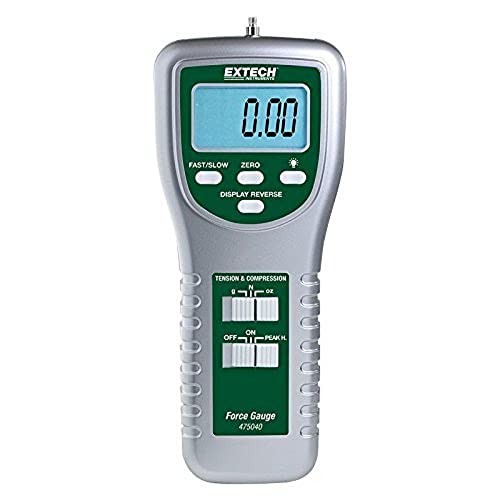
Best for: electronics, spring and packaging checks where loads stay under about 11 lb (49 N).
For small parts, however, a big gauge is the wrong tool, because full-scale error eats your reading. Specifically, the Extech 475040 has a 5,000 g (176 oz, 49 N) capacity, and it resolves 1 g, 0.05 oz or 0.01 N. As a result, it fits keypad and switch actuation, light spring tests, peel checks and connector insertion.
Also, Extech lists a basic accuracy of +/-0.4%, and the gauge tolerates a 10 kg overload. It also has peak hold, fast or slow update and a 5-digit LCD. Finally, like its bigger sibling, it runs on six AA batteries.
- Capacity: 5,000 g / 176 oz / 49 N; overload to 10 kg
- Resolution: 1 g, 0.05 oz, 0.01 N
- Basic accuracy: +/-0.4%
- Peak hold; 0.2 s fast or 0.6 s slow update
- Power: 6 x AA batteries
Pros
- Fine 1 g steps for light loads
- Generous overload margin
- Simple controls
- Adapters and case included
Cons
- Too small for heavy pulls
- No PC output listed
- Reads oz, g and N, but not lbf
Skip it if: your loads go past 11 lb (49 N); in that case, step up to the 475044.
Best Tension Gauge
6. EISCO Labs Acrylic Tubular Spring Scale (30 N / 3 kg)

Best for: physics classes, makers and hobby users who only need to measure a pulling force.
Still, not every job needs a push-pull gauge. Indeed, a spring tension gauge measures pull only, and this EISCO Labs scale is a common classroom choice. For example, it reads up to 30 N (3 kg) in 0.5 N or 50 g divisions, so one tube shows both newtons and grams. In addition, a twist screw lets you set zero before each pull.
Because the tube is clear acrylic, students can watch the spring stretch, which ties the reading back to Hooke’s law. However, EISCO gives no numeric accuracy figure, and there is no peak hold, so read it while the load is steady. In short, treat it as a teaching tool, not a quality-control gauge.
- Capacity: 30 N / 3 kg
- Divisions: 0.5 N / 50 g
- Dual scales in newtons and grams
- Twist zeroing screw; ring on top, hook on bottom
- Size: 6 in (152 mm) tube, 9.5 in (241 mm) overall with hooks
Pros
- Shows force as a visible spring stretch
- Reads N and g on one scale
- No batteries
- Other capacities from 1 N to 50 N in the same line
Cons
- Pull only, no compression
- No stated accuracy or peak hold
- Coarse 0.5 N steps
Skip it if: you need to push on a part, catch a break peak or document results for a customer.
Best for Young Students
7. EISCO Push Pull Balance (5 N / 500 g)

Best for: elementary and middle school science, where kids compare pushes and pulls by feel and by number.
Above all, this clear EISCO spring tube is sold as a push-pull balance. In fact, it reads up to 5 N (500 g) in 10 g steps, and the dual scale shows grams for mass work and newtons for force work. Thus, it suits early lessons on what a newton feels like.
For example, students can push a toy car and pull a drawer, then compare the two forces on one scale. However, the maker does not list an accuracy figure or a zero screw, so treat the readings as rough. In short, it is a teaching aid, and the 30 N EISCO scale or a digital gauge is better for real data.
- Capacity: 5 N / 500 g
- Subdivision: 10 g
- Dual scales in grams and newtons
- Transparent acrylic tube, about 11 in long
Pros
- Shows push and pull on one tool
- Clear tube makes the spring easy to see
- No batteries or setup
Cons
- Very low capacity
- No stated accuracy
- No zero adjustment listed
Skip it if: your students are ready for real lab data; then the 30 N scale suits them better.
How We Chose the Best Force Gauge Picks
First of all, our picks are research-based. In other words, we did not run hands-on tests in a lab. Instead, we compared manufacturer spec pages from Mark-10, Wagner Instruments, Extech and EISCO Labs, along with user guides, retailer listings and patterns in owner feedback. We also used the NIST force conversion factors for every unit figure on this page.
Next, we scored each gauge on five points:
- Accuracy and resolution: the stated error, whether it is a percent of full scale, and the smallest step the display shows.
- Range and overload: how far the gauge reads and how much abuse the load cell or spring can take.
- Test tools: peak hold, sampling rate, memory, set points and data output.
- Build and power: battery type, runtime, attachments and test stand mounting.
- Distinct use case: each pick had to serve a different buyer, with no more than two models per brand.
Finally, we dropped unbranded listings with vague specs, and we left out any spec we could not confirm on a maker page.
N, lbf and kgf: Force Gauge Units Explained
To start, force is a push or a pull, and the SI unit is the newton (N). In other words, one newton is the force that speeds up a 1 kg mass by 1 m/s every second. For example, a small apple in your hand weighs roughly 1 N.
However, many US shops still use pound-force (lbf). In fact, one lbf is the force that gravity puts on a 1 lb mass under standard gravity, and it equals about 4.448 N. Similarly, a kilogram-force (kgf) is the pull of standard gravity on 1 kg, which is exactly 9.80665 N. Therefore, kgf and lbf are force units, not mass units, even though they borrow mass names. Our guide to what mass is explains why that difference matters.
| Newtons (N) | Pound-force (lbf) | Kilogram-force (kgf) | Ounce-force (ozf) |
|---|---|---|---|
| 1 N | 0.225 lbf | 0.102 kgf | 3.60 ozf |
| 10 N | 2.248 lbf | 1.020 kgf | 35.97 ozf |
| 50 N | 11.24 lbf | 5.099 kgf | 179.9 ozf |
| 100 N | 22.48 lbf | 10.20 kgf | 359.7 ozf |
| 250 N | 56.20 lbf | 25.49 kgf | 899.2 ozf |
| 500 N | 112.4 lbf | 50.99 kgf | 1,798 ozf |
| 1,000 N (1 kN) | 224.8 lbf | 102.0 kgf | 3,597 ozf |
In short, multiply lbf by 4.448 to get N, and multiply kgf by 9.807 to get N. Conversely, 1 kgf is about 2.205 lbf. Also, gram-force (gF) is one thousandth of a kgf; therefore, it suits light loads such as keypad buttons. Note that 100 lbf is about 445 N, yet makers often label that size 500 N.
Push-Pull vs Tension Gauges: Which Type Do You Need?
First, a push-pull gauge has a shaft that accepts load in both directions. Therefore, you can press a button with a flat tip, then pull a wire with a hook, on the same tool. In addition, most digital gauges show a T or C flag, or a plus or minus sign, to tell you which way the load runs.
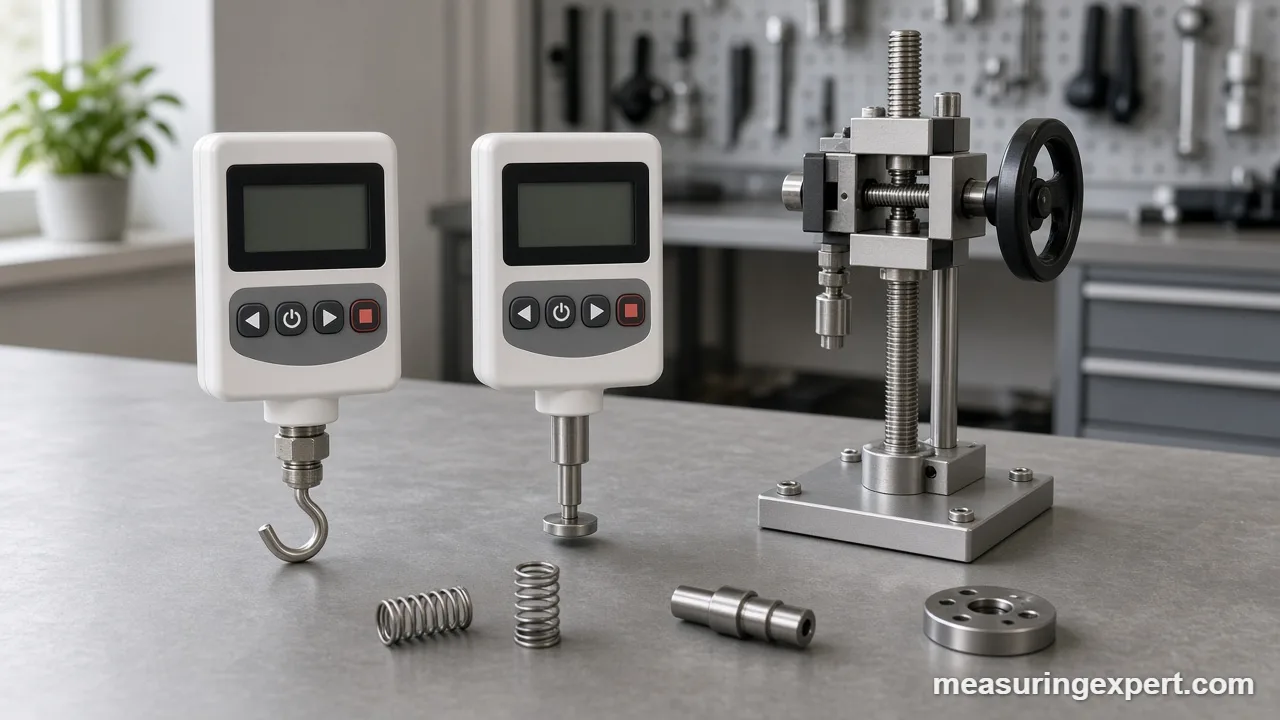
A tension gauge, by contrast, measures pull only. For instance, spring scales, hanging dynamometers and cable tensiometers all fit here. Because they skip the compression side, they are simpler and often cheaper. However, they cannot test a snap fit, a spring under compression or a foam pad.
| Type | Measures | Typical accuracy | Strength | Good for |
|---|---|---|---|---|
| Digital push-pull gauge | Tension and compression | +/-0.1% to +/-0.5% of full scale | Peak hold, unit switching, data output | QC, R&D, test stands |
| Mechanical dial gauge | Tension and compression | +/-0.2% to +/-0.3% of full scale, or +/-1 graduation | No battery, quick to read | Production pass/fail checks |
| Spring tension gauge | Tension only | Often not stated; check the maker | Low cost, visual | Classrooms, simple pulls |
| Cable tensiometer | Tension in a taut cable | Varies by model | Measures in place | Rigging, guy wires |
Specs That Matter on the Best Force Gauge
Accuracy as a percent of full scale. Generally, makers quote accuracy as a percent of full scale (FS), not of the reading. For example, a 500 N gauge at +/-0.3% FS can be off by 1.5 N at any load. In other words, that is 0.3% of a 500 N reading but 15% of a 10 N reading. Therefore, try to keep normal tests above 10 to 20% of the gauge capacity.
Resolution. Resolution is the smallest step the display shows. However, it is not the same as accuracy. So a gauge that reads 0.1 N can still be wrong by 1.5 N if its accuracy spec says so.
Sampling rate and peak hold. For example, when a part breaks, the peak can last only a few milliseconds. As a result, a gauge that samples 1,000 to 7,000 times per second catches it far more reliably than one that updates every 0.2 s. Then, peak hold freezes the top value.
Overload rating. In fact, a sudden overload can damage a load cell. So look for a safe overload of 150 to 200% of full scale, and never use a gauge near its limit for sharp breaks.
How to Take a Reading With a Force Gauge
Above all, setup matters as much as the gauge.
- First, pick a gauge whose capacity is about 1.5 to 2 times your highest expected load.
- Fit the right attachment, such as a flat tip for pushing or a hook for pulling, and tighten it by hand.
- Next, hold the gauge or mount it on a test stand so the shaft lines up with the direction of force.
- After that, choose the unit and the mode, either real-time or peak.
- Then zero the gauge with the attachment fitted and the shaft pointing the way it will be used.
- Apply the load slowly and steadily, without twisting or side loading the shaft.
- Finally, read the peak or steady value, note the direction, and repeat the test three times to check consistency.
Keep the Best Force Gauge Accurate: Calibration and Care
Generally, most quality systems send gauges out for calibration once a year. In addition, you can run a quick check between visits. First, hang a known weight from the hook with the gauge pointing straight down. Then compare the reading with the weight times standard gravity. For instance, a 1 kg test weight should read 9.807 N, 1 kgf or 2.205 lbf.
Also, store the gauge in its case, keep the shaft clean and avoid drops. Likewise, if a gauge takes a shock load past its rating, retire it until it is checked. For the units behind torque tools, see our explainer on what Nm means.
Honest Limits of Even the Best Force Gauge
Above all, a force gauge measures what reaches the shaft, so poor fixturing shows up as bad data. Also, hand-held readings vary between people, because each operator pulls at a different speed and angle. Finally, no gauge replaces a proper test method, which sets the speed, the fixture and the pass limit.
Best Force Gauge FAQ
What is the best force gauge for most people?
For most shops and labs, the Mark-10 M3-100 is the best force gauge. Moreover, it reads tension and compression to 500 N (100 lbf), holds +/-0.3% of full scale and sends data over USB.
What is the difference between N, lbf and kgf?
In short, they are three units of force. For example, one pound-force (lbf) equals about 4.448 N, and one kilogram-force (kgf) equals exactly 9.80665 N. Thus, 100 N is about 22.5 lbf or 10.2 kgf.
Is a push-pull gauge the same as a tension gauge?
Not quite. A push-pull gauge measures both compression and tension. By contrast, a tension gauge, such as a spring scale or a cable tensiometer, measures pulling force only.
How do I pick the right capacity for the best force gauge?
First, choose a capacity about 1.5 to 2 times your highest expected load. Also, try to keep normal readings above 10 to 20% of full scale, because accuracy is usually quoted as a percent of full scale.
How accurate is a digital force gauge?
In general, good digital gauges are rated from about +/-0.1% to +/-0.5% of full scale. For example, a 500 N gauge at +/-0.3% can be off by up to 1.5 N at any reading.
How often should a force gauge be calibrated?
Typically, quality systems calibrate once a year. However, heavy use, a drop or an overload is a good reason to check it sooner against known weights or a calibration lab.
Can I use a luggage scale instead of a force gauge?
For a rough pull reading, yes. However, a luggage scale has no compression mode, no proper attachments and usually no stated accuracy, so it is not a substitute for quality testing.
What does peak hold do on a force gauge?
In short, peak hold freezes the highest force seen during a test. As a result, you can read the break force of a part after it snaps instead of trying to catch it live.
Do I need a test stand with my force gauge?
For repeatable results, a stand helps a lot. That is because it keeps the load in line with the gauge and applies it at a steady speed, so readings vary less between operators.
Can an analog dial be the best force gauge?
Yes, for simple pass/fail checks. After all, a dial gauge needs no battery and is easy to read, but it cannot log data and its resolution is coarser than a digital gauge.
The Bottom Line on the Best Force Gauge
For most readers, the Mark-10 M3-100 is the best force gauge to buy. Above all, it pairs a 500 N (100 lbf) range and +/-0.3% accuracy with fast sampling and USB output. Meanwhile, pick the Wagner FDX 50 to save money, the M5-100 for audited lab work, and a dial or spring gauge when you only need a quick check.
1 thought on “Best Force Gauge: 7 Push-Pull and Tension Gauges for Accurate Testing”