

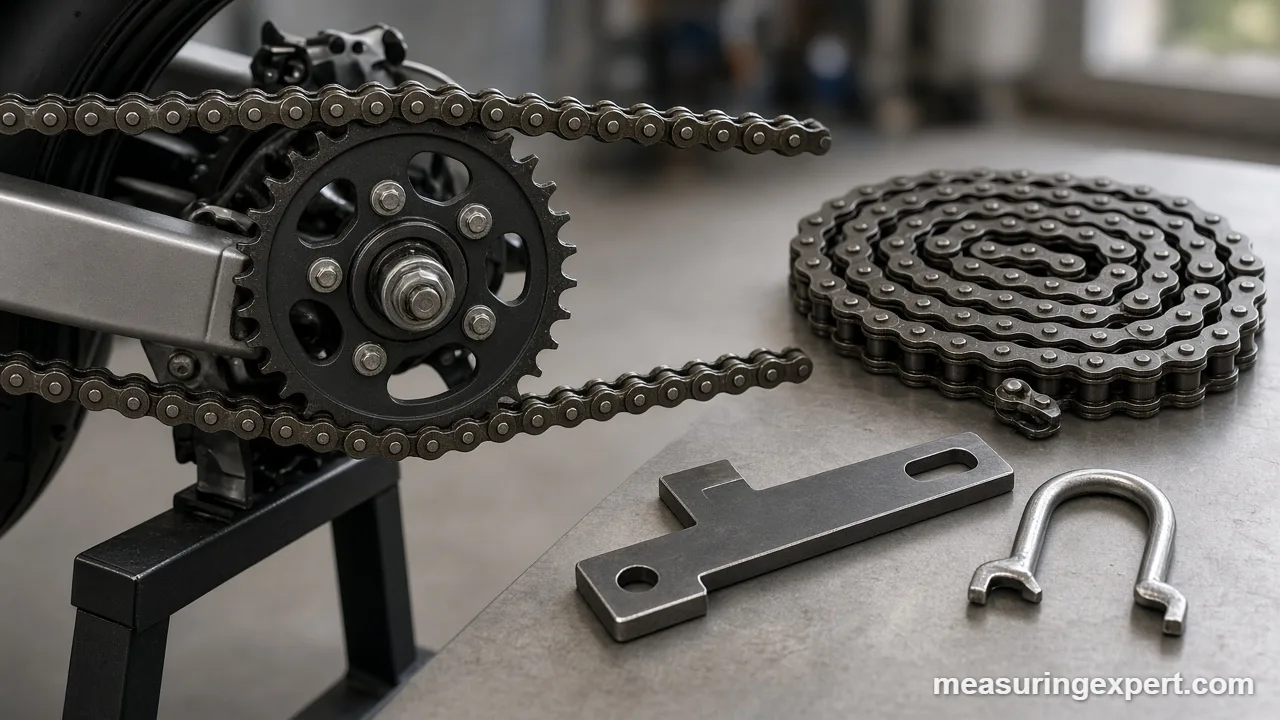
The best chain tension gauge for most riders is the Motion Pro SlackSetter Pro, because it reads motorcycle chain slack in millimeters up to 75 mm. However, the right tool depends on the chain: motorcycles need a slack tool, bicycles need a wear checker, and every drive chain needs straight sprocket alignment.
In short: get the SlackSetter Pro for motorcycle slack, the Park Tool CC-3.2 for cheap bike wear checks, and the Tru-Tension Chain Monkey for repeatable slack settings.
As an Amazon Associate, Measuring Expert earns from qualifying purchases. Our picks are based on research, specifications and owner feedback, not paid placement.
Best Overall


Best Chain Tension Gauge Picks at a Glance
- Motorcycle slack, all-round: Motion Pro SlackSetter Pro, two mm scales, reads up to 75 mm of slack.
- Bike chain wear on a budget: Park Tool CC-3.2, a go/no-go gauge for 0.5% and 0.75% wear.
- Repeatable slack in the pits: Tru-Tension Chain Monkey, set once and reuse at every adjustment.
- Bike wear with three steps: Park Tool CC-4.2, reads 0.5%, 0.75% and 1.0%.
- Alloy or steel sprockets: Rohloff Caliber 2, with a separate side for each.
- Quick OK or not OK: BPA-Racing Slack Setter, spring loaded with a three-zone indicator.
- Sprocket alignment: Motion Pro Chain Alignment Tool 08-0048, no batteries needed.
On This Page
- Comparison table
- The 7 picks, reviewed
- How we chose
- Slack, wear or alignment?
- Slack and elongation numbers
- mm and inch converter
- How to set motorcycle chain slack
- Checks and common mistakes
- What a gauge cannot tell you
- FAQ
- Bottom line
Chain Slack, Wear and Alignment Tools Compared
First, find the chain you work on. Next, check the standout feature, and then jump to the full review below.
| # | Product | Best For | Standout Feature | Amazon |
|---|---|---|---|---|
| 1 | Motion Pro SlackSetter Pro 08-0674 | Motorcycle slack, most bikes | Two mm scales, up to 75 mm slack | View |
| 2 | Park Tool CC-3.2 | Budget bike wear checks | 0.5% and 0.75% go/no-go ends | View |
| 3 | Tru-Tension Chain Monkey | Repeatable motorcycle slack | Preset stop, then tighten to the mark | View |
| 4 | Park Tool CC-4.2 | Tracking bike chain wear | Reads 0.5%, 0.75% and 1.0% | View |
| 5 | Rohloff Caliber 2 | Matching wear to sprocket metal | Side A for alloy, side S for steel | View |
| 6 | BPA-Racing Slack Setter | Fast roadside checks | Too Loose / OK / Too Tight zones | View |
| 7 | Motion Pro Chain Alignment Tool 08-0048 | Budget sprocket alignment | Clamps to the rear sprocket with a sight rod | View |
The 7 Best Chain Tension Gauge Picks, Reviewed
We start with motorcycle slack tools, then cover bicycle wear checkers, and finish with an alignment tool. Every number below comes from the maker of each best chain tension gauge pick. Also, we added metric or US values in brackets where they help.
Best Overall
1. Motion Pro SlackSetter Pro 08-0674
Best for: Street and dirt bike riders who want to read chain slack as a number, not guess it with a thumb.
The Motion Pro SlackSetter Pro is our pick as the best chain tension gauge for most riders. First, it measures chain slack and chain-to-swingarm clearance on two scales in millimeters. As a result, you can match the exact figure in your owner’s manual instead of eyeballing a gap. Motion Pro says it works on most street and dirt bikes with up to 75 mm (about 2.95 in) of slack.
The body is engineered nylon, and the scale is anodized, laser-etched aluminum, so the markings should not rub off in a toolbox. It is also small enough for a road kit. However, Motion Pro states that it does not work on bikes with a Gullwing-type swingarm. Details are on the Motion Pro SlackSetter Pro page.
- Measures: chain slack and chain-to-swingarm clearance
- Scales: two, in millimeters
- Range: up to 75 mm (2.95 in) of slack
- Build: nylon body, laser-etched aluminum scale
- Not for: Gullwing-type swingarms
Pros
- Gives a real mm number to compare with the manual
- Etched scale resists wear
- Compact enough for a road kit
Cons
- Metric scale only, so inch specs need converting
- Will not fit Gullwing swingarms
- Does not measure chain wear
Skip it if: Your bike has a single-sided Gullwing swingarm, or you only ride a bicycle, where slack is set by the derailleur.
Best Budget
2. Park Tool CC-3.2 Chain Wear Indicator
Best for: Cyclists who want a fast, cheap yes-or-no answer on chain wear.
The CC-3.2 is a flat go/no-go gauge with two ends. First, you hook the end stamped 0.5 into a link with inner plates. If the tip does not drop in, the chain has less than 0.5% wear. If it does drop in, the chain has reached 0.5%. Then you flip the tool and repeat the test with the 0.75 end.
Also, Park Tool suggests replacing the chain at 0.5% on 11-speed and wider drivetrains, and at 0.75% on 10-speed or fewer. So this one tool covers both common limits. However, it gives no reading between the marks, and it cannot track wear over time the way a dial or ruler can. Park Tool explains the method in its chain replacement guide.
- Type: go/no-go wear indicator
- Limits: 0.5% and 0.75% elongation
- Use: hook on an inner-plate link, then flip for the second limit
- Fits: 5- to 12-speed bicycle chains, per the listing title
Pros
- Very simple to read
- Covers both common replacement limits
- Thin enough to carry in a saddle bag
Cons
- No reading between 0.5% and 0.75%
- Roller play can make it read early
- Not for motorcycle chains
Skip it if: You want to log wear in small steps, because the CC-4.2 below adds a third mark.
Best Pro Slack Tool
3. Tru-Tension Chain Monkey
Best for: Track-day riders and shops that adjust the same bikes again and again.
The Chain Monkey works differently from a ruler. First, you look up your bike’s slack figure in the manual and find the matching line on the tool. Next, you set the domed nut to that line and spin the stop down to the orange base. Then you hook it onto the chain and tighten until the stop meets the base again. At that point, the slack is set, and you lock the axle.
For example, Tru-Tension says the tool was used by a Ducati team in British Superbike racing. It also suggests checking tension every 2 or 3 refuels, or every 500 mi (about 800 km). Because the setting stays on the tool, the next check takes seconds. However, there is no printed mm readout, so you trust the setting chart. Tru-Tension prints the full steps with the tool.
- Method: preset stop, then tighten to the mark
- Check: too tight if you cannot reach the mark, too loose if slack remains
- Weight: 0.45 kg (about 1 lb)
- Use: motorcycle drive chains
Pros
- Same slack every time once set
- Holds the chain while you center the wheel
- Also works as a quick check
Cons
- Heavier than a ruler-style gauge
- No direct mm readout
- Setup takes a few minutes the first time
Skip it if: You ride several different bikes and want to read a number each time, because the SlackSetter Pro does that.
Best for Tracking Wear
4. Park Tool CC-4.2 Chain Checker

Best for: Home mechanics who check chains often and want to see wear build up.
The CC-4.2 touches the chain at three points instead of two. Park Tool says this design works on 5- to 12-speed chains, including SRAM AXS 12-speed. To use it, you hold tension on a short run of chain and push it onto the gauge tip. The tip position then shows 0.5%, 0.75% or 1.0% wear.
So it gives you three steps where the CC-3.2 gives two. In addition, the 1.0% mark suits single-speed chains, which Park Tool says can run to 1.0% before replacement. However, it is still a step reading, not a dial. Therefore, log the date when it first touches 0.5%, and you will learn how fast your chains wear.
- Type: three-point chain checker
- Readings: 0.5%, 0.75% and 1.0%
- Fits: 5- to 12-speed chains, including SRAM AXS
- Use: hold tension, push chain onto the tip
Pros
- Three wear levels in one tool
- Covers single-speed limits too
- Three-point contact steadies the reading
Cons
- Bulkier than a flat gauge
- Still no in-between values
- Bicycle chains only
Skip it if: You only need a pass or fail answer once a season, because the CC-3.2 is simpler.
Best for Sprocket Material
5. Rohloff Caliber 2

Best for: Cyclists who run aluminum chainrings or cogs and want to protect them.
The Rohloff Caliber 2 hooks into the chain, and a finger drops between the rollers. On a new chain, the finger barely moves. Then, as the chain wears, it sinks deeper. When side A sinks fully, wear has reached 0.075 mm per link. Rohloff says to replace the chain at that point if you run aluminum sprockets.
Side S works the same way, but it marks 0.1 mm per link, which suits steel sprockets. On a 1/2 in (12.7 mm) pitch bike chain, those limits work out to about 0.6% and 0.8% elongation (our calculation). Also, the tool is a single piece with no moving parts to adjust. Rohloff describes both sides in its product notes.
- Side A: 0.075 mm per link, for aluminum sprockets
- Side S: 0.1 mm per link, for steel sprockets
- Reading: tool lies flat on the rollers at the limit
- Equivalent: about 0.6% and 0.8% on 1/2 in pitch
Pros
- Limits matched to sprocket material
- No parts to adjust or lose
- Easy to read flat or not flat
Cons
- Two fixed limits only
- Costs more than flat gauges
- Bicycle chains only
Skip it if: You run all-steel cassettes and only want a quick check, because the CC-3.2 does that for less.
Best Quick Check
6. BPA-Racing Slack Setter

Best for: Adventure and enduro riders who want a fast OK or not OK at a fuel stop.
The BPA-Racing Slack Setter uses a spring-loaded mechanism and a visual indicator with three zones: Too Loose, OK and Too Tight. First, you calibrate it once with a tape measure against your bike’s recommended slack. After that, you hook it on the chain and read the zone. BPA-Racing says it stays set after a tire change, so you do not repeat the setup.
In addition, the body is stainless steel, and the maker lists it for road, touring, adventure, enduro and motocross bikes, plus chain-driven quads. However, BPA-Racing does not publish a slack range or a tolerance. Therefore, treat it as a quick check, and confirm with a ruler after big changes such as a new chain.
- Method: spring loaded, three-zone indicator
- Setup: calibrate once with a tape measure
- Body: stainless steel
- Use: chain-drive motorcycles and quads
Pros
- Very fast to read
- Holds its setting between checks
- Sturdy stainless body
Cons
- No numeric readout
- No published range or tolerance
- Needs a careful first calibration
Skip it if: You need to record slack in mm for a service log, because the SlackSetter Pro reads a number.
Best Budget Alignment
7. Motion Pro Chain Alignment Tool 08-0048

Best for: Riders who set slack with the axle adjusters and want the wheel straight too.
Above all, tension and alignment go together. When you move the axle to set slack, one side can move more than the other. As a result, the chain runs at an angle and wears the sprocket teeth on one side. The Motion Pro alignment tool clamps to the rear sprocket, and its rod shows whether the sprocket lines up with the chain run.
Moreover, it is a simple mechanical tool with no batteries. Also, Motion Pro backs it with a lifetime limited warranty. However, the maker does not list specific bikes or sprocket sizes, so check that the clamp fits your sprocket first.
- Method: clamps to the rear sprocket with a sight rod
- Power: none needed
- Warranty: lifetime limited, per Motion Pro
- Use: motorcycles and ATVs
Pros
- No batteries to fail
- Low cost for a dedicated tool
- Checks the real sprocket, not axle marks
Cons
- Rod is harder to sight than a laser
- Fit list not published
- Does not measure slack
Skip it if: You run a belt drive, because this tool is made for chain sprockets, not pulleys.
How We Chose the Best Chain Tension Gauge Picks
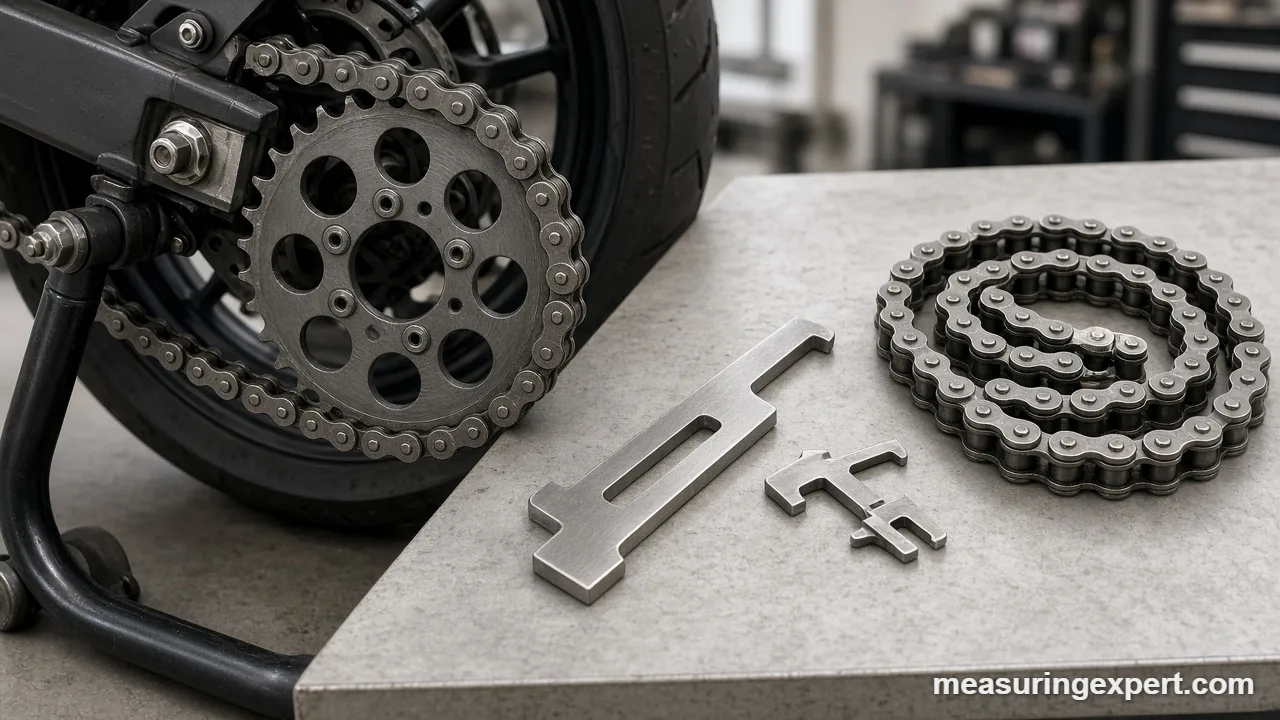
We did not test these tools by hand. Instead, we built this list from research. First, we read the maker’s page for each tool and kept only specs we could confirm there. Next, we compared owner feedback for fit and readability. Finally, we checked that each pick does a distinct job.
- Measures something real: slack in mm, wear in percent, or alignment along the chain run.
- Clear reading: a scale, a step mark or a laser line, not a vague feel.
- Known maker: Motion Pro, Tru-Tension, Park Tool, Rohloff and BPA-Racing all publish instructions.
- Distinct use: no two picks do the same job for the same chain.
- Not a belt gauge: for belts, see our best tension gauge guide instead.
Our sources include Park Tool’s chain replacement guide, Rohloff’s Caliber 2 notes, the Motion Pro and Tru-Tension product pages, and the Tsubaki chain wear indicator guide for industrial roller chain.
Slack, Wear or Alignment: Which Tool Do You Need?
People say “chain tension gauge” for three different jobs. Therefore, pick the type that matches your question.
| Tool type | What it measures | Main users | Unit |
|---|---|---|---|
| Slack gauge | Free up-and-down play at mid-span | Motorcycles, ATVs | mm or in |
| Wear checker | Elongation from pin and roller wear | Bicycles | % or mm per link |
| Wear indicator kit | Pass or fail elongation by pitch size | Industrial roller chain | % |
| Alignment tool | Rear sprocket angle against the chain run | Motorcycles, ATVs | Straight or not |
For example, a motorcycle owner usually needs a slack gauge plus an alignment tool. By contrast, a cyclist needs only a wear checker, because the derailleur sets tension. Meanwhile, a plant technician uses a wear kit or a tape over many pitches.
The Numbers Behind Chain Slack and Elongation
Every best chain tension gauge reads one of two numbers: slack or elongation. So it helps to know what each one means.
Motorcycle chain slack
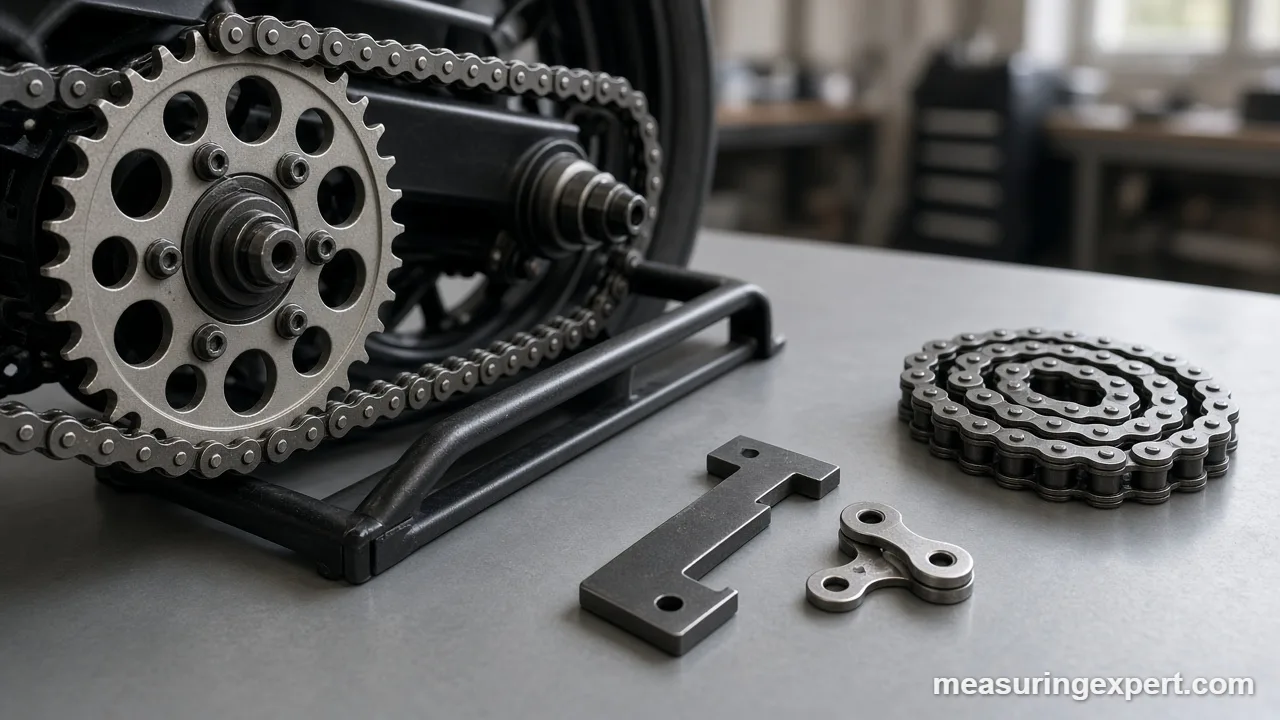
Specifically, slack is the up-and-down free play at the middle of the lower chain run. Your owner’s manual lists it, often as a range in mm or inches. Also, the manual says whether to measure with the bike on its side stand, on a stand, or with a rider on board. Because the swingarm moves through an arc, slack changes as the suspension compresses. That is why the factory figure looks loose when the bike is parked.
Bicycle chain wear
In fact, bike chains do not stretch like rubber. Instead, the pins and rollers wear, and each link gets a little longer. Park Tool’s ruler check lines up a rivet at zero and counts 24 more rivets, which should land at 12 in. Similarly, Sheldon Brown’s chain wear article says to replace the chain at 1/16 in past the mark. That is about 0.52% over 12 in (our calculation). At 1/8 in (about 1.04%), the sprockets are likely worn too.
Industrial roller chain
For plant chain, Tsubaki says 1.5% to 2% elongation is the typical wear life limit in most uses. In addition, its indicator kit covers ANSI sizes 35 to 80 and British sizes 06B to 16B. To measure with a tape, first pull the chain tight. Then measure across a set number of pitches, and compare with the nominal length.
The math is simple. Elongation (%) = (measured length – nominal length) / nominal length x 100, where nominal length = number of pitches x pitch. For example, 10 pitches of #40 chain (1/2 in pitch) should measure 5 in (127 mm). At 1.5% wear, the same span reads about 5.075 in (128.9 mm).
| Chain | Pitch | Common limit | Over 12 in (305 mm) |
|---|---|---|---|
| Bike, 11-speed or more | 1/2 in (12.7 mm) | 0.5% | +0.06 in (1.5 mm) |
| Bike, 10-speed or fewer | 1/2 in (12.7 mm) | 0.75% | +0.09 in (2.3 mm) |
| Bike, single speed | 1/2 in (12.7 mm) | 1.0% | +0.12 in (3.0 mm) |
| Industrial roller chain | by size | 1.5% to 2% | +0.18 to 0.24 in (4.6 to 6.1 mm) |
Motorcycle makers usually give a service limit as a length over a set number of links. So check your manual, and measure with a tape or a digital caliper over that span.
Best Chain Tension Gauge Converter: mm to Inches
Slack specs come in mm or inches, and wear specs may come in either. So use this converter to switch units before you set a best chain tension gauge. For more on measuring spans, see our guide on how to measure length.
How to Set Motorcycle Chain Slack Step by Step
Overall, this is the general method. However, your manual comes first, because stand position, load and torque values vary by bike.
- Look up the slack range and the measuring position in your owner’s manual.
- Put the bike in that position, in neutral, and find the tightest spot by rolling the wheel.
- Measure slack at the middle of the lower run with your gauge.
- Loosen the rear axle nut, then turn both adjusters by the same amount.
- Check sprocket alignment with an alignment tool, not just the swingarm marks.
- Tighten the axle nut to the torque in the manual, then measure slack again.
- Spin the wheel, check a few spots, and log the reading and the date.
Chain Checks, Care and Common Mistakes
In any case, a gauge only helps if the chain is clean and you read it the same way each time. So keep these habits.
Also, check slack after a new chain beds in, because new chains settle in the first rides. In addition, replace the chain and sprockets together on a motorcycle when the sprocket teeth look hooked. Finally, wipe the gauge after use, since grit on a scale or tip can shift the reading.
What the Best Chain Tension Gauge Cannot Tell You
Of course, even the best chain tension gauge has limits. For example, step-type wear checkers can read early, because roller play adds to pin wear. Sheldon Brown notes that most checkers are affected by roller play. So confirm a borderline result with a 12 in ruler.
- A slack gauge cannot see a stiff link, so look for links that do not bend freely.
- A wear checker cannot see sprocket wear, so inspect the teeth too.
- An alignment tool cannot fix a bent swingarm or a worn wheel bearing.
- No tool on this list tells you the tension force in pounds or newtons.
Best Chain Tension Gauge FAQ
What is the best chain tension gauge for motorcycles?
For most riders, the best chain tension gauge is the Motion Pro SlackSetter Pro. It reads slack in mm up to 75 mm, so you can match the figure in your manual. However, it does not fit Gullwing swingarms.
Does a bicycle need a chain tension gauge?
No. On a derailleur bike, the rear derailleur spring sets tension. Instead, a cyclist needs a chain wear checker such as the Park Tool CC-3.2 or CC-4.2.
How much slack should a motorcycle chain have?
It depends on the bike, so use the figure in your owner’s manual. Also, follow the manual on stand position and load, because slack changes as the swingarm moves.
When should I replace a bike chain?
Park Tool suggests 0.5% wear for 11-speed and wider drivetrains, 0.75% for 10-speed or fewer, and 1.0% for single speed. However, follow your drivetrain maker if it gives a different limit.
Is the best chain tension gauge accurate on worn chains?
A slack gauge stays accurate, but a worn chain has tight and loose spots. Therefore, measure at the tightest spot. If slack varies a lot around the chain, the chain is likely worn out.
How do I measure chain elongation with a ruler?
First, line up a pin at zero. Then count 24 more pins on a bike chain, which should land at 12 in. If the pin sits 1/16 in past the mark, the chain has about 0.5% wear.
What elongation means industrial roller chain is worn out?
Tsubaki says 1.5% to 2% elongation is the typical wear life limit for most industrial roller chain. So replace the chain before it reaches that range.
Can the best chain tension gauge check sprocket alignment?
No. A slack gauge or wear checker does not show alignment. Instead, use a sprocket alignment tool such as the Motion Pro 08-0048, which clamps to the rear sprocket.
Is a laser alignment tool better than a sight rod?
A laser line is easier to see over the full chain run. However, it needs batteries and eye safety care. In contrast, a sight-rod tool such as the Motion Pro 08-0048 is simpler and cheaper.
Does the best chain tension gauge work on belt drives?
Mostly not. Chain slack tools and wear checkers are made for chains. For belts, use a belt tension gauge, which measures deflection force instead of chain slack.
Bottom Line
For most motorcycle owners, the Motion Pro SlackSetter Pro is the best chain tension gauge, because it turns chain slack into a mm number you can match to the manual. Also, add an alignment tool for straight sprockets. For bicycles, pick the Park Tool CC-3.2 or CC-4.2 instead.
1 thought on “Best Chain Tension Gauge for Motorcycle, Bike and Industrial Chains (2026)”