

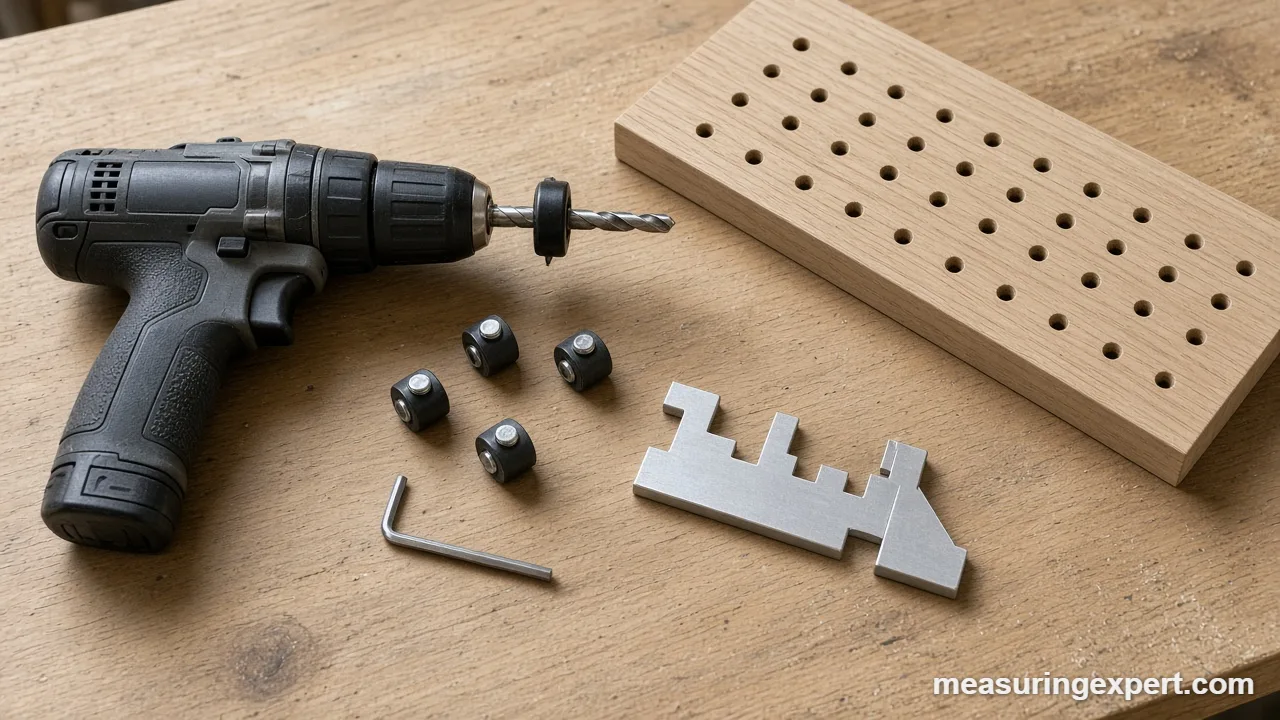
The best drill depth gauge for most shops is the Infinity Tools Adjustable Drill Depth Stops set, because two split collars cover bits from 1/8 to just over 1/2 in. However, the right pick depends on how you drill: collars suit hand drills, a drill guide adds square holes, and a digital readout suits a drill press.
In short: buy the Infinity Tools stops as an all-rounder, the Century Drill and Tool pair on a budget, and the iGaging EZ-Depth if you work at a drill press.
As an Amazon Associate, Measuring Expert earns from qualifying purchases. Our picks are based on research, specifications and owner feedback, not paid placement.
Best Overall
Best Budget
Best Digital

Quick Answer: The Best Drill Depth Gauge by Job
- All-round hand drilling: Infinity Tools Adjustable Drill Depth Stops, two collars for 1/8 to 1/2 in bits.
- Lowest cost: Century Drill and Tool 2-piece drill stop set, 1/16 to 1/2 in.
- Drill press work: iGaging EZ-Depth digital readout for quill travel.
- Square holes with a hand drill: Woodpeckers Auto-Line Drill Guide with its stop collar.
- Angled holes: WEN WA1412 portable drill guide, up to 60 degrees each way.
- Pocket holes: Kreg Easy-Set stop collar and thickness gauge.
- Setting collars to a number: Taytools depth stop setting gauge.
On This Page
- Side-by-side table
- The 8 picks, reviewed
- How we chose
- Stop collars vs guides vs readouts
- What decides depth accuracy
- Inch to mm converter
- How to set a drilling depth
- Mistakes to avoid
- FAQ
- Bottom line
Best Drill Depth Gauge Comparison
First, decide where you drill: by hand, in a guide or at a drill press, because the best drill depth gauge differs for each. Next, scan the standout feature, and then jump to the full review.
| # | Product | Best For | Standout Feature | Amazon |
|---|---|---|---|---|
| 1 | Infinity Tools Adjustable Drill Depth Stops | Everyday hand drilling in wood | Two split collars, dual set screws | View |
| 2 | Century Drill and Tool Drill Stop Set | Occasional jobs on a tight budget | Two stops cover 1/16 to 1/2 in | View |
| 3 | iGaging EZ-Depth | Drill press depth by the number | Digital readout of quill travel | View |
| 4 | Woodpeckers Auto-Line Drill Guide | Square, repeatable holes away from the shop | Self-centering base, stop collar | View |
| 5 | WEN WA1412 Portable Drill Guide | Angled holes and round stock | Tilts up to 60 degrees each way | View |
| 6 | Kreg Easy-Set Stop Collar Kit | Pocket-hole joinery | Gauge reads 1/2 to 1-1/2 in stock | View |
| 7 | Taytools Depth Stop Setting Gauge | Setting collars to an exact depth | Inch and metric scale | View |
| 8 | POWERTEC 5-in-1 Step Depth Gauge | Quick go/no-go height checks | Fixed steps, no scale to read | View |
The 8 Best Drill Depth Gauge Picks, Reviewed
We start with stop collars, because they suit the most people. After that, we move to the digital readout, two drill guides and the setup gauges. If you need to measure a hole after drilling it, see our best depth measuring gauge guide instead.
Best Overall
1. Infinity Tools Adjustable Drill Depth Stops
Best for: Woodworkers who drill dowel holes, shelf-pin holes and pilot holes by hand and want one set that fits most bits.
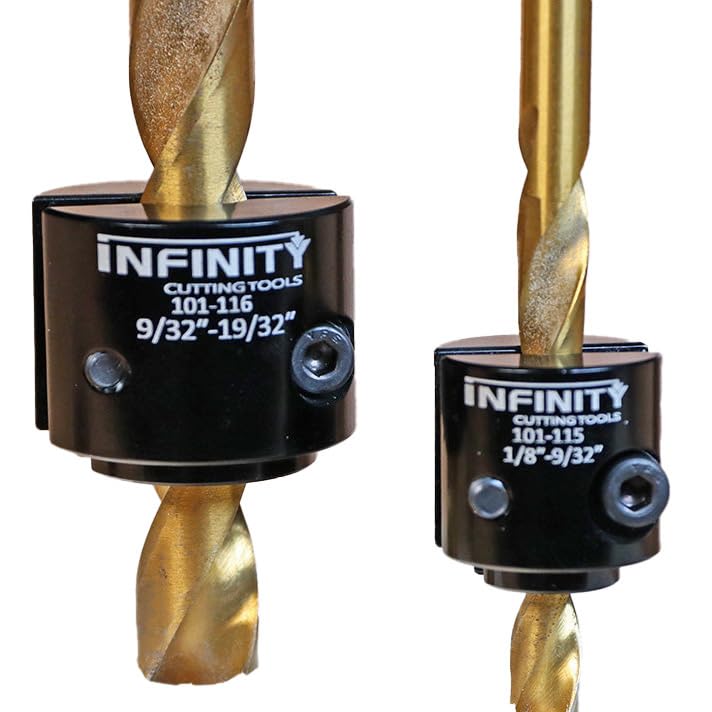
This is our pick as the best drill depth gauge for most people, although it is really a pair of depth stops. Instead of a dozen fixed collars, you get two adjustable ones. The small stop fits bits from 1/8 in to just over 1/4 in, and the large stop runs from just over 1/4 in to just over 1/2 in. Infinity Tools says both also fit the matching metric bits, so a 6 mm or 10 mm bit is covered too.
Each stop is split into two halves, and each half has its own set screw. As a result, the collar clamps evenly around the bit instead of pushing it to one side. Also, the bottom edges are rounded, which helps avoid a ring-shaped dent in the workpiece. Details are on the Infinity Tools product page.
- Small stop: 1/8 in to just over 1/4 in, plus metric equivalents
- Large stop: just over 1/4 in to just over 1/2 in, plus metric equivalents
- Design: two-piece collar, one set screw per half
- Rounded bottom edge to limit marring
- Includes: a hex wrench with each stop
Pros
- Two stops replace a full collar set
- Even clamping from dual screws
- Also fits metric bits
Cons
- Costs more than basic collars
- Tightening two screws takes longer
- No scale on the collar itself
Skip it if: You drill only once in a while, because the Century pair does the same job for less.
Best Budget
2. Century Drill and Tool Drill Stop Set (2 Piece)
Best for: DIYers who need a depth stop now and then for anchors, hinges and small pilot holes.
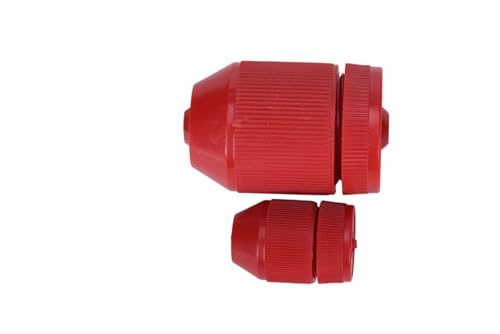
To start, Century Drill and Tool sells a simple pair of adjustable stops. According to the maker, the small stop fits drills from 1/16 in to 15/64 in, and the large one fits 1/4 in to 1/2 in. So two pieces cover nearly every twist bit in a home drill index, including the tiny sizes that fixed collar sets skip.
Because the stops adjust, you also do not need one collar per bit size. However, a single clamp point can tilt slightly on a small bit, so check the setting after you tighten it. Still, for a quick wall-anchor hole, that is plenty. Specs are on the Century Drill and Tool product page.
- Pieces: 2 adjustable stops
- Small stop: 1/16 in to 15/64 in bits
- Large stop: 1/4 in to 1/2 in bits
- Use: twist bits in a hand drill or drill press
Pros
- Very low cost
- Covers bits down to 1/16 in
- Also easy to keep in a drill case
Cons
- Basic finish
- Single clamp point can tilt
- No wrench storage
Skip it if: You drill many visible dowel holes, since the Infinity stops clamp more evenly.
Best Digital
3. iGaging EZ-Depth Drill Press Digital Readout
Best for: Drill press owners who want to drill to a number instead of a pencil mark.
At a drill press, this is the best drill depth gauge on our list. Most drill presses have a depth stop and a rough scale on the quill. In practice, that scale is hard to read closer than about 1/16 in (1.6 mm). Instead, the EZ-Depth adds a digital readout that tracks quill travel. So you lower the bit until it touches the work, zero the display, and drill until it shows your target depth.
For example, a 1/2 in deep hinge-cup hole becomes a matter of watching the display rather than squinting at a scale. Also, a readout makes it easy to repeat a depth on a part you drilled last week. However, it is only as good as the setup: zero it with the bit touching the work, and still lock the press depth stop for long runs. Check the listing for the current range and resolution before you buy.
- Type: digital readout for drill press quill travel
- Use: zero at contact, then drill to a displayed depth
- Works alongside the press’s own mechanical depth stop
Pros
- Reads depth as a number
- Easy to repeat a setting later
- Also no math with a quill scale
Cons
- Drill press only
- Needs a battery and a careful install
- Does not stop the quill by itself
Skip it if: You drill with a hand drill, because a stop collar or drill guide is the right tool there.
Best Pro Drill Guide
4. Woodpeckers Auto-Line Drill Guide

Best for: Furniture makers and installers who need square, repeatable holes in parts too big for a drill press.
If you want a guide rather than a collar, this is the best drill depth gauge setup for square holes. A drill guide holds your drill on two steel columns, so the bit enters square to the surface. On the Auto-Line, one column carries an adjustable stop collar, which sets how far the chuck can travel. Woodpeckers says it holds with only fingertip pressure, and a spring on the other column helps control the cut.
In addition, centering pins line the guide up on stock up to 3-1/8 in (79 mm) wide. Also, the base opening clears bits up to 3/4 in, and with the chuck carrier turned outside the base you can bore holes up to 2 in. Moreover, it uses a 1/2 in chuck and a quick-release shaft that fits any corded or cordless drill. The Deluxe Kit listing adds extension rods and flip stops for the fence. See the Woodpeckers product page for the full list.
- Chuck: 1/2 in
- Base opening: bits up to 3/4 in; up to 2 in holes with the carrier outside
- Centering capacity: stock up to 3-1/8 in wide
- Fence: 7 in, with optional 12 in or 24 in extensions
- Not for use with impact drivers
Pros
- Square holes anywhere
- Self-centering on edges
- Also a solid stop collar on the column
Cons
- Expensive for a drill guide
- No depth scale to read
- Bulky in a tool bag
Skip it if: You only need straight holes now and then, because a stop collar and care do the job.
Best for Angled Holes
5. WEN WA1412 Portable Drill Guide

Best for: DIYers who drill at an angle, into dowels and pipe, or on site where a drill press cannot go.
In short, the WEN WA1412 turns a hand drill into a small portable drill press. Unlike the Woodpeckers guide, it tilts: WEN lists drilling angles up to 60 degrees in either direction, with laser-etched scales and a lock. Meanwhile, an adjustable depth stop sets a consistent hole depth on repeat jobs.
In addition, its keyed chuck accepts bits from 1/16 in to 1/2 in. Also, V-grooves on both ends of the aluminum base center the guide on dowels and round stock, and pre-drilled holes let you screw it to a board. However, an angled hole is longer than its vertical depth, so read the geometry note in our guide below before you set the stop. Specs are on the WEN product page.
- Angle: up to 60 degrees each way, etched scales and lock
- Chuck: keyed, 1/16 in to 1/2 in bits
- Base: aluminum with V-grooves at both ends and mounting holes
- Adjustable depth stop for repeat holes
Pros
- Drills at an angle
- V-grooves for round stock
- Also a real depth stop
Cons
- Some flex at full extension
- Keyed chuck is slower to change
- Angle scale is a guide, not a protractor
Skip it if: You only drill square holes in flat panels, since the Woodpeckers guide is more rigid.
Best for Pocket Holes
6. Kreg Easy-Set Stop Collar and Material Thickness Gauge (KPHA330)

Best for: Anyone who builds with a Kreg pocket-hole jig and wants a fast, correct bit depth.
Pocket-hole depth is set by stock thickness, so this kit pairs a collar with a gauge. First, you measure the board with the gauge, which reads 1/2 in to 1-1/2 in. Then you slide the collar until its window lines up with the matching mark on a Kreg Easy-Set bit. As a result, the bit stops at the right depth for 1/2 in, 3/4 in or 1-1/2 in material.
Meanwhile, the collar fits all standard 3/8 in Kreg pocket-hole bits, and the set screw comes pre-installed. Also, the gauge doubles as the hex wrench. Kreg lists it as a direct replacement for the collar and gauge sold with the 320, 310, 520PRO, 720 and 720PRO jigs, but not the Micro or XL systems. See the Kreg KPHA330 page.
- Fits: standard 3/8 in Kreg pocket-hole bits
- Gauge range: 1/2 in to 1-1/2 in material
- Collar window matches Easy-Set bit markings
- Built-in hex wrench; steel and plastic
Pros
- No measuring for common stock
- Gauge and wrench in one
- Also very low cost
Cons
- Kreg pocket-hole bits only
- Not for Micro or XL jigs
- Small parts are easy to lose
Skip it if: You do not use pocket holes, because the collar fits only 3/8 in Kreg bits.
Best Setting Gauge
7. Taytools Drill Bit Depth Stop Setting Gauge

Best for: Woodworkers who want to set a stop collar to an exact number instead of eyeballing a tape.
A stop collar controls depth, but something still has to measure the gap between the collar and the bit tip. For that reason, this anodized aluminum gauge does that job. Its listing gives a 0 to 3 in (0 to 80 mm) scale, so you rest the collar on the gauge, drop the bit to the target line and tighten. That is faster and more repeatable than holding a ruler beside a spinning-sharp bit.
In practice, it pairs well with any collar on this list. For instance, set a 3/8 in deep shelf-pin hole once, then reset it to the same reading next year. However, remember that brad-point spurs and twist-bit tips are not flat, so decide whether you are setting to the tip or the full-diameter shoulder.
- Scale: 0 to 3 in (0 to 80 mm), per the listing
- Material: anodized aluminum
- Use: set the gap from a stop collar to the bit tip
Pros
- Repeatable collar settings
- Inch and metric
- Also small enough for a drawer
Cons
- Not a stop by itself
- 3 in limit
- Scale is easy to misread in low light
Skip it if: You already own a caliper with a depth rod, which does the same job.
Best Go/No-Go Gauge
8. POWERTEC 5-in-1 Step Depth Gauge

Best for: Shop users who set the same few heights and depths over and over at the drill press, router table or saw.
Simply put, a step gauge is a block with machined steps. Rather than reading a scale, you set the bit or stop so it just touches the right step. Consequently, there is no parallax and no small marks to read. That makes it handy for a drill press depth stop when you drill the same depth on many parts.
Because the steps are fixed, it cannot give an odd value such as 0.41 in. So treat it as a quick setup tool next to a scale gauge or caliper. Check the listing for the exact step sizes before you buy.
- Type: fixed-step setup gauge
- Use: set bit height or stop depth by touch
- No battery or scale to read
Pros
- Fast, touch-based setup
- Also works at the router table
- No reading errors
Cons
- Only the fixed step sizes
- Not a drill stop on its own
- Overlaps with a caliper
Skip it if: You need many odd depths, because a scale gauge or a digital caliper is more flexible.
How We Chose the Best Drill Depth Gauge Picks
To be clear, we did not test these tools by hand. Instead, our picks are research-based. First, we read maker pages from Infinity Tools, Century Drill and Tool, Woodpeckers, WEN and Kreg for bit range, clamping, chuck size and stop design. Next, we weighed owner feedback on slipping collars, marred surfaces and setup time. Finally, we checked the inch and metric math against the NIST page on SI units of length, which defines 1 in as exactly 25.4 mm.
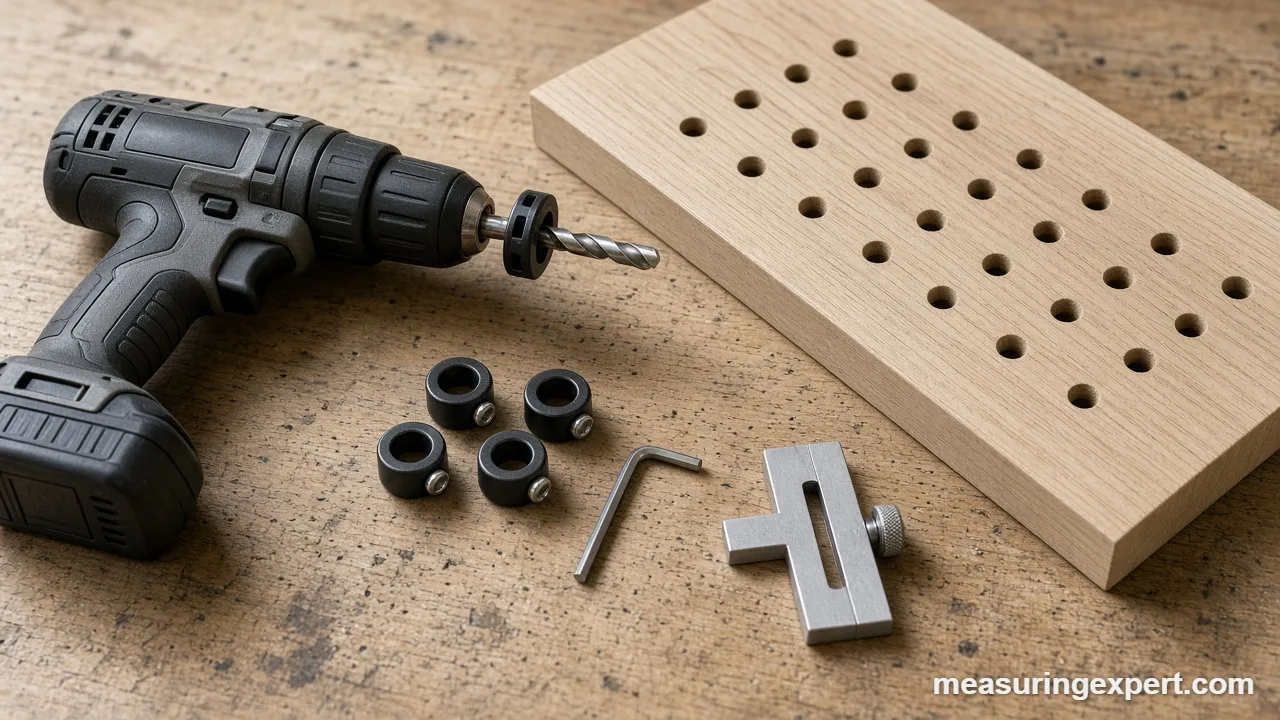
We also kept to established brands and allowed no more than two models per brand. In addition, we covered distinct jobs: hand drilling, budget use, drill press work, square holes, angled holes, pocket holes and setup. We left out unbranded multi-gauges whose specs we could not confirm, because the best drill depth gauge should have published specs.
Best Drill Depth Gauge Types: Collars, Guides and Readouts
The best drill depth gauge for you depends on the type. A drill depth tool does one of two jobs. Either it physically stops the bit, or it tells you how deep the bit has gone. The best tools do both. Here is how the main types compare.
| Type | How it sets depth | Typical repeatability | Best for |
|---|---|---|---|
| Stop collar | Clamps on the bit; hits the surface | Good if set with a gauge | Hand drills, dowels, pilot holes |
| Depth stop rod | Rod on the drill handle touches the work | Fair; rod can shift | Hammer drills and anchor holes in masonry |
| Drill guide | Collar or stop on guide columns | Good, and holes stay square | Large parts, on-site work, angled holes |
| Drill press stop | Threaded stop limits quill travel | Very good | Batches of identical holes |
| Digital readout | Shows quill travel as a number | Very good when zeroed at contact | Drilling to a specific value |
| Setting or step gauge | Measures the gap you set | Depends on the stop it sets | Setting collars and press stops |
Depth stop rods deserve a note. For example, most hammer drills and rotary hammers ship with one that clamps to the side handle. So you usually do not need to buy one, but you should set it with a tape, not by eye, because concrete anchors need a hole deeper than the anchor length.
What Decides Best Drill Depth Gauge Accuracy
Even the best drill depth gauge cannot fix a poor setup. Depth sounds simple, yet several small errors add up. Therefore, it helps to know where they come from before you trust a setting.
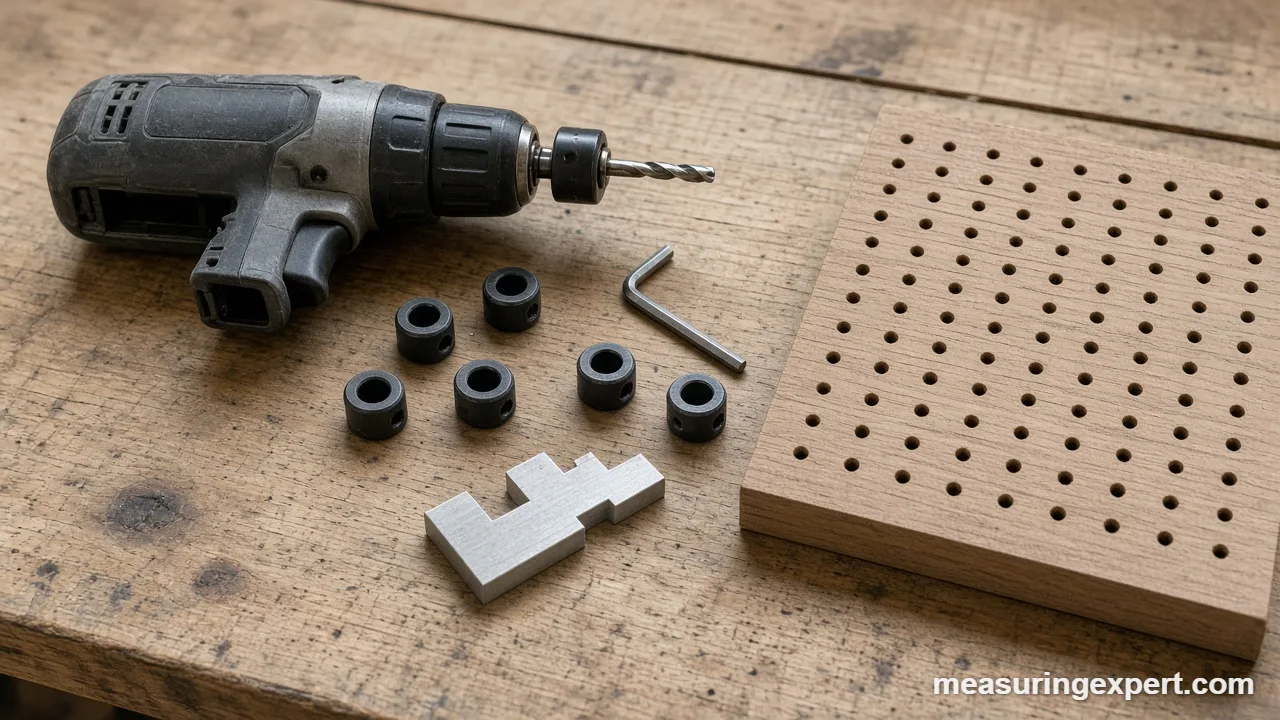
Where depth is measured from
A twist bit has a 118 or 135 degree point, so the tip leads the full-diameter cut. For example, on a 1/2 in (12.7 mm) bit with a 118 degree point, the cone is about 0.15 in (3.8 mm) long. In other words, a stop set to the tip gives a hole whose full-width depth is shallower than you think. Brad-point and Forstner bits have much shorter points, so the difference is small.
Collar slip and tilt
A single set screw pushes the bit to one side, and a loose screw lets the collar creep up the bit under load. As a result, two-screw or split collars hold better. Also, tighten the screw onto a flat or a smooth shank, never onto the cutting flutes.
Angled holes
On an angled guide, the stop controls the length along the bit, not the vertical depth. So the vertical depth equals the hole length times the cosine of the angle from vertical. For instance, a 1 in (25.4 mm) bore at 30 degrees from vertical reaches only about 0.87 in (22 mm) deep.
Reading and parallax
In general, scales on quills and tapes are hard to read closer than about 1/32 to 1/16 in. Meanwhile, a digital readout or a setting gauge removes most of that reading error. For more on reading small lengths, see our guide on how to measure length.
Drill Depth Inch to Millimeter Converter
Pair the best drill depth gauge with quick unit math. After all, bit sizes and plans mix fractions of an inch with millimeters. So use this length converter to turn an inch depth into millimeters or centimeters. The default is 1 in.
For example, a 32 mm system shelf-pin hole is often drilled about 3/8 in (9.5 mm) deep. Similarly, a 35 mm hinge cup usually needs about 1/2 in (12.7 mm), but always follow the hinge maker’s number.
How to Use the Best Drill Depth Gauge: Setting a Stop Collar
Good technique matters as much as the best drill depth gauge you can buy. So follow these steps each time you set a stop.
- First, decide the depth you need and whether it is measured to the tip or the full diameter.
- Next, slide the collar onto the bit with the set screw over a smooth part of the shank.
- Set the gap from the collar face to the bit tip with a setting gauge or caliper.
- Then tighten the set screw firmly, or both screws in turn on a split collar.
- Drill a test hole in scrap at the same speed you will use on the part.
- Measure the test hole with a depth gauge or caliper depth rod and adjust if needed.
- Finally, drill the real holes and stop as soon as the collar touches the surface.
Drill Depth Mistakes to Avoid
Most depth errors come from setup, not the tool, so the best drill depth gauge still needs care. Here is what to do and what to avoid.
Do
- Check each setting on scrap before drilling a finished part.
- Also, clear chips often on deep holes so the bit does not ride up.
- Re-check the collar after every dozen holes.
Don’t
- Never tighten a set screw onto the flutes of the bit.
- Avoid running the drill hard after the collar touches the surface.
- Do not trust a depth stop rod on a hammer drill without measuring it.
Best Drill Depth Gauge FAQ
What is the best drill depth gauge for a hand drill?
For most hand drilling, an adjustable stop collar is the best drill depth gauge. The Infinity Tools stops cover 1/8 to just over 1/2 in with two collars, while the Century pair is a cheaper option for occasional jobs.
How accurate is a drill stop collar?
A well-tightened collar repeats closely from hole to hole. However, its accuracy depends on how you set it, so use a setting gauge or caliper and drill a test hole first.
Do I measure drilling depth to the tip or the shoulder?
It depends on the job. For example, for dowels and shelf pins, measure to the full-diameter shoulder. For pilot holes, the tip is fine, because the screw tip needs room anyway.
What is a depth stop rod on a drill?
It is a metal rod that clamps to the side handle of a hammer drill or rotary hammer. When the rod touches the wall, you stop drilling, which helps with anchor holes in masonry.
Is a digital readout the best drill depth gauge for a drill press?
Yes, if you often drill to a specific number. A readout such as the iGaging EZ-Depth shows quill travel directly, so you avoid squinting at the small quill scale.
Is a drill guide the best drill depth gauge for square holes?
For many jobs, yes. A guide like the Woodpeckers Auto-Line or WEN WA1412 keeps holes square or at a set angle, and both have depth stops. Still, a drill press is more rigid for large bits and metal.
How deep should a pocket hole be?
Depth follows stock thickness. First, the Kreg Easy-Set gauge reads 1/2 to 1-1/2 in, and the collar window then lines up with the matching mark on the bit.
Why does my stop collar slip?
Usually the set screw sits on a flute or is not tight enough. So move it to the smooth shank, tighten it firmly and consider a split collar with two screws.
How do I convert drilling depth from inches to millimeters?
Multiply inches by 25.4, because 1 in is exactly 25.4 mm. For example, a 3/8 in deep hole is 9.525 mm deep.
Will a stop collar mark the wood?
It can, especially if the drill keeps spinning after contact. So ease off when the collar touches, or use a collar with a rounded face like the Infinity Tools stops.
Bottom Line: Which Best Drill Depth Gauge to Buy
For most people, the Infinity Tools Adjustable Drill Depth Stops are the best drill depth gauge. After all, two split collars cover 1/8 to just over 1/2 in, clamp evenly and fit metric bits too. However, choose the Century pair on a tight budget, the iGaging EZ-Depth at a drill press, or the Kreg kit for pocket holes.
1 thought on “Best Drill Depth Gauge: 8 Stop Collars, Drill Guides and Digital Readouts”