

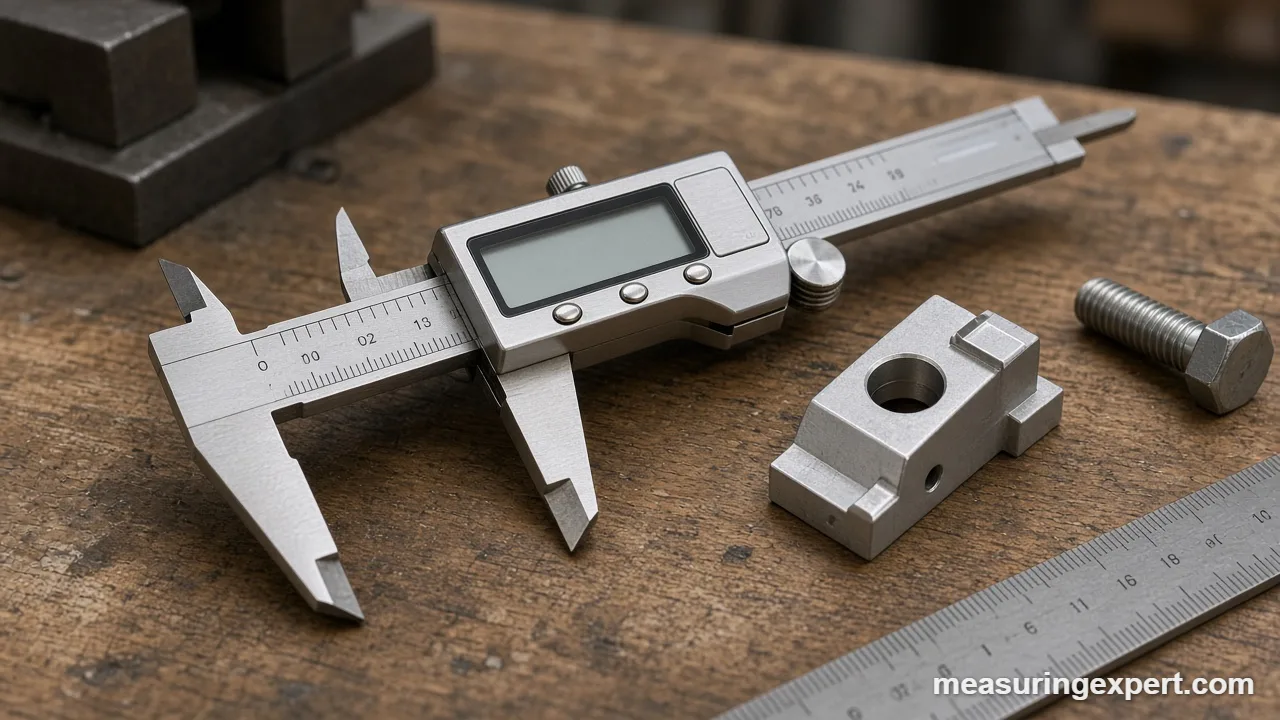
The best digital caliper for most people is the iGaging Absolute Origin 0-6 inch, because it keeps its zero when switched off, reads to 0.0005 in (0.01 mm) and resists dust and splashes. However, your choice really depends on three things: the accuracy you need, the shop conditions and how far you must reach.
In short: buy the iGaging Absolute Origin for all-round work, the Starrett 798A for coolant-soaked shop floors and the NEIKO 01407A for light hobby use.
As an Amazon Associate, Measuring Expert earns from qualifying purchases. Our picks are based on research, specifications and owner feedback, not paid placement.
Best Overall

Best Pro
Best Budget
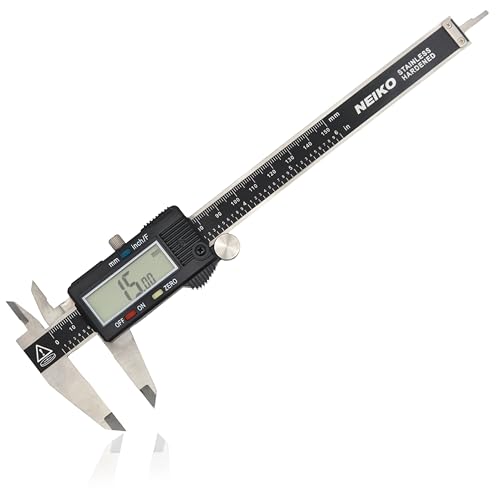
Quick Answer: The Best Digital Caliper for Each Job
- iGaging Absolute Origin 0-6 in: holds its origin through power-off, carries an IP54 rating and has a data port.
- Starrett 798A-6/150: an IP67 caliper with an inductive encoder that shrugs off coolant and oil.
- NEIKO 01407A: a low-cost entry point that also reads fractions down to 1/128 in.
- Clockwise Tools DCLR-0605: IP54 protection and three reading modes for home shops.
- Fowler Xtra-Value Cal: a name-brand basic caliper with absolute and incremental modes.
- HARDELL Rechargeable: charges over USB-C, so you never hunt for a button cell.
- General Tools 147 and 14712: large fractional displays in 6-inch and 12-inch lengths.
On This Page
- Side-by-side table
- The 8 picks, reviewed
- How we chose
- Specs that matter
- Digital vs dial vs vernier
- How to measure with a caliper
- Inch to mm converter
- Care and accuracy checks
- Honest limits
- FAQ
- Bottom line
Best Digital Caliper Picks Side by Side
First, use this table to narrow the field. Then jump to the review of any caliper that matches your work.
| # | Product | Best For | Standout Feature | Amazon |
|---|---|---|---|---|
| 1 | iGaging Absolute Origin 0-6 in | Most shops and makers | Absolute origin, IP54, data port | View |
| 2 | Starrett 798A-6/150 | Machinists using coolant | IP67 inductive encoder | View |
| 3 | NEIKO 01407A | Budget and hobby use | Inch, mm and 1/128 in fractions | View |
| 4 | Clockwise Tools DCLR-0605 | Dusty home workshops | IP54 with three-way reading | View |
| 5 | Fowler Xtra-Value Cal | Students and trainees | Absolute and incremental modes | View |
| 6 | HARDELL Rechargeable 6 in | 3D printing and electronics | USB-C charging, battery gauge | View |
| 7 | General Tools 147 | Woodworkers | Tall digits, 1/64 in fractions | View |
| 8 | General Tools 14712 | Large parts | 0 to 12 in (305 mm) reach | View |
The 8 Best Digital Caliper Options, Reviewed
We ranked these electronic calipers by how well each one serves a typical buyer. So the most versatile tools come first, while the more specialized picks follow. If you prefer a needle and gear rack, see our separate guide to the best dial caliper.
Best Overall
1. iGaging Absolute Origin 0-6 in
Best for: machinists, makers and serious DIYers who want near-pro features without a pro price tag.
Most low-cost calipers use an incremental scale. In other words, they count movement from wherever you last pressed zero, so they forget the origin when they power down. By contrast, the Absolute Origin stores its zero point. As a result, you can switch it on with the jaws open and it still shows the true distance. Therefore, it saves a step on every job and also removes a common source of error.
iGaging lists a 0 to 6 in (0 to 150 mm) range, 0.0005 in (0.01 mm) resolution and 0.001 in (0.02 mm) accuracy. In addition, the IP54 rating protects it against dust and splashing water. Also, the SPC/USB port can send readings to a computer, although the cable is sold separately. Meanwhile, a single CR2032 cell powers it, and a spare comes in the box.
- Range: 0 to 6 in (0 to 150 mm).
- Resolution: 0.0005 in (0.01 mm); accuracy 0.001 in (0.02 mm).
- Protection: IP54 against dust and splashes.
- Output: SPC data over a USB-style port (cable extra).
- Power: one CR2032 cell, with a spare included.
Pros
- Keeps its origin, even after power-off.
- Pro-level resolution and published accuracy.
- Data output for quality records.
Cons
- This listing reads inch and metric only, not fractions.
- Also, the data cable costs extra.
Skip it if: you work in fractional inches all day; a General Tools 147 shows 1/64 in steps directly.
Best Pro
2. Starrett 798A-6/150
Best for: production machinists who measure parts covered in coolant, oil or chips.
Starrett has made precision tools for well over a century, and the 798A clearly shows it. Instead of the common capacitive scale, it uses an induction-type linear encoder. Because of that design, liquids on the beam disturb it far less. Its IP67 rating also means the head is dust tight and survives temporary immersion.
Starrett rates it at plus or minus 0.001 in over 0 to 6 in, and plus or minus 0.02 mm from 0 to 100 mm. In addition, resolution is 0.0005 in (0.01 mm). Moreover, it has a fine adjustment roller, a slide lock and a 30-minute auto-off that wakes without losing position. Finally, one 3 V cell runs it for over a year of normal use, according to the spec sheet.
- Range: 0 to 6 in (0 to 150 mm).
- Accuracy: plus or minus 0.001 in; 0.02 mm up to 100 mm.
- Protection: IP67 against coolant, water and dust.
- Encoder: inductive, with zero at any position.
- Battery: one 3 V cell, over a year of typical use.
Pros
- IP67 sealing for wet shop floors.
- Inductive scale resists coolant errors.
- Fine adjust and slide lock for repeat checks.
Cons
- However, it costs several times more than hobby calipers.
- Also, there is no fraction display.
Skip it if: you only measure dry wood or plastic at home, because the iGaging gives similar resolution for less.
Best Budget
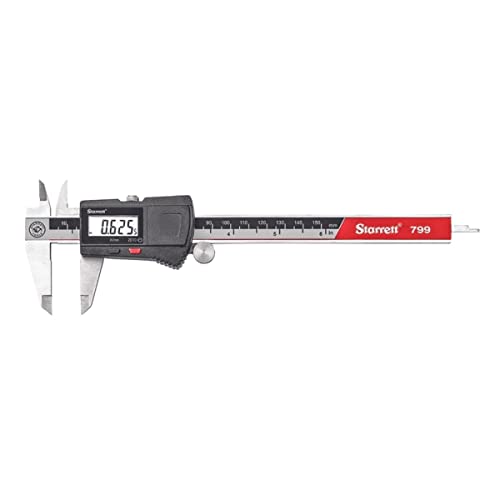
3. NEIKO 01407A
Best for: hobbyists, 3D printer owners and anyone buying a first electronic caliper.
The NEIKO has been a go-to starter caliper for years. First of all, it measures outside, inside, depth and step dimensions over 0 to 6 in (0 to 150 mm). In addition, it switches between decimal inches, millimeters and fractions. In fraction mode it resolves 1/128 in, which equals about 0.2 mm.
The maker claims 0.001 in (0.02 mm) accuracy, and the display steps in 0.0005 in (0.01 mm). Also, it runs on an LR44 button cell, and NEIKO packs a spare. However, owners often report that the unit can wake by itself in the case and drain the cell. So pull the battery during long storage, or keep a few spares on hand.
- Range: 0 to 6 in (0 to 150 mm).
- Units: inch, mm and fractions to 1/128 in.
- Resolution: 0.0005 in (0.01 mm).
- Battery: LR44, spare included.
Pros
- Very low cost for a stainless caliper.
- Three display modes, including fractions.
- Also includes a fine adjustment roller and padded case.
Cons
- Some units turn on by themselves and drain the cell.
- Fractions only round to 1/128 in.
- Also, it has no splash or dust rating.
Skip it if: you need traceable accuracy for paid work; instead, step up to the iGaging or Starrett.
Best for Dusty Shops
4. Clockwise Tools DCLR-0605
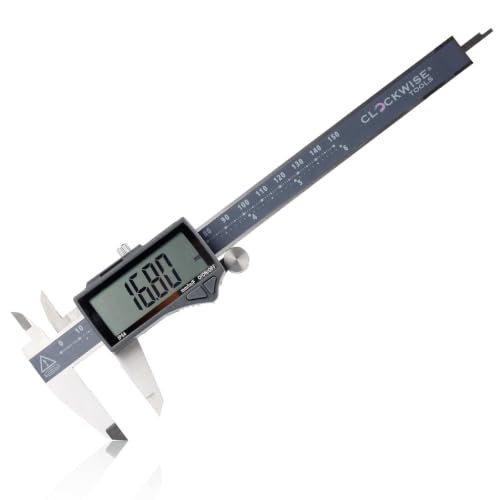
Best for: garage and woodshop users who want splash and dust protection on a small budget.
Clockwise Tools is a US-based brand that focuses on measuring tools. In particular, its DCLR-0605 adds an IP54 rating to an otherwise simple caliper. Therefore, sawdust and the odd splash are less likely to scramble the reading. It also reads decimal inches, millimeters and fractions to 1/128 in.
The listed accuracy is plus or minus 0.001 in, and resolution is 0.0005 in (0.01 mm). On top of that, it shuts off after roughly 5 to 7 minutes of rest to save power. Finally, the stainless body has a polished finish, and it ships in a hard plastic case.
- Range: 0 to 6 in (0 to 150 mm).
- Protection: IP54 dust and splash rating.
- Modes: decimal inch, metric and fractions.
- Auto-off: after about 5 to 7 minutes idle.
Pros
- IP54 at a hobby-level cost.
- Three-way display with fractions.
- Besides, the LCD is large and clear.
Cons
- Incremental scale, so you re-zero after power-off.
- Also, there is no data output.
Skip it if: you work under flood coolant; IP54 is not built for that, but the Starrett 798A is.
Best for Students
5. Fowler Xtra-Value Cal 54-101-150-2

Best for: machining students, apprentices and anyone who wants an established metrology brand at a modest cost.
Fowler has supplied shop tools for decades, and the Xtra-Value Cal is its entry electronic model. It covers 0 to 6 in (0 to 150 mm) with 0.0005 in (0.01 mm) resolution and 0.001 in (0.02 mm) accuracy. Also, it handles the usual four measurements: outside, inside, depth and step.
Two modes make it a good teaching tool. First, absolute mode measures from the closed-jaw zero. Second, incremental mode lets you zero at any opening and read the difference. For example, you can zero on a reference pin and read how much each part varies from it. In addition, a molded case is included.
- Range: 0 to 6 in (0 to 150 mm).
- Accuracy: 0.001 in (0.02 mm).
- Modes: absolute and incremental; inch and metric.
- Body: stainless steel frame with molded case.
Pros
- Trusted shop brand.
- Handy incremental comparison mode.
- Clear inch and metric switching.
Cons
- However, there is no fraction mode.
- Also, there is no published IP rating.
Skip it if: your shop is wet or dusty, because the Clockwise or Starrett suit that better.
Best Rechargeable
6. HARDELL Rechargeable 6 in
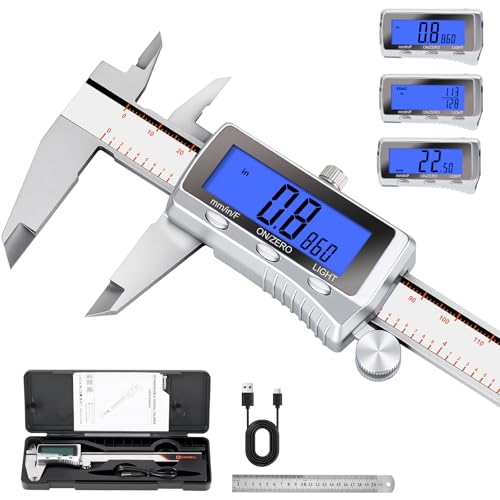
Best for: 3D printing, electronics and craft benches where a dead coin cell always seems to strike at the wrong time.
Button cells are the weak point of many cheap calipers. So HARDELL swapped them for a built-in lithium-ion battery that charges through a USB-C port with a dust cover. In addition, the screen shows the remaining charge and has a backlight, which helps in a dim garage.
HARDELL lists plus or minus 0.02 mm (0.001 in) accuracy over its 6 in range. Besides that, it switches between metric, imperial and fractions with one button, and it sleeps after 5 minutes of rest. As well, the kit includes the charging cable and a storage case.
- Range: 6 in (150 mm class).
- Accuracy: plus or minus 0.02 mm (0.001 in), per the maker.
- Power: built-in Li-ion battery, USB-C charging.
- Display: backlit LCD with battery level.
Pros
- No button cells to buy.
- Backlit screen with charge indicator.
- Metric, inch and fraction modes.
Cons
- However, independent spec documentation is thin.
- Eventually, the internal battery will age.
Skip it if: you need a long track record or traceable paperwork; the Starrett or iGaging fit better.
Best for Woodworkers
7. General Tools 147 Fraction+

Best for: woodworkers and home builders who think in 1/16s and 1/64s rather than thousandths.
Woodworking plans often list stock as 3/4 in or 13/16 in. For that reason, a caliper that shows fractions saves you a trip to a chart. Specifically, the General 147 displays decimal inches to 0.0005 in, millimeters to 0.01 mm and fractions in 1/64 in steps. Also, its LCD digits stand 7/16 in tall, so you can read them at arm’s length.
The beam is also marked in tenths of an inch on one edge and millimeters on the other. As a result, you can sanity-check the display at a glance. In addition, the jaws are about 1-9/16 in deep, which lets you reach past an edge on boards and trim.
- Range: 0 to 6 in (0 to 150 mm).
- Fractions: 1/64 in steps; decimal 0.0005 in.
- Display: digits 7/16 in high.
- Jaw depth: about 1-9/16 in.
Pros
- Large, easy-to-read digits.
- True 1/64 in fraction mode.
- Dual-scale beam as a backup.
Cons
- Also, it has no IP rating.
- However, accuracy is not stated in the manual.
Skip it if: you machine metal to thousandths; a caliper with a published accuracy spec is the safer choice.
Best Long Reach
8. General Tools 14712 (12 in)

Best for: measuring wide boards, pipe flanges, cabinet parts and anything over 6 inches.
Most calipers stop at 6 in (150 mm). However, plenty of parts are bigger. The 14712 doubles the reach to 12 in (about 305 mm) while keeping the same three display modes: decimal inches, millimeters and 1/64 in fractions. In addition, it runs on an SR44 cell and shuts itself off when idle.
Keep in mind that a long beam is heavier and harder to hold square. Therefore, support the far end on large parts and use light, even jaw pressure. Also, plan on a longer case or a wall rack, because a 12 in caliper will not fit in a standard drawer insert.
- Range: 0 to 12 in (0 to 300 mm class).
- Resolution: 0.0005 in, 0.01 mm or 1/64 in.
- Battery: SR44, included.
- Functions: outside, inside, depth and step.
Pros
- Twice the reach of a 6 in caliper.
- Fraction display for shop drawings.
- Auto power-off saves the cell.
Cons
- However, it feels bulky on small parts.
- Also, sellers list conflicting accuracy figures.
Skip it if: nearly all your parts are under 6 in, since a shorter caliper is easier to control.
How We Chose the Best Digital Caliper Picks
To be clear, we did not run hands-on lab tests. Instead, these picks are research-based. First, we searched for electronic calipers from established makers such as Starrett, iGaging, Fowler, General Tools, NEIKO and Clockwise Tools. Next, we read manufacturer manuals and distributor spec sheets, and we kept only specs we could confirm there. Finally, we weighed long-term owner feedback on battery drain, zero drift and build quality.
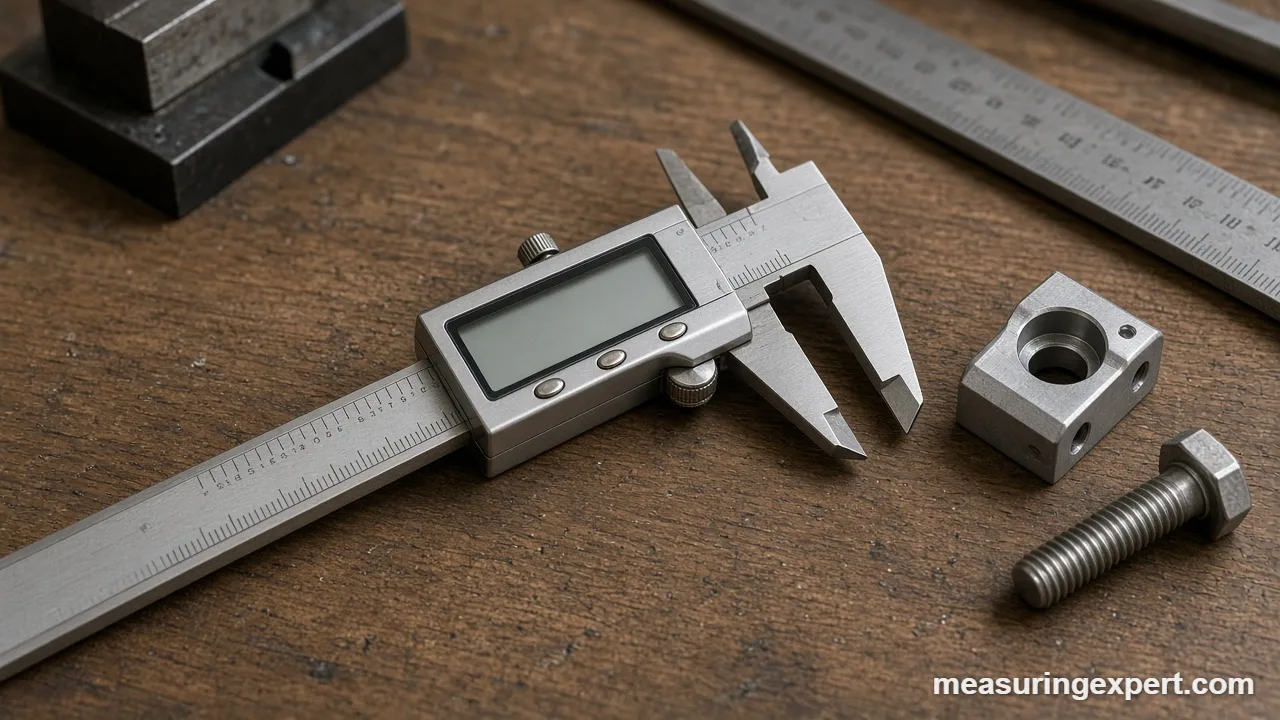
Then we scored each caliper on published accuracy, resolution, scale type (absolute or incremental), ingress rating, power source and range. We also capped the list at two models per brand and, as a result, dropped unbranded clones. In addition, we checked each listing for a complete tool, not a replacement part. For background on caliper performance, we referred to the scope of ASME B89.1.14, the US standard for specifying and calibrating calipers.
What Makes the Best Digital Caliper Accurate
A caliper is a tool for linear measurement, but the numbers on the box can mislead. So it pays to know what each spec actually means, because the gaps matter.
- Resolution: the smallest step the display shows, usually 0.0005 in or 0.01 mm. However, it is not the same as accuracy.
- Accuracy: how close the reading sits to the true size. A typical good 6 in caliper is rated at plus or minus 0.001 in (0.02 to 0.03 mm).
- Repeatability: whether you get the same number twice. For example, jaw pressure and how square you hold the tool affect it most.
- Scale type: incremental scales need a fresh zero at each power-on. Absolute scales, like the iGaging Absolute Origin, remember the origin.
- Encoder: most calipers use a capacitive sensor, which liquids can upset. In contrast, inductive designs such as the Starrett 798A tolerate coolant.
- IP rating: IP54 means dust protected and splash resistant. Similarly, IP67 means dust tight and able to survive short immersion.
- Units: decimal inch, metric and fractions. Note that 1 in equals exactly 25.4 mm, as NIST explains.
- Power: most use CR2032, LR44 or SR44 cells; however, a few have a built-in rechargeable battery.
Digital, Dial or Vernier: Which Caliper Type Fits?
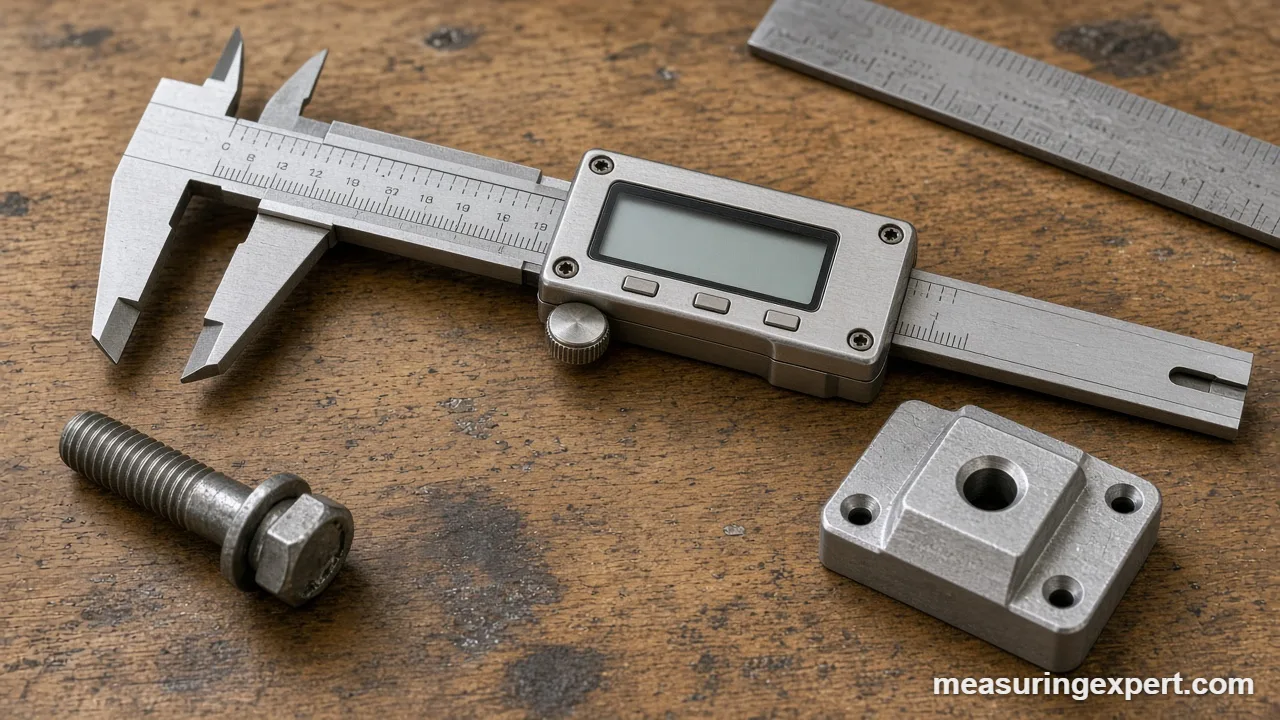
All three caliper types measure the same four ways. However, they differ in how you read them and what can go wrong.
| Type | How you read it | Strengths | Weak spots |
|---|---|---|---|
| Digital (electronic) | LCD number | Fast, switches units, zero anywhere | Needs power; liquids can upset capacitive scales |
| Dial | Needle on a dial plus beam scale | No battery; easy to see trends | Gear rack can skip if dropped or dirty |
| Vernier | Two engraved scales | No battery or gears; very durable | Slow to read; eye strain |
For most people, a digital model is the easiest to learn. In fact, the unit switch alone removes many conversion mistakes. On the other hand, a vernier lives happily in a toolbox for decades without a battery. Our broader guide to measuring length compares calipers with rulers, tapes and micrometers.
How to Measure With a Digital Caliper
In general, these steps suit any of the calipers above. Still, check your own manual, since buttons differ.
- Wipe the jaws and the beam with a clean, dry cloth.
- Close the jaws fully, then press zero (skip this on an absolute caliper that already reads 0.00).
- Open and close the jaws once more, and confirm the display returns to zero.
- For an outside size, place the part deep in the large jaws and close them with light, steady pressure.
- For a bore, use the small upper jaws and rock the caliper slightly to find the largest reading.
- For depth, rest the end of the beam on the top face and slide until the rod touches bottom.
- Read the display, lock the slide if you need to, and record the value with its unit.
Convert Best Digital Caliper Readings Between Units
Most electronic calipers switch units with one button. Even so, you may need to convert a recorded number later. So enter a value below to convert inches to millimeters, centimeters or mils.
Notice that a “6 in / 150 mm” caliper is a small compromise: 6 in is actually 152.4 mm, while 150 mm is about 5.906 in. For quick metric checks, our 10 cm to inches page shows the math step by step.
Keep the Best Digital Caliper Reading True
Good habits matter more than the price tag. First, check zero every time you pick the caliper up. Second, verify it now and then against a known reference, such as a gauge block or a micrometer standard. If it misses by more than its rated accuracy, clean it and test again before you trust it.
Also, keep the beam clean and lightly oiled with instrument oil, and never use compressed air, which drives grit under the slide. Next, store it with the jaws slightly open so temperature changes do not stress the faces. Finally, remove the cell from any caliper that will sit unused for months, because a leaking cell can ruin the electronics.
Honest Limits of Electronic Calipers
Even a top caliper is a general-purpose tool. After all, its jaws are long, so small flexes and tilt add error that a micrometer avoids. Likewise, soft materials such as foam or thin plastic squash under jaw pressure, and the display will happily show that squashed size to 0.01 mm.
In addition, a 0.0005 in display does not make a 0.0005 in tool. Instead, treat the last digit as a hint, not a promise. For tight-tolerance parts, use a micrometer or a dedicated thickness gauge instead.
Best Digital Caliper FAQ
What is the best digital caliper for most people?
For most buyers, the best digital caliper is the iGaging Absolute Origin 0-6 in. It keeps its zero through power-off, reads to 0.0005 in (0.01 mm) and carries an IP54 rating.
How accurate is a digital caliper?
Good 6 in models are rated at about plus or minus 0.001 in (0.02 to 0.03 mm). However, real results depend on clean jaws, light pressure and holding the tool square.
What is the difference between resolution and accuracy?
Resolution is the smallest step the screen shows, such as 0.01 mm. Accuracy is how close that number is to the true size, so a caliper can display 0.01 mm yet be accurate only to 0.02 mm.
What is the best digital caliper for coolant or wet shops?
The Starrett 798A-6/150 is the best digital caliper for wet work on our list. That is because it has an IP67 rating and an inductive encoder that tolerates coolant and oil.
Why does my digital caliper reading jump or drift?
The usual causes are a weak battery, dirt or moisture on the beam, or a capacitive scale near liquid. So replace the cell, clean the beam and re-zero.
Do digital calipers need calibration?
Yes. Check zero daily and verify against a gauge block or standard on a regular schedule. In addition, shops with a quality system often send calipers out for certified calibration once a year.
Is a digital caliper better than a dial caliper?
For most users, yes, because it reads faster and switches units. Even so, a dial caliper needs no battery, and some machinists prefer its needle for spotting trends.
What is the best digital caliper for woodworking?
The General Tools 147 is the best digital caliper for woodworkers on our list. In fact, it shows fractions in 1/64 in steps and has large 7/16 in digits.
What battery does a digital caliper use?
Most use an LR44, SR44 or CR2032 button cell. However, some newer models, such as the HARDELL Rechargeable, use a built-in battery that charges over USB-C.
Can a digital caliper measure depth?
Yes. The thin rod that slides out of the end of the beam measures depth. Then rest the beam end on the top surface and slide until the rod touches the bottom.
Bottom Line: Our Best Digital Caliper Pick
For most readers, the iGaging Absolute Origin 0-6 in is the best digital caliper, thanks to its absolute scale, IP54 protection and data output. On the other hand, if you work in a wet machine shop, the Starrett 798A is worth the extra cost. And if you just need a dependable first tool, the NEIKO 01407A covers the basics.
4 thoughts on “Best Digital Caliper: 8 Research-Based Picks for Precise Measuring”