

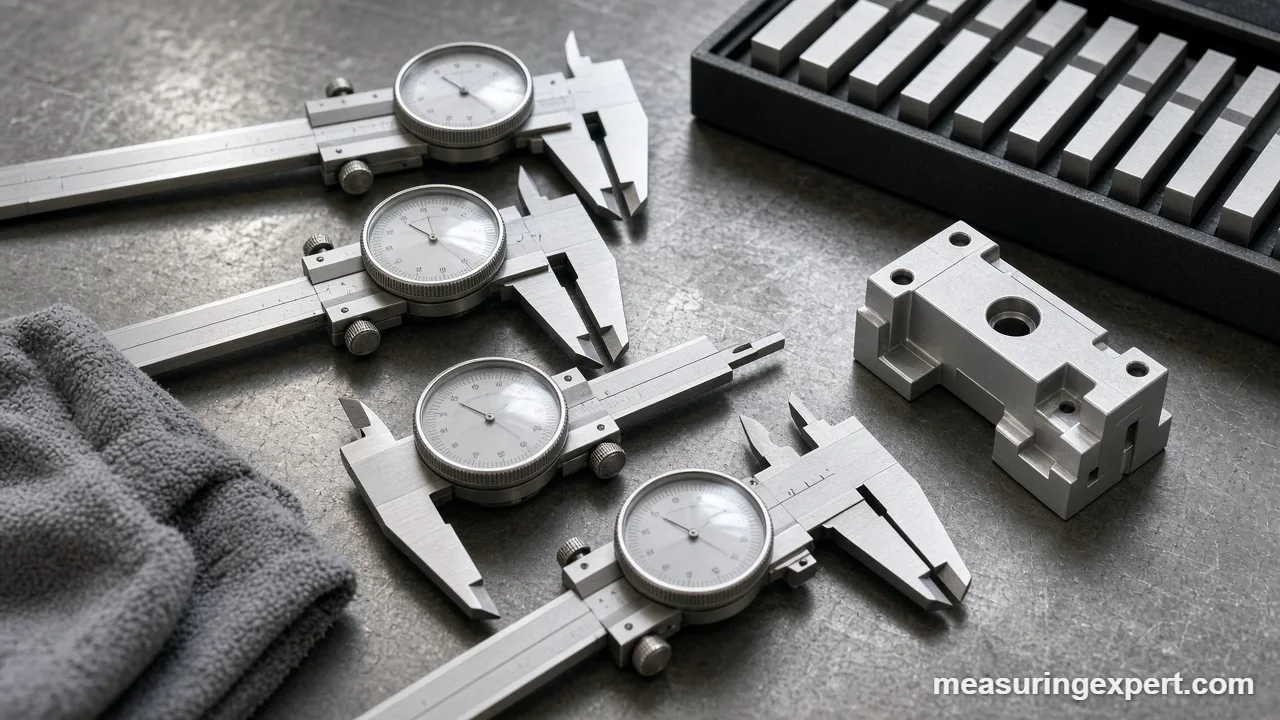
The best dial caliper for most shops is the Mitutoyo 505-742J, a 0 to 6 in tool rated at plus or minus 0.001 in that never needs a battery. Even so, three things decide the right choice: inch or metric scale, how far the jaws must reach, and how tight your tolerances really are.
In short: choose the Mitutoyo 505-742J for inch work, the Mitutoyo 505-732 for metric, the Accusize P920-B216 for value, and the Fowler 12 in for long parts.
As an Amazon Associate, Measuring Expert earns from qualifying purchases. Our picks are based on research, specifications and owner feedback, not paid placement.
Best Overall
Best Value

Best Metric
Quick Answer: Which Dial Caliper Fits You?
- Inch machining: the Mitutoyo 505-742J reads 0.001 in with a published accuracy rating.
- Metric parts: the Mitutoyo 505-732 reads 0.01 mm, so no conversion is needed.
- Value with specs: the Accusize P920-B216 lists plus or minus 0.001 in and a no-glare black dial.
- Shop standard: the Starrett 0-6 in model has an adjustable bezel for plus-or-minus checks.
- Woodworking: the iGaging dual-scale dial shows fractions and decimals together.
- Long stock: the Fowler 52-008-712 reaches 12 in.
- Tight budget: the HFS 0-6 in model is a fair first tool or a spare.
On This Page
- Comparison table
- The 7 picks, reviewed
- How we chose
- How a dial caliper works
- Reading the dial, with examples
- Dial vs digital vs vernier
- What to look for
- How to measure, step by step
- Inch to millimeter converter
- Zeroing, calibration and care
- Honest limits
- FAQ
- Bottom line
Best Dial Caliper Comparison Table
First, find the row that matches your work. Then jump to the full review below.
| # | Product | Best For | Standout Feature | Amazon |
|---|---|---|---|---|
| 1 | Mitutoyo 505-742J Dial Caliper | Most machinists, mechanics and serious hobbyists | 0.001 in dial, 0.1 in per turn | View |
| 2 | Starrett Dial Caliper 0-6 in | Shops that standardize on Starrett | Adjustable bezel, 0.001 in graduation | View |
| 3 | Accusize P920-B216 Black Face Dial Caliper | Value-minded machinists | Black face, satin chrome no-glare dial | View |
| 4 | Mitutoyo 505-732 Metric Dial Caliper | Metric drawings and imported parts | 0.01 mm graduation, 1 mm per turn | View |
| 5 | iGaging 6 in Fractional and Decimal Dial Caliper | Woodworkers and fraction users | Decimal and fractional inch on one dial | View |
| 6 | Fowler 52-008-712 Premium Dial Caliper (12 in) | Parts longer than 6 in | 12 in reach, shockproof dial | View |
| 7 | HFS 0-6 in Shockproof Dial Caliper | First dial caliper, light use | Low cost with case and 1-year warranty | View |
The 7 Best Dial Caliper Options, Reviewed
This guide covers dial models only. If you are still deciding between types, our best caliper roundup compares dial, digital and vernier tools side by side. And if you already prefer a screen, see our best digital caliper picks instead.
Best Overall
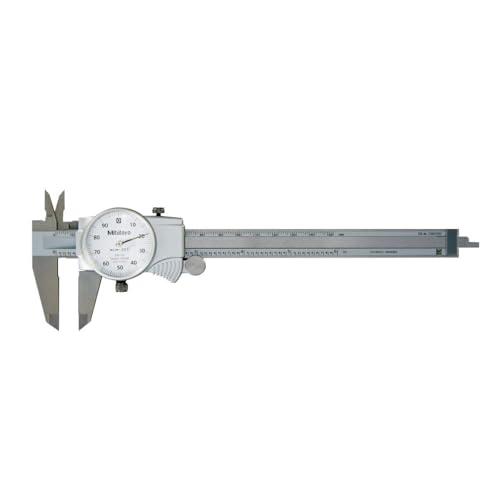
1. Mitutoyo 505-742J (0-6 in)
Best for: machinists, engine builders and home shop owners who want a dependable inch dial caliper that is always ready.
Mitutoyo’s 505-742J earns the top spot because it does the basic job very well. Its needle makes one full turn for every 0.1 in (2.54 mm) of jaw travel, and the dial carries 100 marks, so each mark equals 0.001 in. As a result, you read tenths on the beam and thousandths on the dial with no math beyond adding two numbers.
Mitutoyo rates it at plus or minus 0.001 in across the full 0 to 6 in range. In addition, distributors describe a shock-protected dial movement and lock screws for both the bezel and the slide. So you can lock the jaws on a reference part and then use the needle as a quick go or no-go check. Because nothing runs on a battery, it reads the moment you pick it up, even after a year in a drawer.
- Range: 0 to 6 in (0 to 152.4 mm).
- Graduation: 0.001 in; 0.1 in per dial revolution.
- Rated accuracy: plus or minus 0.001 in.
- Outside, inside, depth and step measurement.
- Locking screws for the bezel and the slide.
Pros
- Never needs a battery.
- A sweeping needle shows trends as you hone or lap a part.
- Also, the maker publishes a clear accuracy rating.
Cons
- Inch only, so metric drawings need conversion.
- A hard drop or grit in the rack can knock the dial out of time.
Skip it if: you work mostly from metric drawings; the Mitutoyo 505-732 reads directly in millimeters.
Best Heritage Brand
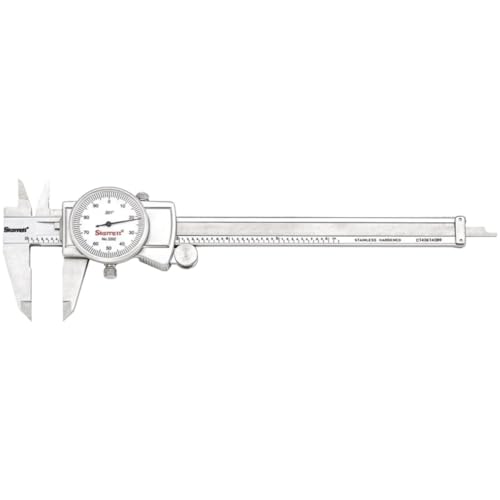
2. Starrett Dial Caliper (0-6 in)
Best for: tool rooms and buyers who already trust Starrett gauges and want a matching analog caliper.
Starrett has made precision hand tools in Massachusetts for well over a century, and many shops keep a full drawer of its gauges. This dial caliper fits that kind of kit. It covers 0 to 6 in with 0.001 in graduations, and its adjustable bezel lets you turn the dial so the needle sits at zero.
That bezel matters more than it sounds. For instance, you can close the jaws on a 1.000 in gauge block, zero the dial there, and then read every part as plus or minus from nominal. In short, it becomes a quick comparator for batch work. However, we list only the specs Starrett’s listing confirms, so check the model number if you need a written accuracy rating.
- Range: 0 to 6 in (0 to 152.4 mm).
- Graduation: 0.001 in.
- Adjustable bezel for zero setting.
- Outside, inside, depth and step measurement.
Pros
- Well-known maker with long service support.
- The bezel makes plus-or-minus checks easy.
- No battery or electronics to fail.
Cons
- The listing gives fewer published specs than Mitutoyo does.
- Inch only.
Skip it if: you need a documented accuracy figure on the box; the Mitutoyo and Accusize listings state theirs.
Best Value
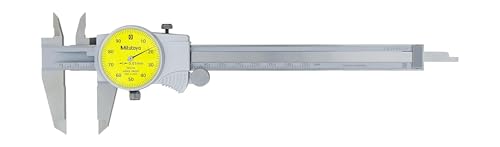
3. Accusize P920-B216 Black Face
Best for: buyers who want published specs and a readable dial without paying for a premium name.
Accusize builds this caliper with a black dial face, white graduations and a red needle. That high-contrast layout is easy on the eyes under bright shop lights, and the satin chrome finish around the dial cuts glare. Meanwhile, the beam and jaws are hardened stainless steel with lapped measuring faces.
On paper, it matches the big names. Accusize lists a 0 to 6 in range, 0.001 in resolution and plus or minus 0.001 in accuracy. It also has an adjustable bezel with a lock, and it ships in a fitted plastic case. If you later need more reach, the same family includes a 12 in version, the P920-B212, which Accusize rates at plus or minus 0.0015 in.
- Range: 0 to 6 in (0 to 152.4 mm).
- Resolution: 0.001 in; accuracy plus or minus 0.001 in.
- Hardened stainless beam and jaws with lapped faces.
- Adjustable bezel with lock; fitted plastic case.
Pros
- Published accuracy at a mid-range price.
- High-contrast black dial is quick to read.
- Also, a 12 in sibling uses the same layout.
Cons
- Smaller brand, so local calibration labs may know it less well.
- Inch only.
Skip it if: you want a name an auditor will recognize at a glance; choose the Mitutoyo instead.
Best Metric
4. Mitutoyo 505-732 (0-150 mm)
Best for: anyone who works in millimeters, from 3D printing and bicycles to imported machinery.
Most dial calipers sold in the US read only in inches. However, a lot of real work is metric: printer nozzles, bike parts, car fasteners and nearly every imported machine. The 505-732 solves that with a dial that turns once per 1 mm of travel, split into 100 marks of 0.01 mm each.
Reading it works the same way as an inch model. First, read whole millimeters on the beam scale. Next, add the hundredths from the dial. For example, 23 mm on the beam plus 47 marks on the dial reads 23.47 mm. Also, with no unit switching, you cannot read the wrong mode.
- Range: 0 to 150 mm (0 to 5.9 in).
- Graduation: 0.01 mm; 1 mm per dial revolution.
- Outside, inside, depth and step measurement.
- No battery or electronics.
Pros
- Reads metric parts directly, with no conversion.
- Fine 0.01 mm marks on a 1 mm dial.
- Also shares Mitutoyo’s mature dial design.
Cons
- Metric only; inch drawings need math.
- Slightly shorter range than a 6 in tool.
Skip it if: your prints are in inches; the 505-742J is the inch twin.
Best for Woodworkers
5. iGaging Fractional and Decimal Dial (6 in)
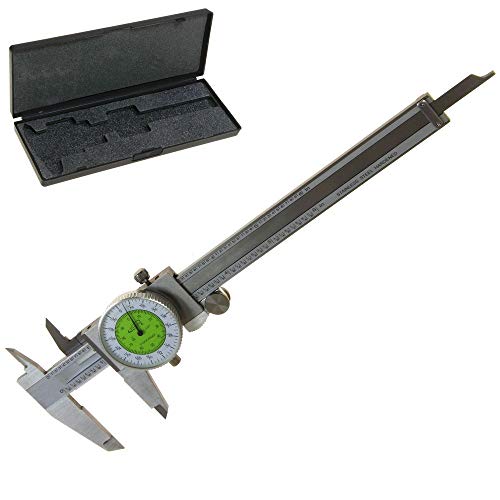
Best for: woodworkers, luthiers and DIYers who think in 1/64 in steps but sometimes need thousandths.
Woodworkers rarely measure in thousandths. Instead, plans call for 3/4 in stock or a 5/16 in dowel. This iGaging dial caliper puts decimal and fractional inch markings on one dial, so you can read either style without a chart.
That dual scale also helps you learn the link between the two systems. For instance, 0.375 in sits exactly on 3/8 in, while 0.391 in lands close to 25/64 in (0.3906 in). So the dial teaches you which fraction a decimal reading is closest to. In addition, the analog needle shows when stock is slightly over or under, which is handy when you sneak up on a tenon.
- Range: 0 to 6 in (0 to 152.4 mm).
- Decimal and fractional inch scales on one dial.
- Outside, inside, depth and step measurement.
- Battery-free analog readout.
Pros
- Reads fractions directly, with no conversion chart.
- Affordable for a shop drawer.
- Also helps beginners learn decimal equivalents.
Cons
- Not built for tight machining tolerances.
- The listing does not publish an accuracy figure.
Skip it if: you machine metal to 0.001 in; pick the Mitutoyo or Accusize.
Best Long Range
6. Fowler 52-008-712 (0-12 in)

Best for: fabricators, engine builders and woodworkers who often measure stock longer than 6 in.
A 6 in caliper runs out of room quickly on pipe, lumber, brake rotors or crank journals. Fowler’s premium dial model doubles the reach to 12 in (304.8 mm) while keeping the familiar 0.1 in per turn dial with 0.001 in marks. Fowler also describes a shockproof movement that helps the dial resist backlash.
Keep expectations realistic, though. Fowler rates this tool at plus or minus 0.002 in, which is normal for a longer beam. In addition, long jaws magnify any tilt, so hold the part close to the beam. Even so, it beats stacking readings from a short tool.
- Range: 0 to 12 in (0 to 304.8 mm).
- Graduation: 0.001 in; 0.1 in per revolution.
- Rated accuracy: plus or minus 0.002 in.
- Shockproof dial, thumb roll and knurled lock.
- Stainless steel; case included.
Pros
- Twice the reach of a standard tool.
- Lock holds a setting for repeat checks.
- Also needs no battery.
Cons
- Looser accuracy than the 6 in models.
- Heavy and awkward on small parts.
Skip it if: most of your parts fit inside 6 in; a short caliper is easier to hold square.
Best Budget
7. HFS 0-6 in Shockproof Dial
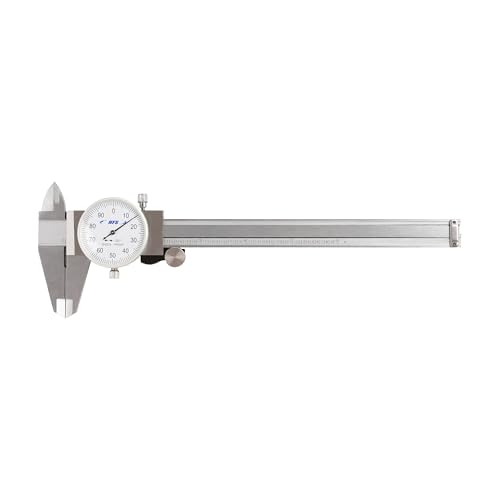
Best for: students, hobbyists and anyone who wants a backup caliper for the garage.
Of course, not everyone needs a premium caliper. For checking bolt sizes, drill bits or 3D-printed parts, an entry-level dial model can be enough. Hardware Factory Store (HFS) sells this 0 to 6 in four-way caliper with 0.001 in graduations, a plastic case and a one-year warranty.
HFS markets a double shockproof design and lists plus or minus 0.001 in accuracy. That said, treat the claim with care. For example, the listing calls the tool stainless steel in its title but hardened carbon steel in its description, so wipe it down and oil it lightly if your shop is damp. Also, verify it against a known standard before you trust it for close work.
- Range: 0 to 6 in (0 to 152.4 mm).
- Graduation: 0.001 in; listed accuracy plus or minus 0.001 in.
- Outside, inside, depth and step measurement.
- Plastic case; one-year warranty.
Pros
- Low cost for a battery-free tool.
- Includes a case for storage.
- Also a fine spare for the truck or garage.
Cons
- Mixed material claims in the listing.
- Finish and dial feel trail the premium brands.
Skip it if: you need traceable accuracy for paid work; spend more on the Mitutoyo or Accusize.
How We Chose the Best Dial Caliper Picks
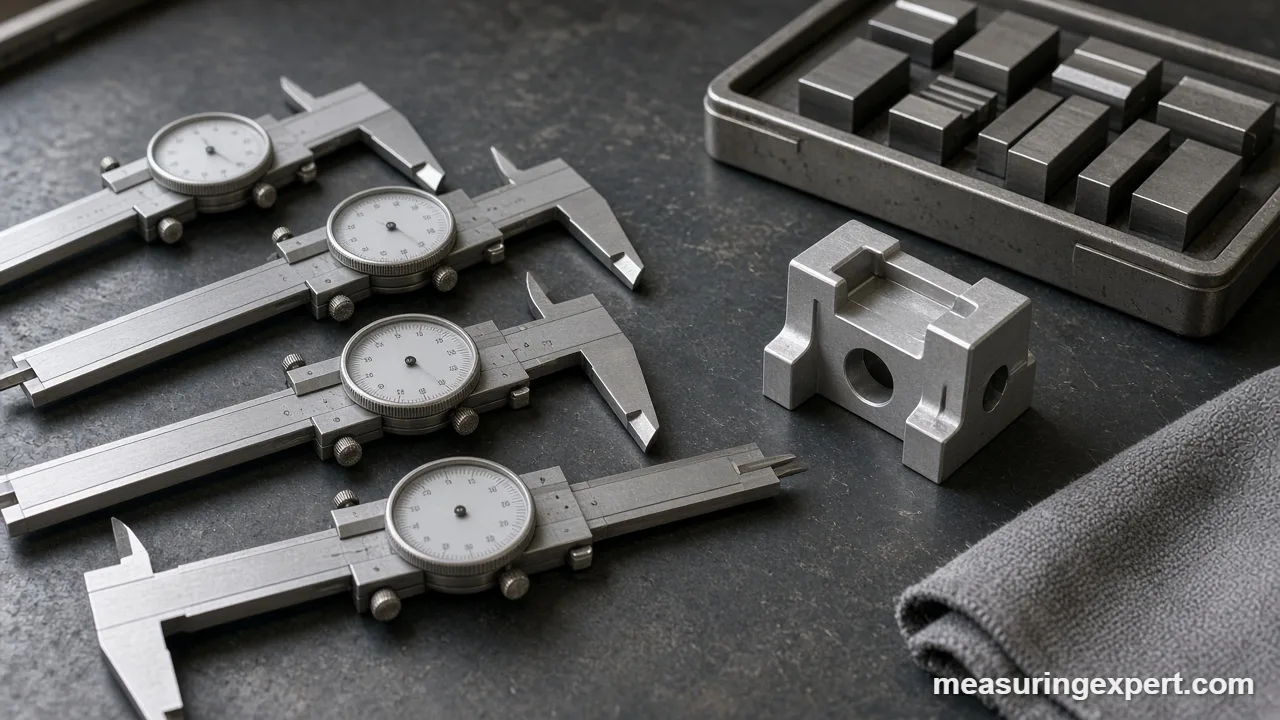
We did not run hands-on lab tests. Instead, these picks are research-based. We compared manufacturer and seller specifications, read owner feedback for recurring faults, and checked that every model is a complete, current caliper rather than a part or a discontinued listing. Then we weighed each tool against five questions:
- Published accuracy: does the maker state a plus or minus figure, not just a graduation?
- Scale fit: inch, metric or fractional, matched to real jobs.
- Dial design: travel per revolution, contrast, bezel lock and shock protection.
- Build: hardened stainless steel, lapped jaw faces and a smooth slide.
- Brand spread: no more than two models from one maker, plus a range of budgets.
For unit definitions, we relied on the NIST guide to SI length units, which confirms that 1 inch is exactly 25.4 mm. For maker specs, we used product pages such as the Accusize dial caliper page.
How a Dial Caliper Works Inside
A dial caliper is a sliding jaw on a steel beam, just like a vernier. However, the difference sits inside the dial housing. First, a fine-toothed rack runs along the beam, and a small pinion gear on the slider meshes with it. As you move the jaw, the pinion turns, and gears inside the housing spin the needle.
Because the gearing is fixed, each revolution of the needle always equals the same jaw travel. On most inch tools, that is 0.1 in. Some inch models use 0.2 in per turn instead, so check before you read one for the first time. On metric tools, 1 mm or 2 mm per turn is common. Meanwhile, the beam itself carries a coarse scale in tenths of an inch or whole millimeters. Therefore, every reading is two parts: the beam gives the coarse value, and the dial adds the fine value.
As a result, it needs no power, and the sweeping needle lets you watch a size change as you file or turn a part. However, the rack is also the weak point. A chip of metal or a grain of sand on the rack can make the needle jump a tooth, which shifts every later reading.
Reading the Dial: Two Worked Examples
Once you know the two-part method, reading a dial takes a second or two. Here are two common cases.
Example 1, inch dial at 0.1 in per turn. The slider edge sits past the 1.2 in mark on the beam, and the needle points to 37. So the reading is 1.2 + 0.037 = 1.237 in. In metric, that equals 31.42 mm, because 1.237 x 25.4 = 31.4198 mm.
Example 2, metric dial at 1 mm per turn. The beam shows 23 whole millimeters, and the needle points to 47. Each mark is 0.01 mm, so the reading is 23 + 0.47 = 23.47 mm, or about 0.924 in.
Dial vs Digital vs Vernier: Which Type Wins?
All three caliper types take the same four measurements: outside, inside, depth and step. The difference, then, is how you read them and what can go wrong.
| Feature | Dial | Digital | Vernier |
|---|---|---|---|
| Power | None | Battery | None |
| Typical resolution | 0.001 in or 0.01 to 0.02 mm | 0.0005 in or 0.01 mm | 0.001 in or 0.02 to 0.05 mm |
| Unit switching | No (one scale per tool, except dual-scale dials) | Yes, at a button press | Often both scales on one beam |
| Speed of reading | Fast | Fastest | Slow |
| Shows trends | Yes, the needle sweeps | Harder, digits flicker | No |
| Main weakness | Grit in the rack, drops | Dead battery, moisture | Eye strain, parallax |
In short, a dial caliper suits anyone who wants a fast analog readout with no battery to fail. On the other hand, digital wins when you switch between inch and metric all day. Meanwhile, a vernier remains the most rugged choice, but it is the slowest to read.
What to Look For in the Best Dial Caliper
The specs that matter are few, so focus on these points.
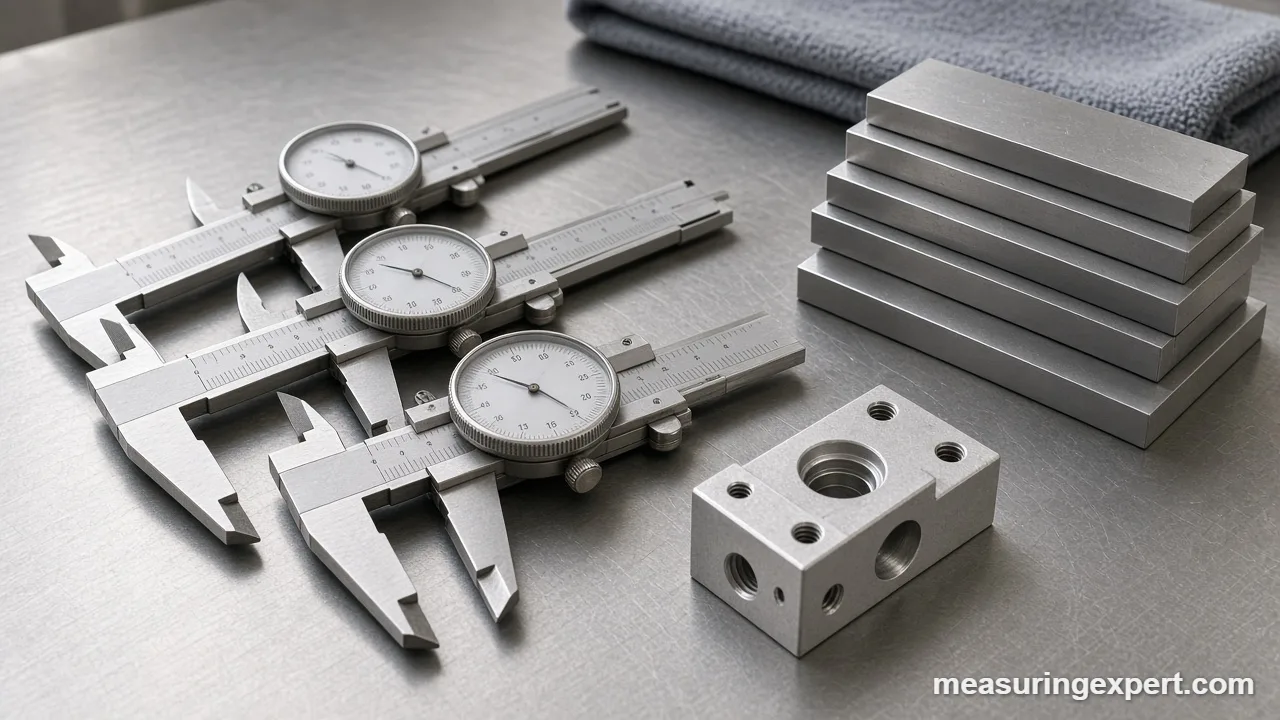
Accuracy vs graduation. Graduation is the smallest mark on the dial, such as 0.001 in. In contrast, accuracy is how close the reading is to the true size, such as plus or minus 0.001 in. A tool can have fine marks and still read poorly, so look for a stated accuracy figure. Also, expect longer tools to be rated looser; a 12 in caliper at plus or minus 0.002 in is normal.
Travel per revolution. A 0.1 in per turn dial is the most common inch layout, and it is the easiest to read. Similarly, 1 mm per turn is the easiest metric layout.
Range. A 6 in (150 mm) tool covers most bench work and is easier to hold square. Choose 8 or 12 in only if you often measure larger parts.
Shock protection. A shockproof movement lets the gear train slip slightly on impact instead of breaking teeth. It helps, but it does not make a dial drop-proof.
Bezel and slide locks. A bezel lock keeps your zero from drifting, and a slide lock holds a setting for repeat checks. As a result, both are worth having for batch work.
Materials. Hardened stainless steel with lapped jaw faces resists wear and rust. Be cautious with listings that mix steel types in their descriptions.
How to Measure With a Dial Caliper, Step by Step
Good technique matters more than the price of the tool. Follow these steps for repeatable readings.
- Wipe the jaw faces, beam and rack with a clean, dry, lint-free cloth.
- Close the jaws gently, then turn the bezel so the needle points exactly to zero.
- Open the jaws wider than the part, place the part deep in the jaws near the beam, and close them with light, steady thumb pressure.
- Hold the caliper square to the part, and rock it slightly to find the smallest outside reading.
- For a bore, use the inside jaws and rock gently to find the largest reading.
- For depth, rest the end of the beam on the top face and slide until the depth rod touches bottom.
- Read the beam scale, add the dial value, and record the result with its unit.
For a broader look at length tools and methods, see our guide on how to measure length.
Inch to Millimeter Converter for Dial Readings
Most dial calipers read in a single unit system. Therefore, when a drawing calls for the other unit, use this converter. Enter an inch reading to see it in millimeters, centimeters and mils. For quick metric sizes, our 10 cm to inches page shows the math in the other direction.
Zeroing, Calibration and Care
A dial caliper stays accurate only if you look after the rack and check zero often. Fortunately, the routine is short.
Zero every session. Close the jaws gently and turn the bezel so the needle sits on zero. If the needle will not return to the same spot twice, clean the jaws and the rack before you go on.
Check against a standard. In addition, measure a gauge block, a ring gauge or a micrometer standard of known size. Do this at a few points across the range, such as 0.5, 2 and 5 in. Many shops also send calipers for certified calibration once a year.
Watch for a skipped tooth. If every reading is off by exactly 0.1 in, or by one full turn on a metric dial, the pinion has jumped a tooth. Clean the rack, then reset the needle or send the tool for service.
Honest Limits of Even the Best Dial Caliper
Even the best dial caliper is a general-purpose tool, not a final inspection gauge. For one thing, its jaws sit off to the side of the scale. As a result, any tilt or jaw flex adds error, which engineers call the Abbe error. A micrometer avoids most of this because its spindle lines up with the scale.
Next, your hand matters. Too much thumb pressure springs the jaws, and soft parts such as foam, rubber or thin plastic squash under them. Likewise, a dial reads only as well as you can see it; parallax from a sideways glance can shift a reading by a mark. Finally, the rack is open to dirt, so a dial is a poor choice for a dusty saw bench unless you clean it often.
Best Dial Caliper FAQ
What is the best dial caliper for most people?
For most buyers, the best dial caliper is the Mitutoyo 505-742J. It covers 0 to 6 in, reads 0.001 in at 0.1 in per turn, and Mitutoyo rates it at plus or minus 0.001 in.
Is a dial caliper more accurate than a digital caliper?
Not by nature. Both types are typically rated near plus or minus 0.001 in for a 6 in tool. A dial needs no battery and shows trends, while a digital reads faster and switches units.
How do you read a dial caliper?
First, read the coarse value on the beam scale, such as 1.2 in. Next, add the dial reading in thousandths, such as 0.037 in. Together, that gives 1.237 in.
What does 0.1 inch per revolution mean?
It means the needle makes one full turn for every 0.1 in of jaw travel. With 100 marks on the dial, each mark equals 0.001 in.
What is the best dial caliper for metric work?
A metric dial such as the Mitutoyo 505-732 is the best dial caliper for millimeter drawings. It reads 0.01 mm per mark at 1 mm per revolution, so no conversion is needed.
Why does my dial caliper read exactly 0.1 inch off?
In most cases, the pinion has skipped a tooth on the rack, often after a drop or because of grit. Clean the rack, then reset the needle if your model allows it, or send it for service.
How often should a dial caliper be calibrated?
Check zero at the start of every session and verify against a gauge block regularly. Also, many shops send calipers for certified calibration once a year.
Which is the best dial caliper size: 6 inch or 12 inch?
A 6 in tool covers most bench work and is easier to hold square. So choose 12 in only if you often measure longer parts, and expect a looser rating, such as plus or minus 0.002 in.
Can a dial caliper replace a micrometer?
Not for tight tolerances. A micrometer lines its spindle up with the scale, so it avoids most tilt error. A caliper, by contrast, is faster and more versatile.
What is the best dial caliper for woodworking?
Woodworkers usually think in fractions; therefore, a dual-scale model such as the iGaging fractional and decimal dial is the best dial caliper for that shop. It shows both scales on one dial.
Bottom Line: The Best Dial Caliper for Most Shops
For most readers, the Mitutoyo 505-742J is the best dial caliper. It reads 0.001 in, carries a plus or minus 0.001 in rating and never needs a battery. On the other hand, metric users should pick its twin, the 505-732, and anyone measuring long stock should step up to the Fowler 12 in model.
1 thought on “Best Dial Caliper: 7 Battery-Free Picks for Precise Measuring (2026)”