

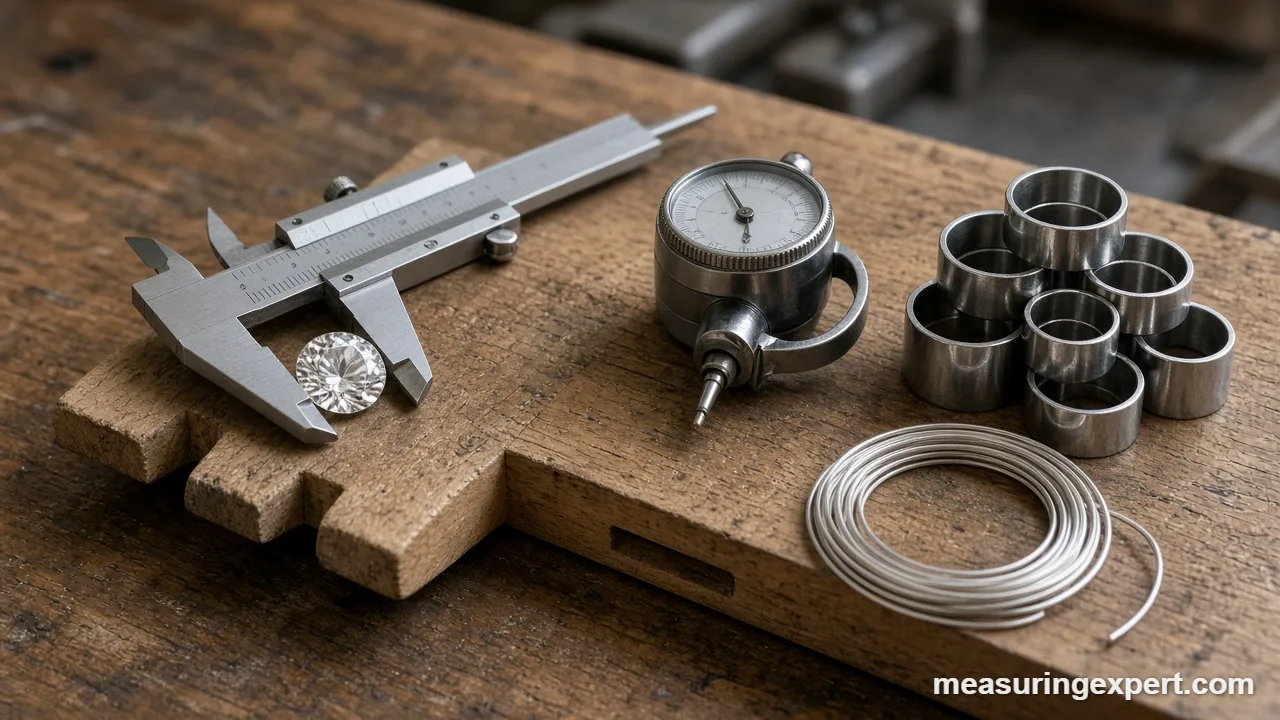
The best jewelry caliper for most makers is the Fowler 0-4 inch shockproof dial caliper: small, battery-free and readable to 0.001 inch. Still, the right tool depends on what you size. Gemstones call for a millimeter gem gauge, fingers need a ring sizer, and wire is easiest with a slot gauge.
In short: buy the Fowler dial caliper for general bench work, the Neoteck mini digital caliper on a budget, and a Presidium gem gauge if you size diamonds and colored stones for a living.
As an Amazon Associate, Measuring Expert earns from qualifying purchases. Our picks are based on research, specifications and owner feedback, not paid placement.
Best Overall

Best Budget

Best Pro Gem Gauge

Quick Answer: Which Jewelry Measuring Tool Do You Need?
- General bench work: a compact 4-inch caliper such as the Fowler dial model covers wire, beads, shanks and clasps.
- Tight budget: a mini digital caliper like the Neoteck shows a plain digital number, so there is no scale to misread.
- Diamonds and colored stones: a gem gauge with slim, spring-loaded jaws, such as a Presidium model, reads stones in mm.
- Loose stone sorting: a Baker-style hole gauge from SFC Tools is the quickest way to size a parcel.
- Finger sizes: use a ring sizer set, not a caliper; the Beadsmith half-round gauge covers U.S. sizes 1 to 15.
- Wire thickness: a slotted wire gauge names the gauge number in seconds.
On This Page
- Comparison table
- The picks, reviewed
- How we chose
- Caliper, gem gauge or sizer?
- Specs explained
- mm, inch, ring size and carat conversions
- Length converter
- How to measure a gemstone
- Care and zero checks
- Honest limits
- FAQ
- Bottom line
Best Jewelry Caliper Comparison Table
First, find your main job in the Best For column. Then jump to the full review for the details that matter for that job.
| # | Product | Best For | Standout Feature | Amazon |
|---|---|---|---|---|
| 1 | Fowler 0-4 in Dial Caliper | Bench work on rings, beads and findings | 0.001 in dial, no battery | View |
| 2 | Presidium Electronic Gemstone Gauge | Loose and mounted gemstones | Digital mm readout made for gems | View |
| 3 | Presidium Gemstone Dial Gauge | Battery-free stone sizing | Analog dial with carat conversion | View |
| 4 | Neoteck 4 in / 100 mm Digital | Beaders and hobby makers | Pocket-size 100 mm digital | View |
| 5 | SFC Tools Baker-Style Stone Gauge | Sorting loose round stones | Hole plate for quick mm sizing | View |
| 6 | Beadsmith Half-Round Finger Gauge | Sizing fingers for rings | 29 steel rings, sizes 1-15 | View |
| 7 | Beadsmith Wire/Drill Gauge | Identifying wire and drill sizes | Laser-cut slots, sizes 1-36 | View |
The 7 Best Jewelry Caliper and Gauge Picks, Reviewed
To start, a quick note on scope. A jewelry bench needs more than one kind of measuring tool, so we included gem gauges, a ring sizer and a wire gauge next to the calipers. Also, if you want a full-size shop caliper rather than a jewelry tool, see our separate guides to the best caliper, the best digital caliper and the best dial caliper.
Best Overall
1. Fowler 0-4 Inch Shockproof Dial Caliper
Best for: Jewelers and serious hobbyists who want a compact, battery-free caliper for ring shanks, wire, beads, clasps and stone settings.
We rank the Fowler 0-4 inch dial caliper as the best jewelry caliper for most benches because it is small enough to handle like a pair of tweezers, yet it is built like a machinist tool. For example, a 4-inch caliper covers almost everything a jeweler measures, from 20-gauge wire to a cuff bracelet width, without the bulk of a 6-inch model.
According to Fowler, the dial reads in 0.001 inch steps, one full turn of the needle equals 0.100 inch, and a shockproof design prevents dial backlash. In addition, the four-way jaws take outside, inside, depth and step readings, so you can check a bezel depth or the inside of a ring shank. However, this is an inch-only dial, so convert to millimeters with our calculator below (1 inch = 25.4 mm exactly).
- Range: 0 to 4 in (0 to 101.6 mm)
- Graduation: 0.001 in; one dial turn = 0.100 in
- Stainless steel body with thumb roll and knurled lock
- Shockproof dial; carrying case included
Pros
- No battery, so nothing dies mid-project
- Small frame suits fine work
- Four measuring modes
Cons
- Inch-only dial means converting to mm
- Also, the dial can be misread by a full turn
- Not a gem gauge for mounted stones
Skip it if: you think in millimeters all day; then a digital caliper or a gem gauge that reads mm directly will save time.
Best Pro Gem Gauge
2. Presidium Electronic Gemstone Gauge (PEGG)
Best for: Appraisers, jewelry store counters and gem dealers who measure diamonds and colored stones every day.
Presidium is a Singapore-based maker of gem testing instruments, and the PEGG is its electronic gemstone gauge. In short, it is a digital gauge that the listing describes as a jewelry and diamond measuring tool, so it is built around gemstones rather than machine parts. As a result, it suits counter work where a bulky shop caliper feels clumsy.
Gem gauges like this read in millimeters, because stone sizes and carat-weight tables are written in millimeters. Therefore, you can read the diameter and depth of a round brilliant and compare them with a weight-estimate chart. Keep in mind that any gauge only estimates the weight of a mounted stone; only a carat scale gives the true weight.
- Type: electronic (digital) gemstone gauge
- Reads gemstone dimensions in millimeters
- Listed as a jewelry and diamond measuring tool
- Brand focused on gem testing instruments
Pros
- Built specifically for gemstones
- Direct mm reading, no conversion
- From a recognized gem instrument brand
Cons
- Costs far more than a hobby caliper
- Also, the range is narrow next to a shop caliper
- Weight estimates are still estimates
Skip it if: you mostly measure wire, beads and findings; a general caliper does those jobs for much less.
Best Leveridge-Style Gauge
3. Presidium Gemstone Dial Gauge (PDG)

Best for: Gem buyers and bench jewelers who want a classic degree-style dial gauge for stones and ring work, with no batteries.
The PDG is an analog gemstone dial gauge, the same family of tool many jewelers call a Leveridge-style or degree gauge. In other words, a spring pushes the jaws closed on the stone, and a needle on the dial shows the size in millimeters. The listing mentions carat conversion for diamonds and ring size use, so it covers two common counter jobs.
Because the gauge is spring-loaded, it applies a similar light pressure every time, which helps you repeat a reading. Next, you compare the length, width and depth with a weight table for the cut. Also, dial gauges never need batteries, which matters for a tool that lives in a drawer between appraisals.
- Type: analog dial gemstone gauge (degree-gauge style)
- Reads stone size in millimeters
- Carat conversion for diamonds, per the listing
- Analog needle readout, no battery
Pros
- No batteries, so no dead display
- Steady spring pressure
- Carat conversion built into the system
Cons
- Dial takes practice to read
- Still pricey for casual use
- Not meant for long parts
Skip it if: you prefer a digital number or need to measure anything over a few centimeters.
Best Budget
4. Neoteck 4 Inch (100 mm) Mini Digital Caliper
Best for: Beaders, wire workers and new jewelry makers who want a small, low-cost digital caliper.
Next up is a budget pick. Neoteck sells this 4-inch (100 mm) digital caliper with a stainless steel frame, and the short beam makes it easy to pinch a bead or a jump ring between the outside jaws. In addition, a digital display removes the most common beginner mistake, which is misreading a vernier or dial scale.
For beading, read in millimeters whenever you can, since beads, crimps and jump rings are sold by millimeter size. However, budget digital calipers are best for hobby accuracy. For example, they are fine for telling a 6 mm bead from an 8 mm bead, but we would not use one to settle a dispute about a diamond diameter.
- Range: 4 in / 100 mm
- Stainless steel metal frame
- Digital readout
- Mini size for small parts
Pros
- Small and light, so it fits a pocket
- Digital number, no scale to read
- Also easy for beginners
Cons
- Battery powered
- Also, accuracy is budget grade
- Wide jaws for set stones
Skip it if: you need traceable, professional readings; choose the Fowler or a Presidium gauge instead.
Best for Loose Stone Sizes
5. SFC Tools Baker-Style Stone Gauge (35-558)
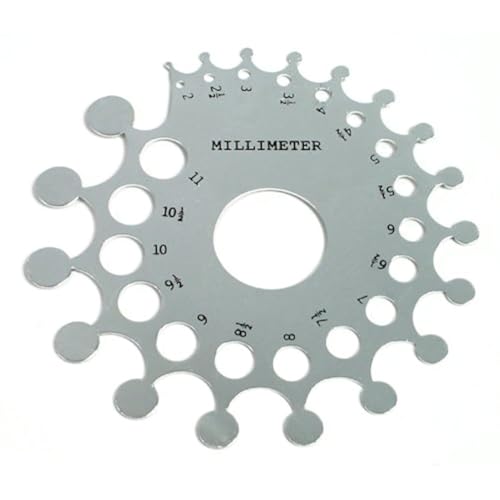
Best for: Stone setters and hobbyists who sort loose round stones and cabochons by millimeter size.
SFC Tools is a jewelry tool brand, and its 35-558 is a Baker-style stone gauge. Instead of jaws, this kind of gauge is a flat plate with graduated holes, so you drop a loose round stone into holes until it fits. As a result, sorting a parcel of small stones goes much faster than closing a caliper on every one.
However, a hole gauge only works for loose stones, and it measures the girdle diameter only. So, for depth, or for a stone that is already set, use a gem gauge or caliper instead. Likewise, check that the stone sits level in the hole before you trust the size.
- Type: Baker-style stone gauge (hole plate)
- Sizes loose round stones by diameter
- Made for jewelry making, per SFC Tools
- Model: 35-558
Pros
- Very fast for sorting, so parcels go quickly
- No battery, no moving parts
- Also simple for beginners
Cons
- Diameter only, no depth
- Loose stones only
- Besides, hole sizes come in fixed steps
Skip it if: you need depth readings or measure stones that are already mounted.
Best Ring Sizer
6. The Beadsmith Half-Round Finger Gauge

Best for: Ring makers and sellers who need to size a finger before they cut or order a ring.
A caliper is the wrong tool for a finger, because skin squashes and knuckles get in the way. Instead, jewelers use a finger gauge, which is a set of sizing rings. The Beadsmith set covers U.S. sizes 1 to 15 in full and half sizes, with 29 marked steel rings, so you can test the fit the way a customer will feel it.
The rings are half-round, which means they feel more like a comfort-fit band than a flat strip. Also, you can use them to check a finished ring: slide the ring over a gauge ring of the same size and look for a snug fit. For the math behind U.S. sizes, see our guide on how to measure ring size.
- U.S. ring sizes 1 to 15, full and half sizes
- 29 marked steel rings
- Half-round profile
- Brand: The Beadsmith
Pros
- Fits like a real ring, so the feel is honest
- Covers adult and child sizes
- Durable steel, so it lasts
Cons
- No quarter sizes
- Also, wide bands may size differently
- U.S. sizes only
Skip it if: you sell to buyers who use UK or EU letters and numbers; you will need a conversion chart as well.
Best for Wire
7. The Beadsmith Wire/Drill Gauge

Best for: Wire wrappers and metalsmiths who need to identify mystery wire or match a drill bit to a jump ring.
Jewelry wire is sold by gauge, and the numbers run backward: a bigger gauge number means thinner wire. The Beadsmith wire and drill gauge is a flat round disk with laser-cut slots marked from 1 to 36 in imperial standard units. Therefore, you slide the wire into slots until it fits snugly, and the slot number is the gauge.
For example, 20 AWG wire is about 0.81 mm (0.032 in) thick, while 24 AWG is about 0.51 mm (0.020 in). Because a caliper can read those same numbers, the two tools check each other. In addition, the disk works for drill bits, which helps when you need a hole that matches a wire size.
- Slots marked 1 to 36
- Imperial standard units
- Laser-cut slots in a flat circular disk
- Sizes both wire and drill bits
Pros
- Fast wire identification
- Cheap and also durable
- No battery
Cons
- Gauge numbers only, no mm
- Check which gauge standard your wire uses
- Besides, worn slots lose accuracy
Skip it if: you buy wire only by millimeter size; a caliper then gives you the number you need.
How We Chose the Best Jewelry Caliper Picks
We did not run hands-on tests for this guide. Instead, our picks are research-based. We read manufacturer product pages and listings, compared published ranges and graduations, and looked at what jewelers and gem dealers report about each type of tool. In addition, we checked unit facts against the National Institute of Standards and Technology, which states that the inch is exactly 25.4 mm, and carat facts against GIA, which defines a metric carat as 200 milligrams.
Our criteria were simple. First, each tool had to come from an established brand. Next, it had to solve a real jewelry task: bench measuring, gem sizing, ring sizing or wire sizing. After that, we kept only one tool per job where possible, so you are not choosing between near-twins. Finally, we skipped any caliper that already appears in our general caliper guides.
Caliper, Gem Gauge or Ring Sizer: Which Type Fits?
Each tool type answers a different question. So, before you buy, match the tool to the thing you measure most often.
- Compact caliper (dial or digital): measures wire, beads, shanks, findings and bezels to 0.001 in or 0.01 mm. However, its jaws are wide for set stones.
- Gem gauge (Leveridge or degree style): reads stone length, width and depth in millimeters. On the other hand, its range is short.
- Hole stone gauge: sizes loose round stones in fixed mm steps. Even so, it gives no depth and cannot read set stones.
- Finger gauge (ring sizer): gives a U.S. ring size directly. Still, fit is partly a feel test.
- Wire gauge: names wire and drill sizes by number. Meanwhile, gauge standards differ by country.
In short, most makers need a caliper first. Then, add a gem gauge if you buy or appraise stones, and a sizer if you make rings to order.
What Makes the Best Jewelry Caliper Accurate
Resolution vs accuracy. Resolution is the smallest step the tool can show, such as 0.01 mm. Accuracy is how close that number is to the truth. For example, Fowler lists its 4-inch economy digital caliper with 0.0005 inch resolution but 0.001 inch accuracy, which shows how the two can differ. So, never assume the last digit on a display is exact.
Range. Jewelry parts are small, so a 4-inch (100 mm) caliper is usually enough. Gem gauges have an even shorter range, which keeps them light and precise.
Units. Stones, beads and jump rings are sold in millimeters, while U.S. wire and many U.S. tools use inches and gauge numbers. Therefore, a tool that shows mm directly saves conversions.
Jaw shape. Thin, pointed jaws reach into settings and between prongs. By contrast, broad shop jaws are better for flat stock and wire.
Power. Dial and vernier tools never need batteries. Digital tools are faster to read, but a weak battery can cause drifting numbers.
Best Jewelry Caliper Conversions: mm, Inches, Ring Size and Carats
A jewelry caliper is only half the job; the other half is turning the number into something useful. These tables cover the most common conversions. Every inch value uses the exact definition 1 in = 25.4 mm.
Bead and stone sizes, mm to inches
For instance, 2 mm seed and crimp beads measure 0.079 in, while 3 mm spacers measure 0.118 in. Similarly, 4 mm rounds and studs are 0.157 in, and classic 6 mm bracelet beads are 0.236 in. Likewise, 8 mm beads and pearls are 0.315 in. Finally, 10 mm focal beads are 0.394 in, and 12 mm statement beads are 0.472 in.
U.S. ring size to inside diameter
Each whole U.S. size adds about 0.032 in (0.81 mm) to the inside diameter. As a result, you can check a finished ring with the inside jaws of a caliper.
| U.S. size | Inside diameter |
|---|---|
| 4 | 14.88 mm (0.586 in) |
| 5 | 15.70 mm (0.618 in) |
| 6 | 16.51 mm (0.650 in) |
| 7 | 17.32 mm (0.682 in) |
| 8 | 18.14 mm (0.714 in) |
| 9 | 18.95 mm (0.746 in) |
| 10 | 19.76 mm (0.778 in) |
| 11 | 20.57 mm (0.810 in) |
Round diamond diameter to approximate carats
Carat is a weight, not a size. However, for a well-cut round brilliant, a common estimate is weight (ct) = diameter x diameter x depth x 0.0061, with all sizes in mm. So, assuming a depth of about 61% of the diameter, a 4.1 mm stone is about 0.26 ct, and a 5.2 mm stone is about 0.52 ct. Similarly, 5.8 mm works out to about 0.73 ct, while 6.5 mm is about 1.02 ct. In the same way, 7.4 mm comes to about 1.51 ct, and 8.2 mm comes to about 2.05 ct.
These are estimates for diamonds only. Because colored stones differ in density, a ruby or an emerald of the same size weighs a different amount. To see why, read our explainer on how dense diamond is.
Wire gauge to thickness
In the American Wire Gauge (AWG) system, thinner wire gets a higher number. For example, 16 AWG is about 1.29 mm (0.051 in), and 18 AWG is about 1.02 mm (0.040 in). Next, 20 AWG is about 0.81 mm (0.032 in), while 22 AWG is about 0.64 mm (0.025 in). Finally, 24 AWG is about 0.51 mm (0.020 in), and 26 AWG is about 0.41 mm (0.016 in).
Jewelry Length Converter (mm to Inches)
Type a caliper reading below to switch between millimeters, inches, centimeters and mils (thousandths of an inch).
For example, a 6 mm bead is 0.236 in, or about 236 mils. Also, a 0.5 mm reading equals about 20 mils, which is handy when a supplier lists wire in thousandths.
How to Measure a Gemstone With the Best Jewelry Caliper
This method works with a gem gauge or a compact caliper. Take your time, because a few hundredths of a millimeter matter on small stones.
- First, clean the stone and the jaws with a soft cloth, because dust and oil add size.
- Next, close the jaws and zero the tool, or check that the dial needle sits on zero.
- Then hold the stone by the girdle with tweezers, or steady the ring on a soft pad.
- After that, close the jaws gently on the widest point of the girdle and read the diameter.
- Now turn the stone a quarter turn and measure again; for a fancy shape, record length and width.
- Next, measure the depth from the table to the culet, keeping the jaws square to the stone.
- Finally, write down all three numbers in millimeters and use a weight table or formula to estimate carats.
Keeping Your Jewelry Caliper True
Small tools lose accuracy in small ways. For that reason, a zero check takes ten seconds and should happen every session.
- Clean the jaws first. Polishing compound and skin oil add a few hundredths of a millimeter.
- Close and zero. A digital caliper should read 0.00 with the jaws closed; a dial needle should sit on zero.
- Check against a known size. A drill bit shank or gauge pin of a known size is a cheap reference.
- Store it open a little. This keeps the jaw faces from pressing together.
- Remove dead batteries. Leaking cells can ruin a digital caliper.
Honest Limits of Any Jewelry Gauge
No gauge can tell you a mounted stone’s true weight. Instead, it gives an estimate that depends on cut and proportions. Similarly, a finger can change size with heat, cold and time of day, so size twice at different times. Also, gauge numbers for wire differ between American (AWG) and other standards, so check which one a seller uses. Finally, a budget caliper is a hobby tool; for appraisals and sales, use a pro gem gauge and a carat scale.
Best Jewelry Caliper FAQ
What is the best jewelry caliper for beginners?
For most beginners, a small digital caliper such as the Neoteck 4-inch model is the easiest start, because a digital number is easy to read. Later, upgrade to the Fowler dial caliper for better build quality.
Is a digital or dial caliper better for jewelry?
Both work. A digital caliper is quicker to read and switches to mm, while a dial caliper never needs batteries. So, pick digital for speed and dial for reliability.
What is a Leveridge gauge?
A Leveridge gauge is a spring-loaded dial gauge made for gemstones. It reads stone size in millimeters, and jewelers pair the readings with tables to estimate carat weight.
Can the best jewelry caliper measure ring size?
Yes, in part. The inside jaws can read a ring’s inside diameter, which you then match to a size chart. However, to size a finger, use a ring sizer set instead.
How do I convert mm to inches for beads?
Divide the millimeter size by 25.4. For example, a 6 mm bead is 6 / 25.4 = 0.236 in, and an 8 mm bead is 0.315 in.
How accurate does the best jewelry caliper need to be?
For beads and wire, 0.1 mm is plenty. For gemstones, aim for 0.01 mm resolution, because small changes in size mean large changes in estimated carat weight.
Can a caliper tell me how many carats a diamond is?
Not exactly. A caliper or gem gauge gives the size, and a formula or table turns that into an estimated weight. Only a carat scale gives the true weight.
What size is 20 gauge wire in mm?
In the American Wire Gauge system, 20 AWG wire is about 0.81 mm, or 0.032 in, thick. Also, check which gauge system your supplier uses.
Why does my digital caliper reading drift?
Usually, a weak battery or dirty jaws are to blame. First, clean the jaws and zero the tool; if the drift continues, replace the battery.
Do I need a caliper and a gem gauge?
Not always. A caliper covers wire, beads and findings, while a gem gauge is worth adding only if you size stones often, especially stones that are already set.
The Bottom Line on the Best Jewelry Caliper
For most benches, the Fowler 0-4 inch shockproof dial caliper is the best jewelry caliper: compact, battery-free and graduated in 0.001 inch steps. Then, add a Presidium gem gauge for stones, a Beadsmith sizer for fingers and a slot gauge for wire.
1 thought on “Best Jewelry Caliper: 7 Tools for Gems, Beads and Rings”