

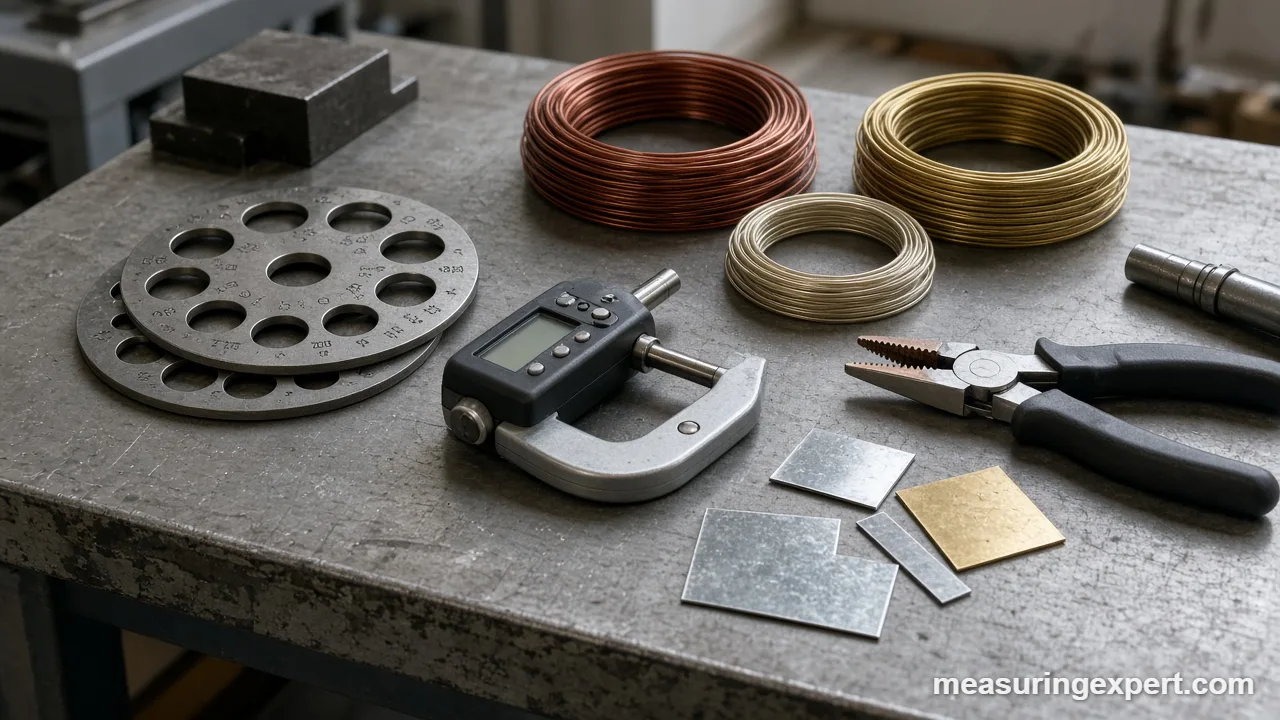
The best wire gauge tool for most electricians, makers and metal workers is the General Tools 20, a hardened round American Standard gage that sizes 0 to 36 AWG with decimal equivalents on the back. Your choice depends on the gauge system you need (AWG, SWG or sheet steel) and whether you want a slot gauge or a micrometer.
In short: get the General Tools 20 for AWG wire, the SE dual-sided gauge if budget comes first, and a Mitutoyo micrometer when you need thousandths you can trust.
As an Amazon Associate, Measuring Expert earns from qualifying purchases. Our picks are based on research, specifications and owner feedback, not paid placement.
Best Overall
Best Pro
Quick Answer: Which Wire Gauge Tool Do You Need?
- Most people: General Tools 20 round AWG gage, 0 to 36.
- Tight budget or jewelry wire: SE dual-sided non-ferrous gauge with AWG on one face and decimals on the other.
- British SWG or iron wire: Starrett English Standard (Birmingham) wire gage.
- Sheet steel and plate: PEC Tools US Standard sheet metal gage.
- Exact diameters to 0.001 mm: Mitutoyo 293-340 Coolant-Proof Digimatic micrometer.
- Electrical work in the field: Klein 11055 Klein-Kurve stripper, which strips and marks 10 to 18 AWG solid wire.
- Not sure about calipers? Our best micrometer screw gauge guide compares more micrometers.
On This Page
- Best Wire Gauge Tool Comparison Table
- The 9 Best Wire Gauge Tool Picks, Reviewed
- How We Chose the Best Wire Gauge Tool
- AWG vs SWG vs Sheet Metal Gauge: Know Your System
- AWG Formula and Diameter Table
- How to Use the Best Wire Gauge Tool Correctly
- What Matters When Picking the Best Wire Gauge Tool
- Care and Accuracy Checks for Your Best Wire Gauge Tool
- Honest Limits of Slot Gauges
- Best Wire Gauge Tool FAQ
- Bottom Line on the Best Wire Gauge Tool
Best Wire Gauge Tool Comparison Table
| # | Image | Product | Best For | Standout Feature | Link |
|---|---|---|---|---|---|
| 1 |  | General Tools 20 Wire Gage | Everyday AWG sizing | Hardened steel, 0 to 36 AWG, decimals on back | View |
| 2 |  | SE Dual-Sided Non-Ferrous Gauge | Budget and jewelry wire | AWG face plus 0.005 to 0.325 in decimal face | View |
| 3 | 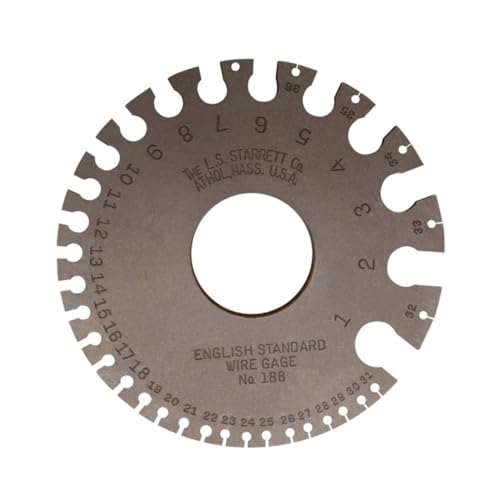 | Starrett English Standard Wire Gage | SWG and iron wire | Birmingham/Stubs system, hardened | View |
| 4 | 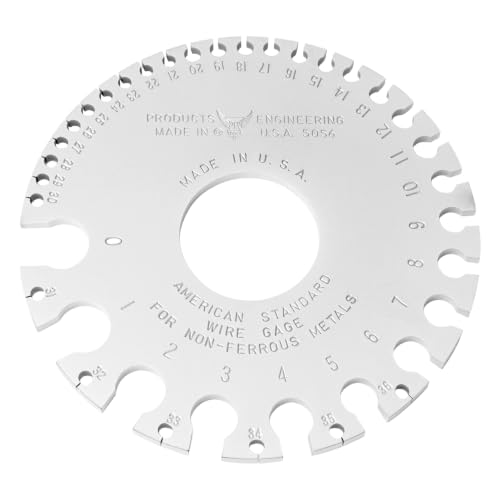 | PEC Tools American Standard Gage | Made-in-USA AWG option | Non-ferrous wire and sheet, 0 to 36 | View |
| 5 | 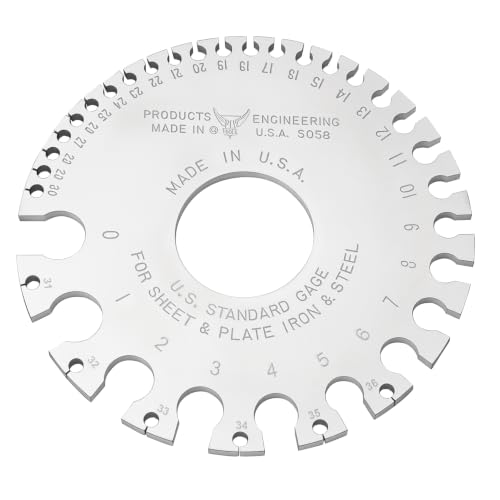 | PEC Tools US Standard Sheet Gage | Sheet steel and plate | US Standard 0 to 36 for iron and steel | View |
| 6 | 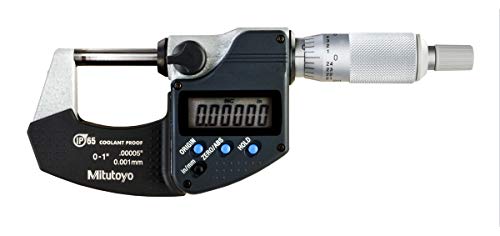 | Mitutoyo 293-340 Micrometer | Lab-grade diameters | 0.00005 in resolution, IP65 | View |
| 7 |  | iGaging 0-1 in Digital Micrometer | Budget digital readings | Inch and metric LCD | View |
| 8 |  | Klein 11055 Klein-Kurve | Electricians | Gauge-marked holes, 10-18 AWG solid | View |
| 9 |  | Klein 11063W Automatic Stripper | Fast one-hand stripping | 8-20 AWG solid, 10-22 AWG stranded | View |
The 9 Best Wire Gauge Tool Picks, Reviewed
To start, we grouped the list by job. First come the round slot gauges, then the sheet gauge, then micrometers and finally strippers with gauge markings.
Best for everyday AWG sizing
1. General Tools 20 American Standard Wire Gage
Best for: electricians, hobbyists and fabricators who, above all, size copper, brass and aluminum wire.
The General Tools 20 is the classic round slot gauge. To use it, you slide a wire into the slots until it fits snugly, then read the AWG number beside that slot. Because the American Standard system (also called Brown and Sharpe) covers non-ferrous metals, it matches the wire most people handle at home and on the bench. In addition, the back of the disc lists decimal inch equivalents, so you can check a supplier spec without a chart.
Overall, it is a simple tool, and that is its strength. However, a slot gauge only tells you which standard size a wire is closest to. So if you need the exact diameter of a worn or odd wire, pair it with a micrometer.
- Standard: American Standard (AWG / B and S), sizes 0 to 36
- Heavy-gauge hardened and tempered steel, satin finish
- Decimal equivalents stamped on the back
- Size: 3-1/4 in across, 3/32 in thick (8.26 x 0.24 cm)
Pros
- Covers the full 0 to 36 AWG range
- Hardened slots resist wear, so it stays true
- Also has a decimal table on the back
Cons
- Not meant for steel sheet gauges
- Small stamps are hard to read, especially in dim light
Skip it if: you mainly measure sheet steel or, for example, British SWG wire.
Best budget pick for jewelry wire
2. SE Dual-Sided Non-Ferrous Wire Gauge (JT47WG-C)
Best for: jewelers, beaders and hobbyists who especially want AWG numbers and decimal sizes on one disc.
This 3.5 in disc puts American Standard sizes 0 to 36 on one face and decimal inch sizes from 0.005 to 0.325 in on the other. As a result, you can size silver, gold, copper or brass wire and read the diameter directly. In addition, the larger disc gives the numbers a little more room than a pocket gauge.
Also, it suits craft work where a few thousandths do not matter. For tighter tolerances, however, check the size with a micrometer. If you shop for jewelry tools, our best jewelry caliper guide covers calipers for stones and findings.
- Side one: AWG 0 to 36; side two: 0.005 to 0.325 in
- About 3-1/2 in diameter, 3/32 in thick
- Tempered steel, made especially for non-ferrous metals
Pros
- Two scales on one tool
- Large disc, so it is easy to hold
- Low cost, therefore fine for occasional use
Cons
- Fit and finish vary more than premium brands
- Also not for steel wire or sheet
Skip it if: you need a gauge for daily shop use or, above all, certified accuracy.
Best for SWG and iron wire
3. Starrett English Standard Wire Gage (Birmingham)
Best for: anyone reading British plans or, similarly,, restoring older equipment or working with iron wire and rolled sheet steel.
Starrett lists its English Standard gage (model 188) under the Birmingham or Stubs’ Iron Wire system, sizes 1 to 36, which run from 0.300 to 0.004 in. Notably, that system differs from AWG at almost every number. For example, a size 14 wire is about 0.083 in on the Birmingham scale but 0.064 in on AWG. So the right gauge system matters as much as the tool.
Starrett hardens these gages and tests them after hardening, according to its catalog. Therefore, it is the pick for a shop that wants a gauge to stay true for years.
- Standard: English Standard (Birmingham / Stubs’ Iron Wire), 1 to 36
- Decimal range 0.300 to 0.004 in
- Hardened, plus a satin finish
- For iron wire, hot and cold rolled sheet steel
Pros
- Starrett build quality
- Hardened and then tested after hardening
- Covers an older system that many charts skip
Cons
- Wrong system for US electrical wire
- Costs more than generic gauges, of course
Skip it if: all your wire is sold in AWG, because then it adds nothing.
Best made-in-USA AWG gauge
4. PEC Tools American Standard Wire and Sheet Gage
Best for: shops that also want a second AWG option from a US maker of precision rules and gages.
PEC Tools makes this gage for sheet, plate and wire of non-ferrous metals such as copper, brass and aluminum. Also, it reads sizes 0 to 36, and the reverse side lists decimal equivalents. In practice, it does the same job as the General Tools 20. Meanwhile, it gives you a choice of brand when one is out of stock.
Because it covers sheet as well as wire, it also helps a sign maker or HVAC tech who cuts aluminum or copper sheet and wants a quick gauge check at the bench.
- Standard: American Standard (AWG), 0 to 36
- Made for non-ferrous wire, sheet and plate as well
- Decimal equivalents on the reverse
Pros
- Handles sheet edges as well as wire
- Decimal reference built in, so no chart is needed
- From an established US gage maker
Cons
- Same limits as any slot gauge
- Similarly, not for steel sheet gauges
Skip it if: you already own a good AWG gauge, since it would only duplicate it.
Best for sheet steel
5. PEC Tools US Standard Sheet Metal Gage
Best for: welders, fabricators and auto body workers who, for instance, check uncoated steel sheet and plate.
In contrast, this PEC gage uses the US Standard system, sizes 0 to 36, made for uncoated sheet and plate iron and steel. That matters because a 16 gauge steel sheet is much thicker than 16 AWG wire. In other words, you need a sheet gauge for sheet and a wire gauge for wire.
Keep in mind that modern steel mills often quote the Manufacturers’ Standard Gauge, which differs slightly from the old US Standard. So for critical parts, confirm the actual thickness with a micrometer or our best thickness gauge picks.
- Standard: US Standard, 0 to 36
- For uncoated sheet and plate iron and steel
- Slot style gauge, so it reads sheet edges
Pros
- The right system for steel sheet
- Fast go or no-go check, for example at the shear
Cons
- Galvanized and stainless sheet use other gauge tables
- Also, burrs on cut edges can block the slot
Skip it if: you only measure electrical wire, because a wire gauge fits better.
Best for exact diameters
6. Mitutoyo 293-340 Coolant-Proof Digimatic Micrometer
Best for: machinists, QC inspectors and anyone who needs a real number rather than the nearest gauge size.
Unlike a slot gauge, a micrometer measures the actual diameter. The Mitutoyo 293-340 series covers 0 to 1 in (0 to 25.4 mm) with 0.00005 in (0.001 mm) resolution, and the 293-340-30 spec sheet lists accuracy of plus or minus 0.00005 in. Next, you convert that reading to AWG with the formula below, or simply compare it to a table.
It also carries an IP65 rating for coolant and dust, and a ratchet stop gives the same light force on every reading. As a result, two people get the same number on the same wire. In addition, Mitutoyo builds it in Japan.
- Range 0 to 1 in / 0 to 25.4 mm
- Resolution 0.00005 in / 0.001 mm
- Accuracy plus or minus 0.00005 in (293-340-30 spec)
- IP65 coolant-proof, ratchet stop, SR44 battery
Pros
- True diameter, not just a size number
- Ratchet gives repeatable force, so readings agree
- Sealed against shop fluids
Cons
- Costs many times more than a slot gauge
- Also slower for quick sorting
Skip it if: you only need to know whether a wire is 12 or 14 AWG; instead, buy a slot gauge.
Best budget digital micrometer
7. iGaging 0-1 in Digital Electronic Micrometer
Best for: hobbyists and home shops that want digital diameters but without the Mitutoyo cost.
Meanwhile, the iGaging micrometer reads 0 to 1 in (0 to 25 mm) on a large LCD and switches between inch and metric. At first glance, its 0.00005 in (0.001 mm) display resolution looks the same as the Mitutoyo. However, iGaging’s own listing gives accuracy of 0.00015 in (0.003 mm), which is three times looser. Even so, for wire sizing, that is still far finer than one AWG step.
Also, it is a good way to learn what real wire diameters look like before you trust a slot gauge alone.
- Range 0 to 1 in / 0 to 25 mm
- Resolution 0.00005 in / 0.001 mm
- Stated accuracy 0.00015 in / 0.003 mm
- Inch and metric LCD display as well
Pros
- Large, clear display
- Inch and metric at a button press
- Even so, plenty of accuracy for AWG checks
Cons
- Looser accuracy than premium brands
- In addition, light dust protection only
Skip it if: you need inspection-grade readings to the last digit; in that case, choose the Mitutoyo.
Best stripper with gauge markings
8. Klein Tools 11055 Klein-Kurve Wire Stripper/Cutter
Best for: electricians who want to confirm wire size at the same time as they strip it.
The Klein-Kurve strips 10 to 18 AWG solid and 12 to 20 AWG stranded wire through precision-ground holes, each with easy-to-read gauge markings. In practice, if 12 AWG solid strips cleanly in the 12 hole without nicking copper, you have confirmed the size. Besides that, it cuts wire, loops it and shears 6-32 and 8-32 screws.
So even though it is not a measuring instrument, it is the gauge check most electricians actually use on the job.
- Strips 10-18 AWG solid, 12-20 AWG stranded
- Overall length 7-1/8 in
- Serrated nose, looping holes and also screw shearing
- Coil spring for self-opening action
Pros
- Marked holes double as a size check
- Strips, cuts, loops and also shears screws
- Comfortable curved handle
Cons
- Covers only common building wire sizes
- Not a precise diameter reading, however
Skip it if: you work with fine wire below 20 AWG; for example, 24 AWG electronics wire.
Best automatic stripper
9. Klein Tools 11063W Automatic Wire Stripper/Cutter
Best for: panel builders and installers who, in short, strip a lot of wire in a day.
By contrast, this automatic stripper grips and strips insulation with one squeeze. Klein rates it for 8 to 20 AWG solid and 10 to 22 AWG stranded wire, and its cutter handles solid wire up to 8 AWG. Because it self-adjusts, it does not read the size for you. Instead, it saves time once you know the gauge.
Then pair it with a slot gauge in the bag, and you can both identify and prepare wire quickly.
- Strips 8-20 AWG solid, 10-22 AWG stranded
- Strips up to 1 in of insulation in one step
- Cast alloy body, 6.59 in long, 12 oz (340 g)
Pros
- One-hand, one-squeeze stripping
- Wide gauge range
- Plus a built-in cutter
Cons
- Does not identify wire size
- Also bulkier than a plain stripper
Skip it if: you strip only a few wires a month, because a manual stripper is enough.
How We Chose the Best Wire Gauge Tool
To be clear, we did not run hands-on tests. Instead, we built this list from research. First, we read maker catalogs and spec sheets from Starrett, General Tools, PEC, Mitutoyo, iGaging and Klein. Next, we compared each tool with the gauge standard it claims, such as ASTM B258 for AWG wire diameters. Finally, we read owner feedback for common faults like soft slots, unreadable stamps or loose fit.
- Correct standard: the gauge must say which system it uses.
- Hardened slots or a sound measuring mechanism.
- Readable markings and, ideally, decimal references.
- Variety of jobs: wire, sheet, precision and field use.
- Brand limit: no more than two products per brand, so the list stays varied.
Starrett’s wire gage catalog page was especially useful, because it lists each gauge system with its range and intended metal.
AWG vs SWG vs Sheet Metal Gauge: Know Your System
In practice, the number on a gauge means nothing until you know the system. For example, “14 gauge” can be 0.064 in, 0.083 in or about 0.078 in depending on the table. So check the gauge face before you trust a size.
| System | Also called | Used for | Range on Starrett gages |
|---|---|---|---|
| American Standard | AWG, Brown and Sharpe | Copper, brass, aluminum wire and sheet | 0-36: 0.325 to 0.005 in |
| English Standard | Birmingham, Stubs’ Iron Wire | Iron wire, rolled sheet steel | 1-36: 0.300 to 0.004 in |
| US Standard | Sheet and plate gauge | Uncoated sheet and plate iron and steel | 0-36: 0.3125 to 0.007 in |
| Steel Wire Gage | Washburn and Moen | Steel wire, drill rod | 0-36: 0.3065 to 0.009 in |
In addition, the British Standard Wire Gauge (SWG) used in the UK is close to, but not identical with, Birmingham. Therefore, buy the gauge that matches the drawings or the wire spool label.
AWG Formula and Diameter Table
Unlike the older systems, AWG follows a fixed geometric rule. Size 36 is 0.005 in and size 0000 is 0.46 in, with 39 equal ratio steps between them. As a result, the diameter of any size n is:
d (in) = 0.005 x 92^((36 – n) / 39), or d (mm) = 0.127 x 92^((36 – n) / 39)
Two handy rules follow. First, every 6 gauge numbers halve or double the diameter. Second, every 3 gauge numbers roughly halve or double the cross-sectional area.
| AWG | Diameter (in) | Diameter (mils) | Diameter (mm) | Area (mm2) |
|---|---|---|---|---|
| 0 | 0.3249 | 324.9 | 8.251 | 53.5 |
| 4 | 0.2043 | 204.3 | 5.189 | 21.2 |
| 6 | 0.1620 | 162.0 | 4.115 | 13.3 |
| 8 | 0.1285 | 128.5 | 3.264 | 8.37 |
| 10 | 0.1019 | 101.9 | 2.588 | 5.26 |
| 12 | 0.0808 | 80.8 | 2.053 | 3.31 |
| 14 | 0.0641 | 64.1 | 1.628 | 2.08 |
| 16 | 0.0508 | 50.8 | 1.291 | 1.31 |
| 18 | 0.0403 | 40.3 | 1.024 | 0.823 |
| 20 | 0.0320 | 32.0 | 0.812 | 0.518 |
| 22 | 0.0253 | 25.3 | 0.644 | 0.326 |
| 24 | 0.0201 | 20.1 | 0.511 | 0.205 |
| 26 | 0.0159 | 15.9 | 0.405 | 0.129 |
| 30 | 0.0100 | 10.0 | 0.255 | 0.051 |
Micrometers often read in inches, while metric wire specs use millimeters and many charts use mils (thousandths of an inch). So use the converter below to move between them.
How to Use the Best Wire Gauge Tool Correctly
Even so, a slot gauge is easy to misread. In fact, the most common mistake is pushing wire into the round hole instead of the slot. Follow these steps for a reliable size.
- Pick the right system. First, confirm the gauge face says AWG, SWG or US Standard to match your material.
- Strip and clean the wire. Next, remove the insulation and wipe off oil or oxide, since the slot measures bare metal only.
- Straighten the end. A bent or crushed tip reads wrong, so cut a fresh square end.
- Use the slot, not the hole. Slide the wire sideways into the narrow slot; the round hole at the end is only clearance.
- Find the snug fit. Try larger slots first and move smaller until the wire just slides in without force.
- Read the number. Then read the size stamped beside that slot, and check the decimal on the back if it has one.
- Confirm when it matters. Finally, measure stranded or worn wire with a micrometer and compare it with the AWG table.
What Matters When Picking the Best Wire Gauge Tool
- Gauge standard: the single most important line, because each system gives a different size for the same number.
- Range: most round gauges cover 0 to 36; however, fine jewelry wire may need a decimal scale too.
- Hardness: hardened slots keep their width even after years of steel wire wear.
- Decimal equivalents: a table on the back means you can skip a trip to a chart.
- Resolution and accuracy (micrometers): 0.001 mm resolution is common; however, check the stated accuracy, which is often looser.
- IP rating: an IP65 tool shrugs off coolant and dust, while an IP40 tool needs a clean bench.
Also note that resolution is only the smallest step on the screen. Accuracy, on the other hand, is how close that step is to the truth.
Care and Accuracy Checks for Your Best Wire Gauge Tool
Generally, steel gauges last decades with simple care. However, a single drop can nick a slot and change its width.
- Check slots with known wire. Keep short offcuts of 12 and 14 AWG solid copper and test the gauge with them now and then.
- Zero the micrometer. First clean the faces, then close them with the ratchet and confirm a reading of zero before each session.
- Store dry. Also, a light film of oil stops rust on uncoated steel gauges.
- Never force wire. Otherwise, steel wire can spread the slot over time.
Honest Limits of Slot Gauges
In the end, a slot gauge sorts wire into standard sizes. So it cannot tell you that a wire is 0.002 in undersize. Likewise, it reads stranded wire poorly and cannot measure insulation thickness. Also, cheap gauges sometimes carry a different system than the label claims. Therefore, if a reading looks odd, verify it with a micrometer before you cut, order or wire anything.
Best Wire Gauge Tool FAQ
What is the best wire gauge tool for electricians?
For quick field checks, a stripper with marked holes such as the Klein 11055 works well. For a dedicated tool, on the other hand, a round AWG gauge such as the General Tools 20 sizes 0 to 36 AWG bare copper.
How do you read a round wire gauge?
First, slide the bare wire into the slots, not the round holes, until it fits snugly without force. Then read the number stamped next to that slot.
Is AWG the same as SWG?
No. AWG is the American system for non-ferrous wire, while SWG is the British system. As a result, the same number gives a different diameter, so 14 SWG is thicker than 14 AWG.
Can a wire gauge measure sheet metal?
Yes, as long as it uses the right system. For example, use an AWG gauge for copper, brass and aluminum sheet, and a US Standard sheet gauge for uncoated steel sheet.
Which best wire gauge tool works for jewelry wire?
Ideally, a dual-sided non-ferrous gauge with AWG on one face and decimal inches on the other suits jewelry wire such as silver, gold and copper.
How accurate is a slot wire gauge?
It identifies the nearest standard size, which is enough for most work. For exact diameters, however, a micrometer with 0.001 mm resolution is far more precise.
How do you measure stranded wire gauge?
First, read the size printed on the jacket if present. Otherwise, count the strands, measure one strand with a micrometer and compare the total area with an AWG table.
Is a digital micrometer the best wire gauge tool for precision?
Yes for exact diameters. In fact, a 0 to 1 in micrometer reads every AWG size from 0 to 36, and you then convert the reading with the AWG formula or a table.
What is the AWG formula?
The diameter in inches equals 0.005 times 92 raised to the power (36 minus n) divided by 39. Similarly, in millimeters, replace 0.005 with 0.127.
Why is a lower gauge number thicker?
Historically, gauge numbers came from the number of drawing steps through dies. More draws made thinner wire, so higher numbers mean smaller diameters.
Bottom Line on the Best Wire Gauge Tool
For most readers, the General Tools 20 American Standard Wire Gage is the best wire gauge tool, because it covers 0 to 36 AWG in hardened steel with decimals on the back. Then add a micrometer when you need exact numbers, and buy a sheet or SWG gauge only if your work calls for that system.
Black Friday is coming: shop the deals with Prime