

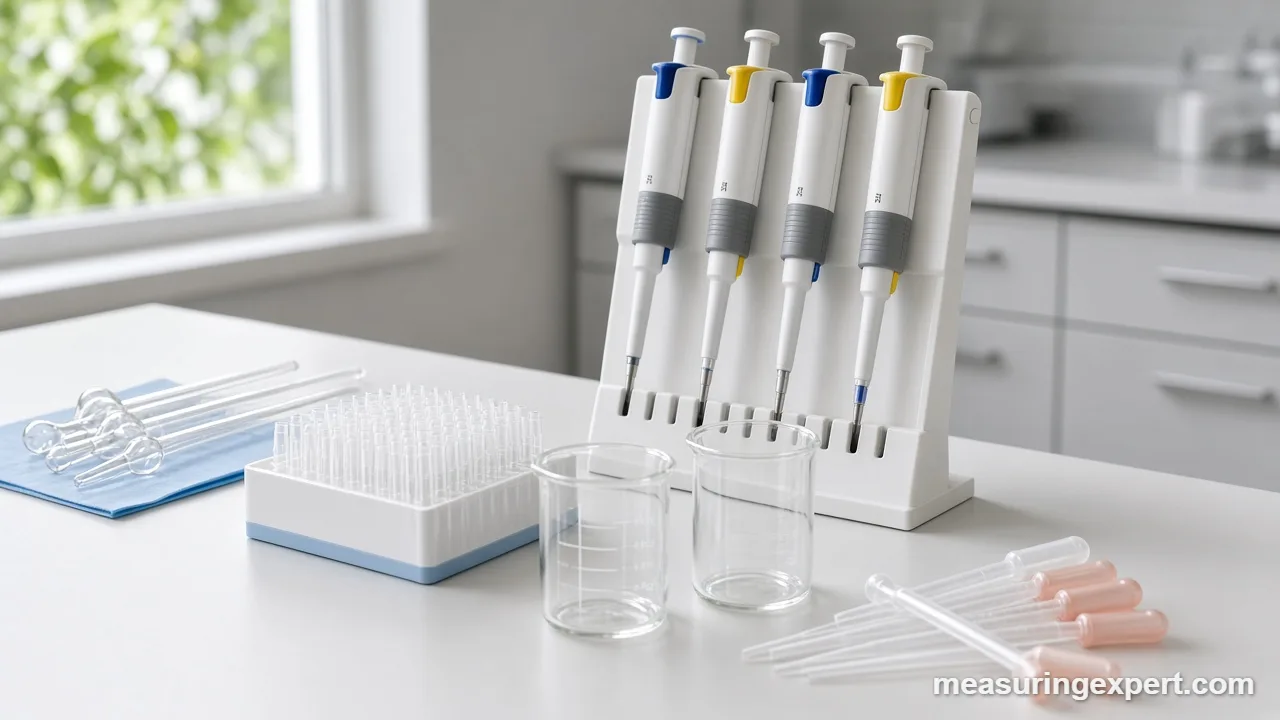
The best lab pipette for most labs is the Gilson PIPETMAN L Starter Kit, because its three adjustable pipettes cover 2 to 1000 uL with published ISO 8655 error limits and a volume lock. Your choice depends on the volume range you use, the accuracy you need, and whether glass or disposable plastic fits the job.
In short: buy the Gilson kit to equip a bench, the Eppendorf Research plus 2-20 uL for PCR work, and the ONiLAB 100-1000 uL if budget comes first.
As an Amazon Associate, Measuring Expert earns from qualifying purchases. Our picks are based on research, specifications and owner feedback, not paid placement.
Best Overall
Best Budget
Best Pro Small Volume
Quick Answer: The Best Lab Pipette by Need
- Best overall: Gilson PIPETMAN L Starter Kit, three pipettes from 2 to 1000 uL.
- Small volumes: Eppendorf Research plus 2-20 uL, rated to plus or minus 1.0% at 20 uL.
- Heavy daily use: Thermo Scientific Finnpipette F2, with a detachable tip cone and 5-year warranty.
- On a budget: ONiLAB 100-1000 uL, which ships with a calibration certificate.
- Milliliter volumes: FOUR E’S SCIENTIFIC 1-10 mL, adjustable in 100 uL steps.
- Glass accuracy: Vee Gee Class A 5 mL volumetric pipet, 0.01 mL tolerance.
- Quick transfers: Globe Scientific 7 mL graduated transfer pipets, 500 per box.
On This Page
- Comparison Table
- The 8 Picks, Reviewed
- How We Chose
- Pipette Types Compared
- Accuracy, Precision and ISO 8655
- Microliter and Milliliter Converter
- How to Pipette Accurately
- Calibration and Tip Fit
- Do and Don’t
- Honest Limits
- FAQ
- Bottom Line
Best Lab Pipette Comparison Table
| # | Image | Product | Best For | Standout Feature | Link |
|---|---|---|---|---|---|
| 1 | 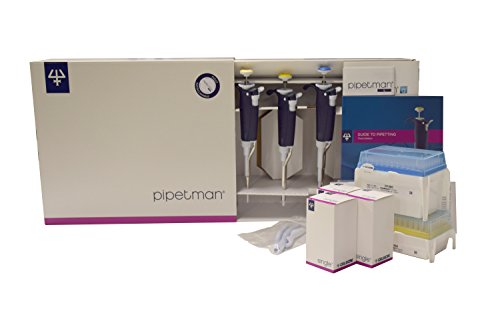 | Gilson PIPETMAN L Starter Kit | A new bench or teaching lab | Three pipettes cover 2 to 1000 uL | View |
| 2 | 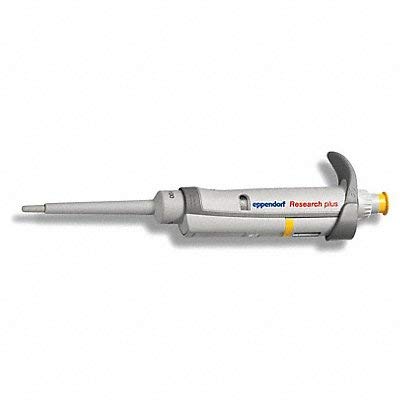 | Eppendorf Research plus 2-20 uL | PCR mixes and small-volume work | Spring-loaded tip cone | View |
| 3 |  | Thermo Scientific Finnpipette F2 | Busy shared labs | Detachable tip cone, 5-year warranty | View |
| 4 |  | ONiLAB 100-1000 uL Micropipette | Students, hobby labs, tight budgets | Low cost with calibration certificate | View |
| 5 |  | FOUR E’S SCIENTIFIC 1-10 mL | Milliliter-scale transfers | 1 to 10 mL in 100 uL steps | View |
| 6 |  | Vee Gee Class A Volumetric Pipet 5 mL | Analytical chemistry and standards | Class A, 0.01 mL tolerance | View |
| 7 |  | Corning PYREX 7065-10 Measuring Pipet | Variable milliliter volumes | 0.1 mL graduations, plus or minus 0.06 mL | View |
| 8 |  | Globe Scientific Graduated Transfer Pipet | Rough transfers, no cross-contamination | LDPE, graduated to 3 mL | View |
The 8 Best Lab Pipette Picks, Reviewed
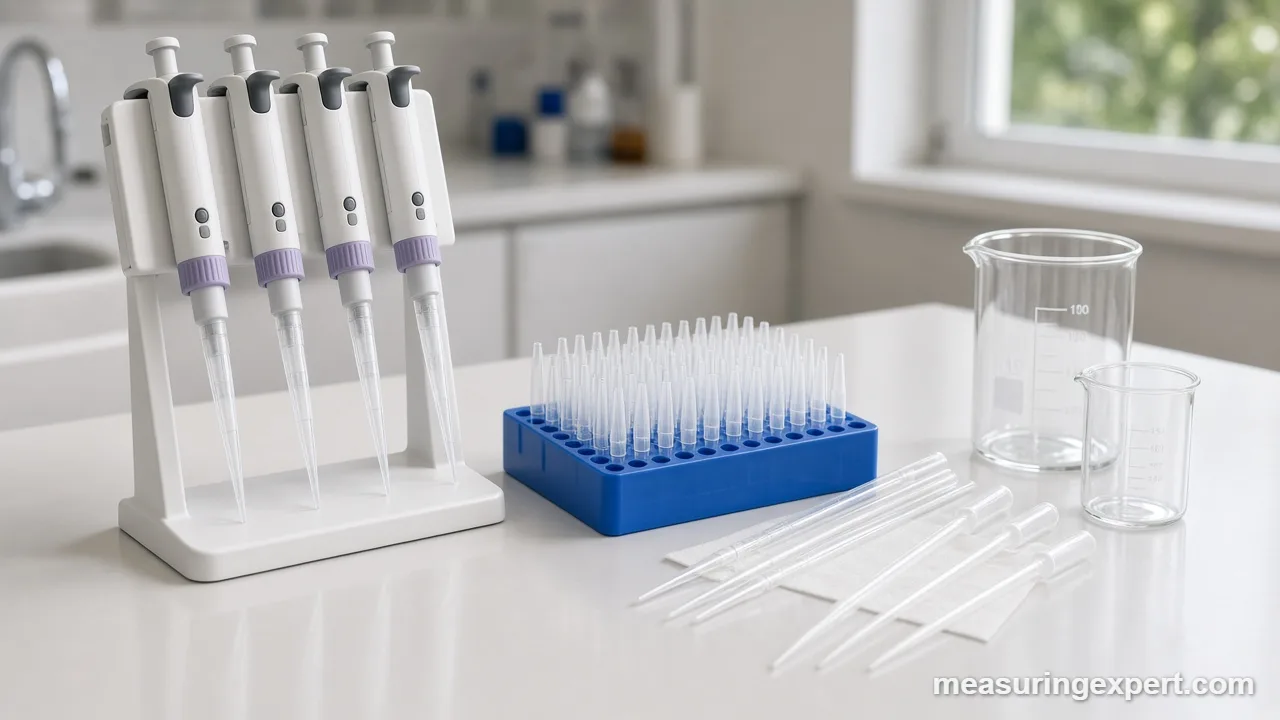
This list covers three families on purpose: adjustable air-displacement micropipettes, glass pipettes and disposable transfer pipettes. As a result, the best lab pipette for you depends on the volume and accuracy your work needs, not on brand alone.
Best Overall
1. Gilson PIPETMAN L Starter Kit (P20L, P200L, P1000L)
Best for: Labs that need one purchase to cover the everyday range, from 2 uL enzyme additions to 1 mL buffer transfers.
For most labs, the best lab pipette setup is not one pipette but three. This Gilson kit bundles the P20L, P200L and P1000L, so together they span 2 to 1000 uL. In addition, Gilson includes two boxes of DIAMOND tips (D200 and D1000), three wall holders and three plastic ejectors for corrosive liquids.
The PIPETMAN L line has a true volume lock, which stops the setting from drifting while you work. Also, the ejector position adjusts for right- or left-handed users, and the variable models are fully autoclavable without taking them apart. On the measurement side, Gilson lists a maximum systematic error of plus or minus 8.0 uL (0.8%) and a random error of 1.5 uL or less at 1000 uL on the P1000L. At 20 uL, the P20L is rated to plus or minus 0.20 uL (1.0%).
- Kit: P20L, P200L and P1000L, range 2 to 1000 uL overall
- P1000L at 1000 uL: plus or minus 8.0 uL systematic, 1.5 uL or less random error
- P20L at 20 uL: plus or minus 0.20 uL systematic, 0.060 uL or less random error
- True volume-locking mechanism; autoclavable without disassembly
- 3-year warranty listed by Gilson; specs apply with Gilson DIAMOND tips
Pros
- Covers three ranges in one order
- Volume lock prevents accidental changes
- Published error limits for every test volume
Cons
- Large up-front cost compared with one pipette
- Error limits assume Gilson’s own tips
Skip it if: you only ever pipette one volume range and would rather buy a single unit.
Best for Small Volumes
2. Eppendorf Research plus 2-20 uL
Best for: Molecular biology users who set up PCR, qPCR or enzyme reactions where a few tenths of a microliter matter.
The Research plus is a long-running Eppendorf workhorse, and the 2-20 uL size is the one most people reach for at the PCR bench. Eppendorf states a systematic error of plus or minus 1.0% (0.2 uL) and a random error of 0.3% (0.06 uL) at 20 uL. However, the numbers widen at the bottom of the range: at 2 uL the limits are plus or minus 5.0% and 1.5%.
Specifically, its spring-loaded tip cone seats tips with a consistent force, which helps tip fit and lowers the push you need. Also, the four-digit display has a magnifying shape, so small settings are easier to read. Finally, the whole pipette or only its lower part can go in the autoclave.
- Range 2 to 20 uL, so it suits PCR setups
- At 20 uL: plus or minus 1.0% (0.2 uL) systematic, 0.3% (0.06 uL) random error
- At 2 uL: plus or minus 5.0% (0.1 uL) systematic, 1.5% (0.03 uL) random error
- Spring-loaded tip cone, plus a four-digit display that stays clear when set low
- Fully autoclavable or lower part only; specs apply with epT.I.P.S. tips
Pros
- Tight specs for a 20 uL pipette
- Comfortable spring-loaded tip fit
- Display stays easy to read when set to small volumes
Cons
- Covers only 2 to 20 uL, so larger volumes need another pipette
- Error limits assume Eppendorf tips
Skip it if: most of your work is above 200 uL.
Best for Heavy Use
3. Thermo Scientific Finnpipette F2 100-1000 uL
Best for: Shared and teaching labs where a pipette gets dropped, wiped with harsh chemicals and autoclaved often.
The Finnpipette F2 is Thermo Scientific’s rugged mid-range pipette. This model covers 100 to 1000 uL in 1 uL steps, so it handles most buffer and media transfers. In addition, Thermo builds it with PVDF parts that resist harsh chemicals and UV light.
Meanwhile, maintenance is a strength. The tip cone detaches for daily cleaning or decontamination, and the whole pipette is autoclavable without disassembly. Also, Thermo lists a 5-year warranty with online registration, which is long for a manual pipette. Finally, it fits Finntip 1000 tips, including filter and extended versions.
- Range 100 to 1000 uL, 1 uL increments
- PVDF parts that resist chemicals and UV, especially useful in shared labs
- Detachable tip cone, so cleaning takes seconds
- Fully autoclavable without disassembly
- 5-year warranty with registration (may vary by country)
Pros
- Built for daily heavy use
- Easy to clean and decontaminate
- Long warranty, especially for a manual pipette
Cons
- Single range only, so you may need a second pipette
- Thermo’s product page did not list accuracy figures for this model
Skip it if: you need sub-microliter volumes or want one kit for every range.
Best Budget Micropipette
4. ONiLAB 100-1000 uL Adjustable Micropipette
Best for: Students, home brewers, small startups and hobby labs that need a real air-displacement micropipette at a lower cost.
Still, not every bench needs a premium brand. The ONiLAB is a single-channel, adjustable air-displacement pipette for 100 to 1000 uL. ONiLAB says each unit ships with an individual calibration certificate, and the tip cone is autoclavable.
However, the trade-off is documentation. We could not find a published accuracy table from ONiLAB for this model. Therefore, treat it as a pipette you should check yourself with a balance before you trust it for critical work. For teaching and routine transfers, however, it is a sensible way to start.
- Range 100 to 1000 uL, single channel
- Air-displacement design, similar to premium brands
- Individual calibration certificate per unit (per ONiLAB)
- Also has an autoclavable tip cone
Pros
- Low cost entry into micropipetting
- Ships with a calibration certificate
- Uses standard 1000 uL tips
Cons
- No published ISO 8655 error table found
- Less proven long-term durability
Skip it if: you work in a regulated lab that needs documented performance specs.
Best for Large Volumes
5. FOUR E’S SCIENTIFIC 1-10 mL Adjustable Pipette
Best for: Users who move milliliters, not microliters: media prep, reagent aliquots and sample dilution.
A 1-10 mL micropipette fills the gap between a 1000 uL pipette and a glass pipette. This FOUR E’S SCIENTIFIC model adjusts from 1 to 10 mL in 100 uL steps. So you can set 2.5 mL or 7.3 mL directly, without a pipette pump.
The maker says it is ISO 8655 tested and that each unit comes with an individual test certificate. Also, the tip cone is autoclavable at 121 C (250 F). On the other hand, 10 mL tips are long and cost more per tip, so keep a box on hand.
- Range 1 to 10 mL (1,000 to 10,000 uL)
- Adjusts in 100 uL steps, so 2.5 mL is easy to set
- ISO 8655 tested with individual test certificate (per maker)
- Autoclavable tip cone at 121 C (250 F)
Pros
- Handles volumes most micropipettes cannot
- Fine 100 uL steps
- Budget friendly, so it suits small labs
Cons
- Needs large 10 mL tips, which cost more than standard tips
- Accuracy figures not published as a table
Skip it if: your volumes stay under 1 mL.
Best Glass Volumetric
6. Vee Gee Scientific 2040A Class A Volumetric Pipet, 5 mL (12-pack)
Best for: Analytical chemistry, titrations and preparing standards, where you need one exact volume many times.
Unlike a graduated pipet, a volumetric (one-mark) pipette delivers one fixed volume, and it does that very well. This Vee Gee 5 mL pipet meets ASTM E969 Class A and is calibrated to deliver (TD). Specifically, the listing states a tolerance of 0.01 mL, which is 0.2% of 5 mL.
Because there is only one mark, reading is simple: draw liquid just above the line, then lower the meniscus onto it. Also, the markings are enameled on, and the pipets are reusable and autoclavable. You will need a pipette bulb or pump, because mouth pipetting is never safe.
- Capacity 5 mL, single mark, to deliver (TD)
- ASTM E969 Class A; tolerance 0.01 mL (0.2%)
- White color band, so you can spot the size quickly
- Reusable and autoclavable; pack of 12
Pros
- Excellent accuracy for one fixed volume
- No moving parts to drift
- Low cost per pipet
Cons
- Only one volume, unlike an adjustable pipette
- Glass can break when dropped
- Needs a separate pipette filler
Skip it if: your volumes change from task to task.
Best Graduated Glass
7. Corning PYREX 7065-10 Reusable Measuring Pipet, 10 mL
Best for: Teaching and chemistry labs that need to measure any volume up to 10 mL in glass, with 0.1 mL resolution.
A graduated (measuring) pipette trades a little accuracy for flexibility. This PYREX 10 mL pipet has 0.1 mL subdivisions and an accuracy of plus or minus 0.06 mL, according to the Sigma-Aldrich listing for Corning 7065-10. That is looser than the Class A volumetric pipet above, but you can deliver 3.4 mL or 8.0 mL with the same tool.
It is calibrated to deliver without blow-out, so you let it drain rather than forcing out the last drop. In addition, the graduations are enameled and color-coded, which makes sorting a drawer of pipets easy. The glass is 380 mm long, so use a pipette pump.
- Capacity 10 mL, 0.1 mL subdivisions
- Accuracy plus or minus 0.06 mL
- To deliver (TD), no blow-out
- Color-coded enameled graduations; 380 mm long
Pros
- Any volume up to 10 mL
- Reusable PYREX lab glass
- Enameled markings, so the scale resists wear
Cons
- Less accurate than a volumetric pipet
- Reading the meniscus takes practice
Skip it if: you need the tightest possible accuracy at one volume.
Best Transfer Pipette
8. Globe Scientific 135030 Graduated Transfer Pipet, 7 mL (500)
Best for: Quick, disposable transfers of samples, stains and reagents where 0.1 mL accuracy is not needed.
Unlike a micropipette, a transfer pipette is a one-piece plastic dropper with a bulb. It is not a precision tool, yet every lab uses hundreds of them. These Globe Scientific pipets are LDPE, hold 7 mL and are graduated to 3 mL, with a stated draw of about 3.2 mL.
Because each one is disposable, there is no washing and little risk of carryover between samples. However, the graduations are only a rough guide. For anything you will report as a number, use a micropipette or glass pipette instead. Finally, they come non-sterile, 500 per box.
- Capacity 7 mL; graduated to 3 mL
- Draw volume about 3.2 mL, so one squeeze moves roughly 3 mL
- Custom-grade LDPE, non-sterile
- Box of 500, so one order lasts a while
Pros
- Cheap, so you can discard each one after use
- No cleaning or cross-contamination
- Flexible and unbreakable
Cons
- Graduations are rough, so they are not for data
- Also adds plastic waste
- Not sterile, so avoid them for cell culture
Skip it if: you need a measured, reportable volume.
How We Chose the Best Lab Pipette Picks
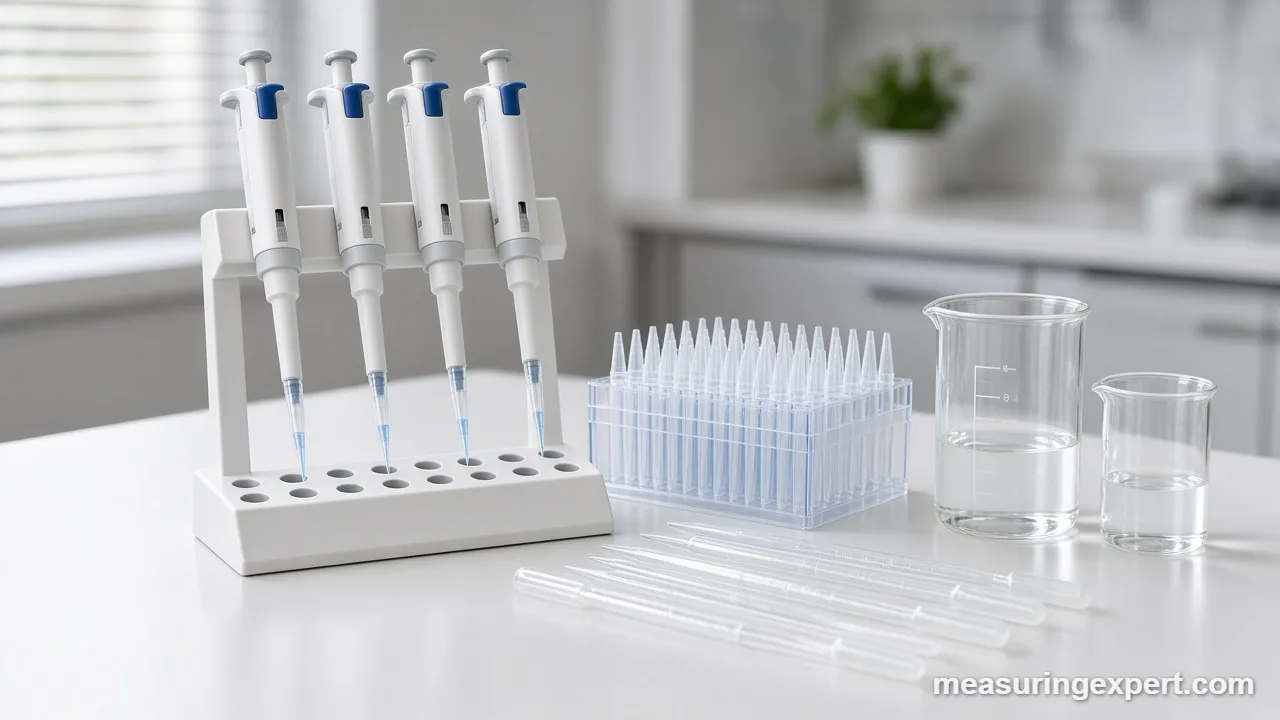
We did not run hands-on gravimetric tests. Instead, these picks are research-based. First, we read manufacturer and distributor spec sheets for volume range, systematic and random error, increments and autoclave rules. Next, we checked owner feedback for common problems, such as drifting volumes, stiff plungers and poor tip fit. Finally, we dropped models that a distributor listed as discontinued, including one popular classic pipette.
- Published accuracy: pipettes with a full error table at several test volumes ranked higher.
- Range coverage: together, the picks span 2 uL to 10 mL.
- Tip fit and tips: clear tip compatibility, since a loose seal leaks air.
- Maintenance: autoclavable parts, a removable tip cone and also a real warranty.
- Use case: one strong option for teaching, PCR, analytical chemistry and quick transfers.
For the standards side, we used the scope of ISO 8655-2:2022 for piston pipettes and the gravimetric method in NIST SOP 14 for volumetric calibration.
Best Lab Pipette Types: Micropipette vs Glass vs Transfer
Overall, each type measures volume in a different way. An air-displacement micropipette moves a piston, and a cushion of air pulls liquid into a disposable tip. A glass pipette, by contrast, uses marks on the glass itself. A transfer pipette simply squeezes a bulb, so it is the least exact.
| Type | Typical range | How it measures | Strength | Weakness |
|---|---|---|---|---|
| Adjustable micropipette | 0.1 uL to 10 mL | Piston and air cushion | Fast, repeatable, adjustable | Needs calibration and matched tips |
| Volumetric (one-mark) glass | 0.5 to 100 mL | Single calibration mark | Highest accuracy at one volume | One volume only, fragile |
| Graduated (measuring) glass | 1 to 25 mL | Graduation scale | Any volume up to capacity | Meniscus reading error |
| Transfer pipette (plastic) | 1 to 7 mL | Squeeze bulb, rough marks | Cheap and disposable | Not for measured volumes |
If you need volumes larger than a pipette handles, a beaker or graduated cylinder takes over; see our guide to the best laboratory beakers. For dosing liquids by hand outside the lab, the best syringe guide covers oral and measuring syringes. Also, our post on the minimum pipette volume explains why you should not set a pipette below about 10% of its maximum.
Best Lab Pipette Specs: Accuracy, Precision and ISO 8655
Basically, pipette specs use two numbers, and they mean different things. Systematic error (accuracy) is the gap between the average delivered volume and the set volume. Random error (precision) is the scatter between repeated deliveries, often given as a coefficient of variation (CV).
For example, Gilson rates the P1000L at plus or minus 8.0 uL systematic and 1.5 uL or less random error at 1000 uL. So ten deliveries should average between 992 and 1008 uL, and they should cluster tightly. In addition, error grows as a share of the volume near the bottom of the range. The Eppendorf 2-20 uL, for instance, goes from plus or minus 1.0% at 20 uL to 5.0% at 2 uL.
ISO 8655-2:2022 sets maximum permissible errors for air-displacement and positive-displacement pipettes. Importantly, the standard treats the pipette and its tips as one system. Therefore, a published spec only holds with the tips the maker specifies. Glass pipettes follow a different standard; in the US, ASTM E969 defines Class A volumetric pipets, such as the Vee Gee 5 mL with its 0.01 mL tolerance.
| Pick | Test volume | Systematic error | Random error |
|---|---|---|---|
| Gilson P1000L | 1000 uL | plus or minus 8.0 uL (0.8%) | 1.5 uL or less (0.15%) |
| Gilson P200L | 200 uL | plus or minus 1.60 uL (0.8%) | 0.30 uL or less (0.15%) |
| Gilson P20L | 20 uL | plus or minus 0.20 uL (1.0%) | 0.060 uL or less (0.3%) |
Convert Microliters and Milliliters
Micropipettes are set in microliters, while glassware is marked in milliliters. The rule is simple: 1 mL equals exactly 1,000 uL, and 1 mL is the same as 1 cubic centimeter (cc). Enter a milliliter value below to convert it; then multiply by 1,000 for microliters.
How to Pipette Accurately With a Micropipette
Indeed, good technique matters as much as a good pipette. So follow these steps for forward pipetting of water-like liquids. For a longer walkthrough, see how to use a pipette.
- Set the volume. Turn the plunger or knob to the target volume, approaching it from a higher setting. Then lock the volume if your pipette has a lock.
- Fit the right tip. Press the tip firmly onto the tip cone with a slight twist. Next, check that it sits straight with no gap.
- Pre-wet the tip. Aspirate and dispense the liquid two or three times. This step saturates the air inside the tip and reduces evaporation error.
- Press to the first stop and aspirate. Hold the pipette upright, press to the first stop, immerse the tip 2 to 3 mm, and release the plunger slowly and smoothly.
- Dispense against the wall. Touch the tip to the inside wall of the vessel at an angle. Press to the first stop, pause, then press to the second stop to blow out the last drop.
- Eject the tip. Withdraw the tip along the wall, release the plunger, and eject the tip into waste. Finally, use a fresh tip for every new liquid.
Calibration, Tip Fit and Care
A pipette is a measuring instrument, so it drifts. Eventually, seals wear, pistons pick up residue, and a drop can shift the calibration. For that reason, most labs check pipettes on a schedule, often every 3 to 12 months, and after any drop or repair.
Generally, the standard check is gravimetric. First, let distilled water, the pipette and tips reach room temperature. Next, dispense the set volume onto an analytical balance ten times and record each mass. Then convert mass to volume with the water density at that temperature. Near 20 C (68 F), water is about 0.998 g/mL, so 1,000 mg corresponds to about 1,002 uL, or about 1,003 uL once air buoyancy is included. Finally, compare the mean with the systematic limit and the spread with the random limit. NIST SOP 14 describes the same weigh-the-water idea for glassware, including temperature and air-buoyancy corrections.
- Tip fit: a tip should seal with light force and sit straight. If it rocks or drips, try the maker’s own tips.
- Leak test: aspirate water, hold the pipette still for 10 to 15 seconds, and watch for a drop forming.
- Cleaning: wipe the outside with 70% ethanol, and also remove the tip cone if your model allows.
- Storage: hang pipettes upright on a stand, set to their maximum volume to relax the spring.
- Glass care: rinse glass pipettes right after use, then let them drain tip-down.
Pipetting Do and Don’t
Honest Limits of Even the Best Lab Pipette
Still, no pipette fixes bad technique. In fact, hand warmth, fast plunger release and a tilted pipette can each add more error than the spec sheet shows. Also, published specs are measured with water at controlled temperature; solvents, glycerol and protein solutions behave differently. Budget pipettes may perform well, but without a published error table you have to verify them yourself. Finally, a transfer pipette is a dropper, not a measuring device, so do not report its volumes as data.
Best Lab Pipette FAQ
What is the best lab pipette for most labs?
For most labs, the Gilson PIPETMAN L Starter Kit is the best pick, because its P20L, P200L and P1000L cover 2 to 1000 uL with published error limits. If you only need small volumes, the Eppendorf Research plus 2-20 uL is a strong single choice.
What is the difference between accuracy and precision in a pipette?
Accuracy (systematic error) is how close the average delivered volume is to the set volume. Precision (random error) is how close repeated deliveries are to each other. A pipette can be precise but inaccurate, so ISO 8655 limits both.
What does ISO 8655 mean on a pipette?
ISO 8655 is the international standard for piston-operated volumetric apparatus. Part 2 sets measurement requirements and maximum permissible errors for air-displacement and positive-displacement pipettes. Importantly, it applies to the pipette together with its tips.
How often should a lab pipette be calibrated?
Many labs check pipettes every 3 to 12 months, depending on use, risk and their quality system. In addition, do a quick gravimetric check after a drop, a repair or any doubtful result.
How do you check pipette accuracy at home or in the lab?
Weigh water. Dispense the set volume of distilled water onto an analytical balance 10 times, record each mass, and convert mass to volume. At about 20 C, 1 mg of water is close to 1 uL, although precise work applies a small density correction.
Do pipette tips affect accuracy?
Yes. Makers such as Eppendorf and Gilson state their error limits only with their own tips. A loose or poorly matched tip can leak air and deliver too little, so check tip fit before you blame the pipette.
How many microliters are in a milliliter?
There are exactly 1,000 microliters (uL) in 1 milliliter (mL). So 250 uL equals 0.25 mL, and 5 mL equals 5,000 uL. Use the converter on this page for other values.
Is a glass or plastic pipette more accurate?
A Class A glass volumetric pipette is very accurate at its one volume; for example, a 5 mL Class A pipet has a 0.01 mL tolerance. A plastic transfer pipette, by contrast, is only a rough measure.
Which best lab pipette type should a student buy?
A student usually needs a budget 100-1000 uL adjustable micropipette, such as the ONiLAB, plus a box of tips. Check it with a balance first, because budget models rarely publish detailed accuracy tables.
Can you autoclave a micropipette?
Many can. The Gilson PIPETMAN L and Finnpipette F2 are fully autoclavable without disassembly, while some budget models only allow the tip cone in the autoclave. Always follow the manual’s temperature and drying steps.
Bottom Line: The Best Lab Pipette for Most Benches
The Gilson PIPETMAN L Starter Kit is the best lab pipette choice for most benches, because three locked, autoclavable pipettes cover 2 to 1000 uL with clear error limits. For PCR work, add the Eppendorf Research plus 2-20 uL. And for exact milliliters in glass, a Class A volumetric pipet is still hard to beat.
Black Friday is coming: shop the deals with Prime
1 thought on “8 Best Lab Pipette Picks for 2026: Micropipettes, Glass and Transfer Pipettes”