

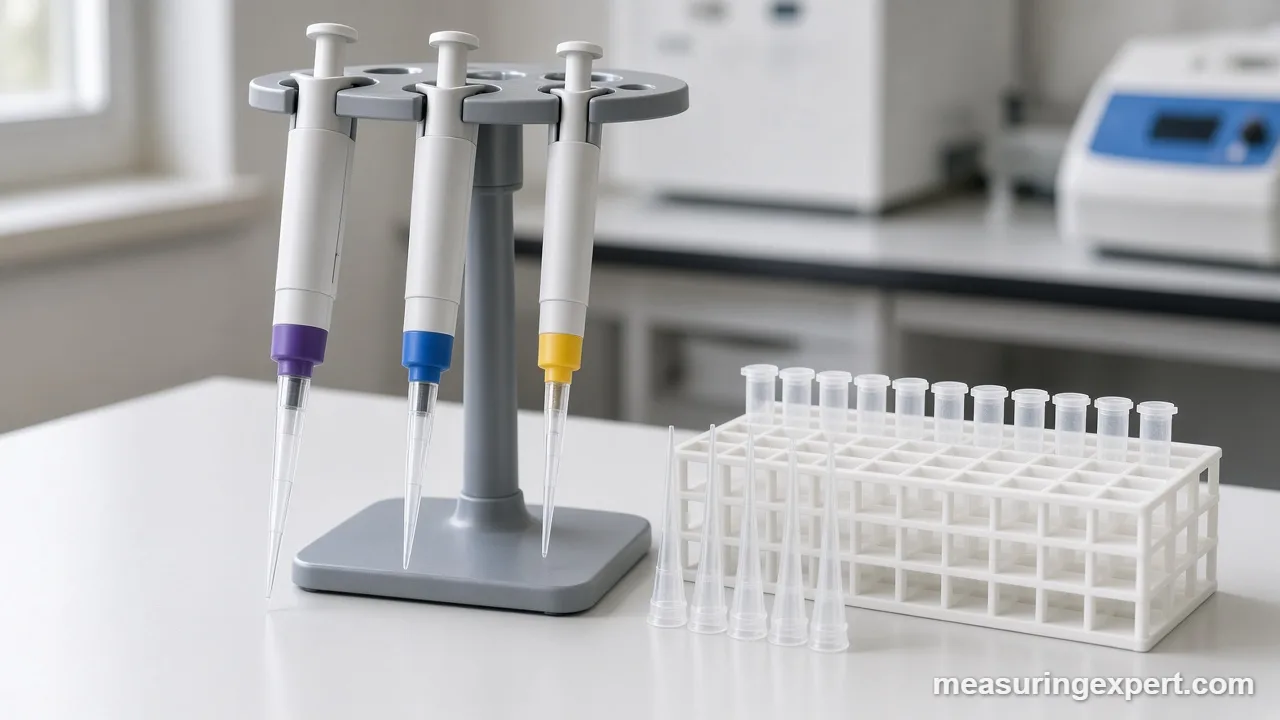
The minimum pipette volume depends on the pipette. A P2 micropipette reaches 0.2 microliters (uL), a P10 about 1 uL, and a P20 2 uL. However, accuracy is best between roughly 10% and 100% of the range, and ISO 8655 errors grow sharply at the bottom of each range.
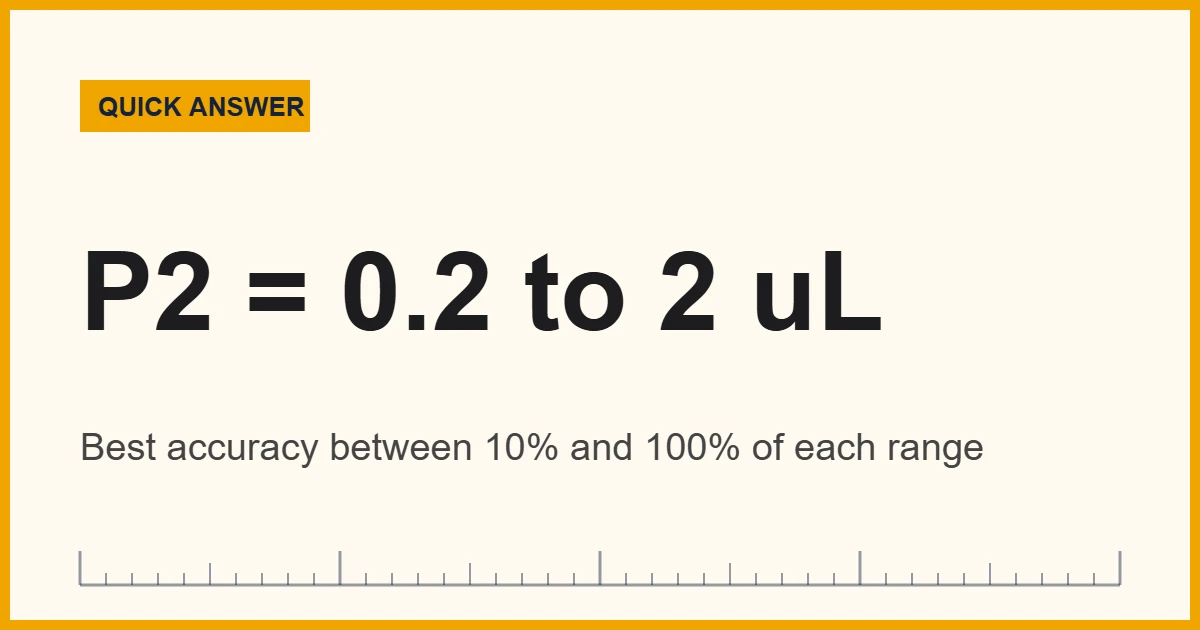
Ask ten lab workers for the smallest volume a pipette can measure and you will hear “0.1 uL”, “0.2 uL” and “it depends”. In fact, the last answer is the honest one, because every pipette has a printed range, but the bottom of that range is not where it works best. So the real question is not only “how small can it go?” but also “how small can it go and still be accurate enough for my work?”
Why the Minimum Pipette Volume Is Not One Number
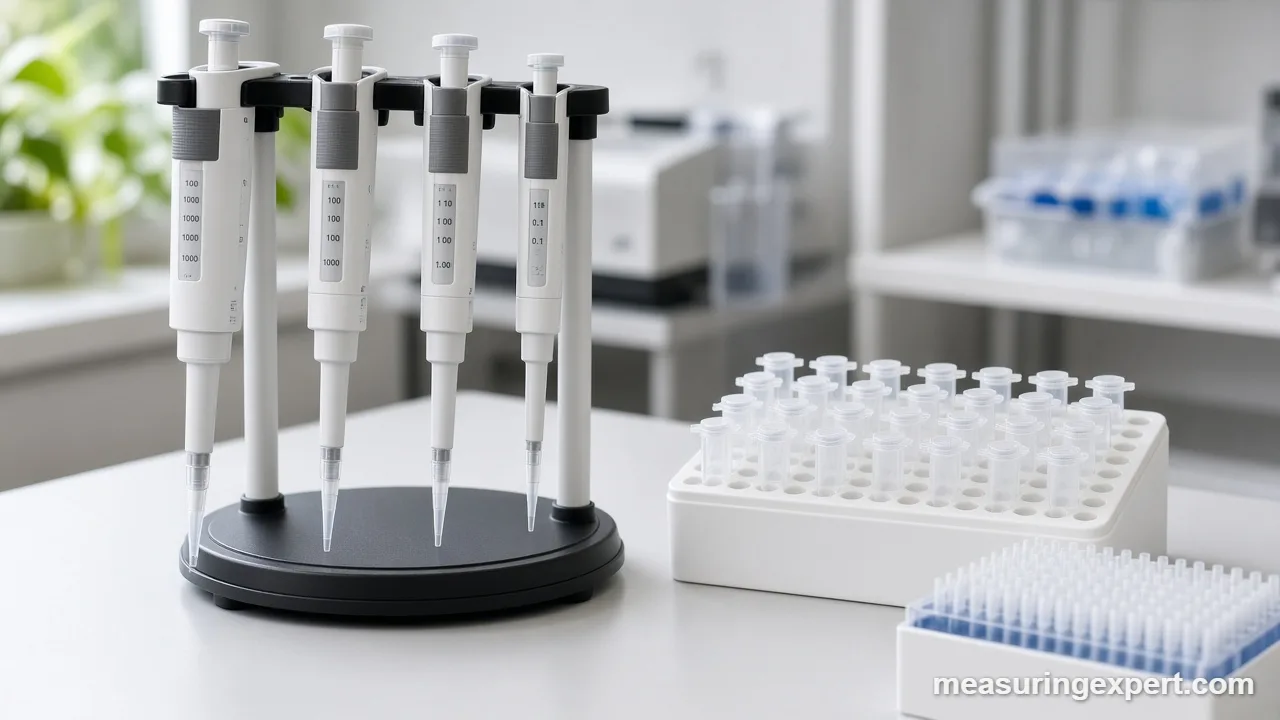
In practical terms, the minimum pipette volume is set by the smallest air-displacement micropipette in your drawer. The common P2 model covers 0.2 to 2 uL, which makes 0.2 uL (0.0002 mL) the routine lower limit in most labs. Above that, the P10 covers about 1 to 10 uL, the P20 2 to 20 uL, the P200 20 to 200 uL and the P1000 100 to 1,000 uL. Each model is held to ISO 8655 error limits that are fixed in microliters, so the percentage error rises as you dial down. By contrast, glass pipettes start much higher: the smallest Class A volumetric pipettes hold about 0.5 mL.
In short: pick the smallest pipette whose range includes your volume, and stay in the upper part of that range when you can. For example, 2 uL is the top of a P2 and also the bottom of a P20, but the P2 delivers it far more accurately.
Above all, the figures on this page come from published specifications. Pipette maker Gilson lists, for each PIPETMAN model, both its own limits and the ISO 8655 maximum permissible errors at several test volumes. Similarly, the ASTM E969 standard sets the tolerances for glass volumetric transfer pipettes.
Below, you will find a converter for tiny volumes, a range chart for every common micropipette, the error math, and finally a step-by-step routine for pipetting small volumes well.
Convert Microliters, Milliliters and Kitchen Units
First, one microliter is one thousandth of a milliliter, so 0.2 uL is 0.0002 mL and 20 uL is 0.02 mL. Next, type a volume in milliliters below to see it in other units. For example, enter 0.002 to check what a full P2 holds. The converter uses exact US definitions (1 US teaspoon = 4.92892159375 mL).
Recommended Pipettes for Small Volumes
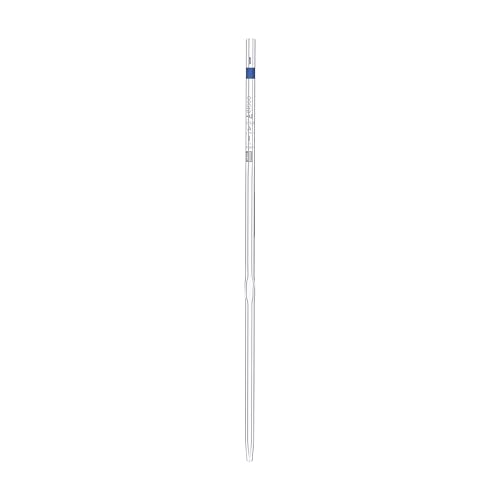
For volumes under 10 uL, the most useful single purchase is a 0.1 to 2.5 uL or 0.2 to 2 uL micropipette. Next, add a 100 to 1,000 uL model for general work. Also, a Class A glass volumetric pipette is still the cheapest way to deliver one fixed volume, such as 1 mL or 5 mL, very accurately. Finally, check that any micropipette ships with a calibration certificate and fits standard tips.


As an Amazon Associate, Measuring Expert earns from qualifying purchases.
Key Takeaways
- The routine minimum pipette volume is 0.2 uL, with a P2 micropipette.
- Some 0.1 to 2.5 uL models go lower, but their error at 0.1 uL is large.
- Work between about 10% and 100% of the range; the top half is more accurate.
- ISO 8655 limits are fixed in uL, so a P20 set to 2 uL may be off by 10%.
- Glass volumetric pipettes start at about 0.5 mL (Class A tolerance 0.006 mL).
- Below 0.2 uL, dilute the sample and pipette a larger volume instead.
- Calibration, tip fit and technique matter as much as the pipette model.
Minimum Pipette Volume by Micropipette Size
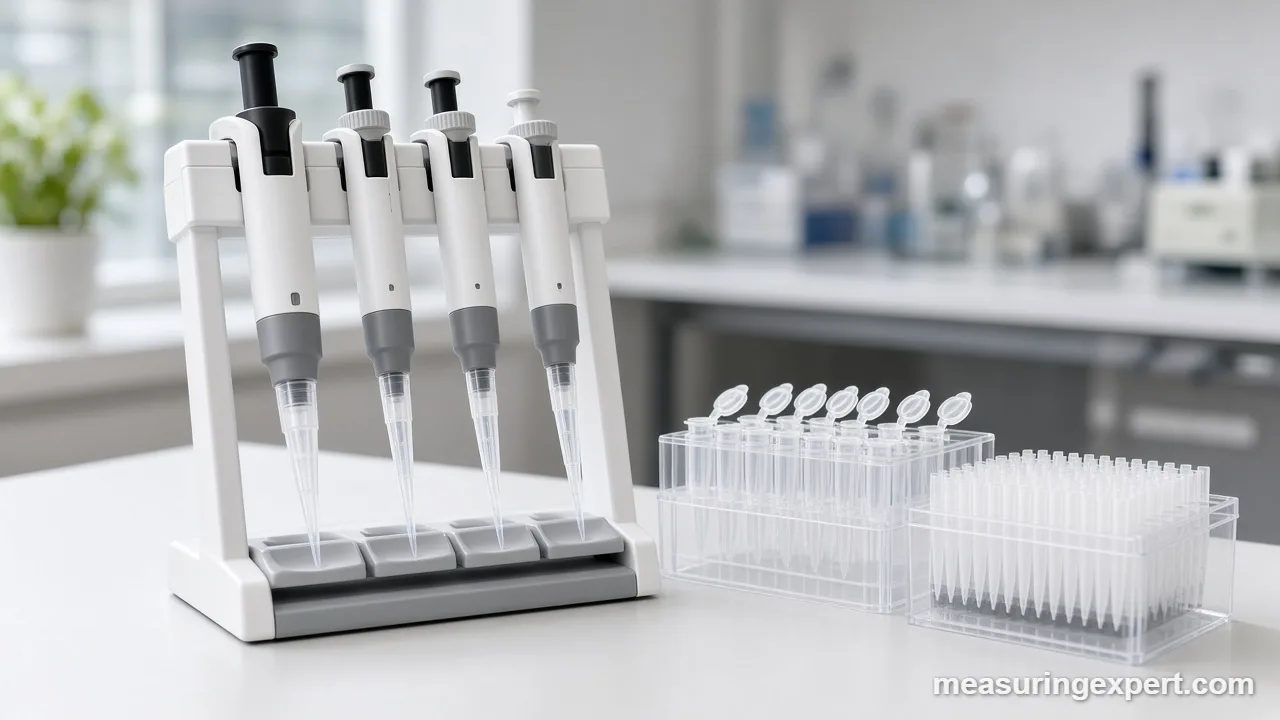
Micropipettes are named after their maximum volume in microliters. Thus a P200 tops out at 200 uL. Meanwhile, the bottom of each range is usually one tenth of the top, which gives the familiar 10% to 100% working window. The table below uses the Gilson PIPETMAN ranges; other brands are similar, although some sell a 0.5 to 10 uL model instead of 1 to 10 uL.
| Model | Range | Minimum in mL | Best used for |
|---|---|---|---|
| P2 | 0.2 – 2 uL | 0.0002 mL | Enzymes, primers, tiny reagent additions |
| P10 | 1 – 10 uL | 0.001 mL | PCR setup, gel loading |
| P20 | 2 – 20 uL | 0.002 mL | Samples and standards from 5 to 20 uL |
| P100 | 10 – 100 uL | 0.01 mL | Plate assays, dilutions |
| P200 | 20 – 200 uL | 0.02 mL | General buffers and samples |
| P1000 | 100 – 1,000 uL | 0.1 mL | Larger transfers up to 1 mL |
Because ranges overlap, you often have two choices, so pick carefully. In that case, use the smaller pipette. For instance, 20 uL is the top of a P20 and the bottom of a P200, and the P20 is the better tool.
ISO 8655 Limits at the Minimum Pipette Volume
ISO 8655 is the international standard for piston-operated volumetric apparatus. It sets two limits for each nominal size. First, the systematic error is how far the average delivery may sit from the set volume. Second, the random error is how much repeated deliveries may scatter. Importantly, for adjustable pipettes these limits are given in microliters at the nominal (maximum) volume and apply across the whole range. So the same absolute error becomes a much bigger percentage at the minimum pipette volume.
| Model | ISO systematic limit | ISO random limit | At maximum | At minimum setting |
|---|---|---|---|---|
| P2 | +/- 0.08 uL | 0.04 uL | 4% / 2% | 40% / 20% at 0.2 uL |
| P10 | +/- 0.12 uL | 0.08 uL | 1.2% / 0.8% | 12% / 8% at 1 uL |
| P20 | +/- 0.2 uL | 0.1 uL | 1% / 0.5% | 10% / 5% at 2 uL |
| P100 | +/- 0.8 uL | 0.3 uL | 0.8% / 0.3% | 8% / 3% at 10 uL |
| P200 | +/- 1.6 uL | 0.6 uL | 0.8% / 0.3% | 8% / 3% at 20 uL |
| P1000 | +/- 8 uL | 3 uL | 0.8% / 0.3% | 8% / 3% at 100 uL |
Keep in mind that these are the widest errors the standard allows, not typical results. In fact, good pipettes do much better. Gilson, for example, specifies its P2 at 0.2 uL to within 0.024 uL systematic and 0.012 uL random, which works out to 12% and 6%. Similarly, its P20 at 2 uL is held to 0.10 uL, or 5%. Even so, the pattern stays the same: the lower you set a pipette, the larger the relative error.
Accuracy vs Precision for a Minimum Pipette Volume
Often, people use “accurate” for both ideas, but a pipette can fail in two different ways. So knowing which one you have tells you how to fix it.
| Term | What it means | ISO 8655 name | Typical cause when poor |
|---|---|---|---|
| Accuracy (trueness) | The average delivery is close to the set volume | Systematic error | Calibration drift, wrong tip, temperature |
| Precision | Repeated deliveries agree with each other | Random error (CV) | Technique, worn seals, air bubbles |
| Resolution | The smallest step on the volume dial | Not an ISO limit | Not a cause; a dial step is not proof of accuracy |
For example, a P2 that reads 0.20 uL on its dial can still deliver 0.17 uL every time. In other words, that pipette is precise but not accurate. Our guide to the most accurate volume measurement tool explains how pipettes compare with burets, flasks and balances.
Minimum Pipette Volume for Glass Pipettes
Unlike micropipettes, glass pipettes work by draining to a line, so surface tension and the film left on the glass limit how small they can go. Consequently, their practical minimum is far above a micropipette’s. For example, volumetric (bulb) pipettes deliver one fixed volume. Graduated (measuring) pipettes, on the other hand, have a scale and deliver variable amounts.
| Class A volumetric pipette | Tolerance (ASTM E969) | Relative error |
|---|---|---|
| 0.5 mL (500 uL) | +/- 0.006 mL | 1.2% |
| 1 mL | +/- 0.006 mL | 0.6% |
| 10 mL | +/- 0.02 mL | 0.2% |
| 50 mL | +/- 0.05 mL | 0.1% |
Also, Class B pipettes allow twice these tolerances. Graduated pipettes come as small as 0.1 mL; however, reading a meniscus against a scale adds error. In practice, a glass pipette is a poor choice below about 0.1 mL (100 uL), and a P200 or P1000 is simpler there. For the wider picture, see our list of lab equipment to measure volume.
How to Pipette Close to the Minimum Pipette Volume
- Choose the smallest pipette that covers your volume. Aim for the upper half of its range when you can.
- Let the pipette, tips and liquid reach room temperature. Otherwise, warm hands and cold reagents shift tiny volumes noticeably.
- Fit a matching tip firmly. Use the maker’s tips or certified-compatible ones, because a loose tip leaks air.
- Pre-wet the tip. Aspirate and dispense the liquid two or three times so the air inside reaches equilibrium.
- Hold the pipette vertical and immerse the tip only 1 to 2 mm. This matters because deeper immersion carries liquid on the outside of the tip.
- Release the plunger slowly and wait a second. Then withdraw the tip smoothly along the tube wall.
- Dispense against the wall or into the liquid. For volumes under 2 uL, touch the tip to the receiving liquid and press to the second stop.
- Change the tip for every new sample. Finally, record the pipette ID so results stay traceable.
Going Below the Minimum Pipette Volume
Sometimes a protocol calls for 0.05 uL of a stock. However, no hand pipette does that reliably. Instead, make an intermediate dilution. For example, dilute the stock 1:10 and pipette 0.5 uL, or better, dilute 1:100 and pipette 5 uL. As a result, both deliver the same amount of material, but the larger volume sits in a much more accurate part of the range.
Alternatively, labs that need nanoliter volumes use positive-displacement pipettes or automated liquid handlers, including acoustic dispensers. Note, though, that these tools sit outside ISO 8655’s hand-pipette tables and come with their own specifications. Also, weighing is an option for larger volumes: 1 uL of water weighs about 1 mg at room temperature, so a balance with 0.01 mg readability can check deliveries of a few microliters.
Do and Don’t for Small-Volume Pipetting
Do
- Use the smallest pipette that covers the volume.
- Pre-wet each new tip two or three times.
- Keep the pipette upright when it holds liquid.
- Check calibration on a set schedule.
- Dilute stocks when the volume falls under 0.2 uL.
Don’t
- Set a pipette below its printed minimum.
- Turn the dial past its maximum; it can damage the mechanism.
- Let the plunger snap back after aspirating.
- Lay a pipette on its side with liquid in the tip.
- Trust the dial reading as proof of accuracy.
Honest Limits of These Numbers
To be clear, the tables above describe pipettes tested with water under controlled conditions. Real samples, however, behave differently. For one thing, viscous liquids such as glycerol, volatile solvents such as ethanol, and foaming protein solutions all move differently in an air-displacement pipette, and reverse pipetting often helps with them. Moreover, results drift with temperature, altitude and the user. In addition, an older pipette with worn seals may fail the limits it met when new. In short, the minimum pipette volume printed on the barrel is a design limit; your own accuracy at that volume is something only a gravimetric check can confirm.
When to Call a Calibration Lab
Most labs check their pipettes at least once a year, and regulated labs often do it more often. Also, send a pipette for service if it fails a quick weighing check, leaks, feels rough, was dropped, or will be used for critical work near its minimum. Then an accredited calibration lab tests it to ISO 8655, replaces seals if needed and issues a certificate. Above all, clinical, pharmaceutical and forensic labs should follow their own quality system, which usually names the interval and method.
Frequently Asked Questions
What is the minimum pipette volume in most labs?
It is 0.2 uL, the bottom of a standard P2 micropipette. A few models are rated down to 0.1 uL, but their percentage error there is large.
What is the smallest volume a P20 can measure?
A P20 is rated from 2 to 20 uL. At 2 uL, the ISO 8655 limit of 0.2 uL equals 10%, so a P2 or P10 is the better choice for 2 uL.
Why should I stay within 10% to 100% of the range?
The reason is that the error limits are fixed in microliters at the maximum volume. As you dial down, the same error becomes a larger share of the delivered volume.
Is the minimum pipette volume the same for every brand?
No. Most brands follow the same pattern, but some sell 0.1 to 2.5 uL or 0.5 to 10 uL models. So always check the range printed on your pipette.
How accurate is a P1000 at 100 uL?
ISO 8655 allows up to 8 uL systematic error, which is 8% at 100 uL. A P200 at 100 uL is allowed 1.6 uL, or 1.6%, so it is the better tool.
What is the smallest glass volumetric pipette?
Class A volumetric pipettes are commonly sold from 0.5 mL or 1 mL. A 0.5 mL Class A pipette has a tolerance of 0.006 mL under ASTM E969.
How many microliters are in a milliliter?
There are 1,000 microliters in 1 milliliter. So 0.2 uL is 0.0002 mL and 200 uL is 0.2 mL.
Can I measure 0.1 uL with a hand pipette?
Only roughly. Instead, dilute the stock and pipette a larger volume, or use an automated dispenser built for nanoliter work.
How can I check a pipette at its minimum pipette volume?
First, weigh several deliveries of water on an analytical balance, and then convert mass to volume. For very small volumes, a calibration lab with a microbalance gives more reliable results.
Are electronic pipettes better at small volumes?
Electronic pipettes control plunger speed, which can improve precision between users. Their minimum volume and ISO limits, however, follow the same size classes as manual models.
The Bottom Line
To sum up, the routine minimum pipette volume is 0.2 uL with a P2, and every larger micropipette has its own floor at about one tenth of its maximum. However, the printed minimum is where error is highest. ISO 8655 limits are fixed in microliters, so a pipette set near its bottom can be off by 10% or more and still pass.
So choose the smallest pipette that covers your volume, work in the upper part of its range, and dilute rather than chase volumes below 0.2 uL. For fixed volumes of 0.5 mL and up, a Class A glass volumetric pipette remains an accurate, low-cost option.
1 thought on “Minimum Pipette Volume: How Small Each Pipette Can Accurately Measure”